
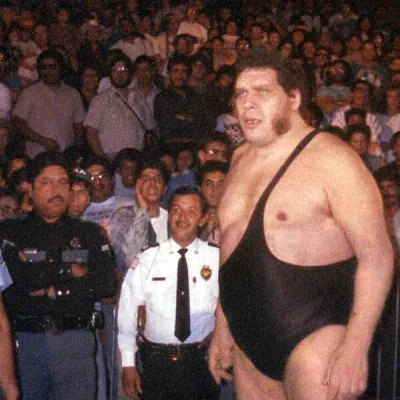
André the Giant
Human Design Chart
Biography
He found success as a fan favorite throughout the 1970s and early 1980s, appearing as an attraction for various professional wrestling promotions. Roussimoff was mentioned in the 1974 Guinness Book of World Records as the highest-paid wrestler in history at that time. He had earned US$400,000 in one year during the early 1970s.
Outside of wrestling, he was best known for appearing as Fezzik, the giant in the film The Princess Bride. Roussimoff has been unofficially crowned "the greatest drunk on Earth" for once consuming over 41 litres of beer in six hours. On an episode of WWE's Legends of Wrestling, Mike Graham said Roussimoff once drank over 73 litres of beer in one sitting.
William Goldman, the author of the novel and the screenplay of The Princess Bride, wrote that Roussimoff was one of the gentlest and most generous people he ever knew.
He had one daughter, Robin Christensen (born 1979), also a wrestler and actress of considerable size.
Roussimoff died of heart failure on 27 January 1993 in a Paris hotel room at age 46. He was in Paris to attend his father's funeral.
The Human Design of André the Giant: Generator 4/6
Generator 4/6 — Design at a Glance
André the Giant possessed immense physical endurance and an enormous energy reservoir. As a Generator, he had plenty of sacral energy, which made him seem like a strong workhorse – provided this power was used for tasks that resonated with his inner self. His design indicated that his effectiveness depended on reacting to impulses from his environment rather than initiating independently. The motto 'react, don't initiate' was central: Only when the sacral center gave a clear 'yes' and he responded with action could he use his energy effectively.
If André the Giant lived in harmony with this strategy, deep satisfaction and a sense of fulfillment would emerge. If he tried to force things or acted against inner signals, frustration and energy depletion were likely. Two stumbling blocks shaped his potential: First, the risk of wasting energy on tasks without intrinsic joy, which could lead to burnout. Second, the danger of being held back from his heart project when he still wanted to continue working with full power. His strength thus lay not in merely having power but in its correct application through reacting to life signals. If he acted from the gut and waited for external cues, nothing could stop him; if he acted wrongly, however, he faced persistent frustration.
Emotional Authority
André the Giant lived with an inner orientation that compelled him to sleep on every significant decision overnight. His design featured Emotional Authority, meaning his defined emotional center not only controlled his moods but also served as the sole authority for decisions – independent of all other defined centers in his chart. This configuration generated a constant wave of emotional highs and lows; the world appeared colored by the current mood state. What was seen as inspiring one moment could be completely negative the next. Since this immediate reaction was merely a fleeting snapshot, quick action from emotion often led to misjudgments. The mechanics of his authority thus required time: Only through patience and multiple nights' reflection on a situation could emotional clarity emerge. Once intense feelings subsided and emotional distance was gained, clarity prevailed. This process of calmness was not an optional tool for André the Giant but a structural necessity to recognize his true inner truth, especially in long-term decisions that significantly influenced his life path.
The 4/6 Profile — Opportunist / Role Model
André the Giant's design indicated a tendency to intensely experiment in youth before later adopting a role as a wise role model. This aligned with Profile 4/6: In the first three decades of life, Line 6 still acted like a third line, prompting André the Giant to try much in relationships and friendships. This phase served the exploration of his individuality within a network.
With Saturn's return, this dynamic fundamentally changed. The sixth line fully activated, revealing the inner conflict between the desire for community (Line 4) and the need for detached wisdom (Line 6). André the Giant now faced the task of integrating this contradiction. While Line 4 focused on respect, recognition, and waiting for the right moment to contribute in the collective, Line 6 demanded discipline and assertiveness.
In this later phase, it was crucial for him to eliminate negative feelings and focus on positive experiences with valuable people. His mission was to set a positive example through clear-mindedness and readiness to support weaker individuals. Communicating his individuality became the decisive factor for change in his environment. Restrictions played no role; his unique contribution lay in fostering others while meeting the high standards of being an exemplar without losing himself.
Split Definition — Defined & Open Centers
André the Giant's Human Design profile established a tendency towards a deeply rooted, unshakeable self-identity. His defined G Center gave him a clear sense of direction and mission in life; he knew intuitively who he was and where he belonged without needing external confirmation. This inner security allowed him to show others new perspectives or paths, as he himself did not rely on their approval. His presence was marked by this magnetic clarity: He walked his path, and whoever wanted to follow could do so – yet he did not forcefully direct anyone but simply radiated his own truth.
This stable identity was reinforced by immense vital energy. His defined Sacral Center generated a constant stream of energy daily that propelled him and gave him physical endurance that was hard to match. This energy was only fully available when he responded to his inner resonance – a deep "yes" or "no" from the gut. If he ignored this sacral answer and instead followed mental decisions, his system would become resistant and frustrated. His life force was thus not an unlimited tank but a source that needed correct reactions to be replenished.
At the same time, André the Giant moved through a complex emotional landscape. His defined Solar Plexus Center meant that his inner authority did not lie in rational thought but in the perception of feelings over time. He had to wait out waves of passion and melancholy to reach clarity; spontaneous decisions at the peak of an emotional wave often led to later regret. This emotional depth was connected with his defined Spleen Center, which gave him a sharp intuitive body awareness. He sensed in the moment what was healthy and safe – a kind of vital instinct that protected him from danger as long as it wasn't drowned out by the mind. The constant pressure of his defined Root Center also propelled him physically, giving him endurance to withstand stress and thrive in the material world.
Yet this powerful inner system stood in contrast to his open centers, which made him vulnerable to external influences. His open Head Center had no consistent source for inspiration or mental clarity; he tended to catch questions and confusion from others, leading to internal pressure to find answers to problems that were not his own. Similarly, his open Ajna Center meant his thinking was flexible and open to various concepts but lacked a stable personal opinion formation. He mirrored ideas like a mirror, which made him appear intelligent but also led him sometimes to feel unsure when he did not have a firm position.
Especially defining was his open Heart Center. It meant that he was not designed for consistent willpower in the sense of assertiveness or competition. He tended to compare himself with others and felt the need to prove his worth by making promises he could not always keep due to his energetic nature. This often led into a cycle of self-doubt: The more he failed, the more he tried to make up for it through greater effort, which further exhausted him. His challenge was recognizing that he did not need to prove anything; his value was not tied to performance or dominance but to loyalty to his own energy and identity.
Finally, his open Throat Center showed ambivalence in communication. He had no consistent way of speaking, making him vulnerable to the pressure to seek attention or take the floor so as not to be overlooked. Often he said things later seen as inappropriate because he tried to fill silence or elicit a reaction. The healthy mechanism for him was to wait until invited – then his voice came naturally and powerfully, supported by the energy of his Sacral and G Centers.
In summary, André the Giant displayed a design of immense inner substance – clear identity, vital force, and intuitive security – complemented by open mental and will-related centers. This openness made him susceptible to the thoughts and expectations of the world, leading him to feel he needed to prove himself or find answers where none were necessary. His strength lay in returning to his sacral energy and emotional depth while learning to let go of mental noise and heart pressure. Thus, he could exercise his natural authority: not through dominance or intellectual superiority but through the quiet, powerful emanation of his true self.
Channels for rhythm, critical judgment and emotional release.
André the Giant demonstrated a mutative leadership stance: he had the ability to show new directions for others through his mere presence and reactions. This did not happen through deliberate maneuvering but by trusting in his inner generative energy. The Channel of the Beat 14-2 connected Gate 14, the Gate of Power Competence, with Gate 2, the Gate of Higher Knowledge. This configuration served as a key custodian for resources needed to translate innovation and uniqueness into material reality. His task was to be honest about his own identity and destiny; by openly reacting to life, he mechanically encouraged others to find their own direction.
At the same time, there was a strict inner logic of perfectionism at work. The Channel of Judgment 58-18 linked vitality (Gate 58) with the urge to correct (Gate 18). This mechanism served as a sentry checking patterns for health and feasibility. It was an insatiable impulse to improve life and correct errors, but joy came from being explicitly asked for solutions. Without such invitations, this process could appear as an endless stream of criticism.
Emotionally, he was marked by the Channel of Emotion Release 39-55, which connected provocation (Gate 39) with spirit (Gate 55). This created a pulsating wave between ecstatic joy and melancholic uncertainty. This moodiness was not a disturbance but a mutative force that allowed him to tease out and recognize the true spirits of other people and who truly fit him. Authenticity in this emotional depth was crucial; only by surrendering to his moods could he infect others with passionate warmth.
Additionally, further Gates supported this Profile: Gate 8 promoted individual stepping up for group goals as a creative role model. Gate 30 contributed to the recognition of feelings and acceptance of limitations as destiny. Gate 29 demanded a clear yes to challenges in order to receive the inevitable reward. Gate 57 offered intuitive clarity in the here and now, while Gate 37 nurtured organic community structures and mystical connections. Gate 50 protected traditional values through a conservative protective reflex, and Gate 53 enabled the beginning of new developmental cycles as a pioneer.
Individual Circuitry — Circuit Signature
André the Giant revealed himself as someone marked by two distinct, parallel energetic poles. This divided definition meant that his energies did not flow in a single continuous stream but existed as independent areas. One pole connected the Identity Center with the Sacral Center and the Solar Plexus Center with the Root Center. Here, the energy of personal identity and creative mutations pulsed, paired with emotional waves expressed through the Throat Center. It was about learning new knowledge and transforming it into the world, driven by an acoustic, present-focused intensity.
The second completely separate pole connected the Spleen Center and the Root Center. This area stood for focused, emotionless ratio and strategic judgment. Here, it was about sharing logical insights and guiding society through structure and intellect towards a better future – free from conditioning and emotional coloring.
These two circuits – the Knowledge Circuit and the Understanding Circuit – did not work together in André the Giant but rather side by side. While one part of his energy aimed at initiating change through emotional creativity and individual expression, the other focused on rational analysis and strategic planning. This separation created a dynamic in which intuitive, pulsing impulses on one hand and cold, logical structure on the other acted as separate forces without directly mixing or influencing each other.
Right Angle Cross of Contagion 2
André the Giant's Human Design featured the signature of the right Incarnation Cross. This configuration established a specific psychological dynamic where self-worth was closely tied to how others perceived him. In Human-Design terms, this cross describes a deep need for external validation and love, coupled with an unconscious tendency to sacrifice oneself or even harm oneself to secure affection from others or bind their attention.
For André the Giant, this meant that his innermost self often sought a mirror to affirm his existence and value. The mechanics of this cross reveal an internal conflict between wanting to be loved and fearing rejection. This could lead him to tolerate situations or relationships that seemed harmful at first glance as long as they made him feel needed or seen. It was not a conscious act of martyrdom but an automatic response of his design to gain emotional security. The energy of this cross pushed towards defining oneself through suffering or devotion to others, which profoundly shaped his interactions with the outside world and often led to dependence on external validation.
Saturn Return · Uranus Opposition — Life Cycles
André the Giant's Human Design indicated a tendency for external affirmation through size and recognition. In 1974, at age 28, he adopted the nickname “The Eighth Wonder of the World” in the USA as well. This coincided with his first Saturn Return, a cycle that often condenses years of hard work into a stable outcome and solidifies one's structure.
A decade later, however, another dynamic emerged. In 1986, at age 40, Roussimoff underwent back surgery and was suspended from wrestling. This aligned with the Uranus Opposition, a point where the system is often challenged by sudden breaks or external shocks to break down structures that are no longer viable. The physical strain and resulting pause marked a phase of breakdown, where his previous lifestyle reached its limits. While the Saturn Return brought affirmation, the Uranus Opposition signaled the need for deep change or cessation before a new path could be found. These configurations describe the shift from stabilization in young adulthood to a midlife crisis that questioned the foundation of past success and forced reorientation.
Generator · Emotional Authority — Synthesis
André the Giant was a Generator whose life was marked by a profound inner drive to generate energy and set things in motion (Sacral Center). This generative impulse manifested in his ability to inspire others and initiate new directions (Channel of Beats), with a central role for seeking uniqueness and mutation (Knowledge Circuit). Emotional authority, however, required time to mature decisions, adding complexity in the context of public life and constant expectations.
A central paradox in his design lay in the interplay between individual expression and the desire for belonging (Profile 4/6). On one hand, he aspired to act as a wise role model through cooperation, while on the other, there was a deeply rooted urge to distance himself and chart his own course. This led to lifelong conflict between the heart – the longing for connection – and the mind – the need for independent thought and action, which showed in phases of intense activity (1974) and crises (1986).
3 Defined Channels
Incarnation Cross - Right Angle Cross of Contagion 2
Solar Return
The Solar Return shows the moment when the sun returns to its exact birth position - your personal solar year.
Life Cycles
Discover the life cycles with a detailed triple view (birth chart, cycle chart, composite).
Human Design Profile
- Type
- Generator
- Strategy
- To respond - wait for something to respond to
- Authority
- Emotional Authority
- Profile
- 4/6 - Opportunist / Role Model
- Definition
- Split Definition
- Incarnation Cross
- Right Angle Cross of Contagion 2
- Date of Birth
- 19.05.1946 15:10
- Place of Birth
- Coulommiers, France
Frequently Asked Questions
What is André the Giant's Human Design type?
Which Profile did André the Giant have in Human Design?
What Authority guided André the Giant?
What incarnation cross was assigned to André the Giant?
When was André the Giant born?
Discover your own Human Design
Are you also a Generator? Find out in a personal reading how to use your sacral energy correctly and discover deep satisfaction.
More Personalities
Back to overviewSissy Spacek

Aaliyah

Alexia

Anémone

Angèle

Ann-Margret
