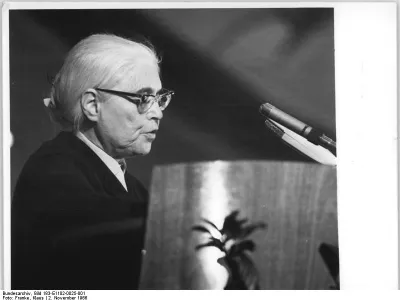
Anna Seghers
Human Design Chart
Biography
While in Paris in 1939 she had written The Seventh Cross, for which she received the Büchner-Prize in 1947. The novel is set in 1936 and describes the escape of seven prisoners from a concentration camp. It was published in the United States in 1942 and produced as a movie in 1944 by MGM starring Spencer Tracy. The Seventh Cross was one of the very few depictions of Nazi concentration camps, in either literature or the cinema, during World War II.
Seghers's best-known story, The Outing of the Dead Girls (1946), written in Mexico, was an autobiographical reminiscence of a pre-World War I class excursion on the Rhine river in which the actions of the protagonist's classmates are seen in light of their decisions and ultimate fates during both world wars. In describing them, the German countryside, and her soon-to-be destroyed hometown Mainz, Seghers gives the reader a strong sense of lost innocence and the senseless injustices of war, from which there proves to be no escape, whether or not you sympathized with the NSDAP (Nazi Party). Other notable Seghers stories include Sagen von Artemis (1938) and The Ship of the Argonauts (1953), both based on myths.
Seghers received the Georg Büchner Prize in 1947, the first Nationalpreis der DDR in 1951, and the Stalin Peace Prize in 1951. She died in Berlin on 1 June 1983 at age 82.
Anna Seghers as a Manifesting Generator 3/5 in Human Design
Manifesting Generator 3/5 — Design at a Glance
Anna Seghers lived as a Manifesting Generator, a hybrid energy type with unique dynamics. Her design endowed her with the constant power of a Generator through a defined Sacral Center, paired with the lightning-fast assertiveness of a Manifestor. This allowed her to skip steps and push projects forward rapidly, but this speed also carried risks: She tended to overlook important phases or get lost in too many undertakings simultaneously, often leading to frustration – her specific Non-Self theme.
Anna Seghers’ strategy was not to initiate herself but to react to inner impulses. Only when her Sacral Center signaled a clear “Yes,” should she act. This feedback loop served as a filter against hasty actions and multitasking without genuine enthusiasm. If she followed this strategy, she found deep satisfaction in her work. Her design promoted a playful approach to variety; parallel projects were not a burden but a source of energy as long as there was inner consent. Thus, her potential chaos turned into productive diversity, provided she remained in harmony with her inner authority and reacted authentically to life rather than fighting against it or controlling too much.
Sacral Authority
Anna Seghers’ design inclined towards spontaneous, physically grounded decisions. As a Generator, she possessed sacral authority, simplifying her decision-making process: strategy and inner guidance merged into one. This mechanism worked through immediate reactions to external impulses. If there was a surge of energy or an internal confirmation – audible as grunting, humming, or a confirming “Mhm” – she followed this gut feeling. This gave her vitality and inexhaustible energy, enabling her to perform tasks with great enthusiasm, free from rigid purposefulness. The open Emotional Center was a prerequisite; it prevented impulsive actions without emotional clarity. Additionally, an activated Spleen Center supported this authority. This connection allowed for quick, instinctive judgments about one’s well-being. Thus, Anna Seghers could reliably orient herself to this physical perception, allowing her to act spontaneously and effectively by listening to these inner signals and finding joy and satisfaction in doing so.
The 3/5 Profile — Martyr / Heretic
Anna Seghers was someone who gained knowledge not from books but through direct experimentation. Her design as a 3/5 Profile – Explorer and Hero – established a basic attitude: She believed nothing theoretical at first, but had to experience everything herself. This line of the Adventurer (Line 3) required trial and error to develop material power and find her own path.
This experientially gained knowledge then became the foundation for her role as a heroine (Line 5). Others projected expectations onto her; she was seen as a source of practical wisdom. Her design created a strong attraction, as people wanted to learn from her lived experiences. Yet this hero role carried the risk of public failure if experiments failed or too many commitments accumulated.
The mechanics of her profile described a cycle: First, selfless work for others to preserve individuality (Gate 14), then overcoming social projections and ambition (Gate 29). If she overextended herself, stress was imminent. Her path lay in learning from her mistakes about whom she should dedicate her energy to so as not to collapse under the weight of other people’s expectations. She presented her treasure trove of practical life experiences, making her design attractive but also vulnerable if reality fell short of high standards.
Single Definition — Defined & Open Centers
Anna Seghers had a reliable inner identity and direction. Her defined G Center gave her a stable sense of self and the ability to give others guidance without needing to control their paths. This clear orientation directly influenced her communication: Through her also defined Throat Center, she spoke with consistent clarity and honesty, allowing messages from within to come across authentically in the world.
As a Generator, Anna Seghers had a powerful source of vital energy in her Sacral Center. However, this energy was only available when she responded to external impulses rather than initiating herself. Her strategy involved waiting and responding to avoid frustration and exhaustion. This endurance was supported by a defined Spleen Center, which gave her spontaneous intuitive intelligence in the present moment. She could trust subtle signals from her body, helping her make health-promoting decisions and protect herself from harmful influences. Additionally, she had a set way of dealing with stress through her defined Root Center, providing the necessary pressure for material survival and progress.
In contrast, Head, Ajna, and Heart Centers were open. This made Anna Seghers vulnerable to mental confusion and doubt that did not originate within herself. She tended to identify with foreign questions or feel pressured to provide answers where none was needed. The open Ajna Center could lead her to adopt other people's concepts as her own truth. Especially the undefined Heart Center challenged her: It drove her into the trap of wanting to prove her worth through promises and performance, despite this energy source not being consistently available. Instead, she would have had to learn that she did not need to prove herself and trust in her inner authority to break the cycle of self-doubt and overcompensation.
Channels for intuitive clarity, rhythm and powerful manifestation.
Anna Seghers was someone whose life was marked by a deep internal rhythm. The Rhythm Channel 5-15 connected her sacral life force with the G Center, giving her an almost magical sense of time. Gate 5 held onto fixed habits while Gate 15 brought the diversity of society into this flow. She was carried forward by life and drew others into her frequency through her magnetic pulse if she listened to her reactions.
At the same time, Anna Seghers had a powerful ability to concentrate. The Concentration Channel 52-9 connected her Root Center with the Sacral. Gate 52 promoted non-action and stillness while Gate 9 focused on details. This combination allowed her to gather energy and correct or perfect patterns precisely without being distracted.
Her way of expression was characterized by constant awakening. The Awakening Channel 10-20 connected her G Center with the Throat Center. Gate 10 ensured authentic presence, while Gate 20 offered the ability to act in the present moment and articulate principles. She spoke from the essence of her being, helping others feel their own clarity.
This self-affirmation was strengthened by the Exploration Channel 34-10. Here, Gate 34 provided inner strength for convictions that Gate 10 translated into behavior. She lived independently and encouraged others to love themselves. This was complemented by the Perfect Form Channel 57-10, which linked intuitive insight (Gate 57) with self-expression. Thus, she acted spontaneously and appropriately, guided by a deep intuition for well-being in the moment.
Her charismatic presence stemmed from the Charisma Channel 34-20. The sacral power (Gate 34) met the expression in the present (Gate 20), giving her energy to be active and self-absorbed. This drive towards manifestation through reaction often made her appear busy but was a source of inspiration for others.
Intuitive truths were articulated through the Flash of Insight Channel 57-20. The Spleen intuition (Gate 57) found its voice directly in the Throat Center (Gate 20). She spoke the truth of the moment, free from fear of the future.
The foundation of her vitality was the Power Channel 34-57. Here, sacral energy (Gate 34) supported existential awareness of the Spleen (Gate 57), keeping her alert and healthy, ready to respond spontaneously to dangers and secure her individual survival.
Additionally, Gates like Gate 14 with its skillful handling of power, Gate 8 as a contribution to the group, and Gate 30 with its recognition of feelings in her design played roles.
Individual Circuitry — Circuit Signature
Anna Seghers was revealed through her design as a person with deeply rooted individual strength that often remained internal. Her simple definition connected the Sacral, Identity, Throat, Spleen, and Root Centers into one continuous energetic flow. This created a coherent basis of life energy (Sacral), self-worth (Heart/Identity) and intuition (Spleen).
The Centering Circuit in her linked the Identity with the Sacral Center through the Exploration Channel. This promoted solid convictions and courage, but lacked a direct connection to the Throat Center within this specific circuit, making it harder to express this inner strength outwardly. Parallel to this, the Knowledge Circuit worked: The Flash of Insight Channel connected the Spleen with the Throat Center. This allowed spontaneous creative insights that could be directly articulated – a pulsating, acoustic energy of individuality.
The Understanding Circuit added logical thinking and strategy (Identity, Sacral, Root) working together to create structures free from emotional influence by the Solar Plexus Center, which was not involved here. Finally, the Integration Circuit integrated these aspects: Channels like Awakening, Charisma, Perfect Form, and Power closely connected Throat, Sacral, Spleen, and Identity. This served to secure survival through the interplay of intuitive knowledge, correct reaction to life, and expression in the present moment. Anna Seghers thus lived in a constant synthesis of inner affirmation, strategic clarity, and spontaneous creative expression, with all her defined centers functioning as one unified whole.
Right Angle Cross of Contagion 4
Anna Seghers had the right infection cross in her design. This configuration shaped a fundamental attitude characterized by intense emotional dedication and a strong desire for deep connection. In Human Design, this pattern marks a focus on feelings as the central driving force behind actions and relationships. It was not about superficial sympathy but rather an almost painful willingness to open emotionally and grow into others.
This structure promoted a kind of empathy that transcended ego boundaries. Anna Seghers showed herself to be someone who felt emotions, but also understood them as essential parts of her identity and work. The right infection cross indicates that emotional intensity and sharing inner states with others were driving forces. It was a pattern that tended towards engaging in relationships or creative expressions where authenticity and emotional truth were at the forefront. The energy of this cross often acted as a catalyst for deep interpersonal bonds based on mutual understanding and the exchange of feelings. For Anna Seghers, this meant that her way of being was strongly marked by this emotional penetration without necessarily being rationally planned or strategically thought out. It was a natural orientation of the design towards connection through the heart.
Saturn Return · Uranus Opposition · Chiron Return · 2nd Saturn Return — Life Cycles
Anna Seghers lived a life path marked by clear cyclical turning points. Her design showed a tendency toward structured milestones that correlated with planetary cycles. The first Saturn return often marked the transition from preparation to established position. In 1928, at age 28, her first book “The Uprising of the Fishermen of St. Barbara” was published and she received the Kleist Prize – a success reflecting years of groundwork condensed into a viable result.
Later disruptive forces became stronger. The Uranus opposition represents unexpected breaks and external shocks that challenge inner structures. In 1943, Anna Seghers suffered severe injuries in a traffic accident requiring a long hospital stay. This crisis forced her to confront her own fragility and the need for new orientation in an unpredictable world.
The Chiron return finally is a fulfillment cycle where one’s incarnation cross unfolds and meaning becomes tangible – if lived according to strategy and authority. In 1950, Anna Seghers moved from West Berlin to East Berlin and was appointed to the World Peace Council. This step signaled not healing of old wounds but active realization of her life mission on a political level where her purpose now became publicly effective.
Manifesting Generator · Sacral Authority — Synthesis
Anna Seghers lived a life path marked by a deep connection to sacral energy and an unstoppable drive towards transformation. Her defined Sacral motor (Design) in combination with the Rhythm channel (Channels/Gates) points to someone driven by the flow of life – not through initiation but through reaction to what was presented. The profile as an experimenter and hero (Profile Role) reinforced this tendency, leading her to gather experiences herself and then share that knowledge. The ability to attract things quickly (Manifesting Generator) seemed a key characteristic of her way of living, strengthened by the defined Throat Center (Centers).
At the same time, her design revealed a central paradox: The fast energy and drive for transformation (Knowledge Circuit) stood in tension with the need for return and correction if important steps were skipped (Manifesting Generator). This was seen in cycles where moments of success (Saturn Return, 1928) alternated with phases of crisis and necessity to adapt (Uranus Opposition, 1943), before she found new paths in her career area (Chiron Return, 1950). This dynamic between rapid progress and the need for reflection shaped her path.
8 Defined Channels
Incarnation Cross - Right Angle Cross of Contagion 4
Solar Return
The Solar Return shows the moment when the sun returns to its exact birth position - your personal solar year.
Life Cycles
Discover the life cycles with a detailed triple view (birth chart, cycle chart, composite).
Human Design Profile
- Strategy
- To respond - wait for something to respond to
- Authority
- Sacral Authority
- Profile
- 3/5 - Martyr / Heretic
- Definition
- Single Definition
- Incarnation Cross
- Right Angle Cross of Contagion 4
- Date of Birth
- 19.11.1900 21:00
- Place of Birth
- Mainz, GER
Frequently Asked Questions
What was Anna Seghers' Human Design type?
What Profile did Anna Seghers have in Human Design?
Which Authority guided Anna Seghers' decisions?
Which incarnation cross determined the life path of Anna Seghers?
When was Anna Seghers born?
Discover your own Human Design
Are you also a Manifesting Generator? Find out in a personal reading how to unfold your multi-talents and direct your energy wisely.
More Personalities
Back to overviewAlain-Fournier

Aldair

Alizée

Angeli

Arletty

Artus