
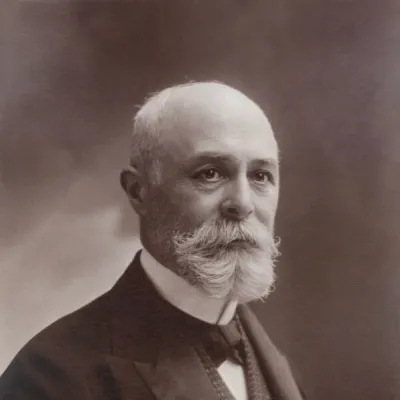
Antoine Becquerel
Human Design Chart
Biography
In 1896, he discovered that uranium salts emit radiation capable of penetrating black paper and other substances. Originally called Becquerel rays, the phenomena he discovered later became known as radioactivity. He shared the Nobel Prize in physics with Pierre and Marie Curie in 1903.
Becquerel died on 25 August 1908 in Paris, aged 55.
The Human Design of Antoine Becquerel: Generator 2/4
Generator 2/4 — Design at a Glance
Antoine Becquerel possessed immense and enduring strength that allowed him to advance projects over long periods of time. His design suggested that this energy was not most efficiently utilized through constant self-initiative but rather by responding to impulses from his environment. As a Generator, his sacral energy source acted as an engine that could only fully unfold when he gave clear answers to external questions or invitations.
This rhythm of reacting instead of initiating formed the foundation for his well-being. When Antoine Becquerel responded to signals in life and felt his inner 'yes', he could act with great endurance. In these moments of resonance, he found deep satisfaction and a sense of fulfillment. Conversely, ignoring this strategy - such as through forced initiation or working on things without internal consent - often led to frustration and a noticeable loss of energy.
The danger lay in wasting his strength on tasks that did not truly resonate with him or being held back from his heart project while he was still full of power. His path involved patiently waiting for the right signal and then responding fully to it with the intensity of his sacral energy. This process protected him from burnout and ensured that his efforts always aligned with his inner nature.
Emotional Authority
Antoine Becquerel's inner authority resided in the defined Emotional Center. This configuration established a specific decision-making structure: immediate reactions were not seen as truth but rather as mere snapshots, colored by the current mood. His design was subject to a constant up-and-down cycle of emotions; he could be totally enthusiastic at one moment and negatively evaluate the same situation moments later. Since this first impression did not yet provide clarity, spontaneous decisions based on emotion often proved problematic or even negative.
The mechanics of his emotional authority required patience and delay. The more time Antoine Becquerel took to let a decision mature, the deeper and more comprehensive he could perceive the situation. This process demanded consciously sleeping over important questions. He should be teased into giving multiple responses until intense feelings subsided. Only then did he gain the necessary emotional distance for clarity and calmness to emerge. This was particularly relevant for long-term decisions that significantly influenced his life path. Emotional authority always took precedence over other defined centers in his chart; it determined the rhythm of his inner guidance independently of further configurations. By waiting out the emotional waves, he found his true direction rather than getting lost in the chaos of the moment.
The 2/4 Profile — Hermit / Opportunist
Antoine Becquerel revealed a constant interplay between a deep need for withdrawal and an intense attraction to his social environment. His design, Profile 2/4 (Natural Talent / Networker), established a foundational structure that swung him between two poles: Line 2 with its tendency towards isolation and strictness, and Line 4, which yearned for community and emotional connection.
During phases of withdrawal, Antoine Becquerel immersed himself in internal processes. Here he was selective and strict with himself to allow ideas to mature peacefully. This time served to clarify his thoughts and use his imagination without being disturbed by external influences. Once this inner need was satisfied, he returned to his network.
Then the power of Line 4 came into play: a dominant emotional presence often described as an 'emotional steamroller' that strongly influenced its surroundings. This energy was amplified and reflected back by others. The challenge lay in aligning this intense external impact with the necessary inner calm. Antoine Becquerel needed a safe environment to communicate clearly when he sought company and when he wanted solitude. Only through this clear boundary could he effectively reflect upon his network's knowledge and develop brilliant insights, rather than falling into boredom or projecting onto others.
Split Definition — Defined & Open Centers
Antoine Becquerel revealed himself as someone with a solid foundation of inner substance. His design was characterized by six defined centers: G Center (Love and Identity), Heart Center (Willpower), Sacral Center (vital energy), Solar Plexus Center (emotional awareness), Spleen Center (instinct) and Root Center (stress). This configuration created an unshakable self-identity, available vitality, and a constant inner pressure. He was designed to react based on his inner authorities – emotionally, intuitively, and sacral – not mental planning.
In stark contrast, Head, Ajna, and Throat Centers were open. This meant that mental clarity, conceptual security, and spontaneous communication were situational traits dependent on the environment rather than inherent characteristics. The open throat required patience until invited to speak; the open head and ajna centers demanded acceptance of situational confusion or inspiration without identification.
While his defined G Center gave him a firm direction, his open Head Center tended to get stuck in doubts when it did not trust his inner authority. Instead of seeking answers he could not provide, he was designed to accept questions as part of the process. His defined Heart Center endowed him with willpower and the need to let promises in, while his open Ajna Center made him vulnerable to adopting foreign concepts if he did not carefully examine them.
The mechanics of his open throat showed that he did not initiate for attention but waited until the right invitation came. His defined Sacral Center generated constant energy which could only be effectively used through reaction, not initiation. By waiting for the emotional wave from his Solar Plexus Center to clear up, he achieved clarity rather than acting impulsively. So he lived in a clear distinction between his stable 'being' and his flexible, reactive way of thinking and speaking.
Channels for focus, self-expression, care and community.
Antoine Becquerel revealed himself through an intense, logical focus paired with a strong need for individual authenticity. His design conveyed the ability to analyze details precisely while simultaneously living out his own inner truth independent of external norms. This tension between precise observation and self-determined expression was complemented by deep care for the clan as well as a fondness for fair social agreements.
The Focus Channel 52-9 connected Root Center with Sacral Center. Through Gate 52, which promotes non-action, and Gate 9, which enables focus on details, a quiet pressure towards stillness emerged. This allowed Antoine Becquerel to filter out distractions and perfect patterns through logical analysis. This formative energy carried the qualities of the entire Understanding Circuit.
Parallel to this, the Exploration Channel 34-10 between Sacral and G Centers was at work. Gate 34 provided inner strength for self-acceptance while Gate 10 initiated behavior from the deepest within. This drove him towards authentic self-love and enabled him to express his uniqueness without guilt, reinforcing others in their own convictions.
The caring dimension came through the Preservation Channel 27-50. Gate 27 brought selfless interest in nurturing others while Gate 50 guarded traditional clan values and laws. Thus, Antoine Becquerel functioned as a natural caregiver who took responsibility to protect and preserve the community provided he responded correctly to requests.
Social action was shaped by the Community Channel 37-40 connecting Solar Plexus and Heart. Gate 37 sought recognition in the whole while Gate 40 valued fair agreements. This fostered emotional trust in relationships, enabling Antoine Becquerel to build bridges between individuals to create a harmonious community with respected functions for all.
Tribal Circuitry — Circuit Signature
Antoine Becquerel's design combined profound individuality with strategic rationality. The Centering Circuit, activated by Channel 10-34 (Exploration), linked the Sacral Center directly to the Identity Center. This created an inner anchoring in the here and now, marked by strong self-worth and confirmation of one’s individuality. As there was no connection to Throat Center, these firm convictions often remained unspoken; they instead manifested through consistent action.
Parallel to this, the Understanding Circuit via Channel 9-52 (Focus) promoted clear logical thinking. Here, energies from the Sacral Center flowed into the Root Center. This enabled a future-oriented strategy and structuring of insights while emotions were consciously excluded – an 'emotionless ratio' aimed at improvement.
In the social realm, the Ego Circuit via Channel 37-40 (Community) showed a need for mutual support. It linked Heart with Solar Plexus Center, focusing on resource management and balance between giving and taking within a community. Without direct sacral connection, this required pauses to regenerate.
Finally, the Protector Circuit through Channel 27-50 (Preservation) emphasized instinctive protection. It connected Sacral with Spleen Center, resulting in primordial care for the clan system and preservation of genetics.
The split definition was reflected in two energetically separated groups: One group united Sacral, Root, G, and Spleen Centers; the other linked Solar Plexus and Heart. These coexisting forces created a complex personality combining inner centering with outer strategic analysis and social responsibility without directly mixing these areas.
Right Angle Cross of Eden 4
Antoine Becquerel's design was characterized by the 'Right Eden 4 Cross'. This configuration set the archetypal framework for his existence without allowing specific mechanical details such as Gates or Channels to derive a character trait. The design offered no concrete clues about particular behaviors or psychological tendencies, since the raw content did not contain biomechanical specifics or biographical evidence. It was a purely structural marker within Human Design that served as an abstract category but did not allow for individual differentiation. Without further mechanical data, the description remained at this general level. Antoine Becquerel lived within this framework, which however did not generate specific action impulses or character traits. The analysis could therefore not provide a detailed characterization due to the lack of necessary information for deeper classification. The Cross stood as an isolated term in the system, from which no conclusions about Antoine's personal dynamics could be drawn. It was a neutral placeholder in the mechanics that neither implied strength nor weakness but merely marked affiliation with this specific cross category. Without additional data, the picture remained incomplete and general.
Saturn Return · Uranus Opposition · Chiron Return — Life Cycles
In this phase of his life, Antoine Becquerel's design showed itself as a moment of full unfolding. In 1903, at age 51, he received the Nobel Prize in Physics. This marked the Chiron Return, a cycle between ages 49 and 51, during which one's incarnation cross increasingly unfolds in life. Those who had lived according to their strategy and authority now experienced how meaning and purpose became experiential. It was not about healing old wounds or mythological injury narratives but rather an fulfillment cycle of blooming. Years of work condensed into clear authority and measurable contribution. The Nobel Prize here was no random success, but visible proof that his inner design had unfolded its full effect in outer life. This turning point signaled the transformation of his original life task into a source of mastery. Antoine Becquerel stood at a point where his inner potential became external reality, carried by the logic of his Human Design chart.
Generator · Emotional Authority — Synthesis
Antoine Becquerel lived a life deeply marked by reactions to the impulses offered to him. His Generator type and associated sacral energy allowed him to react through action to what his environment provided – an approach strengthened by emotional authority as he only reached clarity after experiencing the emotional wave. This combination of reactive energy and temporal awareness led to a capacity for deep immersion in interests (Gate 9), while his defined G Center gave clear direction that he shared with others. The profile as a natural talent and networker revealed a dance between the need for alone time for reflection and joy in community, nurturing his ability to develop ideas and refine them through exchange with others.
A central paradox in Becquerel's design lay in the tension between his defined root and open head center. The root provided constant pressure towards forward movement and holding onto beliefs, while the open head center made him receptive to new information and perspectives. This led to a dynamic balance between persistence and flexibility – a need for stability paired with the ability to adapt and integrate new things.
4 Defined Channels
Incarnation Cross - Right Angle Cross of Eden 4
Solar Return
The Solar Return shows the moment when the sun returns to its exact birth position - your personal solar year.
Life Cycles
Discover the life cycles with a detailed triple view (birth chart, cycle chart, composite).
Human Design Profile
- Type
- Generator
- Strategy
- To respond - wait for something to respond to
- Authority
- Emotional Authority
- Profile
- 2/4 - Hermit / Opportunist
- Definition
- Split Definition
- Incarnation Cross
- Right Angle Cross of Eden 4
- Date of Birth
- 15.12.1852 15:00
- Place of Birth
- Paris, France
Frequently Asked Questions
What is Antoine Becquerel's Human Design type?
What Profile did Antoine Becquerel have in Human Design?
Which authority guided Antoine Becquerel?
What incarnation cross did Antoine Becquerel have?
When was Antoine Becquerel born?
Discover your own Human Design
Are you also a Generator? Find out in a personal reading how to use your sacral energy correctly and discover deep satisfaction.
More Personalities
Back to overviewAaliyah

Alexia

Angèle

Anne-Marie

Arcángel

Arno
