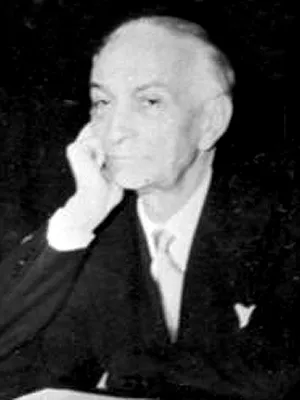
Antonio Segni
Human Design Chart
Biography
Antonio Segni — Projector with Profile 6/3
Projector 6/3 — Design at a Glance
Antonio Segni's Human Design emphasized a tendency towards precise system analysis. As a Projector, he had a dense, focusing aura that allowed him to immediately identify structural weaknesses and errors in complex processes. This ability acted like a bright light beam, targeting areas that were hidden or not functioning optimally.
However, Antonio Segni lacked a constant intrinsic source of life energy due to his undefined Sacral Center. He did not have the steady flow of energy needed to continuously assert himself against societal rhythm demands. Instead, he naturally went through phases of high activity and necessary regeneration. Direct confrontation with identified errors would often be perceived as unpleasant by his environment; therefore, his design promoted indirect leadership through his own harmony and presence, which attracted others.
The central strategy for Antonio Segni was to wait for appreciative invitations before deploying his leadership qualities. This waiting protected him from overexertion and the risk of burnout that would arise if he tried to prove himself in a system not designed for his irregular energy cycles. By awaiting this invitation, he avoided the non-self theme of bitterness and secured the necessary recognition for his specific gift of illuminating others' paths.
Emotional Authority
Antonio Segni exhibited a decision-making stance that required time and distance: spontaneous judgments based on current mood were risky in his design as they only represented snapshots. His inner authority lay in the defined Emotional Center, meaning his perception was always colored by an emotional wave – a constant up-and-down of feelings. In one moment he could be enthusiastic about something, in the next negatively evaluate the same situation. However, his immediate feeling was not automatically the truth but merely a first impression.
Quick decisions made from this emotional heat could therefore have negative consequences. For Antonio Segni it was essential to take time and sleep on decisions. Only through patience and repeatedly questioning an issue did intense feelings subside. This process of emotional distancing created the necessary space for clarity and calmness. He had to go through these wave movements to reach true insight. This mechanism applied regardless of other defined centers in his chart; the Emotional Center always determined the nature of decision-making. Long-term course changes thus required this conscious renunciation of immediate action in favor of a deeper, more comprehensive understanding that only became available after the initial emotional reaction subsided.
The 6/3 Profile — Role Model / Martyr
Antonio Segni's Human Design pointed towards an evolution from experimental adventurer to wise role model. In his first half of life, he lived as a Three-Line: marked by intense self-experiments and the search for the extraordinary, far from everyday standards. This was not mere curiosity but a learning process through trial and error to find authenticity.
After around thirty years, this dynamic changed. Experimentation slowed down but never ceased entirely since the Three-Line remained permanently in his profile. Instead, accumulated experiences turned into wisdom, humor, and responsibility. Antonio Segni showed himself as someone who used his unusual experiences to become a far-sighted role model.
This transformation reflected the paradoxical tension between inner restlessness and outer stability. As a Six-Line, he sought perfection endlessly but found it not in the ordinary. The mechanics of Gate 19 emphasized isolation and spirituality. The path led through dedication and testing towards conscious withdrawal. Antonio Segni understood the ego circuitry and often chose distance to maintain his spiritual authority. His dominance went beyond the material level; he did not seek adaptation to norms but a deep, individual truth that he protected through withdrawal.
Triple Split Definition — Defined & Open Centers
Antonio Segnis Design showed a tendency towards inner intensity: he possessed consistent willpower, emotional depth, and existential intuition. His defined Heart Center gave him the strength to shape his life self-determinedly and keep promises, while his open Sacral Center meant that he did not have a constant work rhythm. Instead, he tended to drive himself through "borrowed" energies of others, which led to exhaustion when overburdened; he had to learn to listen to his inner authority rather than external impulses for work.
Mentally, Antonio Segni was under permanent pressure due to the definition between Head and Ajna Centers to ask questions and form concepts. This mental process ran continuously but could not be directly put into action since he lacked an open Throat Center. He appeared as someone who generated inspiration but could not speak or manifest consistently. Instead of trying to force attention through constant talking – a typical trap of the open Throat Center – it was more effective for him to wait for the right timing to express his thoughts when the environment was ready to receive them.
Emotionally and existentially, he appeared profound. His defined Solar Plexus Center demanded patience: truth revealed itself to him only at the end of the emotional wave, not in the impulsive moment. Combined with his defined Spleen and Root Centers, he had a strong intuition for "now" and a constant pressure to survive and correct. Yet without a fixed self-image (open G Center), his identity was situational; he took on the directions and energies of his environment. His path lay in not seeking a fixed role but thriving in appropriate environments where he could reflect the right energy, without losing himself in wrong places or relationships.
Channel 49-19: Synthesis — Channels & Gates
Antonio Segni revealed himself through a deep-rooted orientation towards loyalty and the cohesion of his social environment. His design was marked by the necessity to secure his position within a community and protect resources as well as territory. This attitude stemmed from the defined Personality Channel Synthesis 19-49, which connected the Root Center with the Solar Plexus Center through the Claim Gate (19) and the Principles Gate (49). It created an emotional frequency that acted like glue for the tribe: acceptance or rejection was not based on logic but rather on the code "Love, Honor, and Obedience." Antonio Segni sought balance between feasibility and fairness, with family as a central enterprise held together by clear belief systems and traditions.
In the background, additional mechanisms were at work. The Channel of Devotion 44-26 connected the Spleen Center and Heart Center (Gate of Alertness 44, Gate of Egotists 26) and gave him an instinctive sense of what his tribe needed, as well as the ability to convey this convincingly. The Channel of Abstraction 64-47 (Tor of Confusion 64, Tor of Comprehension 47) drove him to mentally penetrate experiences and find narrative connections, even though this process was often accompanied by inner restlessness.
Additional Gates shape his Profile: Gate 33 promoted reflection and withdrawal for strengthening before new cycles. Gate 2 stood for receptivity and evolutionary directional changes, while Gate 1 emphasized uniqueness and creative mutations in the here-and-now. Gate 54 linked worldly success with spiritual insight, supported through partnerships. Gate 11 used visual memories to assess the collective situation. Gate 17 organized the future through logical teaching and service to the whole. Gate 60 accepted limitations as a path to transcendence, while Gate 41 understood emotional changes and crises as evolutionary steps. Finally, Gate 50 as a protective reflex ensured awareness and the preservation of traditional values.
Tribal Circuitry — Circuit Signature
Antonio Segni did not act from a constant drive but reacted to environmental stimuli with cyclical phases of activity and necessary recovery. His design showed high sensitivity to external stimuli through the Triple Definition: three separate energetic groups existed parallel to each other – Head-Ajna, Heart-Spleen, and Solar Plexus-Root Centers – without direct flow connecting them. This required quiet periods for regeneration.
The Manifesto Circuit connected his Head with Ajna Center (Channel 64-47). This connection directed energy towards understanding past experiences and finding meaning in them, driven by visual abstraction and emotional wave motions.
Parallel to this, the Ego Circuit worked as part of the Stem Function. Here he linked two separate areas: The Heart-Spleen Connection (Channel 26-44) fostered devotion in resource cooperation and giving/receiving. Simultaneously, the Solar Plexus-Root Center connection (Channel 49-19) supported emotional synthesis and traditional values. Since there was no defined Sacral Center, continuous life force energy was lacking; energy had to be gathered in waves or spurts. Thus, Antonio Segni appeared as someone who linked inner meaning-making from the past with outer resource security within the collective, always dependent on necessary pauses between impulses.
Left Angle Cross of Refinement 2
Antonio Segnis design showed a tendency towards continuous refinement. His character was marked by the drive to not just maintain existing structures but continuously sharpen and optimize them. This wasn't an abrupt impulse, but a deeply rooted principle guiding his actions: the search for more precise form, clearer expression, or more efficient methods.
This orientation stemmed from his configuration as the bearer of the left refinement cross 2. In Human Design mechanics, this pattern describes a life task aimed at transforming raw materials—whether ideas, relationships, or systems—into higher quality and elegance through meticulous processing. It was a process of polishing and adjusting, focusing on improving what already existed rather than starting anew radically. Antonio Segni lived this dynamic as someone whose energy was directed towards eliminating fuzziness and creating clarity. Refinement wasn't just a side hobby but the central expression of his inner nature. It shaped how he dealt with challenges: by analyzing them, breaking them down into finer parts, and then reassembling them in an enhanced form. This mechanism worked as a constant drive to understand perfection not as an end state but as an ongoing act of improvement.
Saturn Return · Uranus Opposition · Chiron Return · 2nd Saturn Return — Life Cycles
Antonio Segnis design showed a tendency towards structured maturation, where inner convictions were aligned with external realities. This dynamic was particularly evident during his second Saturn return. This cycle typically marks a phase of consolidation, where one's life structure is reinforced and long-term values are anchored.
In 1946 at the age of 55, Antonio Segni became Minister for Agriculture. This appointment served as a concrete career technical anchoring of this maturity. The design described no sudden change but rather the logical consequence of a long-term development: his inner stance found its external confirmation in an official position. Through this role, he could bring structural competence and simultaneously strengthen his personal authority in public space. The mechanics of this second Saturn return promoted exactly such moments where private and public were brought into harmony. It was about creating stability and durability in his work. Antonio Segni used this phase to secure his position and translate his visions into concrete political measures. This aligned with the deep need of his design to seek validation through structural recognition.
Projector · Emotional Authority — Synthesis
Antonio Segni lived a process of continuous refinement and seeking deeper meaning. His projector design (design view) predisposed him to recognize patterns and shed light on darkness—a skill enhanced by the defined mental center (centers), creating a constant pressure towards analysis and understanding. However, this recognition of systems and their potential flaws was always tied to emotional waves (authority), requiring time for judgment maturation and reflection on past experiences (sacred circuit). The profile as role model/experimenter (profile role) points to a lifelong search for extraordinary solutions beyond conventional standards.
A central paradox lay in the tension between the need to recognize patterns and formulate principles—embodied by the channel of synthesis (channels/gates)—and the emotional nature of his authority. He was destined to make connections and define ideals, but this process required grappling with personal feelings and the cyclical rise and fall of perception circuit dynamics. This dynamic led him repeatedly back into the past to learn from experiences and let them flow into new syntheses, which refined over time (cross).
3 Defined Channels
Incarnation Cross - Left Angle Cross of Refinement 2
Solar Return
The Solar Return shows the moment when the sun returns to its exact birth position - your personal solar year.
Life Cycles
Discover the life cycles with a detailed triple view (birth chart, cycle chart, composite).
Human Design Profile
- Type
- Projector
- Strategy
- Wait for the respectful invitation
- Authority
- Emotional Authority
- Profile
- 6/3 - Role Model / Martyr
- Definition
- Triple Split
- Incarnation Cross
- Left Angle Cross of Refinement 2
- Date of Birth
- 02.02.1891 09:00
- Place of Birth
- Sassari, Italy
Frequently Asked Questions
What was Antonio Segni's Human Design type?
What profile did Antonio Segni have?
What authority guided Antonio Segni?
What incarnation cross was assigned to Antonio Segni?
When was Antonio Segni born?
Discover your own Human Design
Are you also a Projector? Find out in a personal reading how to unfold your leadership qualities and recognize the right invitations.
More Personalities
Back to overviewSissy Spacek

Alain-Fournier

Anémone

Ann-Margret

Bourvil
Hergé