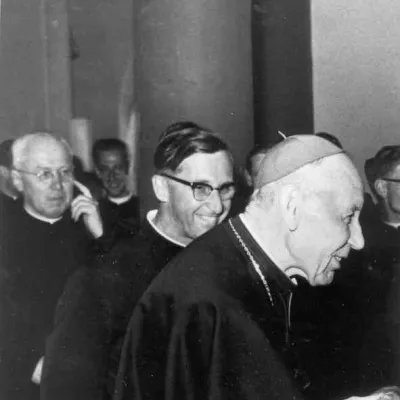
Augustin Bea
Human Design Chart
Biography
Cardinal Bea died on 16 November 1968 from a bronchial infection in Rome at age 87.
Augustin Bea as a Manifestor 2/4 in Human Design
Manifestor 2/4 — Design at a Glance
Augustin Bea was as a Manifestor a pioneer and visionary whose energy was geared towards leading the world into a new future. His design resembled that of an emperor in ancient Rome: He possessed the vision of a great empire but did not lead the necessary wars himself. Instead, he delegated tasks to others, much like a ruler sending soldiers to conquer lands for him.
This superior mindset and the magnitude of his dreams often led to misunderstandings and polarization. While some people loved his visions and followed him, others rejected or even hated him. The central conflict in his design lay in this division caused by his own nature.
To avoid this pain point and find the right followership, it was essential for Augustin Bea to inform others timely and precisely about his intentions and visions. This strategy of informing served to prevent misunderstandings from the outset. If he followed this strategy, he was rewarded with a sense of inner peace. Living against his design by not informing led him instead to feel a persistent, deep anger. His path therefore consisted in attracting the right people through clear communication and thus maintaining inner calm rather than frustration.
Emotional Authority
Augustin Bea's inner authority lay in his defined Solar Plexus Center. This configuration fundamentally determined his decision-making: He was subject to a natural emotional wave that showed itself in a constant up-and-down of his feelings. The world appeared colored by his current mood; one moment he could be totally excited about an issue, the next it seemed negative. However, this immediate feeling was only a snapshot, a first impression that did not necessarily represent his truth yet. Spontaneous reactions or quick decisions based on such emotion could therefore have negative consequences.
His strategy consisted in taking time. The longer he let a decision mature, the deeper and more comprehensive he could perceive the situation. This process required patience and repeatedly sleeping over important questions. By hesitating and asking himself multiple times, intense feelings subsided over time. He gained emotional distance, which led to clarity and calmness. Only then had he gone through the process. This mechanism was particularly relevant for long-term decisions that could have a significant impact on his life course. Emotional authority always took precedence over other defined centers in his chart; it was the central compass for his orientation, independent of any other definitions.
The 2/4 Profile — Hermit / Opportunist
Augustin Bea's design laid a tendency towards tension between hermit tendencies and network needs. He showed himself as someone constantly swinging between two desires: the wish to be alone for internal clarity (Line 2) and the urge to spend time with selected people (Line 4). This 'Natural Talent / Networker' profile required creating a secure environment in which availability boundaries were clearly communicated. Augustin Bea had to learn to signal clearly:
Single Definition — Defined & Open Centers
Augustin Bea revealed himself through a constant, reliable voice and willpower that emerged from his defined Throat and Heart Centers. This configuration gave him the ability to keep promises and clearly articulate his intentions. His communication was not just an exchange of thoughts but a transformative action driven by inner resolve. Yet this strength stood in tension with his emotional authority: His defined Solar Plexus required waiting for the emotional threshold to be reached. Truth revealed itself to him not in the moment, but over time; impulsive decisions were filtered through waves of emotion until clarity emerged.
This firm structure of expression and will contrasted sharply with his situational openness in other areas. His open Head Center made him vulnerable to mental pressure and the temptation to answer questions that weren’t his own. He tended to be distracted by seeking inspiration rather than trusting his inner authority. Similarly, his open Ajna Center allowed him to flexibly adopt others’ concepts instead of holding firm opinions.
His open G Center meant he lacked a fixed identity or direction. Instead, he adapted to the environment and searched for the right place to find love and meaning. He risked adopting “borrowed” identities if he didn’t wait for initiation by others. His open Sacral Center lacked consistent energy; he was vulnerable to exhaustion as he amplified foreign life force rather than generating it himself. Spontaneity here was risky, as his open Spleen Center could lead him to impulsive decisions out of fear or false security. Finally, his open Root Center absorbed external stress, making him vulnerable to overload from environmental pressure.
Channels for ambitious action and communal connectedness.
Augustin Beas Design points towards a tendency for mutative innovation, driven by the desire to improve something new in the collective. This energy focused on experimenting with skills until mastery is achieved, often associated with artistic expression. Gate 16 (Line 2) advanced this process by fostering identification with new abilities and enabling perfection through constant experimentation. Additionally, Gate 9 supported detailed work and taming of details, leading repetitions to precise results.
This individual mastery stood in tension with material reality. The money line Channel 21-45 connected the Heart Center with the Throat Center and demanded control over resources as well as a balance between work and rest. Gate 21, the Hunter, sought authority in service to the tribe, while Gate 45, the Gatherer, held final decision-making power ("I have or I do not"). Augustin Bea had to demonstrate willpower here to achieve material independence while serving others without exploiting himself.
Parallel to this, Channel 37-40 (Community) worked juxta-positioned, emphasizing emotional belonging and correct agreements. Gate 37 sought recognition in the whole, while Gate 40 underscored the need for pauses and rewards for providing for others. This channel required patience in integrating into groups since trust could only be built through personal touch and time. Together, these mechanisms shaped a Profile navigating between individual experimental mastery, material responsibility, and building stable emotional community structures.
Tribal Circuitry — Circuit Signature
Augustin Beas Design shows a tendency towards cooperative action and the joint building of resources. He was someone who valued mutual support and clear exchange structures within a community. This attitude was shaped by the Ego Circuit, which, despite its name, belongs to the Family Circuits and prioritizes collective interests.
In Augustin Bea's design, the Throat, Heart, and Solar Plexus Centers are directly connected. This connection allowed for synchronous energy between communication, will, and emotions. Channel 21-45, known as the Money Line, linked his Heart Center with the Throat Center. This promoted the ability to convey ideas and contributed to the creation of material well-being. At the same time, Channel 37-40 connected Solar Plexus and Throat Centers, establishing a balanced relationship between giving and taking – the principle "Today I give, tomorrow you give."
Since this circuit does not connect to the Sacral Center, it lacks the constant life force of Generators. Instead, there is a ratcheting energy in the emotional realm. Progress and support occur in waves, not linearly. This made regular rest pauses for resource regeneration necessary. The approach was conservative and tradition-oriented, focusing on stable community building through reliable exchange without the pressure of constant productivity.
Right Angle Cross of Planning 2
Augustin Bea's design indicated a tendency towards strategic orientation and long-term vision. He was someone who kept the big picture in mind, planning not just tactical moves but sustainable paths to achieve goals. This attitude stemmed from his configuration of the right cross of Planning 2.
This specific alignment described the ability to look beyond the immediate moment. It was less about spontaneous impulses and more about recognizing structures and translating them into a coherent plan. Augustin Bea had an inner map that helped him not only understand complex situations but also navigate them strategically. The energy of this configuration promoted a clear vision, yet it always remained connected with a pragmatic path.
He knew how to set goals in such a way that they remained achievable without losing sight of the essentials. This combination of foresight and planning strength shaped his approach to challenges. Rather than getting lost in details, he maintained the strategic line. The right cross of Planning 2 thus acted as an inner compass, helping him make decisions within the context of long-term intentions. It provided a stable foundation for leadership and design based on clarity and insight. Augustin Bea used this gift not only to see what was but also where the path could lead.
Saturn Return · Uranus Opposition · Chiron Return · 2nd Saturn Return — Life Cycles
Augustin Bea's design indicated a tendency towards structural anchoring that became particularly evident during phases of maturation. He received his priestly ordination in 1912 at the age of 31 – a moment typical for his chart: the first Saturn return. This cycle often marks the point where years of internal work and identity formation condense into a solid external form. For Augustin Bea, this meant not just professional confirmation but also crystallization of his deepest natural role within a socially recognized structure.
The first Saturn return acts in Human Design as an impulse to consolidate self-image and life purpose. Where previously there was experimentation or uncertainty, clarity about one's position often emerges now. Augustin Bea used this energetic push to translate his spiritual calling into a firm, binding practice. The priestly ordination was thus not an arbitrary date but the expression of an inner necessity activated by the planetary cycle. It laid the foundation for his further work and anchored his identity in a clear, responsible function. This phase shaped him sustainably as it bridged personal potential with public duty.
Manifestor · Emotional Authority — Synthesis
Augustin Bea was a pioneer whose life was marked by profound internal dynamics. His Manifestor design points to visionary power that is always connected with the need to communicate these visions (Throat Center) and simultaneously wait for emotional authority. This combination led to an inner complexity in which he possessed both the potential for strong leadership as well as dependence on acceptance of his ideas. The connection between Heart and Solar Plexus Centers strengthened this pull towards self-determination and expression of will, while open centers made him sensitive to other people's energies and required adaptability.
A central paradox in Augustin Bea's design lies in the tension between his need for solitude (Line 2) and community (Line 4). This duality, combined with the ability to gather and distribute resources (Channel 21-45), points to a personality that was both independent and strongly embedded in social structures. The openness of certain centers intensified this ambivalence by making him receptive to external influences while also enhancing his capacity for adaptation and relationship building.
2 Defined Channels
Incarnation Cross - Right Angle Cross of Planning 2
Solar Return
The Solar Return shows the moment when the sun returns to its exact birth position - your personal solar year.
Life Cycles
Discover the life cycles with a detailed triple view (birth chart, cycle chart, composite).
Human Design Profile
- Type
- Manifestor
- Strategy
- To inform others before acting
- Authority
- Emotional Authority
- Profile
- 2/4 - Hermit / Opportunist
- Definition
- Single Definition
- Incarnation Cross
- Right Angle Cross of Planning 2
- Date of Birth
- 28.05.1881 03:30
- Place of Birth
- Blumberg (Baden-Württemberg), Germany
Frequently Asked Questions
What was Augustin Bea's Human Design type?
What profile did Augustin Bea have in Human Design?
Which authority guided Augustin Bea?
What incarnation cross did Augustin Bea have?
When was Augustin Bea born?
Discover your own Human Design
Are you also a Manifestor? Find out in a personal reading how to use your initiation power peacefully and dissolve resistance.
More Personalities
Back to overviewAlain-Fournier
Angeli

Christian-Jaque
Juninho

Kesha

Lucebert