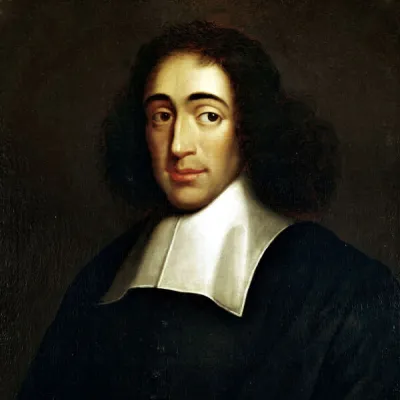
Baruch Spinoza
Human Design Chart
Biography
Spinoza was born in Amsterdam to a Marrano family that fled Portugal for the more tolerant Dutch Republic. He received a traditional Jewish education, learning Hebrew and studying sacred texts within the Portuguese Jewish community, where his father was a prominent merchant. As a young man, Spinoza challenged rabbinic authority and questioned Jewish doctrines, leading to his permanent expulsion from his Jewish community in 1656. Following that expulsion, he distanced himself from all religious affiliations and devoted himself to philosophical inquiry and lens grinding. Spinoza attracted a dedicated circle of followers who gathered to discuss his writings and joined him in the intellectual pursuit of truth.
Spinoza published sparingly during his lifetime to circumvent persecution and the suppression of his works.
Human Design Analysis: Baruch Spinoza as Manifesting Generator 3/6
Manifesting Generator 3/6 — Design at a Glance
Baruch Spinoza's design laid a tendency towards hybrid dynamics: he possessed the constant energy of a Generator paired with the ability to skip steps and call forth swift actions. This configuration, however, required precise navigation between impulse and confirmation. His defined sacral source provided a steady power base that was primarily oriented toward reaction rather than independent initiative.
The challenge lay in the speed of his actions. If Baruch Spinoza moved too quickly, he often skipped necessary intermediate steps, forcing him to backtrack and fill gaps—a process that could easily lead to frustration. Additionally, his design tended to pursue multiple projects simultaneously, driven by various impulses. Without constant resonance checks with his inner authority, this complexity threatened to erode his creative joy.
True satisfaction for Baruch Spinoza only came when he entered a playful mode. Here, variety was not a disturbance but nourishment for his energy. Crucial always was the "yes" of his sacral response: only if this inner confirmation was maintained throughout the process could he carry parallel projects and draw deep satisfaction from his work. His design thus showed that speed was only beneficial when tempered and guided by continuous responsiveness to internal signals.
Emotional Authority
Baruch Spinoza showed a decision-making approach that resisted spontaneous impulses and instead focused on waiting until emotional clarity was achieved. His inner authority lay in the defined Solar Plexus Center. This configuration was subject to constant emotional waves; his perception was always colored by the current mood. What appeared inspiring at one moment could be felt as negative in the next. However, this emotional ups and downs did not mean that the immediate feeling represented the truth. It was merely a snapshot, an initial impression that had yet to mature.
Quick decisions made from immediate emotion often had negative effects on his design, as they were based on this transient coloring. Instead, his mechanics required patience and time. He needed to rethink decisions multiple times and let them rest overnight to allow intense feelings to subside. Through this delay, he gained emotional distance. Only when the wave subsided did clarity and calmness set in. This process of waiting was crucial for long-term life decisions, as it allowed a grounded truth, not driven by fleeting mood, to be recognized. Emotional authority took precedence over other defined centers, regardless of what additional structures were present in his graph.
The 3/6 Profile — Martyr / Role Model
Baruch Spinoza's design set a tendency towards a two-phase development. Until the end of his Saturn return, around 29.5 years old, he primarily acted through experimenting with Line 3. In this first half of life, it was mainly about trial and error as well as becoming aware in dealing with power. This process served to prepare him for higher levels of unfolding.
Only after turning thirty could Baruch Spinoza find more contrast within himself. With the activation of Line 6, there was a desire to withdraw to reflect on previous experiences. The playful and experimental nature of Line 3 now received the wise guidance of Line 6, which sought an overview. One can understand this as carrying both an eight-year-old self and an eighty-year-old self within one person.
This profile often brought uncertainty with it. Although it appeared to seek control, Baruch Spinoza felt torn internally between a need for space to think and his current role. Through learning from the perspectives of both lines, he became an example in later years, around age 50, through charm and wisdom. Additionally, Line 6 recognized the consequences of unions and commitments, which shaped his attitude towards long-term engagements.
Split Definition — Defined & Open Centers
Baruch Spinoza was characterized by a constant, trustworthy mental structure and a clear identity. His defined Ajna Center ensured consistent conceptual thinking; he processed data continuously and formed concepts that were not easily influenced from the outside. This mental authority flowed directly into his defined Throat Center, allowing him to express what he thought – thus, his communication was a reliable manifestation of his inner structure.
His actions were driven by his defined Heart Center, which gave him willpower and the ability to keep promises as well as to use resources self-determinedly. At the same time, in his G Center, he had a firm sense of self-identity and a clear direction for his life path, enabling him to love others without dependency and to show new perspectives. His energy source lay in his defined Sacral Center: As a Generator, he possessed vital power that was only activated through reactions to external impulses. Initiations led to resistance; only by waiting and responding could he fully unfold his capabilities.
Emotionally, Baruch Spinoza moved in waves. His defined Solar Plexus was his inner authority: He needed time for feelings to settle before gaining clarity for decisions. Impulsive actions during emotional highs or lows were avoided in favor of patient waiting. Additionally, his defined Spleen Center supported him through spontaneous intuition in the present moment, helping him recognize health-promoting situations and protect himself from danger.
In contrast, his Head Center was open. He did not have a constant inspired pressure but took inspiration situatively. This made him vulnerable to external mental confusion; he tended to internalize others' questions as his own problems or seek answers that were not within his responsibility. His open Root Center absorbed external stress from the environment. Instead of generating this pressure himself, he felt the adrenaline rush of others and had to learn to distinguish between his own drive and absorbed environmental stress to avoid exhaustion.
Channels for powerful action, intimacy, structure and determination.
Baruch Spinoza's design tended towards intense, time-consuming bonding paired with a strong urge for immediate self-reinforcement. This configuration created an internal tension between the necessity of waiting and the impulse to act.
The Channel of Union 59-6 anchored him in powerful intimacy energy connecting his Sacral Center with his Solar Plexus. Through Gate 59 (Sexuality) and Gate 6 (Friction), a quantum mechanical connection was formed, making relationships personal and profound. As the defined Solar Plexus served as inner authority, this emotional wave of pleasure and pain required patience; clarity only came over time. It was healthier for him to build friendships first before seeking deeper bonds to avoid misunderstandings about his intensity. The emotional wave determined the timing of every approach or distancing.
Parallel to this, the Channel of Charisma 34-20 acted as a personality channel. It connected the raw physiological power of Gate 34 (Power) in the Sacral Center with the urge for expression through the Throat Center via Gate 20 (Now). This generated the classic impulse of the Manifesting Generator: fast, impulsion-driven energy demanding immediate action. However, this energy was only healthy if it waited for the sacral reaction and was not steered by the mind. Without this inner guidance, the energy threatened to become chaotic or manifest as obsession. The challenge lay in channeling this manifesting vitality through proper affirmation here and now while respecting the emotional depth of the Union Channel.
Individual Circuitry — Circuit Signature
Baruch Spinoza's design tended towards structured communication and protection of genetics. His Knowledge Circuit connected Ajna with Throat Center via the Structuring Channel, enabling clear, orderly articulation of thoughts. Simultaneously, the Protector Circuit secured a connection between Sacral and Solar Plexus Centers through the Union Channel; this served to preserve one's own genetics and instinctive family protection.
In the Ego Circuit area, Heart and Spleen Centers were connected via Devotion, promoting cooperation and joint creation of resources without constant sacral drive – rest periods here were necessary. The Purpose Circuit linked Identity and Sacral Centers through the Discovery Channel, sharing emotional insights from the past. Finally, the Integration Circuit secured survival: The Charisma Channel connected Throat and Sacral Centers to express power from life's reactions (Gate 34) in the present.
As a Shared Definition, Baruch Spinoza consisted of two separate energetic groups. The first united Solar Plexus, Sacral, Throat, Ajna, and G Center; the second Heart and Spleen. These blocks worked parallel alongside each other, not as one continuous flow. His mechanics thus revolved around walking his own path, reflecting on the past, resource-creating cooperation, and securing survival through reactions to life.
Right Angle Cross of the Sleeping Phoenix 4
Baruch Spinoza's Human Design carried the signature of the right cross of the sleeping Phoenix 4. This configuration established an inner dynamic that focused less on external dominance and more on a deep, often hidden resonance. The term 'sleeping Phoenix' here does not indicate inactivity but rather a potential held in reserve, which only unfolds its transformative power under very specific conditions. Baruch Spinoza lived with a structure designed to integrate internal processes before they manifested externally. The 'right cross' locates this energy in the realm of personal intuition and emotional balance, meaning that his perception of truth was strongly based on inner clarity rather than external validation. Number 4 adds a dimension of stability to this configuration; he aimed to create foundations that would endure even if initially invisible. His way of being was characterized by a patient accumulation of forces. He did not seek immediate recognition but rather the maturation and ripening of his insights within himself. This mechanism describes a path of inner condensation, where true strength only becomes visible when the interior is fully ordered. Baruch Spinoza followed this logic consistently: His influence arose not through loud appearances but through the quiet yet irresistible effect of a clearly structured internal world.
Saturn Return · Uranus Opposition — Life Cycles
Baruch Spinoza showed a clear shift in his public impact: from established authority to radical confrontation. This was shaped by two distinct astrological cycles that structured phases of his life.
First, at age 31, he entered his first Saturn return cycle. This cycle condensed years of groundwork into a solid, authoritative outcome. Specifically, Spinoza published *Renati Descartes principiorum philosophiae* (PPC) in 1663. It was the only work he released under his own name during his lifetime. With this, he established his philosophical positioning in a form that found acceptance and provided stability.
However, the dynamics fundamentally shifted with the Uranus opposition at age 38. This cycle often brings radical breaks, provocations, and institutional resistance. Spinoza encountered massive rejection here. In 1670, anonymously published was his *Tractatus theologico-politicus* (TTP). The Church then exerted pressure on state authorities to enforce a ban on the work.
This transition from accepted authority in the Saturn cycle to political and religious provocation in the Uranus cycle defined his public phase. While the first phase showed stability and name-bearing authority, the second led to a crisis where his work was contested. The mechanics of these cycles explain the shift from established publication to confrontational rejection by established structures.
Manifesting Generator · Emotional Authority — Synthesis
Spinoza lived a process of continuous expansion of understanding, fueled by constant sacral energy (defined Sacral Center) and a steady mental flow (defined Ajna Center). This combination led to a profound ability to develop and penetrate concepts – an inner certainty that he also imparted to others. The profile as an experimenter (Line 3) in early life, which later evolved into the wisdom of a role model (Line 6), indicates that he actively sought experiences and then developed his own, grounded perspective from them. This development was reinforced by the knowledge circuit driving him to generate new insights and bring them into the world.
A central paradox lay in how Spinoza deployed his energy. As an Manifesting Generator, he had the ability to quickly initiate things, yet simultaneously his emotional authority (emotional center) required time for clarity and maturation of decisions. This led to a tension between the impulse to act – especially through the channel of pairing – and the need to wait until the emotional wave ebbed. The documented events showed this: a work was published (Saturn return), while simultaneously conflicts with authorities erupted (Uranus opposition).
5 Defined Channels
Incarnation Cross - Right Angle Cross of the Sleeping Phoenix 4
Solar Return
The Solar Return shows the moment when the sun returns to its exact birth position - your personal solar year.
Life Cycles
Discover the life cycles with a detailed triple view (birth chart, cycle chart, composite).
Human Design Profile
- Strategy
- To respond - wait for something to respond to
- Authority
- Emotional Authority
- Profile
- 3/6 - Martyr / Role Model
- Definition
- Split Definition
- Incarnation Cross
- Right Angle Cross of the Sleeping Phoenix 4
- Date of Birth
- 24.11.1632 14:00
- Place of Birth
- Amsterdam, Netherlands
Frequently Asked Questions
What was Baruch Spinoza's Human Design type?
What Profile did Baruch Spinoza have in Human Design?
What Authority did Baruch Spinoza have?
What is Baruch Spinoza's incarnation cross?
When was Baruch Spinoza born?
Discover your own Human Design
Are you also a Manifesting Generator? Find out in a personal reading how to unfold your multi-talents and direct your energy wisely.
More Personalities
Back to overviewAldair

Alizée

Angeli

Arletty
Artus

Balthus