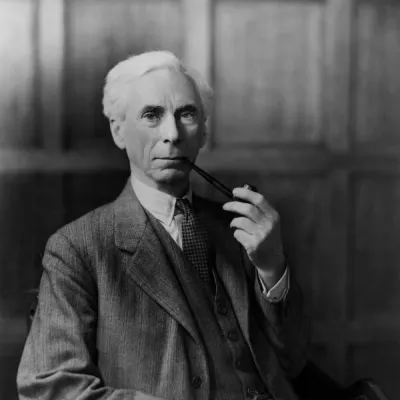
Bertrand Russell
Human Design Chart
Biography
He was one of the early 20th century's prominent logicians and a founder of analytic philosophy, along with his predecessor Gottlob Frege, his friend and colleague G. E. Moore, and his student and protégé Ludwig Wittgenstein. Russell with Moore led the British "revolt against idealism". Together with his former teacher Alfred North Whitehead, Russell wrote Principia Mathematica, a milestone in the development of classical logic and a major attempt to reduce the whole of mathematics to logic (see logicism). Russell's article "On Denoting" has been considered a "paradigm of philosophy".
Russell was educated at Trinity College at the University of Cambridge, where he graduated in 1893. He was a pacifist who championed anti-imperialism and chaired the England-based India League. He went to prison for his pacifism during the First World War, and he initially supported appeasing Adolf Hitler's Nazi Germany, before changing his view in 1943, describing war as a necessary "lesser of two evils". In the wake of the Second World War, he welcomed American global hegemony in preference to either Soviet hegemony or no (or ineffective) world leadership, even if it were to come at the cost of using their nuclear weapons.
Human Design Analysis: Bertrand Russell as Generator 4/6
Generator 4/6 — Design at a Glance
Bertrand Russell had high and enduring sacral energy that made him a powerful force of work. His design suggested he could only fully unleash his potential in response to external impulses rather than through self-initiative. As a Generator, he was designed to answer life's questions with an inner “Yes” from the gut and then act sustainably.
This configuration carried a central paradox: Maximum satisfaction and deep fulfillment came for him only when he responded reactively to heart projects. If he tried instead to initiate actively or forced himself onto tasks without internal resonance, this inevitably led to frustration and energy depletion. Two stumbling blocks defined this dynamic: On the one hand, the danger of wasting energy on unimportant things, which with his high creative potential could quickly lead to burnout. On the other hand, the obstacle of being prevented from working on passionate projects when he was still full of power.
The most successful alignment for Bertrand Russell consisted in waiting for signals from life and then acting only when his sacral center gave consent. Living in harmony with this strategy could not be stopped by anyone and rewarded him with a feeling of deep fulfillment. Deviations from this reactive principle, however, resulted in lasting frustration or a noticeable lack of energy. His strength thus lay not in driving forward but in powerfully responding to what was presented to him.
Sacral Authority
Bertrand Russell showed decision-making based on sacral authority. As a Generator, his strategy was also his inner instance, which simplified the process. His reactions to external stimuli manifested not primarily in the head but as physical signals: a gut feeling or a noticeable surge of energy.
It was crucial for him to perceive these body-specific feedback signals. Sounds like grunts, hums, or an echoing hmm served as clear indicators of the right direction. When his sacral motor responded to a situation, he felt vital and alive. Then it seemed that inexhaustible energy was at his disposal, and he tackled his work with great enthusiasm.
This design predisposed him to go through life with joy and satisfaction. He could immerse himself in tasks without them having to be bound by external purpose. Activating this motor was the key to his vitality. By listening into his body, he reliably found his alignment rather than being guided by external expectations or pure thoughts alone. This connection between physical feeling and action formed the foundation of his inner stability and creative drive.
The 4/6 Profile — Opportunist / Role Model
Bertrand Russell's design was characterized by a clear division of his life dynamics. In the first thirty years, he experimented intensively, especially in the area of relationships and friendships. This early phase was marked by searching behavior typical for his Profile 4/6 (Networker/Roles Model), where Line 6 still acted similarly to a Line 3 during this time.
With the activation of Line 6, a central inner conflict emerged: the contradiction between the deep desire for community belonging that Line 4 represented and the need of Line 6 to withdraw to reflect on the meaning of life. This tension field between heart and head shaped his internal development. In later years, he increasingly showed himself as a wise role model who worked through cooperation with others. His big heart remained cautious to avoid being hurt by false people. At the same time, Line 6 promoted discipline and assertiveness in right action. It valued positive feelings and support for the weak. The mental attitude was key, not just eliminating negative emotions. Thus he united the ability to respect and promote others in their network with his later role as a model through clear stances and support of other people.
Split Definition — Defined & Open Centers
Bertrand Russell's Human Design profile indicated a tendency towards constant mental activity coupled with dependence on external invitations. As a Generator, he had a defined Sacral Center, which provided him with immense vital energy that only became effective through reaction to life circumstances – not through self-initiation. This was complemented by a stable G Center, giving him a firm inner direction and identity independent of external expectations.
At the same time, the defined Channel between Head and Ajna Centers created a constant mental pressure. Russell was perpetually engaged in questioning and understanding connections. Since these centers did not possess their own energy for implementation, this stream of thought served to inspire others or provoke thinking rather than solve problems immediately on his own. Attempting to directly translate this mental pressure into action would have led to frustration; instead, the strength lay in providing intellectual impulses and waiting for the right moment for others to implement them.
The open centers shaped his vulnerabilities. His open Heart Center meant that willpower was not a constant trait; he tended to prove worth through performance or promises, often ending in disappointment when energy faltered. His open Solar Plexus absorbed emotional waves from the environment, putting him at risk of interpreting foreign moods as personal instability and avoiding confrontation to avoid amplifying this emotional charge.
Furthermore, his Root Center being open made him susceptible to stress pressure from others. He could absorb and amplify this adrenalized pressure, leading to inner unrest when trying to keep up with external pace. The open Spleen Center conveyed a deep survival fear and the tendency to cling to uncertain situations for a sense of security through others. Finally, his open Throat Center attracted attention without him actively seeking it; constant talking or acting out to force recognition led to exhaustion and unpredictable expressions. His mechanics thus required patience: waiting for the sacral response, trusting in personal direction, and accepting mental pressure without immediate manifestation.
Channels for rhythm, clarity, determination and life force.
Bertrand Russell was a mind characterized by spontaneous insight and profound somatic intelligence. His thinking did not follow linear logic but rather a process of waiting for inspiration. The Channel of Awareness 61-24 connected the acoustic inspiration from the Head Center with rational processing in the Ajna Center, creating an individual thinker whose knowledge appeared as sudden Satori – a transformative event he could not control but only allow to happen. His mind was geared towards breaking old patterns and offering new perspectives when inner truth ripened.
Parallel to this, a powerful generative energy determined his direction and persistence. The Channel of the Beat 14-2 connected the Sacral Center with the G Center through Gate 14 (Power Competence) and Gate 2 (Higher Knowledge). This gave him the ability to mutate innovative directions and bolster others through his aura by trusting reactions from his sacral center. This mutation occurred in the pulse of life, often unexpectedly but with the power to change the status quo.
His timing was defined by the Channel of Rhythm 5-15 linking fixed habits (Gate 5) with love for diversity and extremes (Gate 15). This bound him to the natural flow of life, independent of intellectual arrogance or emotional waves. He moved in a universal rhythm that magnetically drew others into a continuous energy flow.
Additionally, he possessed the persistence of the Channel of Discovery 29-46. Through Gate 29 (Saying Yes) and Gate 46 (Determination), he was geared towards losing himself in experiences and seeing them through to the end. His discoveries did not arise from control but from letting go of expectations and trusting that being at the right place at the right time would happen. This combination of transformative knowledge and sacral endurance allowed him to gain insights expanding collective understanding without active steering.
Individual Circuitry — Circuit Signature
Bertrand Russell's Human Design profile indicated a tendency towards synthesis between pulsating, creative expression and focused, future-oriented logic. His Knowledge Circuit worked with two separate parts: The Channel 24-61 connected Head and Ajna Centers, fostering innovative mental sparks. Simultaneously, the Channel 2-14 between Identity and Sacral Centers created a stable rhythm for expressing these ideas. These two areas were not directly energy-linked but existed as parallel forces.
The Understanding Circuit complemented this through the Channel 5-15 connecting Identity with the Sacral Center again, giving his logic a clear structure and focus on the future free from emotional conditioning. Since this channel used the same centers as part of the Knowledge Circuit, there was a direct connection between creative impulse and rational strategy.
The Meaning Finding Circuit contributed through the Channel 46-29 to connecting Identity with Sacral Center as well. It directed attention towards reflecting on past experiences to gain insights. With its split definition, Bertrand Russell had two independent groups of defined centers: Head/Ajna and Identity/Sacral. This meant that impulsive thoughts from the Head Center did not directly flow into the powerful action capability of the Sacral Center but needed filtering through Ajna Center. Energy from different circuits thus worked as a complex system where creative inspiration, logical structure, and emotional reflection coexisted without always forming one continuous flow.
Right Angle Cross of Contagion 2
Bertrand Russell revealed himself as someone whose internal state was strongly influenced by the energetic patterns of his environment. His design featured the right infection cross, a configuration that suggests less active engagement and more passive resonance. He seemed to act like a mirror reflecting the moods and states of others.
This mechanism described a profound sensitivity to collective currents. Russell unconsciously absorbed emotions or energetic impulses from his social surroundings without it always being a conscious decision. It was a process of inner transformation through external influences. The pressure to process these absorbed energies significantly shaped his experiential world.
The ability for deep empathy arose because he understood 'infection' not just in the negative sense but as an opportunity to grasp the essence of others and society. His internal landscape was thus no isolated island, but an open system constantly exchanging with the vibrations of those around him. This passive intake of information and feelings formed the basis for his understanding of complex human dynamics since he himself was part of this energetic network and felt its changes directly.
Saturn Return · Uranus Opposition · Chiron Return · 2nd Saturn Return — Life Cycles
Bertrand Russell's design indicated a deepening towards meaning in life during the phase around age 50, marked by clear relationship decisions. In Human Design, Chiron Return does not signify a process of wound healing in clinical or psychological terms but rather marks entry into a period of fulfillment and bloom. Here, the individual incarnation cross unfolds increasingly in daily life if one's strategy has been previously observed. The inner purpose becomes experiential; pain transforms not through therapy but by aligning with one's nature to wisdom and clear action.
This cycle presented itself concretely for Bertrand Russell in 1921, at age 49. He married Dora Black after his divorce from Alys Pearsall Smith. This relationship shift served as evidence of the mechanism: Chiron Return is a fulfillment cycle where life structurally reorders and personal meaning becomes effective. It was not about repairing a deficit but integrating a new quality of life that emerged from previous development. The marriage expressed that the design was now ready to live its deeper intention in interpersonal form. Focus lay on affirming one's path through a partnership fitting the current inner alignment, underlining the transition into this phase of maturity and self-understanding.
Generator · Sacral Authority — Synthesis
Bertrand Russell lived a life deeply influenced by the dynamics of a Generator – an essence driven by sacral energy (Sacral Center) to sustained activity as long as it was fueled by authentic interest. This capacity for endurance, coupled with the pressure of defined Head Center, led to a constant search for understanding and inspiration that in turn stimulated others. The Networker/Role Model Profile suggests he sought balance throughout his life between the desire for community (Line 4) and the necessity for introspective reflection (Line 6) – an interplay that prompted him to share his insights. The energy of the Beat Channel (14/2) further intensified this drive towards innovation and transformation.
Central to Russell's life, however, was a paradox: the tension between the need for validation from others (Line 4) and the profound melancholy accompanying the pursuit of unique knowledge (Knowledge Circuit). He drew strength from interactions with others yet simultaneously felt pulled back by the desire for independent insight. This field of tension manifested in relationships (noted event 1921), where the search for connection clashed with the necessity of individual unfolding.
4 Defined Channels
Incarnation Cross - Right Angle Cross of Contagion 2
Solar Return
The Solar Return shows the moment when the sun returns to its exact birth position - your personal solar year.
Life Cycles
Discover the life cycles with a detailed triple view (birth chart, cycle chart, composite).
Human Design Profile
- Type
- Generator
- Strategy
- To respond - wait for something to respond to
- Authority
- Sacral Authority
- Profile
- 4/6 - Opportunist / Role Model
- Definition
- Split Definition
- Incarnation Cross
- Right Angle Cross of Contagion 2
- Date of Birth
- 18.05.1872 17:45
- Place of Birth
- Trelleck, Wales, United Kingdom
Frequently Asked Questions
What is Bertrand Russell's Human Design type?
Which Profile did Bertrand Russell have in Human Design?
What Authority guided Bertrand Russell's decisions?
What incarnation cross was assigned to Bertrand Russell?
When was Bertrand Russell born?
Discover your own Human Design
Are you also a Generator? Find out in a personal reading how to use your sacral energy correctly and discover deep satisfaction.
More Personalities
Back to overviewAaliyah

Alexia

Angèle

Anne-Marie

Arcángel

Arno