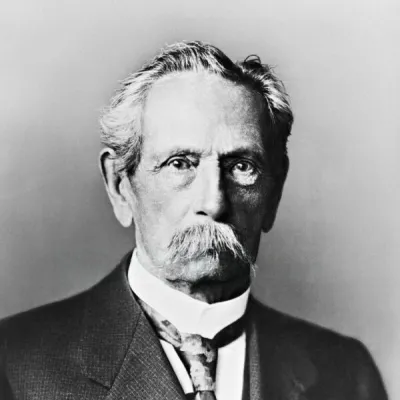
Carl Benz
Human Design Chart
Biography
Benz died on 4 April 1929, Landenburg, Germany.
What does Manifesting Generator 4/1 mean for Carl Benz?
Manifesting Generator 4/1 — Design at a Glance
Carl Benz showed himself to be someone who could achieve quick results by skipping steps. This Design, the Manifesting Generator, combines the constant energy of the Generator with the direct action of a Manifestor. He had an internal power source in his Sacral Center, meaning that his most effective strategy was to respond to external impulses rather than initiate on his own.
His ability to work on multiple projects simultaneously and make rapid progress was characteristic of this type. Yet this extreme speed carried a tension: Often he would skip important intermediate steps, which could lead him to have to return later to fill in the gaps. This risked frustration, the so-called Non-Self theme of this Design.
The key for Carl Benz lay in constant verification through his inner authority. Only when his Sacral Center responded with a clear “Yes” – a feeling of deep satisfaction and fun – was the energy sustainably usable. In this “Play Mode,” he could fully unleash his creative power without falling into frustration. The parallel handling of various tasks was no obstacle for him, but rather a source of satisfaction as long as each action was based on an authentic reaction and not just pure will. Thus, potential overextension turned into productive dynamics.
Emotional Authority
Carl Benz needed time and emotional distance when making important decisions; spontaneous impulses proved misleading in his Design and led to misjudgments. This tendency resulted from his Emotional Authority, which was anchored in the defined Solar Plexus Center. In Human-Design mechanics, the Solar Plexus Center is always the inner authority if it is defined – regardless of other configurations in the chart. Carl Benz was subject to a constant emotional wave of ups and downs that colored his perception through the current mood. What appeared inspiring at one moment could seem negative in the next. His immediate feeling was merely a snapshot, not necessarily the truth. Quick decisions based on this fluctuating emotion risked negative consequences.
The mechanics required patience: The longer Carl Benz let a decision ripen, the deeper his insight became. This demanded consciously “sleeping on” options and pausing multiple times. Over time, intense feelings subsided, allowing him to gain emotional distance. Only then did clarity and calm set in – signs that the inner process was complete. This mechanism primarily applied to long-term decisions with significant influence on his life path. Through hesitation and waiting, his Design filtered out temporary emotional coloring and revealed the true essence.
The 4/1 Profile — Opportunist / Investigator
Carl Benz showed himself as someone with a deeply rooted nature that rarely deviated from his individual path. As a 4/1 Profile, he was marked by a firm structure transitioning from “I” to “You.” His big heart yearned for acceptance; lacking this or encountering well-meaning change impulses, he quickly shut down. Outsiders often saw this as stubbornness or an inability to accept criticism. This distancing served the protection of his inner core, which he neither wanted nor could change.
Such withdrawals could shake his self-confidence since a 4/1 life path is rarely easy. Yet once Carl Benz recognized his own nature and rested secure in his character, he became a stable foundation – like a rock in the surf. In this phase, his special ability to teach others magnificently was revealed.
His inner stability was supported by the lines of his Gates. Gate 34 (Line 4) gave him intuition in the here and now as well as an undisputed power that he respectfully used. Trust was crucial here; misuse or lack of respect for individual survival would have generated mistrust. Simultaneously, Gate 40 (Line 1) called for rest periods to recover his willpower. Only after these phases could he again work effectively, as his inner foundation was strengthened by these pauses.
Single Definition — Defined & Open Centers
Carl Benz revealed himself as someone with immense inner substance and assertiveness. His design indicated a tendency towards constant, independent thinking: The defined Ajna Center ensured consistent mental presence, which he could directly express through his also defined Throat Center. He had clear identity (defined G Center), strong will (defined Heart Center) and enormous vitality (defined Sacral Center). This combination created a powerful energy presence that allowed him to set direction and keep promises.
However, his defined Solar Plexus Center filtered this power through emotional authority. Despite the strong willpower, Carl Benz needed time for emotional clarity; decisions only became effective after waiting out the emotional wave, not in an impulsive moment. This shaped his approach to important steps: patience instead of immediate reaction was mechanically necessary to avoid chaos.
In contrast, his design revealed three open centers that made him situationally adaptable. The open Head Center meant he did not carry constant inspiration but reacted to external stimuli; he tended to be distracted by doubts or questions from others rather than accepting them as his own truth. His open Spleen Center showed a vulnerability to health anxieties and the need for external security; he could unconsciously cling to unhealthy situations to gain a sense of well-being that did not come from within himself. Finally, his open Root Center absorbed external stress; he was sensitive to environmental pressure and tended to misinterpret this adrenalized pressure as his own life impulse or feel pressured by hyperactivity.
While his six defined centers formed an unshakeable foundation of will, energy, and clear communication, the open centers served as mirrors: They reflected inspiration, health states, and stress from his environment without making them part of his core. His strength lay in operating on this stable base while learning not to confuse temporary signals from open centers with his own truth.
Channels for powerful action, emotional depth and cohesion.
Carl Benz revealed himself as someone who radiated a constant physiological presence of generative power and manifestation drive. This energy was dominated by the Channel of Charisma 34-20 in his personality, where Gate 34 (Sun) made this channel an absolute energy focal point. The mechanics of this channel connected the Sacral Center with the Throat Center and dictated waiting for internal sacral reaction before acting to avoid chaotic outbursts and instead exercise charismatic leadership. Consciousness had to follow actions; mental 'shoulds' blocked generative power, while waiting for the inner 'yes' was essential to ensure self-empowerment through correct activity.
Alongside this dominant energy, the Channel of Acceptance 17-62 also worked in his design. It connected the Ajna Center with the Throat Center and allowed Carl Benz to organize information mentally and translate it into details. Gate 17 visualized patterns while Gate 62 manifested them through words, creating ongoing internal order. Anything he could not integrate into his mental system was incomprehensible; for him, verbal clarity was a means of logical categorization of the world.
The Channel of Discovery 29-46 in his design also promoted deep persistence. Through Gate 29 (Yes-Saying) and Gate 46 (Self-Determination), it connected the Sacral Center with the G Center. This allowed him to lose himself in experiences and go through endurance until the end of a process, where the significance of the experience was only revealed at the conclusion.
Additionally, individual gates shaped his profile: Gate 9 in his design stood for detailed work and the ability to perfect through repeated experiments, while Gate 16 promoted collective mastery through experimentation. Gate 25 represented a spiritual stance of innocence and individuation, and Gate 42 emphasized the importance of completing processes for new commitments. These configurations together created a profile that relied on inner confirmation, logical structuring, and persistent experience absorption to effectively deploy his energy.
Collective Circuitry — Circuit Signature
Carl Benz revealed himself as an individual with highest uniqueness whose energy expression was marked by the Charisma Channel (20-34) between Throat and Sacral Centers. This connection directly linked his intuitive life force with expression in the present moment, generating a clear acoustic presence. His design focused on individual survival security and self-strengthening, drawing power from reacting to life (Gate 34), guiding it through correct behavior (Gate 10) and intuitive knowledge (Gate 57), finally realizing it in the moment.
Alongside this individual orientation, Carl Benz possessed the Understanding Circuit with the Channel of Acceptance (17-62). This connected his Ajna Center (Intellect/Strategy) directly to his Throat Center, allowing him to clearly articulate logical insights and strategies for the future. As it was a simple definition, these energetic flows were coherent and not divided into separate groups.
Additionally, the Meaning-Finding Circuit worked through two separate segments: on one hand, connecting Throat and Solar Plexus Centers (Channels 35-36, 46-29), transferring emotional waves from the past to expression; on the other hand, connecting Identity and Sacral Centers. The Ego Circuit closed through the Channel of Community (37-40) which connected his Heart Center with the Solar Plexus. This promoted a relationship of giving and taking as well as mutual support in cooperation, where emotional waves here were more conservative and traditional. Together these elements formed a profile that combined strategic clarity with emotional reflection and cooperative resource creation.
Juxtaposition Cross of Power
Carl Benz revealed himself through the Juxtaposition Cross of Power as someone whose life was marked by a profound tension between inner authority and external recognition. This design inclined him to oscillate between the desire for self-determined leadership and the pressure to fulfill societal expectations. The mechanics of this cross describe a conflict-ridden path where one's own strength is often tested through resistance or isolation. It is not an easy lot, but rather a challenge to draw strength from overcoming oppositions. Carl Benz had to learn to accept his inner authority without falling into arrogance or retreat. The energy of this cross acted as a driving force that pushed him to test boundaries and push through obstacles. This was less about power in the negative sense, but rather the necessity to claim and assert one's place in the world. The constant friction between being and appearing shaped his development significantly. He learned that true power does not arise from suppressing others, but through integrating his own shadow aspects. This process was often painful, yet ultimately led to deep resilience and a clear self-understanding. The challenge lay in trusting his inner compass even when the outer world did not always confirm it.
Saturn Return · Uranus Opposition · Chiron Return · 2nd Saturn Return — Life Cycles
Carl Benz's design was characterized by clear, cyclical phases of consolidation and change. This structure manifested concretely in his life: In 1872, at his first Saturn Return at age 28, he married Bertha Ringer. This cycle often marked the beginning of a phase where personal commitments and structures were established, leading to Benz founding his family base.
A decade later, in 1885, the Uranus Opposition struck him at age 41. This aspect typically brings disruptive forces and a drive for radical innovation. For Carl Benz, this culminated in the construction of Patent Motor Car Number 1, a vehicle with a four-stroke engine and electric ignition. Here, the inner dynamics of change were translated into groundbreaking technical innovation.
The Chiron Return, a fulfillment cycle between ages 49 and 51, brought crisis in 1896: Gottlieb Daimler sued Benz for patent infringement. This process served to clarify and solidify his own position and the purpose of his work. Ultimately, the second Saturn Return in 1899 at age 55 led to institutional anchoring: The transformation into the joint-stock company Benz & Cie. AG stabilized the enterprise sustainably. Carl Benz's path thus followed a pattern where personal commitments, technical revolutions, and legal clarifications gradually led to a solid organizational structure.
Manifesting Generator · Emotional Authority — Synthesis
Carl Benz’s life was marked by a deep inner dynamic between the urge for active shaping and the necessity of reacting to present circumstances. His design as an Manifestor Generator with emotional authority points to a person who both possessed the ability to quickly set things in motion (Gate 34) and required careful consideration before making decisions. This combination of quick action and emotional maturation seems reflected in documented events—from early marriage over groundbreaking inventions to legal disputes, and finally the successful transition of his company into a joint-stock corporation. The connection of the defined G Center with the Throat Center reinforces this impression by pointing to someone who could clearly communicate their inner direction yet was always filtered through the lens of emotional waves.
A central paradox in Carl Benz’s design lies in the tension field between his sacral drive for activity and the necessity to channel that energy through emotional clarity. The Channel of Discovery (29/46) shows a deep commitment to projects that truly interested him, while the Channel of Accepting (17/62) points towards constant analysis and organization of information. This combination suggests he was full of drive but also had a need for logical structure and understanding—a tension that both shaped his successes and crises.
5 Defined Channels
Incarnation Cross - Juxtaposition Cross of Power
Solar Return
The Solar Return shows the moment when the sun returns to its exact birth position - your personal solar year.
Life Cycles
Discover the life cycles with a detailed triple view (birth chart, cycle chart, composite).
Human Design Profile
- Strategy
- To respond - wait for something to respond to
- Authority
- Emotional Authority
- Profile
- 4/1 - Opportunist / Investigator
- Definition
- Single Definition
- Incarnation Cross
- Juxtaposition Cross of Power
- Date of Birth
- 25.11.1844 23:30
- Place of Birth
- Karlsruhe, Germany
Frequently Asked Questions
What is Carl Benz's Human Design type?
What Profile did Carl Benz have in Human Design?
What Authority did Carl Benz have?
What incarnation cross was active for Karl Benz?
When was Karl Benz born?
Discover your own Human Design
Are you also a Manifesting Generator? Find out in a personal reading how to unfold your multi-talents and direct your energy wisely.
More Personalities
Back to overviewAldair

Alizée

Angeli

Arletty

Artus

Balthus