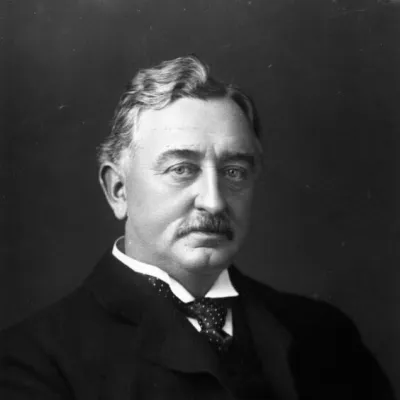
Cecil John Rhodes
Human Design Chart
Biography
The son of a vicar, Rhodes was born in Netteswell House, Bishop's Stortford, Hertfordshire. Due to his ill-health, at age sixteen he was sent to South Africa by his family in the hopes the climate might improve his health. At eighteen, he entered the diamond trade at Kimberley in 1871 and with funding from Rothschild & Co, began to systematically buy out and consolidate diamond mines. Over the next two decades, he gained a near-complete monopoly of the world diamond market. In 1888, he founded the diamond company De Beers, which retains its prominence into the 21st century.
Rhodes entered the Cape Parliament at the age of 27 in 1881, and in 1890, he became prime minister. As prime minister, he expropriated land from black Africans with the Glen Grey Act, while also tripling the wealth requirement for voting under the Franchise and Ballot Act, effectively barring black people from taking part in elections.
Cecil John Rhodes as a Projector 5/1 in Human Design
Projector 5/1 — Design at a Glance
Cecil John Rhodes had a dense, focusing aura that acted like a bright flashlight, revealing system errors in his environment instantly. This ability allowed him to identify weaknesses in others or structures quickly. As a projector, however, he lacked a constant source of intrinsic life energy due to his undefined Sacral Center. Instead, he experienced rhythmic phases of high activity followed by necessary rest periods to avoid exhaustion.
His effective strategy was not direct confrontation with these flaws, which often provoked resistance, but rather radiating his own harmony. By being a shining example himself, Rhodes attracted others who then sought his insights. His success depended on waiting for appreciative invitations instead of forcing himself forward. Living according to this dynamic rewarded him with success; deviating from it and ignoring his need for pauses or pushing his observations led inevitably to the bitterness theme of non-self. Thus, his design required a balance between sharp diagnosis and patient, inviting presence.
Ego Authority
Cecil John Rhodes revealed someone whose inner truth lay in spoken will. His design carried rare authority in ego, a configuration only projectors or manifestors with open Emotional, Sacral, and Spleen Centers and a defined Ego Center exhibit. This great openness made him highly influential; his mind often served others' interests while his spontaneous, uncensored utterances revealed the true truth. Rhodes had to learn to listen to himself when speaking to distinguish between thinking mind and impulsive ego.
When something truly mattered to him, he possessed the willpower to achieve goals and keep promises. This consistent following of his own will often appeared selfish externally but was an expression of inner authenticity. For him, actions always needed to be rewarding, driven by a desire for material success or the urge to be first and break boundaries. It also allowed him to lead others into new directions. A central mechanism of his design was the necessity of rest after goal achievement; constant work did not yield desired results but led to unhealthy exhaustion and illness. His life energy required rhythmic phases of action and rest to stay healthy.
The 5/1 Profile — Heretic / Investigator
Cecil John Rhodes revealed someone who radiated magnetic authority and attracted others while pursuing a deep, slow research drive internally. His design carried the dynamics between external expectation as problem solver and the need for intense personal development. Others often sought him out for solutions to their problems, which could quickly drain his energy if he did not set clear boundaries.
This configuration describes the necessity of saying no to maintain a beneficial balance between research for himself and problem-solving for others. The fifth line projected a provocation ability that could appear in crisis times when absolutely necessary. It allowed him to change rules and cleverly circumvent obstacles rather than overcoming them directly. This contrasted with the first line, which required time for development and dealt with coping with shocking experiences.
The first line showed slow genetic change through experience and willpower, shaped by Pluto forming the ego. Venus highlighted a tendency towards emotional withdrawal after shock before reacting. Cecil John Rhodes used this mechanism to succeed in crisis times and spread mutations by cleverly circumventing obstacles. His ability to change rules helped him achieve success while simultaneously coping with painful development through shocking experiences.
Split Definition — Defined & Open Centers
Cecil John Rhodes revealed himself as someone whose inner conceptualizing and communicating seamlessly intertwined. His defined Ajna, Throat, and G Centers, along with his Heart, formed a stable triad of idea formation, expression, identity, and willpower. This allowed him to immediately translate thoughts into words and act with clear life direction, supported by strong self-esteem. He had a consistent mental function that was not easily influenced from the outside, and could imprint others' thought fields through his aura.
In contrast, Head, Sacral, Solar Plexus, Spleen, and Root Centers were open. The open Head Center meant he lacked personal mental pressure or constant inspiration; instead, he tended to engage with other people's questions or seek external focus to avoid confusion. His open Sacral Center lacked a constant generative energy source for endurance. He was prone to absorbing and amplifying the vital energy of his environment, which could lead to overexertion as he wasn't designed to manage this borrowed energy sustainably or set boundaries independently in workflow.
The open Solar Plexus Center made him sensitive to emotional climate. He absorbed and amplified others' feelings, leading to being pulled between emotional waves without a stable personal emotional base, potentially feeling emotionally out of control or failing to meet environmental expectations. Additionally, the open Spleen Center was receptive to health and well-being anxieties, making him prone to clinging to people with defined Spleens for a false sense of security rather than trusting his own intuitive impulses. The open Root Center led to absorbing and amplifying environmental stress, resulting in cycles of adrenalized pressure and attempts to escape through excessive activity.
Channels for insatiable curiosity and spiritual pioneering.
Cecil John Rhodes revealed himself as someone who probed boundaries through provocative storytelling and encouraged others' unique development. His energy served less to find definitive answers than to stimulate imagination and provoke individual mutation.
This dynamic was rooted in two active channels. The Channel of Curiosity 11-56 connected the Ajna Center with the Throat Center, driving an insatiable search process where information wasn't processed for factual analysis but rather for narrative story creation and philosophical parables. Rhodes functioned as a storyteller; his narratives illustrated ideas and taught through the power of imagination by filling gaps and making abstract connections tangible. This was a magical link between idea and expression that influenced others without relying solely on data.
Parallel to this, the Channel of Initiation 25-51 operated in the Heart Center. Here, the competitive ego energy of Gate 51 merged with the spirit of self from Gate 25. This configuration aimed at individualization through 'shock' or challenge. Rhodes naturally possessed a competitive edge aiming for first place; he also awakened this competitiveness in others to unlock their potential. Competition served as a mutative force, exerting pressure on consciousness and enabling a quantum leap from the collective to 'I am'. Through this combination of narrative magic and competitive shock, his design triggered mutations in others' consciousness by challenging them to transcend normal limits and achieve deeper self-awareness.
Individual Circuitry — Circuit Signature
Cecil John Rhodes revealed himself as someone with solid self-worth and strong inner convictions, yet his energy was strongly inwardly directed. His design linked the Identity Center directly to the Heart Center via Channel 25-51 (Initiation) in the Focusing Circuit. This connection created a pulsating acoustic power of individual affirmation: 'I am who I am'. It strengthened both his own and others' individuality, but lacked a direct bridge to the Throat Center within this circuit. Consequently, these firm inner certainties often could not be effectively articulated outwardly; the convictions remained a silent internal force rather than a loud message.
Parallel to this was an independent energetic structure in the Meaning Circuit. Here, Channel 11-56 (Curiosity) connected the Ajna Center with the Throat Center, generating a cyclical flow of emotional waves from the past. Cecil John Rhodes reflected on past experiences to grasp their meaning and shared these visual, often inexplicable insights with others. As his definition was a Split Definition, these two systems—the inner silent conviction (Heart-Identity) and the emotional sharing of the past (Ajna-Throat)—existed as separate, non-directly connected forces alongside each other. The deep individual affirmation did not flow into the communicative processing of history; they remained two distinct parallel experiences in his essence.
Left Angle Cross of Individualism 1
Cecil John Rhodes' design carried the signature of the left cross of individualism. This configuration laid a foundational structure that focused on the individual and independent aspects. The left cross marks in Human Design a specific energetic framework, which through its positioning within the matrix implies a tendency towards separation from the collective or an emphasis on the personal path. For Rhodes, this mechanism worked as a constant background factor filtering his actions and perception of the world through the lens of individuality. It was not a consciously chosen behavior but rather an inherent alignment of his energy that inclined him to view situations from a perspective where self stood at the center. This structure created a space in which personal autonomy and independence served as natural points of orientation. The mechanics of this cross describe no specific method of action, but an existential stance towards one's own uniqueness within the larger fabric. For Rhodes, it meant that his inner logic always sought and emphasized the difference from the general. This manifestation shaped his way of positioning himself in his environment by drawing a clear line between the self and others. The design thus fostered an attitude where the individual was not only recognized but served as the primary reference point for decisions and attitudes.
Saturn Return · Uranus Opposition — Life Cycles
Cecil John Rhodes' political career followed a clear rhythmic pattern, shaped by two decisive astrological cycles. His design inclined him to initially enter established structures and later encounter a disruptive crisis marking the end of his career. This course was evident: in 1881, at age 28, Rhodes became a member of the Cape Colony Parliament. This corresponded with his first Saturn return cycle, a time when years of groundwork often condensed into a solid result and entry into stable power structures.
The counterpart was the Uranus opposition, a cycle typically signaling a disruptive crisis challenging or ending existing orders. In 1895, at age 42, Rhodes became involved in the Jameson Raid. This event marked his political end and confirmed the mechanics of the Uranus opposition as a turning point where previous stability broke down. The lifespan between these two points defined his period of political effectiveness: from integration into the system to its destruction by an external crisis. Rhodes' design thus not only showed rise and fall but linked these phases with specific temporal windows structuring his access to power and its loss.
Projector · Ego Authority — Synthesis
He was a projector with defined mental centers and authority in ego, distinguished by profound curiosity (Channel 11-56). This combination shaped a character constantly seeking patterns and providing them to others – a Hero/Researcher profile that gathered knowledge to offer solutions. His defined mind enabled him to create concepts and influence others through his ideas, while the projection of his energy aimed at uncovering weaknesses. This process of recognizing and sharing insights formed the red thread of his work, always driven by the need to share his understanding with the world.
Simultaneously, he lived in a tension field between the desire for recognition of his knowledge and potential rejection by others. Curiosity propelled him forward, yet the openness of his centers made him vulnerable to external influences and distractions. The ego-defined center demanded spontaneous speech as an expression of his truth, while the need to offer solutions (Line 5) placed him in situations where his views encountered resistance – as evidenced by an event that triggered a crisis.
2 Defined Channels
Incarnation Cross - Left Angle Cross of Individualism 1
Solar Return
The Solar Return shows the moment when the sun returns to its exact birth position - your personal solar year.
Life Cycles
Discover the life cycles with a detailed triple view (birth chart, cycle chart, composite).
Human Design Profile
- Type
- Projector
- Strategy
- Wait for the respectful invitation
- Authority
- Ego Authority
- Profile
- 5/1 - Heretic / Investigator
- Definition
- Split Definition
- Incarnation Cross
- Left Angle Cross of Individualism 1
- Date of Birth
- 05.07.1853 19:30
- Place of Birth
- Bishop's Stortford, England, United Kingdom
Frequently Asked Questions
What was Cecil John Rhodes' Human Design type?
Which Profile did Cecil John Rhodes have?
What authority did Cecil John Rhodes have?
What incarnation cross did Cecil John Rhodes have?
When was Cecil John Rhodes born?
Discover your own Human Design
Are you also a Projector? Find out in a personal reading how to unfold your leadership qualities and recognize the right invitations.
More Personalities
Back to overviewSissy Spacek

Alain-Fournier

Anémone

Ann-Margret

Bourvil
Christian-Jaque