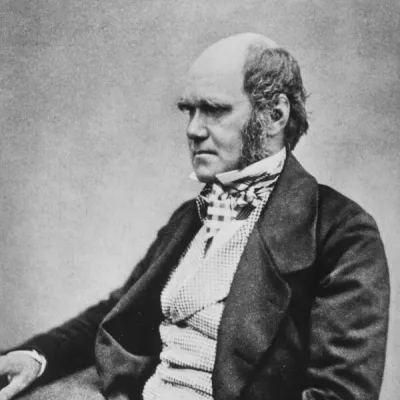
Charles Darwin
Human Design Chart
Biography
Darwin's early interest in nature led him to neglect his medical education at the University of Edinburgh; instead, he helped Robert Edmond Grant to investigate marine invertebrates. His studies at the University of Cambridge's Christ's College from 1828 to 1831 encouraged his passion for natural science. However, it was his five-year voyage on HMS Beagle from 1831 to 1836 that truly established Darwin as an eminent geologist. The observations and theories he developed during his voyage supported Charles Lyell's concept of gradual geological change. Publication of his journal of the voyage made Darwin famous as a popular author. His first scientific work was The Structure and Distribution of Coral Reefs (1842).
Charles Darwin as a Projector 5/1 in Human Design
Projector 5/1 — Design at a Glance
Charles Darwin had a focusing aura that shone like a bright flashlight, revealing system flaws in his environment instantly. This ability allowed him to quickly identify weaknesses in others but addressing these issues directly would often lead to resistance. Instead, he was most effective when he led by example through his own harmonious behavior; others were drawn to this light and sought contact with him. His strategy involved waiting for an honest invitation before offering advice, which protected him from the bitterness that comes from unsolicited intervention. With his undefined Sacral Center, Charles Darwin lacked constant intrinsic life energy. He worked in phases of high intensity followed by necessary rest periods for regeneration. Ignoring this rhythm would have led to exhaustion. By waiting on others' invitations and carefully managing his energy, his influence was effective and rewarded successfully. His design demanded patience: not imposing solutions but shining as an anchor point for those ready to accept leadership.
Splenic Authority
Charles Darwin possessed the inner authority of the Spleen Center, which shaped him into a decision-maker in the immediate moment. His design required vigilance towards a fine, singular impulse that acted as spontaneous inner knowledge, rigorously separating harmful influences and preserving his health. As his Health and Alarm System, his survival intelligence was revealed through intuitive signals about physical well-being and environmental justice. The first impulse was considered correct; later considerations or retreat phases risked drowning out this clear signal tone.
This configuration made long-term planning difficult as the right course of action only became apparent in the moment. Flexibility and freedom were therefore essential to avoid working against his nature through rigid commitments. Crucial for this authority was also that both the Emotional and Sacral Centers remained open, a requirement fulfilled only by Projectors or Manifestors. Charles Darwin had to rely on his spontaneous intuition at all times to make health-promoting choices rather than logical predictions.
The 5/1 Profile — Heretic / Investigator
Charles Darwin's design presented as Profile 5/1, the Hero-Researcher. This configuration gave him a magnetic presence that drew others to him for solutions from his deep knowledge base. Line 1 drove him towards intensive research and gathering of knowledge while Line 5 translated these insights into practical applications for the community.
However, this paradoxical dynamic carried a risk: as people sought his expertise, he threatened to break under the weight of constant inquiries and expectations. Without clear boundaries, this ongoing demand could lead to exhaustion, akin to an expert feeling drained after long consultations while new questions already awaited them. The challenge was maintaining balance between personal research drive and service to others.
By learning to set limits and even say 'no', he protected his energy. This allowed him to optimally utilize his gifts: generating deep knowledge and providing it purposefully for problem-solving without self-sacrifice. Here, the mechanics of a 5/1er show the necessity of remaining sovereign to be effective both as a researcher and hero rather than being overwhelmed by the wave of demand.
Triple Split Definition — Defined & Open Centers
Charles Darwin showed himself to be someone who stood under a constant internal mental pressure to ask questions and understand connections. His design featured defined Head and Ajna Centers, generating a steady flow of inspiration and concept formation. This mental process was not coupled with direct energy; fighting against this nature often led to frustration or deeper concern when answers were not immediately visible. Instead, he acted as an inspiration for others while he himself had to accept the pressure without prematurely turning it into actions.
At the same time, Darwin possessed a firm identity and willpower through his defined G and Heart Centers. This gave him a clear sense of direction and the ability to keep promises and use resources self-determinedly. His actions spoke from this inner security, coupled with a strong intuitive protective instinct of the defined Spleen Center, which acted in the moment and registered health warnings immediately.
In contrast, his open Sacral, Solar Plexus, and Root Centers formed a different picture. Darwin did not have a constant generative energy flow; he tended to wonder if he was doing enough or why he felt tired, although this exhaustion often came from outside influences. He absorbed the emotions of his environment like a barometer, making him vulnerable to emotional waves that were not his own. Furthermore, his open Root Center amplified external stress, putting him at risk of exhausting himself through overwork in an attempt to escape this pressure. His challenge lay in not identifying these absorbed energies as his own and instead trusting his intuitive Spleen authority and inner direction rather than being driven by the conditioning outside world.
Channel 8-1: Inspiration — Channels & Gates
Charles Darwin inspired through authentic presence. The Channel of Inspiration 1-8 connected his G Center with the Throat Center, allowing him to embody his unique individuality. This kind of leadership inspired others not through explanation but by courageously living out his own creative direction and thereby attracting attention.
Parallel to this, Darwin demonstrated a rigorously skeptical mind. The Channel of Logic 63-4 linked his Head Center with the Ajna Center, constantly filtering for persistent patterns. Here doubt was essential; answers were valid only if proven as verifiable, logical structures. This created a tension between the inspiring "being" and the critical examination of "knowledge."
Additionally, the Channel of Awareness 61-24 promoted sudden insights (Satori), while the Channel of Devotion 44-26 connected instinctive awareness with entrepreneurial willpower. Individual Gates such as Gate 49 (Transformation/Principles), Gate 14 (Power/Direction), Gate 17 (Logical Teaching/Following), and Gate 32 (Continuity/Stability) complemented this Profile. Gate 47 sought collective meaning, while Gate 28 made decisions in the here and now. This configuration shaped a personality that influenced through exemplary action, yet whose perception was determined by a pattern-seeking, skeptical mind that rejected unfounded belief.
Individual Circuitry — Circuit Signature
Charles Darwin's Design presented itself through a Triple Definition, meaning he did not have a single constant inner driving force as his sole compass. Instead, he reacted situationally to the environment: His energies were only activated when the surroundings demanded them. This adaptability was shown in three separate, parallel existing energy fields that were not directly connected to each other.
The Knowledge Circuit in him linked two distinct parts: The Head Center with the Ajna Center as well as the Throat Center with the Identity Center. This allowed for creative impulses and the expression of individual transformation, but only as a reaction to external inspiration or emotional waves. Parallel to this, the Mind Circuit consisted of a connection between Head and Ajna Centers. Here, a focused logical energy worked towards structuring rational insights and projecting into the future – free from emotional coloring.
The third field was formed by the Ego Circuit, which connected Heart Center with Spleen Center. This area controlled cooperation and resource management within a community. Since there was no connection to the Sacral Center, this activity required necessary rest pauses for regeneration. Charles Darwin thus used either creatively inspired, logically strategic, or cooperatively resource-oriented approaches, always dependent on the specific demands of his environment rather than a continuous self-determined expression.
Left Angle Cross of Revolution 1
Charles Darwin carried the left cross of Revolution 1. This configuration marks an archetypal structure deeply rooted in the mechanisms of Human Design. It represents a fundamental energetic alignment without specifying particular behavioral patterns or detailed psychological nuances in the given raw content.
The cross acts as an overarching framework permeating the entire design. Unlike individual Gates or Centers, it forms a holistic imprint rather than describing isolated traits. Without further elaboration, its impact on Charles Darwin's daily actions remains abstract and general in nature. It functions as a background melody of his energetic profile, not as a clear leitmotif with explicit instructions.
The mechanics of this cross do not provide concrete strategies for dealing with specific life situations. Instead, it points to a deeper, perhaps elusive layer of personality beyond everyday observations. Charles Darwin lived with this energetic signature whose full significance is not further elaborated in this context. It remains a silent foundation beneath the visible aspects of his design, a constant presence without an explicit narrative function in the given excerpt.
Saturn Return · Uranus Opposition · Chiron Return · 2nd Saturn Return — Life Cycles
Charles Darwin's design established a cyclical structure for life phases that served as a framework for the development and publication of his theories. In 1837, at age 28, he began systematically collecting information on species variability – a typical moment of the first Saturn Return when years of groundwork often condenses into a solid result.
This phase marked the transition from collection to structuring. A decade later in 1849 at age 40, the Uranus Opposition tension was evident: Darwin went to Malvern for water therapy, improving his health. This cycle emphasized the need to resolve internal tensions through new perspectives or rest periods before further steps were possible.
The peak of this development occurred in 1858 when Darwin was 49 years old: The publication of theories on evolution alongside Wallace marked the Chiron Return. In this fulfillment cycle, one's incarnation cross increasingly unfolds in life; meaning and purpose become experiential if lived according to strategy and authority. It was not a healing process for past wounds but a blooming period of personal destiny.
Finally, he solidified his work through the publication of 'The Variation of Animals and Plants under Domestication' in 1868 at age 59 with the second Saturn Return. This book contained speculations on an inheritance mechanism and showed how the second Saturn Return often leads to deeper refinement and consolidation of earlier achievements. The mechanics of his chart cycles were directly reflected in these milestones: from the first systematic collection through a health crisis to public recognition and theoretical refinement.
Projector · Splenic Authority — Synthesis
Charles Darwin was a Projector whose life was marked by a profound drive to recognize patterns and make them accessible to others (defined Head Center). He had the ability to immediately perceive where things did not fit (Projector Design) and used his Line 5/1 to deepen this knowledge in ways that could serve others as problem-solving tools. This process of learning and sharing insights drew people magnetically who sought answers – a tendency he learned to navigate by recognizing clear boundaries. His inner authority in the Spleen enabled him spontaneous knowledge about what was right for him and helped him delineate against harmful influences.
A central paradox lay in his knowledge circuit (Channel 1-8) driving him to express creative perspectives and attract attention, while the need to delineate himself was conditioned by his Projector strategy. Thus, he lived in a tension between wanting to share his knowledge publicly to trigger change and the inner wisdom signaling when it was time for withdrawal and self-protection – an interplay evident in documented cycles from early career steps to successes in advanced age.
4 Defined Channels
Incarnation Cross - Left Angle Cross of Revolution 1
Solar Return
The Solar Return shows the moment when the sun returns to its exact birth position - your personal solar year.
Life Cycles
Discover the life cycles with a detailed triple view (birth chart, cycle chart, composite).
Human Design Profile
- Type
- Projector
- Strategy
- Wait for the respectful invitation
- Authority
- Splenic Authority
- Profile
- 5/1 - Heretic / Investigator
- Definition
- Triple Split
- Incarnation Cross
- Left Angle Cross of Revolution 1
- Date of Birth
- 12.02.1809 03:00
- Place of Birth
- Shrewsbury, England, United Kingdom
Frequently Asked Questions
What is the Human Design type of Charles Darwin?
What Profile did Charles Darwin have in Human Design?
What Authority did Charles Darwin have?
What incarnation cross did Charles Darwin have?
When was Charles Darwin born?
Discover your own Human Design
Are you also a Projector? Find out in a personal reading how to unfold your leadership qualities and recognize the right invitations.
More Personalities
Back to overviewSissy Spacek

Alain-Fournier

Anémone

Ann-Margret

Bourvil
Hergé