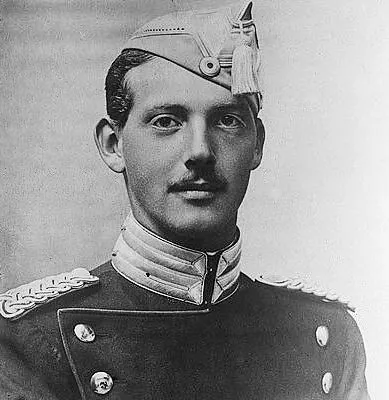
Count of Rosenborg Aage
Human Design Chart
Biography
In 1909 Prince Aage joined the Danish Army, and by 1913 had risen to the rank of lieutenant. During World War I he served as an observer in Italy for a year. Returning home to Denmark he was promoted to captain.
Without the legally required permission of the Danish king, Aage married Matilda Calvi dei conti di Bergolo (Buenos Aires, 17 September 1885 – Copenhagen, 16 October 1949) on 1 February 1914. A few days later, he renounced his place in the line of succession to the Danish throne. Aage and Mathilde had one son before their divorce in 1939.
In 1922, Aage received permission from the King, as required by Danish law, to leave the Danish army in order to join the French Foreign Legion. After negotiations between the Danish and the French governments Prince Aage entered the Foreign Legion with the rank of captain.
He was sent to Morocco as part of the French involvement in the Rif War within a year of service. He received the Croix de Guerre after being shot in the left leg. During his seventeen years in the Foreign Legion Prince Aage attained the rank of lieutenant colonel, and also received France's highest order, the Légion d'honneur.
In 1927 he published the book "A royal adventurer" in English about his time in the Foreign Legion.
Prince Aage died of pleurisy in Taza, Morocco, on 29 February 1940, aged 52.
Count of Rosenborg Aage as a Manifestor 3/5 in Human Design
Manifestor 3/5 — Design at a Glance
Count of Rosenborg Aage's design marked him as a pioneer and visionary whose energy was focused on guiding the world towards a new future. His nature resembled that of an emperor in ancient Rome: He had the grand vision but did not wage the necessary wars himself, instead delegating their execution to others. This broad-minded approach often put him at odds with his surroundings. As he thought further ahead than many of his contemporaries, he was misunderstood and polarized strongly. While some loved his dreams and followed him, this same greatness infuriated others up to hatred.
This division stemmed from the nature of the Manifestor type. To minimize resistance and find the right following, informing was central. By clearly communicating his intentions, he could reduce misunderstandings and clear a path for those who wanted to follow him. If Count of Rosenborg Aage followed this strategy of informing, his design rewarded him with an inner sense of peace. Conversely, if he lived against this mechanism, he was exposed to continuous deep anger. His internal state thus directly depended on whether he proactively shared his visions or acted covertly.
Splenic Authority
Count of Rosenborg Aage exhibited a decision-making structure based on spontaneous survival intelligence. His design suggested that he was guided by a fine inner impulse closely linked to his health. This mechanism originates from the authority in the Spleen Center. For this authority to be effective, both the Emotional and Sacral Centers must remain open; thus, it is only available for Projectors or Manifestors.
The defined Spleen Center functioned as a health and alarm system. It provided spontaneous inner knowledge about whether a situation, environment, or society was beneficial. For Count of Rosenborg Aage, this meant: The first impulse in the moment of occurrence was the right path. It served directly to maintain his well-being and enabled him to rigorously distance himself from harmful influences.
However, this Spleen impulse was subtle and occurred only once. It could easily be drowned out by other voices, requiring high vigilance. Since the right course became clear only in the moment, long-term commitments were counterproductive for his design. Plans could change short-term. Therefore, Count of Rosenborg Aage needed a lot of freedom and flexibility. Instead of being bound to decisions, it was essential for him to act spontaneously and make decisions in the present to not lose his inner intuition.
The 3/5 Profile — Martyr / Heretic
Count of Rosenborg Aage's design tended towards acquiring knowledge through personal experimentation, often error-prone, and later offering this as problem-solving advice to others. His Profile 3/5 describes the path of an experimenter who must initially test everything himself to distill practical wisdom for the community from it. This dynamic created a natural attraction; others sought his counsel, earning him the role of 'hero' or rescuer. Yet, this public status carried risks: If he failed in front of the crowd, it became a deep point of pain.
Especially influential was the Sun in Gate 45 (Line 3), anchoring an intense need for inclusion and support from the 'tribe'. When accepted by the community, he felt validated and could be useful. Without this attention or if humiliation occurred, his design tended towards aggressive reactions as a protective mechanism. The connection to Line 5 also allowed him to act directly and unconventionally in crises, even if it violated established rules. His nature was thus marked by a tension between private experimentation and public utility, with validation from the environment crucial for his well-being.
Single Definition — Defined & Open Centers
Count of Rosenborg Aage's design shows a tendency towards inner strength and clear conception, flanked by high sensitivity to external energetic flows. His defined Ajna Center created a constant mental structure; he thought consistently and formed trustworthy concepts that were not easily influenced by others. This mental clarity flowed into his defined Throat Center, where his thoughts were reliably translated into words or actions – a direct manifestation of what he had understood.
This communicative stability was reinforced by his defined Heart Center, which gave him stable willpower and ego strength. He possessed the energy to keep promises and control resources, forming a strong basis for leadership and self-determination. This was complemented by his defined Spleen Center, allowing intuitive momentary judgments. His intuition was a reliable source for health and survival decisions in the „now“, independent of rational analysis.
At the same time, Head, G-, Sacral, Solar Plexus, and Root Centers were open. These centers acted as sensitive antennae: The open Head Center absorbed inspiration or mental pressure from the environment without generating it itself. His open G-Center meant that identity and direction were context-dependent; he reflected the energy of his surroundings and found his orientation through the right place and people. The open Sacral Center made him vulnerable to overloading by foreign vital energies, while the open Solar Plexus Center tended to amplify emotions of others rather than producing stable feelings himself. Finally, his open Root Center absorbed external stress and pressure.
The challenge lay in not overloading the defined core strength from thinking, will, and intuition through the absorption of foreign energies in the open centers. His mechanics showed a clear separation: The „I“ was firmly anchored and action-capable, while the relationship to the world remained fluid and context-dependent. It was about using the defined authority to not take on the open centers as personal burdens but rather understand them as information sources without identifying with the absorbed pressures, emotions, or identities.
Channels for intuition, logical acceptance and bold actions.
Count of Rosenborg Aage's design shows a tendency towards material sovereignty paired with the ability to logically structure complex relationships. At its core is the money line 21-45, a channel connecting willpower with an authoritative voice. Gate 45, identified as the Personality Sun, carried the weight of „I have or I don’t“ and demanded control over resources, while Gate 21 enforced service to the clan. This created a dynamic where independence and leadership were inseparable; he had to assert his will to serve without being controlled himself.
This material orientation was complemented by the wavelength 48-16, linking intuitive depth from Gate 48 with technical skill in Gate 16. Here a process of perfection emerged: inner intelligence was transformed through repeated practice into an acknowledged talent that required resources for further development. Parallel to this, the channel of Accepting (17-62) organized the mental world. Gate 17 visualized patterns while Gate 62 translated these details linguistically and logically ordered them. This allowed him to prepare information in a way that it became understandable, with timing being crucial for acceptance by others.
Together, these channels formed a profile aiming at mastery in the material world, supported by technical precision and clear logical communication. The challenge always lay in balancing his own will towards control with the need for recognition and service to others.
Collective Circuitry — Circuit Signature
Count of Rosenborg Aage's design shows a tendency towards structured, emotionless ratio aimed at logical improvement and future focus. This results from the Understanding Circuit, which connects Ajna, Throat, and Spleen Centers in him. Through the channel „Accepting“ (17-62) and „The Wavelength“ (16-48), he shared rational insights free of conditioning, with the left chart side directing future-oriented energies. Parallel, the Ego Circuit, belonging to the clan group, promoted cooperation and resource management. Here Count of Rosenborg Aage exclusively connected Heart with Throat Center through the channel „The Money Line“ (45-21). This connection emphasized mutual support – „Today I give, tomorrow you give“ – using material well-being as a resource for the community. Since the Ego Circuit lacks a connection to the Sacral Center, he lacked constant life force; this required mandatory rest periods for regeneration to sustainably generate resources. Both circuits formed separate but coexisting forces in Count of Rosenborg Aage: on one side visual, focused transmission of logic, and on the other the traditional, trust-based giving and taking within the clan. The mechanics show a clear separation between individual cognitive structuring and collective economic cooperation, both without sacral drive force.
Right Angle Cross of Rulership 2
Count of Rosenborg Aage's design indicated a tendency towards strategic foresight. He was someone who could penetrate complex situations to find long-term solutions. This attitude stemmed from his configuration of the right cross of Governing 2.
This cross describes the role of a strategic thinker or advisor. It grants the ability to maintain an overview of large connections without getting lost in details. The energy of this design supports seeing patterns and structures that remain hidden to others. Count of Rosenborg Aage used this inner clarity to show paths beyond what is immediately visible.
The mechanics of the right cross of Governing 2 emphasize not direct action in the foreground but rather the ability to categorize and advise. It's about asking the right questions and assessing the long-term consequences of decisions. Count of Rosenborg Aage thus acted as a stabilizing force, reducing uncertainties through clear analysis. His design fostered an attitude of calmness towards short-term turbulence because his focus was on the bigger picture. This strategic perspective allowed him to create orientation in complex environments and support others in finding their own paths with more clarity.
Saturn Return · Uranus Opposition · Chiron Return · 2nd Saturn Return — Life Cycles
Count of Rosenborg Aage's design indicated a tendency toward clear, binding decisions that came with personal freedom. In 1914, at age 27, he married Matilda Calvi dei conti di Bergolo and renounced his claim to the Danish throne. This marked the first Saturn return: a transition into adult responsibility where identity is strengthened through concrete commitments and letting go of old structures.
Later, his chart showed a phase of rebellion against established norms. In 1927, at age 40, he published the book 'A royal adventurer'. This corresponded to the Uranus opposition, a time of urgent need for individual freedom and desire to break free from conventional roles. Instead of conforming to external expectations, he sought his own voice.
The mechanics describe here two phases: first consolidation through responsibility (Saturn), then liberation through self-assertion (Uranus). Count of Rosenborg Aage used these cycles to shift from a position of duty into one of personal autonomy. His actions – marriage and renunciation of the throne, followed by literary expression – reflect this path: laying the foundation first, then finding his own form. It's not about resistance for its own sake but about the necessity to live out one's truth once the structure is stable enough.
Manifestor · Splenic Authority — Synthesis
A central red thread runs through this design: the dynamic balance between inner authenticity and the need to bring it into the world. The defined Throat Center and Ajna Center signal a clear inner voice and the ability to form concepts – yet this clarity is inseparable from the Spleen Center, which calls for instinctive knowledge and immediate reactions. The profile as an Explorer/Hero points towards a life path shaped by practical experiences that are in turn strengthened by the energy of the Heart, to further share these insights. Thus, a cycle emerges of inner exploration, spontaneous reaction, and the urge to share what has been learned.
The central paradox lies in the tension between the need for autonomy and the desire for influence. The design is manifesting, hinting at a natural leadership role, yet open centers – especially Sacral, Solar Plexus, and Root – make him susceptible to external influences and conditioning. This leads to an inner field of tension: on one hand, the wish to make independent decisions and follow one's own path, on the other, the challenge not to be swept away or overwhelmed by the energy of others. The solution lies in using one's own inner authority (Spleen) as a compass to determine an authentic course amidst these external dynamics.
3 Defined Channels
Incarnation Cross - Right Angle Cross of Rulership 2
Solar Return
The Solar Return shows the moment when the sun returns to its exact birth position - your personal solar year.
Life Cycles
Discover the life cycles with a detailed triple view (birth chart, cycle chart, composite).
Human Design Profile
- Type
- Manifestor
- Strategy
- To inform others before acting
- Authority
- Splenic Authority
- Profile
- 3/5 - Martyr / Heretic
- Definition
- Single Definition
- Incarnation Cross
- Right Angle Cross of Rulership 2
- Date of Birth
- 10.06.1887 13:00
- Place of Birth
- Copenhagen, Denmark
Frequently Asked Questions
What is the Human Design type of Count of Rosenborg Aage?
What Profile does Count of Rosenborg Aage have?
What Authority does Count of Rosenborg Aage have?
What is Count of Rosenborg Aage's incarnation cross?
When was Count of Rosenborg Aage born?
Discover your own Human Design
Are you also a Manifestor? Find out in a personal reading how to use your initiation power peacefully and dissolve resistance.
More Personalities
Back to overviewAlain-Fournier

Angeli

Christian-Jaque
Juninho

Kesha

Lucebert