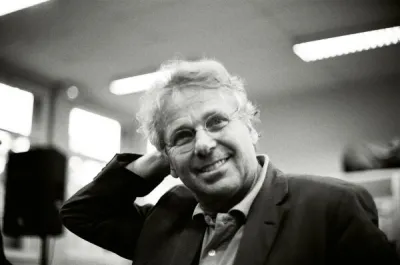
Daniel Cohn-Bendit
Human Design Chart
Biography
The Human Design of Daniel Cohn-Bendit: Manifestor 6/2
Manifestor 6/2 — Design at a Glance
Daniel Cohn-Bendit's design established the foundational structure of a trailblazer and visionary. He was geared towards actively leading the world into new directions, much like an emperor in ancient Rome who possessed the grand vision for the empire but did not personally fight every battle; instead, he inspired others to implement his plans. This configuration comes with a specific pain point: the potential to be misunderstood and polarized. Because his thinking often surpassed that of his surroundings, he was loved and followed by some while being rejected or even hated by others due to these vast visions. To find the right followership, it was crucial for his design to inform others about his intentions in a timely and precise manner. This strategy of informing served to preempt resistance and create clarity. By following this path, he was rewarded with an inner sense of peace. Living against this pattern manifested as persistent, deep-seated anger. Thus, his design marked him not only as a leader but also as someone who had to prepare his environment through communication for impending changes in order to act harmoniously.
Emotional Authority
Daniel Cohn-Bendit's design predisposed him towards emotional wave movements where enthusiasm and criticism would quickly alternate. This results from his Emotional Authority: whenever the Emotional Center is active, it takes over internal leadership regardless of other defined centers. This priority means that his perception was always colored by the current mood; a topic could appear visionary in one moment but be seen as problematic in another.
His feeling in acute situations only captured a snapshot, not necessarily the deeper truth. Quick, spontaneous decisions made from this emotional heat often had negative consequences. Instead, his system required patience and conscious hesitation at crucial turning points. By allowing himself time – sleeping on decisions and re-evaluating them multiple times – the initial emotional intensity could subside. Only when this wave subsided did he gain enough distance from his first reaction to see clarity, which was necessary for long-term, life-defining decisions. This process of waiting and maturing was not a sign of indecision but the specific strategy of his design to reach true inner truth before acting.
The 6/2 Profile — Role Model / Hermit
Daniel Cohn-Bendit's design predisposed him towards an intense experimental phase in youth. Before the age of 30, he followed the principle of trial and error, coupled with necessary retreats after mistakes. This early period served to gather many personal life experiences through direct action.
Around his thirtieth year, the sixth line of his profile activated. This marked a profound transformation: Daniel Cohn-Bendit metaphorically retreated into a 'cave' to reflect on his previous experiments with distance. This phase was characterized by intense reflection, healing, and deep self-awareness. The mechanics of Line 6 describe this transition from chaos to inner order through wisdom.
From this period of introspection, he emerged as a wise person. Others recognized the acquired life wisdom and sought his counsel to partake in his ability for profound self-reflection. His design shows the path from natural talent to role model: first learning through direct experience and mistakes, then condensing these experiences into prudent restraint and discretion before sharing his insights as a trustworthy authority. The sixth line taught him that ineffective action leads to disorder, while correct actions on the right path bring success and inner stability.
Single Definition — Defined & Open Centers
Daniel Cohn-Bendit's Human Design profile points to a tendency towards emotional depth and intuitive sharpness, paired with a clear voice. His defined Throat Center endowed him with the ability to reliably carry messages into the world – not as mere thoughts but as transmuted energy from his inner sources. This communication was often marked by his also defined Solar Plexus Center, meaning that his statements and actions were filtered through an emotional wave. He showed himself to be someone who needed patience to gain clarity; impulsive action at the peaks or troughs of this wave led more to confusion than to lasting results. His inner authority lay in this emotional awareness: The truth only revealed itself after passing through the feeling cycle.
Additionally, he possessed a defined Spleen Center, which gave him spontaneous, intuitive intelligence in the „now“. This existential perception served as a protective mechanism and provided immediate answers to questions of health and survival, independent of rational analysis. His also defined Root Center ensured a constant internal pressure to move forward, especially when dealing with stress and material challenges.
In contrast, his open Head Center revealed a vulnerability to mental distraction. He tended to identify with others' questions or get lost in endless thought spirals if he did not trust his emotional authority. His open Ajna Center allowed him to flexibly take on various concepts and opinions without fixating them as absolute truth, but also made him prone to intellectual overexertion or feigning uncertainty. The open G Center meant that he carried no fixed identity or direction from within himself; instead, he reflected the environment and found his orientation through the right place and fitting people. His open Heart Center was free of the pressure to prove his worth by making promises, while the open Sacral Center guided him to pay attention to his fluctuating energy flow and avoid falling into the trap of conditioned overwork.
Channels for intuition, ambition and emotional expressiveness.
Daniel Cohn-Bendit's Human Design profile points towards intuitive mastery paired with a deep drive for social transformation and emotional authenticity. His character showed someone who transformed inner intelligence through repeated experimentation into concrete talent.
This attitude was shaped by the Channel of Wave 48-16. It connected the intuitive depth of Gate 48 with the technical skillfulness of Gate 16. This created a pattern where skills only developed to true excellence through long-term dedication and practice. It wasn't just knowledge but physical mastery that needed recognition and resources to flourish.
Parallel to this, the Channel of Transformation 54-32 was at work. It drove ambition to rise on his own strength and improve his position. Driven by fear of failing the „tribe“ or community, Daniel Cohn-Bendit sought ways to use talents to create prosperity and security. This channel demanded constancy: Success was only sustainable if it was supported by others.
Emotionally, his design presented through the Channel of Emotion Release 39-55. He had a pulsating emotional wave between joy and melancholy. Rather than rationalizing moods, he used this moodiness as creative power to filter out the true nature of people or groups. His provocation served to free the right spirit in others and form authentic connections.
Additionally, isolated Gates contributed to complexity: Gate 21 directed material control with a focus on respect; Gate 53 initiated new cycles of freedom; Gate 38 set boundaries in the fight for integrity; and Gate 37 sought after organic community structures. These elements formed a person navigating between technical perfectionism, social ascent, and emotional authenticity.
Individual Circuitry — Circuit Signature
Daniel Cohn-Bendit's Human Design profile shows an integrated, simple energy connection between Throat, Spleen, Root, and Solar Plexus Centers. This structure marked him as someone who could directly translate intuitive impulses into expressive action. The Knowledge Circuit connected his Solar Plexus to the Root Center (Channel 55-39). This meant that emotional waves and inner rhythms served as driving force for expression – a pulsating energy based on „now“. Parallel, the Understanding Circuit worked through Channel 16-48 between Throat and Spleen Centers. Here it was about sharing focused, visual insights and strategic logic free of emotional coloring. This connection enabled clear communication of complex relationships. The Ego Circuit closed the chain via Channel 32-54 between Spleen and Root Centers. This transformation channel linked intuitive selection with the ability to convert energy in stressful situations. Since all four centers lie within a single group, these forces flowed seamlessly together: Intuition (Spleen) met emotional dynamics (Solar Plexus), was guided by strategic clarity (Throat), and found its expression in action-oriented implementation (Root). It wasn't a separate system but a closed loop of perception, strategy, emotion, and action.
Left Angle Cross of Endeavour 1
Daniel Cohn-Bendit's Human Design profile is characterized by the configuration of the left cross of effort. This suggests an inner drive to uncover connections and question established structures. The energy of this cross propels him to seek out hidden truths and actively bring these insights into the world, often with the aim of breaking old patterns.
This mechanism describes a life direction that focuses less on passive observation and more on actively engaging with issues relevant to the individual or community. It involves striving to create clarity where confusion or ambiguity prevails. The underlying power supports penetrating complex situations and proposing solutions based on deeper analysis.
For Daniel Cohn-Bendit, this means a natural inclination towards addressing questions that go beyond the obvious. The energy of this design fosters a mindset of curiosity and engagement with topics often hidden or ignored by others. It is a force that encourages not just understanding but also taking action by translating insights into concrete steps. This configuration thus shapes a personality dedicated to initiating change through effort and revealing new perspectives.
Saturn Return · Uranus Opposition · Chiron Return · 2nd Saturn Return — Life Cycles
Daniel Cohn-Bendit's Human Design shows a structure where internal maturation processes and external life turning points are closely intertwined. His first Saturn return around 1974 marked a phase of condensation: In this year, Jean-Paul Sartre visited Andreas Baader in the Stuttgart-Hohenheim prison to support his hunger strike – a moment when years of political groundwork condensed into a viable public stance.
The Uranus opposition around 1985 brought a period of detachment and reorientation. Here he appeared as an actor in "Die Splitter der Eisbombe," signaling that his design was experimental during this life phase, leaving old roles behind to find new forms of expression.
The Chiron return starting in 1994 ushered in his blooming period. As a fulfillment cycle, it opened the way for the realization of his incarnation purpose: He became a member of the European Parliament. This was no coincidence but rather the logical consequence of a life increasingly finding and living its deepest meaning.
His second Saturn return around 2001 brought a hard test. Accusations by journalist Bettina Röhl of sexual abuse put him in a crisis of responsibility. For his design, this was a moment when the weight of earlier decisions and structures showed as heavy burdens he had to carry and integrate to redefine his inner stability.
Manifestor · Emotional Authority — Synthesis
A central red thread runs through the design: the dynamic interaction between inner perception and outer expression. The emotional authority demands time for emotional maturation while the Manifestor type tends towards action and initiation – a synergy that is channeled by the connecting power of the defined Throat Center. The Channel of Wave Length amplifies this tendency, linking deep knowledge with the ability to communicate, leading to innovative impulses in the Circuit of Knowledge. Early years marked by an experimental spirit evolve into a phase of profound reflection and wisdom, which is then carried outward.
The design is characterized by a central paradox: the tension between the desire for independent action and the need for emotional clarity. Manifestor energy pushes for immediate implementation of visions while emotional authority requires delay and deeper engagement. This tension is further intensified by the left Authority of Effort, hinting at an internal conflict between one's own will and circumstances – a pattern that manifests in events such as controversies and crises (Cycles).
3 Defined Channels
Incarnation Cross - Left Angle Cross of Endeavour 1
Solar Return
The Solar Return shows the moment when the sun returns to its exact birth position - your personal solar year.
Life Cycles
Discover the life cycles with a detailed triple view (birth chart, cycle chart, composite).
Human Design Profile
- Type
- Manifestor
- Strategy
- To inform others before acting
- Authority
- Emotional Authority
- Profile
- 6/2 - Role Model / Hermit
- Definition
- Single Definition
- Incarnation Cross
- Left Angle Cross of Endeavour 1
- Date of Birth
- 04.04.1945 20:00
- Place of Birth
- Montauban, France
Frequently Asked Questions
What is Daniel Cohn-Bendit's Human Design type?
What profile does Daniel Cohn-Bendit have?
What authority guides Daniel Cohn-Bendit?
What is Daniel Cohn-Bendit's incarnation cross?
When was Daniel Cohn-Bendit born?
Discover your own Human Design
Are you also a Manifestor? Find out in a personal reading how to use your initiation power peacefully and dissolve resistance.
More Personalities
Back to overviewChristian-Jaque

Kesha

Laurent-Eynac
Lucebert
Masaccio

Papus