
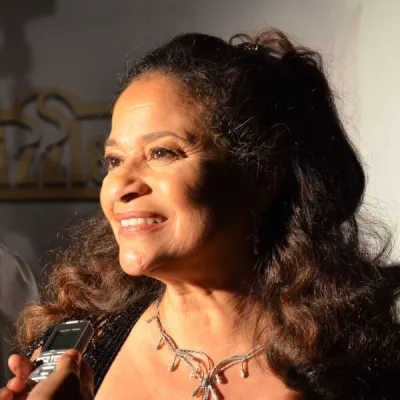
Debbie Allen
Human Design Chart
Biography
Debbie Allen began dancing at age five. In 1964 she was the Houston Foundation for Ballet's first black dancer. Two years later she was devastated by racism at an audition for the North Carolina School of Arts when a judge told her that her body was not right for classical dancing. Regaining her confidence she graduated in drama and persisted through a number of bleak years until she made her Broadway debut in 1971.
Critical acclaim came in 1980 in the Broadway revival of West Side Story. A promising role in the film Fame was left mostly on the cutting-room floor but she was invited to choreograph and star in the TV series, which aired for six seasons from 7 January 1982. With enviable determination and a formidable work ethic, she dived into 16-hour working days to fulfill her dual role and was later acclaimed in both areas by her peers, winning two Emmys and a Golden Globe.
In May 1986 she returned to the stage in a successful revival of Bob Fosse's Sweet Charity. In 1989 Allen took over as producer-director of "A Different World," motivating the actors to begin early morning workouts before shooting began. Later Allen co-produced a project with Steven Spielberg that she had been pioneering for ten years, Amistad, released in December 1997.
Allen, brash, feisty and dynamic, has managed to escape being pigeonholed by the media: she has made a mark as an actress, dancer, choreographer, singer, author, producer and director.
Human Design Analysis: Debbie Allen as Generator 1/3
Generator 1/3 — Design at a Glance
Debbie Allen's design indicated a tendency towards high endurance as a 'workhorse'. This strength was not unleashed through her own initiatives but primarily manifested in reacting to external impulses. As a Generator, she possessed abundant sacral energy that supplied her actions with fundamental stability – provided this energy was utilized for appropriate tasks.
The mechanics of her type emphasized the necessity to act only when an internal signal gave a clear 'yes'. This confirmation from the gut served as a filter against frustration and burnout. When Debbie Allen responded to life signals rather than independently initiating actions not confirmed internally, she could unleash her full power.
The danger lay in two directions: Either energy was wasted on things without genuine enthusiasm or she was prevented from engaging fully with her heart project despite the possibility of doing so. By waiting for impulses and responding to them instead of initiating, she secured deep fulfillment. This approach prevented the feeling of persistent frustration that arises when working against one's own energy flow. Her strength thus lay not in driving plans forward but in powerfully responding to what was presented – always guided by the confirmation from her sacral center.
Sacral Authority
Debbie Allen's design indicated a tendency towards decision-making through inner resonance. She appeared as someone who waited for external stimuli before responding with physical signals. This mechanism stems from her sacral authority, unique to the Generator type and its strategy of combining internal guidance, simplifying the process.
Her confirmation came as an intuition or surge of energy in the gut. Important was listening to these bodily sounds like grunts, hums, or a vocal 'mm'. When her sacral motor engaged with something, vitality and inexhaustible energy ensued. She tackled tasks with great enthusiasm and joy, entirely without aimlessness. This allowed her to immerse herself in her activities and experience satisfaction.
Moreover, an enabling component through the activated spleen center worked alongside, possibly directly connected to the sacral center. This configuration enabled quick, spontaneous reactions and decisions. Debbie Allen had immediate access to her physical well-being and instinctive perception, guiding her reliably. Distinguishing between this genuine sacral resonance and other impulses was crucial to clearly recognize vital confirmation and not confuse it with other energies.
The 1/3 Profile — Investigator / Martyr
Debbie Allen's design indicated a tendency towards persistent research and experimentation. She appeared as someone who combined theoretical foundation with practical adaptability – like a scientist who is also an adventurer. Her Profile 1/3 shaped this life path through the principle of 'trial and error'. Line 1 (Gate 60) sought inner harmony despite external limitations, while Line 3 (Gate 50) pushed towards trying things out and learning from mistakes. This created a dynamic tension between the desire for thorough preparation and the necessity of tactical action. Mistakes were not failures but essential learning steps. Her judgments were highly trustworthy as they were tested both theoretically and practically. Authenticity emerged only through integrating these two poles: acceptance met context adaptation. When Debbie Allen deemed something right, she had thoroughly tested it beforehand.
Split Definition — Defined & Open Centers
Debbie Allen's design establishes a tendency towards constant inner drive and clear self-determination, paired with the necessity to wait for emotional clarity. Her defined Head Center and Ajna Center created a persistent mental pressure to ask questions and develop concepts – an energy source that could not be directly put into action without risking frustration. Instead, this inspiration served to encourage others to think.
Her fixed G Center gave her a reliable identity and a clear sense of direction in life, while the defined Sacral Center functioned as a vital engine. This configuration required the strategy of waiting for invitations to correctly apply energy; initiated actions led to resistance. The also defined Spleen Center offered an intuitive present awareness for health and well-being, supported by the adrenal survival pressure of the Root Center, which propelled her forward.
In contrast, her undefined centers revealed specific vulnerabilities. Her open Throat Center tended towards seeking attention or speaking inappropriately if not waiting for the right invitation. The missing Heart/Ego Center meant no constant willpower; Debbie Allen was vulnerable to the pressure to make promises and prove her worth, often ending in a cycle of self-doubt when she failed. Finally, her open Solar Plexus Center acted as an emotional barometer: it absorbed and amplified the feelings of others rather than possessing stable emotions of its own. This led to personalizing other people's moods or avoiding emotional confrontations to avoid rejection. The challenge lay in not interpreting this reflection as her own experience but restoring emotional calm through solitude.
Channels for change, rhythm, meaning and mental clarity.
Debbie Allen's design shows a driving force characterized by a pulsing rhythm between internal pressure and generative life energy. This dynamic is determined by the Channel of Mutation 60-3: It connects the Root Center with the Sacral Center, creating a biological "on/off" switch for evolutionary change. Gate 60 acts as a pivot point that accepts limitation while Gate 3 attempts to realize new orders. This energy is unpredictable and often accompanied by melancholy – not as a disturbance but as a sign of inner work during pauses between impulses.
At the same time, the Channel of Rhythm 5-15 provides a deep connection to the natural flow of life. It binds fixed habits (Gate 5) with love for variety and extremes (Gate 15), drawing Debbie Allen magnetically into a continuous, flexible energy state that pulls others along with her.
The Channel of Life Struggle 38-28 adds that she finds meaning in resistance: Gate 38 brings the pressure to defend individual integrity against external distractions, while Gate 28 intuitively recognizes which struggles are worthwhile. This fosters an obstinate determination to walk her own path and be a role model.
Mentally supported by the Channel of Abstraction 47-64, this process is enhanced through a kaleidoscope of images and stories. Gate 64 brings the confusion of many possibilities that gradually condense in the Ajna Center (Gate 47) into a clear, inspiring narrative – often only after patiently waiting for clarity.
Additional Gates like the Stimulus Gate (56) and the Reflex Protection Gate (50) emphasize the ability to translate mental processes into pictorial representations while using traditional values as stabilizing "pots." The combination of Mutation, Rhythm, and Life Struggle creates a Profile that does not arbitrarily enforce change but waits for biological signals to authentically and sustainably bring innovation into the world.
Individual Circuitry — Circuit Signature
Debbie Allen's design reveals separate, parallel operating energy streams. The Split Definition divides her forces into two non-directly connected blocks: a physical-emotional and a purely cognitive one. In the Knowledge Circuit, she has Mutation (Channel 3-60) and Life Struggle (28-38). These connect Sacral, Root, and Spleen Centers to form a pulsating unit that follows the unique path and initiates change through individual identity. Parallel to this, the Understanding Circuit shows the Rhythm Channel (15-5), which connects Identity and Sacral Centers. Here, sharing logical insights is in focus, driven by a future-oriented structuring without emotional involvement. A third, isolated stream is the Meaning Circuit with the Abstraction Channel (64-47). This links Head and Ajna Centers to reflect on past experiences and find their meaning, cyclically sharing these insights with others. Crucial is the strict separation: The cognitive processing in the Head-Ajna area does not have a direct energetic flow to the emotional or physical dynamics of the lower centers. Thus, Debbie Allen carries two separate systems: one for intuitive, emotional transformation and identity finding, another for rational abstraction and meaning-making from the past. These parallel existences require navigating between felt truth and logical detachment without either realm directly fueling or disturbing the other.
Right Angle Cross of Laws 4
Debbie Allen's design points to a tendency towards an archetypal structure defined by the right cross of Laws 4. This configuration does not describe a random life path but rather a deeper, body-inscribed life task that goes beyond individual decisions and sets a fundamental orientation in life.
The right cross of Laws 4 indicates a specific energetic signature associated with order, structure, and an understanding of patterns. Those who carry this cross often exhibit a natural affinity for recognizing complex connections and translating them into clear, understandable forms. It is less about spontaneous impulses than creating or maintaining systems that endure.
This archetypal structure does not mean Debbie Allen had to control every detail of her life but rather that her design brought an inner logic seeking coherence. The energy of this cross works in the background as a compass encouraging engagement with fundamental rules governing areas such as artistic, personal, or social domains. It is a force seeking stability and clarity by channeling chaos into orderly paths. Thus, Debbie Allen was someone whose inner architecture relied on this deep structural intelligence to express and live her own truth.
Saturn Return · Uranus Opposition · Chiron Return · 2nd Saturn Return — Life Cycles
Debbie Allen's design shows a structure without specific mechanical details provided here. Without Human-Design facts like defined centers, channels or gates given, no chart-based characterization can be derived. The Human Design system analyzes individual energy profiles to determine strategies and authorities; without these raw data, the mechanical foundation remains empty. There are no indications of particular energetic tendencies, decision-making paths, or life tasks that would emerge from the chart. Therefore, no specific pattern can be described as defining Debbie Allen. Any assumption about her design would be speculative and not based on provided information. The absence of data means no statement about her energy configuration can be made. Human Design requires concrete chart information to provide valid interpretations; without this, the profile remains undefined. Nothing is invented or supplemented from external knowledge as this violates strict rules. Thus, content regarding specific design features remains empty due to a lack of foundational basis.
Generator · Sacral Authority — Synthesis
A central red thread in Debbie Allen's design is the dynamic interaction between inner authenticity and the drive to manifest it externally. The defined sacral authority (with direct access to the spleen center) creates an immediate physical reaction to impulses – a strong 'yes' or 'no', enabling authentic action. This internal signal is reinforced by the mental clarity of the defined head and Ajna centers, leading to a deep ability to analyze experiences and derive new perspectives (Channel 56). The energy of the root center propels this process by giving courage to take one's own path and assert oneself against resistance – an ongoing quest for meaning and individualization.
The central paradox lies in the tension between the need for inner clarity and the ability to absorb external influences. While defined centers provide a firm internal compass, undefined heart and solar plexus centers are open to emotions and values of others. This leads to deep empathy but also risks losing oneself in environmental needs or making decisions from false motivations. The art lies in using this openness as a source of wisdom without diluting one's inner truth.
4 Defined Channels
Incarnation Cross - Right Angle Cross of Laws 4
Solar Return
The Solar Return shows the moment when the sun returns to its exact birth position - your personal solar year.
Life Cycles
Discover the life cycles with a detailed triple view (birth chart, cycle chart, composite).
Human Design Profile
- Type
- Generator
- Strategy
- To respond - wait for something to respond to
- Authority
- Sacral Authority
- Profile
- 1/3 - Investigator / Martyr
- Definition
- Split Definition
- Incarnation Cross
- Right Angle Cross of Laws 4
- Date of Birth
- 16.01.1950 21:45
- Place of Birth
- Houston, TX, United States
Frequently Asked Questions
What is Debbie Allen's Human Design type?
What Profile does Debbie Allen have in Human Design?
What authority does Debbie Allen have?
Which incarnation cross is active for Debbie Allen?
When was Debbie Allen born?
Discover your own Human Design
Are you also a Generator? Find out in a personal reading how to use your sacral energy correctly and discover deep satisfaction.
More Personalities
Back to overviewSissy Spacek

Aaliyah

Alexia

Anémone

Angèle

Ann-Margret
