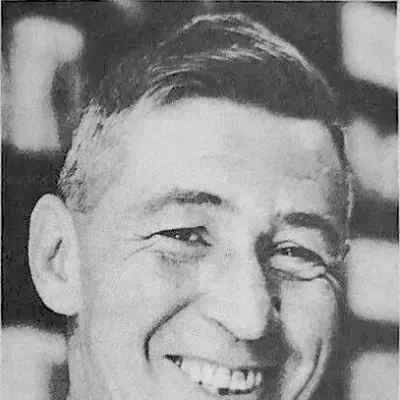
Edmund Landau
Human Design Chart
Biography
During the 1920s, Landau was instrumental in establishing the Mathematics Institute at the nascent Hebrew University of Jerusalem. Landau and his family emigrated to Palestine in 1927 and he began teaching at the Hebrew University. The family had difficulty adjusting to the primitive living standards then available in Jerusalem. He moved to Berlin in 1934, where he died on 19 February 1938, aged 61, of natural causes.
Human Design Analysis: Edmund Landau as Projector 2/4
Projector 2/4 — Design at a Glance
Edmund Landau revealed himself as someone who could immediately identify weaknesses in systems. His design as a projector gave him a dense, focused aura, comparable to a bright flashlight that was directed precisely onto dark spots in others or in structures. However, this ability to pinpoint flaws in the system was a double-edged sword. A direct confrontation with these shortcomings often triggered resistance from his surroundings, as if he were shining an uncomfortable light directly into their faces.
The effective strategy for him involved not forcing these insights but attracting attention through his own harmony and clarity. Since projectors do not have an undefined Sacral Center, they lack a constant intrinsic energy source. Instead, Edmund Landau experienced phases of high productivity followed by necessary rest periods for regeneration. Ignoring this rhythm risked burnout. His life task was to illuminate the path for others and bring light into darkness, but only when he received a respectful invitation to do so. Living according to this principle rewarded him with success; defying his design brought out the theme of bitterness. Thus, his impact depended on the right dosage of his projecting energy and waiting for recognition from others.
Emotional Authority
Edmund Landau displayed an emotional patience: He did not let himself be driven by first impulses but waited until inner clarity emerged. His inner authority was Emotional Authority, carried by the defined Emotional Center. In Human Design mechanics, this configuration is prioritized; it always takes precedence over other defined centers or strategies, regardless of additional chart aspects. This meant for him that his decision-making followed a natural rhythm, marked by waves of different mood states. His perception of the world was always influenced by the current emotional coloring – sometimes enthusiastic, sometimes skeptical. Landau understood, however, that this first impression only represented a snapshot and did not necessarily reflect deeper truth. Quick, spontaneous decisions based on transient emotions could have had negative consequences for him. Instead, he used time to let decisions mature. This process required patience and consciously sleeping over important questions. Through this delay, intense feelings subsided, allowing him to gain emotional distance. Only then did the necessary calmness and clarity set in. This mechanism was particularly crucial for long-term decisions as they shaped his life trajectory significantly. Landau thus truly “dressed up” himself and questioned multiple times before acting to ensure that his choice came from a stable, clear position rather than transient excitement.
The 2/4 Profile — Hermit / Opportunist
Edmund Landau revealed himself as someone who oscillated between the deep need for withdrawal and the desire for connection with close confidants. His design inclined him towards condensing knowledge in solitude to later impart it within a circle of chosen people. This tension stemmed from his Profile 2/4: Line 2 demanded solitary work, while line 4 sought community. For Landau, setting clear boundaries was crucial – he needed to communicate when he wanted to be left alone and when he sought company. In his “cave,” he immersed himself in internal processes, created clarity, and reflected on what he had learned. Only after fulfilling this need for solitude did he re-emerge to spend time with his favorite people. This way, he could utilize the knowledge of his network but first evaluate it through the distance provided by line 2 and transform it into brilliant ideas. His Sun position in Gate 30 promoted a pragmatic stance; it increased his productivity without energy waste, provided he acted selectively and preparedly. Simultaneously, Moon Gate 14 offered him security through practical intelligence and the creation of solid foundations. Landau waited for the right moment to use power and influence – opportunism was not a negative trait here but a strategy for securing himself. Without this foundational ability, his sense of security would have remained hollow. His strength thus lay in balance: withdrawal for inner development of the flame, followed by engaged yet controlled involvement in social structures.
Split Definition — Defined & Open Centers
Edmund Landau revealed himself as a person with a strong, consistent mental structure and a clear will for self-determination. His design indicated a tendency towards consequent intellectual work, coupled with the ability to keep promises and control his own resources. This combination of defined head orientation (Head Center and Ajna Center) and defined Heart Center marked him as someone who was under constant pressure to ask questions and conceptualize answers, yet possessed the willpower to actively steer these processes.
The definition between Head and Ajna created a persistent mental pressure to understand things. Landau was committed to a fixed style of thinking; his inspiration formed questions that he could not simply ignore. Since there was no direct energy available for implementing these thoughts, his success depended on accepting this pressure and inspiring others rather than falling into frustration over unresolved ideas. His defined Heart Center supported this through reliable willpower: He determined his life himself, kept commitments, and enjoyed working independently. This gave him the stability to meet mental demands without being overwhelmed by external expectations.
At the same time, his design revealed specific vulnerabilities. The open G Center meant that Landau did not have a fixed identity or direction. He tended to blend with his environment and was vulnerable to seeking a "borrowed" identity, which could confuse him in relationships or inappropriate contexts. The open Sacral Center made him sensitive to the energy of others; he risked overextending himself through "borrowed" vitality and not setting proper boundaries. Additionally, the open Spleen Center was a source of existential fears and uncertainties about health and well-being, leading him to cling to uncertain situations in order to gain a sense of security. These open centers challenged him to act without impulse and rely on his inner authority rather than spontaneous decisions or external validation.
Channels for logic, structure, community and emotional recognition.
Edmund Landau demonstrated a fundamental attitude of critical thinking: He did not seek blind faith but rather verifiable patterns. This skepticism stemmed from Channel 63-4, which connected his Head Center with the Ajna Center. Here, his mind constantly filtered information; only when a pattern was consistent would it be accepted as true. Doubt was no obstacle for him but rather the essential tool to uncover logical errors. An answer was valid only if it functioned practically and could be proven.
This analytical process led to a unique style of communication. Channel 23-43 connected his Ajna Center with the Throat Center. While others chatted, Landau received spontaneous insights (Gate 43) and formulated them through assimilation (Gate 23) into precise, efficient concepts. His thinking often seemed light-years ahead; he developed techniques that raised the efficiency standards of entire groups. The challenge lay in explaining this innovative knowledge so clearly that it was accepted by the collective rather than dismissed as abstract or foreign.
Emotionally and energetically, Landau was driven by a deep urge for experience. Channel 30-41 connected his Root Center with the Solar Plexus. Pressure from the root (Gate 41) created restlessness, intensified by emotional waves (Gate 30). This created a strong desire to experience and feel new scenarios. At the same time, he sought his place in the whole. Channel 37-40 connected his Solar Plexus with the Heart Center. Here it was about fair agreements: He worked for the group (Gate 40) but needed recognition and belonging (Gate 37). His design fostered connections based on mutual benefit and loyalty, not hierarchy.
Individual gates like Gate 14 (Power) or Gate 29 (Persistence) supported this structure, yet the channels defined his essential nature: logically skeptical, structurally innovative, and emotionally experience-seeking.
Collective Circuitry — Circuit Signature
Edmund Landau revealed himself as someone who translated structured thought processes into clear statements. This tendency resulted from the knowledge circuit that connected his Ajna Center with his Throat Center – a direct line from internal structuring to verbal communication. Parallel to this, the understanding circuit's logic between Head and Ajna Centers promoted cool, rational analysis, separate from emotional influence.
As Edmund Landau had a Split Definition, these intellectual forces did not form a continuous flow with his other centers but existed as independent blocks. One separate block consisted of the meaning-making circuit connecting Solar Plexus Center with Root Center. Here it was about cyclical emotional waves and reflection on past experiences, completely isolated from logical processes in Ajna or Head Centers.
Another independent area was the ego circuit linking Heart and Solar Plexus Centers. This promoted awareness of mutual support and the relationship between giving and taking within a community. Since there were no energetic bridges between these three groups, Landau's rational analysis, his emotional meaning-making, and his cooperative action operated as parallel, non-intermingling forces. Each sphere followed its own laws without direct influence from other channels.
Right Angle Cross of Contagion 1
Edmund Landau exhibited a fundamental disposition marked by the right cross of infection. This configuration in his design connected two specific energies: the impulse for deep, often painful self-exploration with the need to actively share these insights with others. It was not about passive reflection but rather a dynamic process of sharing.
The mechanics of this cross described a life task where inner wounds or profound questions became the source of powerful communication. Edmund Landau used this structure to formulate complex, often painful truths in such a way that they resonated with other people and could have transformative effects. His mode of expression was less about superficial harmony than hitting the core of an issue – even if it was uncomfortable or challenging.
This aspect of his design emphasized the connection between personal experience and collective insight. By sharing his inner processes, he created bridges to others who carried similar questions or difficulties. It was a path that overcame isolation through exchange and turned individual concern into a shared language. The energy of this cross drove him not only to find answers for himself but also to actively carry them into the world where they could be received and further developed by others.
Saturn Return · Uranus Opposition · Chiron Return · 2nd Saturn Return — Life Cycles
Edmund Landau showed himself as someone whose life phases were marked by clear structural turning points. His design indicated a tendency towards cyclical condensation: in periods of maturation, inner attitudes condensed into external realities. This was evident in 1905 when he married Marianne Ehrlich at the age of 28. This first Saturn return marked the transition from development to stable commitment – a moment where years of groundwork often condensed into a sustainable relationship structure.
Later, another cycle became active: The Chiron return around the age of 49 is in Human Design not a healing process of old wounds but a phase of bloom and fulfillment of incarnation purpose. If the strategy was followed, meaning becomes experiential. In 1925 at the age of 48, Landau gave the opening speech at the Hebrew University in Jerusalem. This event illustrated this blooming phase: His inner authority found public expression that made his life purpose visible.
The second Saturn return finally brought a new restructuring. In 1934, at the age of 57, Landau was prematurely retired. For his design, this was not just a crisis but a necessary upheaval: The old structure dissolved to make way for a newly defined existence. These three points – binding, fulfillment and restructuring – showed how Landau's chart rhythmically determined life stations.
Projector · Emotional Authority — Synthesis
Edmund Landau lived an inner rhythm marked by a profound interaction between the need for isolation and the desire for connection. His profile as a natural talent and networker (Profile 2/4) indicates that he periodically turned inward to research – a process that gave him clarity – before seeking out the social field again to share his insights. This dynamic was reinforced by his defined Head Center (Channel 63/4), which constantly generated mental pressure to question patterns and filter knowledge, driving him to delve deeply into topics before communicating them. He was a projector who recognized the potential in others and could bring 'light into darkness' for them, yet always with an awareness of the need to choose the right moment and appropriate manner of address.
A central paradox in his design lay in the tension between his emotional authority and his knowledge circuitry. While he needed time for emotional decision maturation – going through a wave of feelings – his Head Center simultaneously urged him to constantly question and seek answers. This combination likely led to an internal conflict between the need for thorough reflection and the relentless drive towards mental exploration, which was evident in documented events: marriage after careful consideration (1905), but also intense engagement with complex mathematical problems.
4 Defined Channels
Incarnation Cross - Right Angle Cross of Contagion 1
Solar Return
The Solar Return shows the moment when the sun returns to its exact birth position - your personal solar year.
Life Cycles
Discover the life cycles with a detailed triple view (birth chart, cycle chart, composite).
Human Design Profile
- Type
- Projector
- Strategy
- Wait for the respectful invitation
- Authority
- Emotional Authority
- Profile
- 2/4 - Hermit / Opportunist
- Definition
- Split Definition
- Incarnation Cross
- Right Angle Cross of Contagion 1
- Date of Birth
- 14.02.1877 06:00
- Place of Birth
- Berlin, Germany
Frequently Asked Questions
What was Edmund Landau's Human Design type?
Which Profile did Edmund Landau have in Human Design?
Which Authority guided Edmund Landau?
What incarnation cross did Edmund Landau have?
When was Edmund Landau born?
Discover your own Human Design
Are you also a Projector? Find out in a personal reading how to unfold your leadership qualities and recognize the right invitations.
More Personalities
Back to overviewSissy Spacek

Alain-Fournier

Anémone

Ann-Margret

Bourvil
Hergé