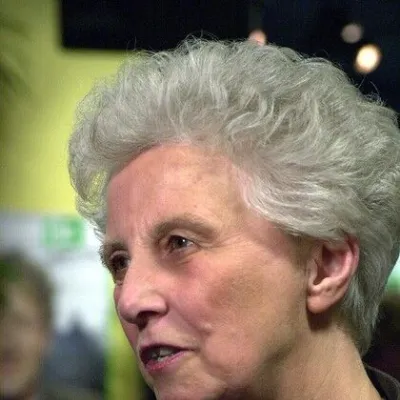
Els Borst
Human Design Chart
Biography
Els Borst grew up in Amsterdam. Her father was as an adjunct director of a mattress factory, her mother was housewife. She was their only child. During wartime (1940-1945) she experienced how her Jewish school friends disappeared. She had no idea what happened to them. On 12 March 1945 she was forced as a child to watch the execution of 30 prisoners at the Weteringplantsoen. Passengers (including children) were forced to watch this act of German terror. She was shocked, decided to become a pediatrician and to work for a better and more humane world.
Medical career
After finishing the Barlaeus Gymnasium (1950), she studied medicine at the University of Amsterdam (1950-1958). After becoming a physician (29 October 1958, A'dam) she worked as a resident at the Onze Lieve Vrouwe Gasthuis hospital specializing in pediatrics (1956-1960) and immunohaematology (1960-1965). From 1965 till 1969 she worked as a scientist at Utrecht University studying immunohaematology. This resulted in a dissertation "Rhesusimmunisatie, ontstaan en preventie" (Rhesus immunisation, development and prevention) at the University of Amsterdam on 16 March 1972.
In 1969 she became head of the Blood Service of the Academic Hospital of Utrecht (UMC) and in 1976 she became medical director of the UMC (1976-1985). She left the UMC to become vice-chair of the Health Council (1 Jan 1986 - 22 Aug 1994), an advisory board of the government. On 30 June 1992 she was elected as a professor at the University of Amsterdam with the mission "Evaluatie-onderzoek van het klinisch handelen" which deals with evidence based medicine. Her oration was held on 1 July 1992: Geneeskunde op recept? (Medicine on receipt?). She left this post on 22 August 1994 when she became Minister of Health, Welfare and Sport.
Els Borst — Projector with Profile 5/1
Projector 5/1 — Design at a Glance
Els Borst appeared through her focusing aura like a bright flashlight that revealed system errors immediately. Her Human Design as a Projector described this ability to recognize in others or structures what was 'in the dark' and not functioning properly. However, this direct error detection was not a tool for unbridled correction. If she addressed her observations right away, she risked resistance, similar to how a light beam directly into someone's face blinds them and repels them.
The mechanics of her design pointed instead towards a more elegant strategy: attracting others through her own harmony. Rather than instructing, her own shining—such as through functioning relationships or clear stances—should automatically attract others to seek advice from her. The crucial step was waiting for an explicit invitation. Only this specific request allowed her to exercise her leadership role without friction and avoid resistance.
Furthermore, her undefined Sacral Center shaped her energy balance. Els Borst did not have a constant intrinsic life force. Instead, she lived in cycles of phases of intense workability and necessary rest periods to prevent burnout. This up-and-down contrasted societal expectations for continuous performance. Living according to this pattern of invitation and rhythm rewarded her design successfully. Ignoring this structure and acting without invitations or against her energy limits led sooner or later to the experience of bitterness as her non-self theme.
Splenic Authority
Els Borst showed decision-making based on an immediate, physical impulse. Her inner authority lay in the defined Spleen Center, meaning that her intuition acted as spontaneous survival intelligence. This center functioned as an alarm system and health guardian; it signaled through subtle bodily signs whether a situation or environment was beneficial or harmful.
For Els Borst, the first unprocessed impulse at the moment was the truth. This spontaneous trigger served direct protection from negative influences and ensured her well-being. Since this spleen voice is very subtle and only occurs once, its use required high vigilance to not be overshadowed by subsequent rumination or external opinions.
A central mechanism of this design was the impossibility of planning ahead. As knowledge about what was right became available only in the concrete moment, priorities could change short-term. This made rigid long-term plans difficult and instead required much flexibility as well as space for spontaneous adjustments. Els Borst therefore had to distance herself from fixed commitments to maintain the necessary agility to react immediately to her inner warning or confirmation signals. This structure shaped a lifestyle where physical well-being and intuitive protection against harmful environments took precedence, but also demanded discipline in consistently listening to this fine internal compass without ignoring it.
The 5/1 Profile — Heretic / Investigator
Els Borst showed a profile marked by fundamental tension: the inner need for withdrawal and healing (Line 1) versus the outer magnetic projection as a problem-solver for others (Line 5). As a 5/1, often called 'Hero/Researcher', she possessed the characteristic that people unconsciously sought her solutions. This Line 5 functioned as a projection line; others projected on her the ability to heal or solve problems. At the same time, her inner Line 1—connected with Gate 25 and the learning process of healing in the here and now—called for withdrawal to gather strength and break down conditioning.
The challenge lay in balance. Without clear boundaries, overexertion threatened due to excessive demand. The design described a pattern of the 'burnt-out expert' who neglected themselves to meet projected expectations. While love for life and experimentation (Gate 58, Line 1) offered vitality, it could lead to frustration without mindfulness. Els Borst had to learn to distinguish between private research for herself and public availability. Only through setting boundaries—even saying no—could she maintain the beneficial balance. Thus, potential burnout transformed into sustainable power where her profound insights were available to others without neglecting her own essence. Healing did not come from constant giving but through respectful handling of her cycles and need for rest.
Split Definition — Defined & Open Centers
Els Borst revealed herself through a solid foundation of self-love and autonomous willpower. Her defined G Center gave her an unchanging identity and a clear sense of direction in life, allowing her to guide others from inner security without being dependent on them. This internal compass was supported by the defined Heart Center, which secured control over personal resources and promises; she acted with strong determination and expected that her word would hold weight. Complemented by the defined Spleen Center, Els Borst trusted spontaneous physical intuition in the present moment to make health-promoting decisions, while the defined Root Center provided a constant pressure to move forward materially and existentially.
At the same time, her design was marked by several open centers that enabled her to reflect the environment. The open Head and Ajna Centers meant that mental inspirations or doubts were not considered as her own constant truth; she tended to question whether certain thoughts truly originated from herself or were merely adopted, rather than getting lost in intellectual monologues. Her open Throat Center resisted the compulsion to constantly demand attention; instead, she waited for invitations to speak, saving energy and appearing authentic. The open Sacral Center made her susceptible to absorbing foreign vitality, requiring awareness of when borrowed energy could lead to exhaustion and boundaries needed to be set. Finally, her open Solar Plexus reflected the emotional climate of her surroundings; rather than identifying with others' waves or avoiding confrontation out of fear of rejection, she used this sensitivity as a barometer for social dynamics without personalizing feelings.
Channels for logical clarity and spiritual pioneering.
Els Borst's design tended towards consequential structuring driven by an insatiable logical process. The Channel of Judgment 58-18 connected the Gate of Vitality with the Gate of Correction. This mechanism generated a constant urge to question and perfect patterns to ensure quality of life for the collective. She assessed whether what was perceived was in balance or needed correction. Crucial here was to only offer this critical assessment when requested; otherwise, it acted as continuous fault-finding.
However, her absolute energy focus lay on the art of initiation. The Channel of Initiation 51-25 connected the Gate of Shock with the Gate of Self Spirit. Here, a natural competitiveness and the ability to recognize potential for individuation in others were evident. When invited, she could deliver the necessary 'shock' that initiated and strengthened others. This process led from collective 'we are' to individual 'I am'. The challenge was not to force this initiation; forcing it led to bitterness, while initiation had to happen naturally.
Additionally, other gates acted as supportive forces. Gate 52 demanded a self-imposed pause for concentration on pattern correction, while Gate 46 enabled success through full dedication and presence in the here and now. Gate 2 responded sensitively to external changes to find new evolutionary directions. Gate 41 propelled development through specific experiences and crises, maintaining an appropriate desire for emotional coolness. Gate 53 allowed her as a pioneer to leave behind old cycles and forge new paths. In the Heart Center, Gate 26 enabled acceptance of innovations in the conservative branch, while Gate 60 demanded acceptance of limitations as a prerequisite for transcendence. Gate 38 set boundaries to preserve individual integrity under pressure, and Gate 40 sought liberation through work but expected recognition and rest as rewards. This configuration shaped a personality that logically corrected to create space for deep personal transformation.
Individual Circuitry — Circuit Signature
Els Borst appeared as a person with deeply rooted, individual beliefs that were often hard to express in words. Her design was marked by two separate energetic streams. The Centering Circuit connected her Identity and Heart Centers exclusively. This connection created strong internal stability and courage for her own individuality without the missing Throat Center communicating this power outwardly. She thus primarily affirmed herself in her uniqueness. Parallel to this, the Understanding Circuit linked Els Borst's Spleen with the Root Center. This Channel of Judgment provided an emotionless ratio and strategic focus. Here it was not about feelings but logical insights for improving the future. Through their separate definitions, these two systems – the inner, hard-to-articulate identity and the rational future strategy – existed as parallel, non-directly connected forces. This created a tension between the strong internal will 'to be who one is' and the cold-minded approach to optimize societal structures through focused analysis. The energy remained directed inward or restricted to strategic planning rather than being discharged in fluid verbal self-presentation.
Left Angle Cross of Healing 1
Els Borst carried the Left Healing Cross in her Human Design. This configuration established a profound, spiritual dimension to her character and marked the archetypal background of her soul's mission. Her life served as a process of transformation and healing. The individual experience was thus transformed into a universal message or service to others.
The Left Healing Cross describes a specific energetic structure that aims at internal work and understanding suffering paths. It is not about superficial solutions but rather engaging with what lies hidden in order to integrate and transform it. For Els Borst, this meant that her personal development was always connected to a greater purpose: the ability to release healing potentials for the collective through her own experiences.
This configuration shapes how one deals with challenges. Instead of avoiding them, they are seen as necessary steps towards wholeness. The energy of this cross supports transforming pain and loss into wisdom and compassion. It is an attitude of dedication to the process of becoming, where one's own story becomes a tool for service to others. Els Borst lived this dynamic by carrying her inner transformation outward and thus helping others find their path of healing.
Saturn Return · Uranus Opposition · Chiron Return · 2nd Saturn Return — Life Cycles
Els Borst's professional development followed a clear rhythm of structural consolidation and authority assumption. Her design showed a tendency to establish identity and competence through cyclical maturation phases, with each transition from one phase to the next accompanied by concrete institutional confirmation.
The first Saturn Return marked the conclusion of the foundational phase: in 1958 at age 26, Els Borst received her medical approval. This cycle condensed years of academic groundwork into a solid professional foundation. Ten years later, during the Uranus Opposition in 1972 (age 40), another turning point occurred: she submitted her dissertation on immunohematology. This phase promoted differentiation of expertise and breaking away from pure beginner structures towards specialized autonomy.
The second Saturn Return in 1986 (age 54) crowned this process of structural establishment. Els Borst was appointed Vice President of the Dutch Health Council. Here, her design showed how long-term responsibility and institutional influence were integrated. The three cycles – approval, dissertation, office assumption – illustrate how her Human Design structured her professional career not as a linear ascent but as a staged appropriation of authority in the medical-political field. Each step solidified her position through demonstrable qualifications and official recognition before new levels of responsibility were taken on.
Projector · Splenic Authority — Synthesis
Els Borst was a Projector, destined by her design to identify errors in the system and shed light on them. This impulse for correction (Channel 58-18) manifested as a deep need for logical precision and the drive towards improvement – a tendency amplified by her defined Root Center, which helped her take on challenges. However, her ability to recognize patterns and make corrections was always coupled with an inner authority (Spleen Center), signaling what was truly right for her in the present moment. This led to a life where she relied on strategic patience to respond to invitations to offer her observations and solutions.
A central paradox in Els Borst's design lay in the combination of her projection capability – the need to guide others and correct them – and her undefined Solar Plexus Center. While she instinctively recognized weaknesses in others (Gate 51), she was simultaneously vulnerable to absorbing emotions and conditioning. This created a tension between the urge to share insights and the necessity to protect herself from emotional overload. The ability to find this balance – through acknowledging her limits and waiting for the right invitation – was crucial for her well-being and success.
2 Defined Channels
Incarnation Cross - Left Angle Cross of Healing 1
Solar Return
The Solar Return shows the moment when the sun returns to its exact birth position - your personal solar year.
Life Cycles
Discover the life cycles with a detailed triple view (birth chart, cycle chart, composite).
Human Design Profile
- Type
- Projector
- Strategy
- Wait for the respectful invitation
- Authority
- Splenic Authority
- Profile
- 5/1 - Heretic / Investigator
- Definition
- Split Definition
- Incarnation Cross
- Left Angle Cross of Healing 1
- Date of Birth
- 22.03.1932 23:00
- Place of Birth
- Amsterdam, Netherlands
Frequently Asked Questions
What Human Design type was Els Borst?
What Profile did Els Borst have in Human Design?
Which Authority guided Els Borst's decisions?
What incarnation cross did Els Borst have?
When was Els Borst born?
Discover your own Human Design
Are you also a Projector? Find out in a personal reading how to unfold your leadership qualities and recognize the right invitations.
More Personalities
Back to overviewSissy Spacek

Alain-Fournier

Anémone

Ann-Margret

Bourvil
Hergé