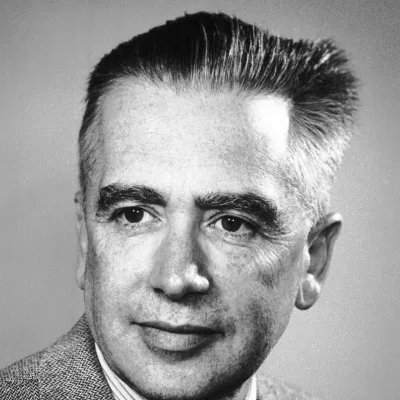
Emilio Segrè
Human Design Chart
Biography
In 1937 Segrè discovered technetium, the first man-made element. In 1938 Segrè was fired from his position as Administrator of the Physics Laboratory at the University of Palermo because Mussolini had deemed that Jewish scientists should not be allowed to hold such posts. He then migrated to America, where he was a group leader in the Manhattan Project. In 1944 he made the crucial discovery that plutonium made in a nuclear reactor has higher levels of the isotope plutonium-240 than plutonium produced in a cyclotron.
Emilio Segrè died from a heart attack on 22 April 1989 at age 84 in Lafayette, California.
What does Projector 5/1 mean for Emilio Segrè?
Projector 5/1 — Design at a Glance
Emilio Segré's Human Design shows a tendency towards focused perception. As a Projector, he lacked an intrinsic energy source in the Sacral Center, leading to alternating phases of high productivity and necessary rest periods to prevent burnout. His aura acted like an intense beam of light that immediately exposed weaknesses or errors in other systems. This direct confrontation could be perceived as unpleasant, similar to a bright spotlight shining into someone's face. The optimal strategy for him was to wait for value-based and honest invitations from his environment rather than pushing forward on his own initiative. Through this patience, his presence became attractive; others actively sought out his advice because he brought clarity to their uncertainties. If he lived by this pattern, he would be rewarded with success. Deviating from it and ignoring his need for recognition through invitation or the necessity of rest led to the non-self theme of 'Bitterness'. This manifests as an emotional reaction to feeling undervalued or unheard when his specific perspective was not validated through a direct request. His path involved letting his light shine gently, giving others space to recognize this value and invite him.
Emotional Authority
Emilio Segré's inner compass was the defined Emotional Center, making him an Emotional Authority. This configuration was subject to constant emotional waves with continuous ups and downs of feelings; the world appeared colored by the current mood, enthusiasm could suddenly shift into negative perspectives. His immediate feeling was only a snapshot, not a reliable indicator of truth. Quick, spontaneous decisions made from this emotional state often had negative consequences.
The mechanics required patience: Emilio Segré needed time to let decisions mature. Only through multiple nights and delays did the intense feelings subside. This process created the necessary emotional distance until clarity and calmness prevailed. Only then was he through the decision-making process and could make a well-founded choice. The necessity of delay was especially important for long-term life decisions with significant influence on his career path. The Emotional Center always took precedence as inner authority over all other defined centers in his chart, regardless of further configurations. This prioritization ensured that his deeper emotional truth - not the first impulse - guided him.
The 5/1 Profile — Heretic / Investigator
Emilio Segré was marked by Profile 5/1: a Researcher who gathered deep, individual insights (Line 1) to later provide authoritative solutions for others (Line 5). This design created almost magnetic吸引力,人们寻求他的建议以找到答案。挑战在于,这种持续的需求会迅速耗尽他的精力,如果他不设定明确的界限的话。
他线条的机制进一步阐明了这一压力。第五线在Gate 19带来了危机时刻牺牲的深刻需求,通常伴随着某种程度的居高临下或情绪不稳定。这可能导致他在没有尊重自己权威的情况下盲目地奉献自己。同时,第一线在Gate 1要求耐心和从自我中解脱出来以创造新的想法。创新和创意突破遵循其自身的规律;它们不能通过意志力强加。
Segré的任务在于保持他深入的、私人的研究过程与作为问题解决者的公共角色之间的平衡。只有当他学会偶尔说“不”时,才能防止他人的期望耗尽他的精力。这样,他就能够最大限度地利用自己的天赋:不是通过无休止的服务,而是有目的地运用他积累的知识,在真正需要的时候发挥作用。
Split Definition — Defined & Open Centers
Emilio Segré's Human Design shows a tendency towards clear, strong-willed communication that stems from an established inner direction. His defined G Center gave him a reliable sense of identity and life mission; he knew who he was and could show others new perspectives. This self-assurance was supported by his defined Heart Center, which granted access to willpower and ego. He could keep promises and determine his own resources, serving as a constant energy source for his actions.
These inner structures flowed into his defined Throat Center, the pivot point of his expressions. His voice was not a random product of the moment but transmuted the energies of identity and will into understandable messages. He spoke with the ease and honesty of someone whose expression rests on steady sources.
At the same time, his design showed complex emotional dynamics. The defined Solar Plexus Center was his inner authority: Emilio Segré had to wait out the waves of his feelings before making decisions. Truth revealed itself to him over time, not in impulsive moments. Parallel to this, the defined Root Center generated a constant pressure to move forward and master existential challenges. This stress was part of his design to rise materially or make corrections.
In contrast, Head, Ajna, and Sacral Centers were open. The open Head and Ajna Centers made him vulnerable to mental confusion and the pressure to find answers that weren’t his own. He tended to get entangled in other people's questions or avoid intellectual pursuits if they didn't have personal value for him. His open Sacral Center also meant he lacked a constant generative energy; he was prone to exhaustion when taking on others' life force instead of trusting his own rhythms and limits.
Channels for synthesis, community and reflective distance.
Emilio Segré showed himself as someone who gathered experiences patiently before putting them into words. The Lost Son 13-33 connected his G Center with the Throat Center: Gate 13 listened and stored secrets, while Gate 33 withdrew to reflect on these memories. This mechanism promoted a stance of waiting for deeper truths beneath the surface before sharing them.
His design also showed strong sensitivity towards belonging and tribal connection. The Synthesis 19-49 connected his Root Center with his Solar Plexus Center. Gate 19 pushed for closeness and belonging, while Gate 49 set principles that rejected anything not fitting into the collective. This created an emotional glue for loyalty and protection of one's group. Parallel to this, the Community 37-40 between Solar Plexus and Heart Centers worked. Here, Gate 37 sought recognition in the whole, while Gate 40 was ready to work but needed rewards and breaks. This channel secured connections through willpower and carefully negotiated agreements that took time to become emotionally clear.
Individual Gates rounded out this picture: Gate 1 emphasized uniqueness in the here and now, Gate 2 receptive evolution. Internally, Gate 58 worked with experimental pressure towards perfection, Gate 54 with a drive for worldly success as a basis for spirituality, and Gate 36, which understood crises as cyclical movements. Gate 10 integrated complex behavior genetically, while Gate 22 allowed calm listening in the design. Gate 52 demanded concentrated pattern correction in silence, and Gate 45 expressed hierarchical tribal strength. Together they shaped a path of observing, binding, and structuring work within familiar circles.
Tribal Circuitry — Circuit Signature
Emilio Segré's Human Design shows a tendency towards emotional reflection and cooperative resource creation. With his Shared Definition, there were two separate energetic streams that did not flow directly into each other. The Meaning Maker Circuit connected the Throat with the Identity Center. Here it was about sharing felt insights from the past. Energy flowed in waves: emotions needed time to clarify before being verbalized. This served to learn together from past experiences.
Parallel to this, the Ego Circuit, connecting Heart, Solar Plexus, and Root Centers, focused on cooperation and creating resources within a group. Without connection to the Sacral Center, there was no constant life force; instead, rest pauses were necessary to regenerate energy for the tribe. The channels promoted a balance of giving and taking as well as synthesis-like connections between emotional perception and impulsive action. Both circuits existed side by side as separate forces: on one hand, emotional meaning-making through communication, on the other hand, traditional resource-oriented cooperation in the community.
Left Angle Cross of Refinement 2
Emilio Segré's Human Design featured the left Refinement Cross. This configuration shaped a fundamental approach where the pursuit of perfection and precision was paramount. It wasn't superficial criticism but rather a deep inner drive to refine things until they matched their true essence.
This cross connects specific energy centers that create a particular sensitivity to details. Emilio Segré appeared as someone who did not simply accept imperfections, but felt compelled to correct and improve them. The mechanics of this design suggested his focus was on elevating processes or ideas through meticulous refinement to a higher level.
The energy of this cross worked like a file: smoothing rough edges and sharpening the contours of thought or action. For Emilio Segré, this likely meant he operated in areas where accuracy was crucial. His inner self demanded clarity and purity of execution. This inclination towards refinement helped him not only to understand complex relationships but also to present them in a form that was logically sound and aesthetically pleasing. It was an optimization force guiding his actions.
Saturn Return · Uranus Opposition · Chiron Return · 2nd Saturn Return — Life Cycles
Emilio Segré's second Saturn Return around the age of 42 marked a phase of maturation and consolidation, where earlier efforts bore tangible results. This cycle laid the groundwork for future recognition by stabilizing internal structures and bringing long-term goals into focus. The mechanics of the Saturn Return often demand discipline and the ability to concentrate on essentials, which in Segré's case was a deep commitment to his research.
In 1959 at age 54, Emilio Segré received the Nobel Prize in Physics alongside Owen Chamberlain. This success did not occur in isolation but was the logical continuation of foundations built during earlier Saturn cycles. The second return had already created a necessary internal order that enabled him to overcome complex scientific challenges and ultimately confirm them through international recognition. The award underscored not only his individual triumph but also the effectiveness of a consistently pursued life path based on structural stability and patient work.
Projector · Emotional Authority — Synthesis
He was a Projector who, through the connection between G Center and Throat Center (Channel of Lost Son), developed a profound ability for reflection and understanding cyclical processes. This inner trait corresponded with his Profile as Hero/Researcher (5/1), endowing him with a thirst for knowledge and the gift to grasp complex information and make it accessible to others. His life was marked by a steady oscillation between absorbing impressions, internal processing, and sharing these insights - a dynamic reinforced by his emotional authority, as he needed time to let feelings mature before communicating them.
A central paradox in his design lay in the tension between his Projector strategy of waiting for invitations to offer knowledge and the magnetic pull his depth of knowledge (Line 5) exerted on others. He tended to offer solutions, which was sought after by others but could also overwhelm him. This discrepancy between wanting to give and needing to maintain boundaries formed a red thread through his life, visible in moments of success (trigger event) followed by reflection.
3 Defined Channels
Incarnation Cross - Left Angle Cross of Refinement 2
Solar Return
The Solar Return shows the moment when the sun returns to its exact birth position - your personal solar year.
Life Cycles
Discover the life cycles with a detailed triple view (birth chart, cycle chart, composite).
Human Design Profile
- Type
- Projector
- Strategy
- Wait for the respectful invitation
- Authority
- Emotional Authority
- Profile
- 5/1 - Heretic / Investigator
- Definition
- Split Definition
- Incarnation Cross
- Left Angle Cross of Refinement 2
- Date of Birth
- 01.02.1905 12:00
- Place of Birth
- Tivoli, Italy
Frequently Asked Questions
What was Emilio Segré's Human Design type?
What Profile did Emilio Segré have?
What Authority did Emilio Segré have?
What incarnation cross did Emilio Segré have?
When was Emilio Segré born?
Discover your own Human Design
Are you also a Projector? Find out in a personal reading how to unfold your leadership qualities and recognize the right invitations.
More Personalities
Back to overviewSissy Spacek
Alain-Fournier

Anémone
Ann-Margret

Bourvil
Hergé