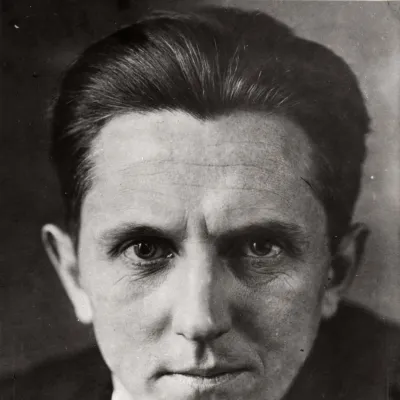
Erwin Piscator
Human Design Chart
Biography
Having studied at the König school of dramatic art and at the university, Piscator began as a volunteer at the Hof Theater in Munich; he became in turn an actor and a director. Working in Berlin during the Weimar Republic (1919–33), Piscator frankly used the theatre to convey radical political instruction. Although he was not a communist, he sympathized at the time with the German working class. A bold innovator, he used films and newsreels to enlarge landscapes and convey mass events, and he employed many optical, acoustical, and mechanical devices to create an experience of total theatre. His passion for machinery could be self-defeating: blaring loudspeakers, flashing lights, air-raid sirens, and revolving sets sometimes obscured his message.
During the Nazi era, Piscator sought outlets outside of Germany. He traveled to Russia in 1934 to direct his only film, the well-regarded Vostaniye rybakov (“The Revolt of the Fishermen”). From 1939 to 1951 he headed the Dramatic Workshop of the New School for Social Research in New York City. He returned to West Germany in 1951 as director of West Berlin’s Volksbühne. Among his sensational productions of that period were Rolf Hochhuth’s Deputy, a study of the role of Pope Pius XII during the Third Reich, and The Investigation by Peter Weiss, dealing with theAuschwitz concentration camp.
He died 30 March 1966, Starnberg.
Erwin Piscator as a Manifesting Generator 4/6 in Human Design
Manifesting Generator 4/6 — Design at a Glance
Erwin Piscators design tends towards hybrid action: He possesses the constant energy source of a Generator but also has Manifestor qualities through an active connection between Motor Centers and Throat Center. This created a type that could quickly draw things into his life by skipping steps. This speed was a double-edged sword. On one hand, it allowed for efficient progress; on the other, skipping important stages meant he sometimes had to backtrack and make up missed steps. Such setbacks often caused frustration, relating to the non-self theme of his configuration.
Furthermore, Piscator tended to pursue multiple things simultaneously as he reacted to various impulses and started parallel projects. Without strict adherence to the strategy – not initiating himself but waiting for inner signals – this creative drive quickly turned into overextension. Crucial was confirmation from his defined Sacral Center. Only when it said “yes” could he channel his energy meaningfully. With correct application of this reaction to life, Piscator found deep satisfaction. He then worked happily on various tasks in parallel and fell into a productive play mode that gave him the necessary variety and fulfillment.
Emotional Authority
Erwin Piscators design tends towards emotional fluctuation: He appeared as someone who always perceived the world through the filter of his current mood. In one moment, he could be totally enthusiastic about something; in the next, view the same matter completely negatively. This configuration stemmed from his defined Solar Plexus Center, which carried inner authority for him. Regardless of what other centers were defined in his chart, this emotional authority always took precedence. It generated a permanent wave of ups and downs in feelings.
For Erwin Piscator, however, an immediate emotional impression was only a snapshot, not necessarily his truth. Quick, spontaneous decisions made directly from such emotion often had negative consequences. The mechanics of his design required patience: the more time he took to let a decision mature, the deeper and more comprehensive he could understand the situation. This meant that he had to rethink important questions multiple times and sleep on them. Through this process, intense feelings gradually subsided. He gained emotional distance, leading to clarity and calmness. Only then was the decision-making process complete. This mechanism was particularly significant for long-term decisions with a major impact on his life course.
The 4/6 Profile — Opportunist / Role Model
Erwin Piscators design tends towards late maturation, marked by Profile 4/6. In the first thirty years of his life, he appeared more experimental and intensively sought connection, driven by Line 4. Only with his first Saturn Return did this dynamic fundamentally change: The inner conflict between heart’s desire for belonging and head’s need for wise distance became his central life drive.
This tension resulted from the interaction between Gate 11 on the fourth line, which enabled transpersonal perspectives and discovery of deeper truths, and the sixth line, embodying highest reason and almost prophetic responsibility. Piscator showed himself as someone who did not simply share knowledge but deliberately made it accessible only to a few – an effect of the “Sun in Fall” aspect at Gate 11. Simultaneously, he tried through the sixth line to control emotions and set clear conditions for connections to ensure that resulting commitments or projects were anchored in a sustainable world.
His role thus developed from a searching networker into a role model who worked through cooperation but was always cautious about opening his heart to “the wrong” people. The expectation of wise and just action stood in constant tension with the necessity of avoiding personal injuries through false alliances. This profile shaped his way of conveying ideas: inspiring for many, yet reserved in its true depth for a select group.
Single Definition — Defined & Open Centers
Erwin Piscator's Human Design profile points towards a tendency for consequent clarity of thought that directly manifests in his communication style. His defined Ajna Center ensures constant mental processes; he thinks continuously and is not easily swayed by other opinions. These concepts seamlessly flow into his defined Throat Center, which serves as the anchor to express these thoughts reliably and without hesitation. Thus, he possesses a mechanical ability to immediately bring what he conceptualizes into the world – not impulsively but as an expression of his stable inner logic.
This intellectual stability starkly contrasts with the driving force from his defined Sacral Center. As a Generator, he has a massive vital energy source that is only activated through reaction. His power is not available for mental initiatives but reacts to external stimuli with a clear yes or no. When he agrees with something, persistent endurance follows; ignoring this sacral response in favor of a mental plan leads to frustration and resistance.
His open Head Center makes him vulnerable to external mental pressure and the need to find answers to questions that are not his own. He tends to be influenced by others' confusion or seek inspiration to relieve this pressure. Simultaneously, he lacks a firm identity in his open G Center; he relies on environment and relationships to initiate direction. Attempts to construct this identity himself often lead nowhere. His open Heart Center prompts him not to prove his worth through willpower or promises – a gift that frees him from the spiral of self-proving as long as he respects his inner authority.
Channels for structure, intuition, charisma, power and change.
Erwin Piscator's Human Design profile points towards an intense, physically anchored perception. The Power Channel 57-34 connects intuitive insight with sacral life force, making him perpetually alert to his environment and able to react spontaneously to dangers or opportunities. This survival intelligence drives him to remain independent and secure his well-being through direct reaction.
His expression is marked by the Brainwave Channel 57-20, which translates intuitive perception directly into communication. He often speaks from the moment, helping others awaken their own inner intelligence. His ability to know in the present and verbalize it gives his statements a mutative effect, provided he trusts these impulsive outbursts.
Simultaneously, there is potential for charismatic action through the Charisma Channel 34-20. Here generative energy meets the capacity for manifestation, propelling him towards active self-assurance. However, this power requires that he only do things that truly matter to avoid obsession or misguided activity.
The development of mastery was a central theme for Erwin Piscator, supported by the Wavelength Channel 48-16. This channel connects deep instinctive intelligence with the drive to perfect skills through repetition. His talent flourished when he dedicated himself to long-term projects and received recognition, allowing him to transform his skill into a unique artistry.
Thought processes were shaped by the Structuring Channel 43-23, which translates spontaneous insights into clear concepts. Erwin Piscator had to learn to give his mind time to develop innovative perspectives and communicate them in ways that others could accept. His knowledge often seemed prescient and required patience until it resonated with the collective.
Emotionally, he was driven by the Transience Channel 36-35, seeking new experiences and change. This led to a restless search for meaning, gaining wisdom from emotional highs and lows. His willingness to take risks helped him live life intensely and inspire others through his stories.
Additionally, Gates like Gate 11 with visual memory and analysis as well as Gate 32 focusing on continuity and material success contributed to the complexity of his design. These elements combined into a personality deeply rooted yet open for mutation.
Individual Circuitry — Circuit Signature
Erwin Piscator's Human Design profile shows a clearly connected energetic structure: Head, Ajna, Throat, and Spleen Centers form a continuous flow. This marks him as someone who translates intuitive impulses from the Ajna Center directly into structured communication through the Throat Center. The Knowledge Circuit connects his Ajna, Throat, and Spleen. Here the lightning flash energy (Channel 20-57) generates innovative ideas from the Ajna Center while structuring (Channel 43-23) formulates these thoughts in the Throat Center. This enabled him to convey new knowledge acoustically and in the present.
Parallel to this, Understanding and Integration Circuits activate additional connections to his Throat and Spleen Centers. The Channel 16-48 (Wavelength) in the Understanding Circuit promotes sharing logical insights free from emotional coloring, fostering a focused, future-oriented orientation. In the Integration Circuit he also connects Throat, Sacral, and Spleen Centers. Channels Charisma (20-34) and Power (34-57) channel power from his Sacral Center – the source of his life energy – through his intuitive Spleen Center to expression in the Throat Center. This gave his expressions an immediate, charismatic impact.
The Meaning Circuit closes the connection between Throat and Solar Plexus Centers over Channel 35-36 (Transience). Here it is about sharing emotional experiences from the past. Since all these circuits lie within a single group for Erwin Piscator, they do not work in isolation but as an integrated whole: intuition, logic, and emotion flow together to bring his unique identity through language and structure into the world.
Right Angle Cross of Eden 4
Erwin Piscator's Human Design profile indicated a tendency towards profound and often fateful turning points. This configuration, the right cross of Eden 4, describes not a linear progression but rather a pattern of sudden breaks and radical new beginnings. It was a mechanism that replaced stability with fundamental change; old structures were not gradually adapted but abruptly abandoned to make way for an entirely new order.
This energy acted as a catalyst for transformative processes. It connected the power of creation with the necessity to break free from what had previously been considered secure. For Erwin Piscator, this meant that his path was marked by unexpected upheavals that forced him to fundamentally reconsider his identity and direction. It was not a gentle evolution but rather a series of revolutions both internally and externally.
The right cross of Eden 4 demanded courage for radical departure from the known. It showed itself as an impetus to give up existing bonds or beliefs when they stood in the way of further development. This process was often painful, yet necessary to achieve higher integrity and authenticity. Erwin Piscator lived this dynamic by repeatedly placing himself in situations that challenged him to leave his comfort zone and tread new, unknown paths. The power of this design lay in its ability to develop a clear, newly defined direction from the chaos of transformation.
Saturn Return · Uranus Opposition · Chiron Return · 2nd Saturn Return — Life Cycles
Erwin Piscator's Human Design profile indicated a tendency towards structural anchoring that manifested in distinct life phases. This mechanism became active in 1920: at age 27, he founded the 'Proletarian Theater' in Berlin. This first Saturn Return marked the point where years of groundwork condensed into a viable institutional result – a typical moment of stabilization and building long-term structures.
Later, in 1934 at age 41, he produced his only play and sound film 'The Uprising of the Fishermen'. This fell during the Uranus Opposition phase, often characterized by unexpected turns or pressure to adapt to new realities. Here, his ability to realize creative projects despite external tensions was evident, even if these often arose as reactions to changed circumstances in this astrological configuration.
His second Saturn Return occurred in 1951 when he was 58 years old. That year saw his summons by the Committee on Un-American Activities and his return to Germany. This cycle frequently brings a phase of maturation and confrontation with the consequences of earlier decisions. Piscator's design showed how external crises could lead to redefining one's position. The structure of his character allowed him to integrate these challenges as necessary steps in a longer development rather than experiencing them merely as setbacks. His life path thus followed the rhythm of building, adaptation, and renewed consolidation.
Manifesting Generator · Emotional Authority — Synthesis
Erwin Piscator was a dynamic Generator type whose life was marked by a constant flow of sacral energy (defined Sacral Center). However, this energy was modulated by his emotional authority: decisions required time to mature within the emotional wave and gain clarity. This interplay between quick reaction and deep evaluation formed the core of his working style – an ongoing balance between impulsive ideas and the need for inner confirmation. The profile as a Networker/Role Model points towards development where early experimentation (Line 4) later led to a role of wisdom and mediator (Line 6), always striving to forge connections and disseminate knowledge.
A central paradox lay in the combination of manifesting qualities and emotional authority. While his ability to quickly initiate things (Channel of Wavelength) propelled him forward, his emotional wave required slowing down and reflection. This led to an internal tension between a desire for immediate implementation and the necessity to weigh decisions carefully – a field of tension that manifested during career phases (Saturn Return 1, Uranus Opposition, Saturn Return 2) and compelled him repeatedly to correct or realign steps.
6 Defined Channels
Incarnation Cross - Right Angle Cross of Eden 4
Solar Return
The Solar Return shows the moment when the sun returns to its exact birth position - your personal solar year.
Life Cycles
Discover the life cycles with a detailed triple view (birth chart, cycle chart, composite).
Human Design Profile
- Strategy
- To respond - wait for something to respond to
- Authority
- Emotional Authority
- Profile
- 4/6 - Opportunist / Role Model
- Definition
- Single Definition
- Incarnation Cross
- Right Angle Cross of Eden 4
- Date of Birth
- 17.12.1893 15:30
- Place of Birth
- Ulm, GER
Frequently Asked Questions
What was Erwin Piscator's Human Design type?
What profile did Erwin Piscator have in Human Design?
What authority did Erwin Piscator have?
What incarnation cross did Erwin Piscator have?
When was Erwin Piscator born?
Discover your own Human Design
Are you also a Manifesting Generator? Find out in a personal reading how to unfold your multi-talents and direct your energy wisely.
More Personalities
Back to overviewAldair

Alizée

Angeli

Arletty

Artus
Balthus