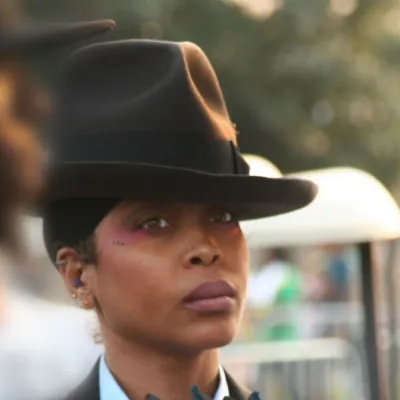
Erykah Badu
Human Design Chart
Biography
Badu's second studio album, Mama's Gun (released 31 October 2000) spawned three singles: "Bag Lady", which became her first top 10 single on the Billboard Hot 100 peaking at #6, "Didn't Cha Know?" and "Cleva". The album was certified Platinum by the RIAA. Badu's third album, Worldwide Underground (released 16 September 2003) generated three singles: "Love of My Life (An Ode to Hip-Hop)", "Danger" and "Back in the Day (Puff)" with 'Love' becoming her second song to reach the top 10 of the Billboard Hot 100, peaking at #9. The album was certified Gold by the RIAA. Badu's fourth album, New Amerykah Part One (26 February 2008) spawned two singles: "Honey" and "Soldier". New Amerykah Part Two (released in 2010) contained the lead single "Window Seat", which led to controversy.
Musically her work includes elements from R&B, hip hop and jazz. She is best known for her role in the rise of the neo soul subgenre. She is known as the "First Lady of Neo-Soul" or the "Queen of Neo-Soul". Early in her career, Badu was recognizable for wearing very large and colorful headwraps. For her musical sensibilities, she has often been compared to jazz great Billie Holiday. She was a core member of the Soulquarians. As an actress, she has played a wide range of supporting roles in movies including Blues Brothers 2000, The Cider House Rules and House of D.
What does Manifesting Generator 2/4 mean for Erykah Badu?
Manifesting Generator 2/4 — Design at a Glance
Erykah Badu revealed herself as someone who operates through a unique blend of initiating power and constant energy. Her design combines the speed of a Manifestor with the endurance of a Generator, allowing her to skip steps and quickly draw results into her life.
However, this configuration is not just about speed. With a defined Sacral Center, Erykah Badu had a constant energy source that required reaction to external impulses rather than self-initiation. The risk lay in the temptation to act too quickly and miss important stages, often leading to frustration – the non-self theme of this type. Similarly, she tended to juggle multiple projects instead of focusing on one.
To harness this dynamic positively, it was crucial for Erykah Badu to respond to life and only act when her Sacral Center gave clear approval. Regular checks of this inner resonance were necessary to ensure that the work in progress still brought joy. When she found this “play mode” and incorporated her authority, she could experience deep satisfaction despite parallel activities. Her creative power flourished when variety was at the forefront and there was no pressure to finish one thing before starting another. Thus, potential frustration transformed into sustained fulfillment through creative action.
Emotional Authority
Erykah Badu's design inclined towards profound, time-intensive decision-making. She appeared as someone who did not blindly follow spontaneous impulses but observed them and let them fade first. This stance stems from her emotional authority: The defined Solar Plexus Center carries her inner authority. In Human-Design, this authority always takes precedence over other defined centers regardless of the rest of the graphic.
This means that Erykah Badu was under a constant emotional wave, manifesting in an ongoing up and down of her feelings. Her perception was always colored by her current mood; the same thing could appear inspiring at one moment and negative the next. However, her immediate feeling was only a snapshot, not a guaranteed truth. Quick decisions made out of emotion could therefore have negative consequences.
Instead, her design required patience and multiple iterations of decision-making. The longer she waited, the deeper she could see. Through the process of waiting, intense feelings subsided, emotional distance gained strength and clarity as well as calmness set in. This cycle was particularly crucial for long-term, life-defining steps to distinguish momentary mood from true inner truth.
The 2/4 Profile — Hermit / Opportunist
Erykah Badu's design inclined towards cyclical movements between withdrawal and connection. She appeared as someone who knew the constant swing between two fundamental needs: the urge for solitude for internal clarity and the desire to spend time with her favorite people. This dynamic of Profile 2/4, Natural Talent and Networker, requires creating a safe environment where clear communication about these states is possible.
In her “Me-Time,” marked by the Hermit aspect of Line 2, she immersed herself in internal processes to calm down and gain clarity. This withdrawal served to reflect on knowledge and develop ideas. Once this need was satisfied, its opposite emerged: The desire to step out of the protective space and move within the familiar network of Line 4. Here lay the challenge in balancing individual responsibility with organic community.
The emphasis of her configuration did not lie on static introversion or extroversion but on the ability to collect resources during withdrawal and then externalize them in the context of familiarity. By clearly communicating “Now I need company” versus “Now I’m withdrawing,” she could utilize the tension between these poles productively. Thus, constant switching transformed into a creative force where network knowledge was evaluated in solitude and brilliant insights forged.
Split Definition — Defined & Open Centers
Erykah Badu's Human Design profile points towards a tendency for authentic, consistent self-expression, supported by clear inner direction and willpower. Her defined centers – Throat, G Center, Heart, Sacral, Solar Plexus, and Spleen – form a mechanical foundation: The Throat serves as the pivot point for communication that speaks directly from these internal sources. The G Center provides her with a reliable identity and knowledge of her own lovability, while the Heart Center supplies willpower and resource control. As the engine, the Sacral Center functions based on reactive energy; it requires waiting rather than initiating to ensure endurance. Emotional decisions are governed by the Solar Plexus, which allows clarity only after processing the emotional wave, and intuitive judgments arise spontaneously in the Spleen Center as a momentary perception of health and well-being.
The challenge lies in not being impulsive or immediately acting on emotional impulses. The open centers – Head, Ajna, and Root – act as mirrors for external influences. The open Head Center makes her susceptible to mental pressure and seeking inspiration from outside rather than trusting internal answers. The open Ajna Center means a flexible mind that takes in concepts from the environment but lacks its own firm theoretical structures; it tends to interpret others' opinions as her own truth. The open Root Center absorbs stress and adrenaline from the surroundings, leading to feelings of pressure that are not her own. This openness allows her to adapt to various environments but challenges her to distinguish between her own pressure and external influence to avoid exhaustion or confusion. Her strength is evident when she waits for her sacral response and seeks emotional clarity rather than being driven by external stimuli.
Channels for community, intuition, devotion and discovery.
Erykah Badu's Human Design profile points towards an intuitive depth that only reveals itself as a talent through years of refinement. This is seen in the Channel of Wavelength 48-16: Gate 48 searches for vital information from the subconscious, while Gate 16 refines this through repeated experimentation to precision. This mechanism requires engagement and recognition to transform inner intelligence into communicable mastery.
Parallel to this, there's an instinctive entrepreneurship that sustains the tribe. The Channel of Devotion 44-26 connects the vigilance of the Spleen Center (Gate 44) with the willpower of the Heart (Gate 26). This enabled Erykah Badu to intuitively recognize what others needed – often before they knew it themselves – and sell these needs convincingly. It's the energy of a promoter who generates resources and sustains the tribe through skillful manipulation of egos, always ready to offer what represents an improvement.
Her life journey was also marked by a persistent quest for discovery. The Channel of Discovery 29-46 links the Yes-Saying of the Sacral Center (Gate 29) with the determination in the G Center (Gate 46). This is not about control but letting go of expectations and fully immersing oneself in an experience. Through proper reaction and patience, one finds themselves at the right place at the right time; the meaning reveals itself only at the end of the process, often after years of endurance.
Finally, Erykah Badu sought authentic community and emotional clarity in relationships. The Channel of Community 37-40 connects the Solar Plexus Center (Gate 37) with the Heart Center (Gate 40). This requires that agreements be carefully considered and emotionally clarified before being made. It's not a spontaneous transaction but a process of mutual sustenance: Gate 37 seeks recognition as a whole, while Gate 40 is ready to work to sustain loved ones in exchange for respect and pauses. This configuration builds bridges between individuals to live in a community where everyone has an honorable place.
Tribal Circuitry — Circuit Signature
Erykah Badu exhibited a characteristic tension between cool, future-oriented logic and emotional meaning-making from the past. The Understanding Circuit connected her Throat and Spleen Centers through the Channel 'The Wavelength'. This promoted the sharing of rational, emotionless strategies for improving the future – free from conditioning. Parallel to this, the Meaning-Making Circuit worked through the connection between Identity and Sacral Centers ('Discovery'). Here it was about cyclic emotional processing of past experiences to learn together from them. These two circuits formed separate segments; they did not flow into each other but existed as parallel forces: rational progress on one hand, emotional reflection on the other.
This duality was balanced by the Ego Circuit, which connected Heart, Solar Plexus, and Spleen Centers (Channels 'Devotion' and 'Community'). As a Tribe Circuit, it focused on cooperation, resource cooperation, and mutual support ('Today I give, tomorrow you give'). Since this circuit lacked a direct connection to the Sacral Center – its constant life force was missing – pauses were essential. Only through regeneration could the necessary resources for the tribe be sustainably generated. Erykah Badu's Human Design profile thus suggests that her work is based on the interplay of strategic clarity, emotional processing, and cooperative resource generation, with pauses for recovery being indispensable to maintain these dynamics.
Right Angle Cross of Planning 1
Erykah Badu is characterized by a profound need to strategically view life and set long-term goals. Her design suggests that her soul seeks a greater purpose, which she aims to achieve through structured planning. This attitude stems from the mechanics of the right cross of Planning 1. This element describes an inner architecture designed not just to grasp complex connections but actively to translate them into a coherent plan. It is less about spontaneous impulses and more about the ability to break down visions into manageable steps while maintaining an overview of the big picture.
For Erykah Badu, this means a natural orientation towards foresight and organization. The energy of this cross supports the identity of a planner and visionary who not only observes her environment but actively shapes it by creating clear structures. This structured approach served to minimize uncertainties and provide a stable framework for personal and creative developments. The emphasis was on strategic depth: It involved thoughtful navigation through life, where every decision was seen in the context of long-term intentions. This configuration thus promoted a lifestyle in which planning is not seen as a limitation but rather as a tool for realizing a higher purpose.
Saturn Return · Uranus Opposition · Chiron Return — Life Cycles
Erykah Badu's design points to a deep examination of her identity triggered by the pressure of external validation. This mechanism becomes apparent during her first Saturn return, that phase when self-esteem often stabilizes or breaks in the mirror of public recognition. In 1997, at age 26, she released her debut album “Baduizm,” which was a huge success. For her configuration, this moment marked not only the start of her career but also the critical point where internal doubts were confronted by external triumphs. The Saturn return functions here as a catalyst: It forces one to test their substance against the yardstick of the world. That “Baduizm” was successful confirmed her inner direction and helped transform initial uncertainty into sustainable self-assurance. This cycle shows how external successes in this design are not merely trophies but essential building blocks for constructing a stable ego. Public resonance served as a mirror helping her to recognize who she truly is and what value she possesses – beyond mere popularity. It was a process of anchoring, where the noise of the outside world became the silence of inner certainty.
Manifesting Generator · Emotional Authority — Synthesis
Erykah Badu's chart reveals a central continuity in the dynamic balance between inner depth and the outward expression of this depth. The defined Throat Center, connected with the G Center and Sacral Center, points to an authentic voice that draws from deep self-understanding and a constant energy source. This connection is strengthened by the presence of several Gates in the realm of shaping and perfecting (Channel of Wave Length), indicating that Badu is always striving to bring her inner vision into concrete forms – a process marked by profound self-commitment and a need for recognition of this work. The ability to instinctively perceive and attract resources (Channel of Devotion) underscores a natural gift for building communities and inspiring them.
A central paradox in Badu's design lies in the interplay between emotional authority and the manifesting Generator type. While the defined Solar Plexus Center requires deep experience and weighing, the connection to the Throat Center enables rapid implementation of ideas. This tension carries the risk of skipping necessary steps (as described in MG Design), but is balanced by an emotional wave that provides clarity about the long-term correctness of impulses. Thus, a creative process emerges that is both impulsive and profound – a balance between spontaneous expression and careful reflection.
4 Defined Channels
Incarnation Cross - Right Angle Cross of Planning 1
Solar Return
The Solar Return shows the moment when the sun returns to its exact birth position - your personal solar year.
Life Cycles
Discover the life cycles with a detailed triple view (birth chart, cycle chart, composite).
Human Design Profile
- Strategy
- To respond - wait for something to respond to
- Authority
- Emotional Authority
- Profile
- 2/4 - Hermit / Opportunist
- Definition
- Split Definition
- Incarnation Cross
- Right Angle Cross of Planning 1
- Date of Birth
- 26.02.1971 01:10
- Place of Birth
- Dallas, TX, United States
Frequently Asked Questions
What is Erykah Badu's Human Design type?
What Profile does Erykah Badu have in Human Design?
What Authority does Erykah Badu have?
What incarnation cross does Erykah Badu have?
When was Erykah Badu born?
Discover your own Human Design
Are you also a Manifesting Generator? Find out in a personal reading how to unfold your multi-talents and direct your energy wisely.
More Personalities
Back to overviewSissy Spacek
Aldair

Alizée

Anémone
Angeli

Ann-Margret