
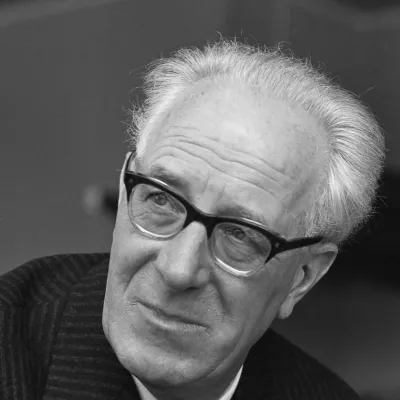
Eugen Jochum
Human Design Chart
Biography
Jochum's older brother Otto Jochum (1898–1969) was a composer and choral conductor; his younger brother Georg Ludwig Jochum (1909–1970) was, like Jochum, an orchestral conductor. His daughter Veronica Jochum is a pianist on the faculty of the New England Conservatory of Music in Boston, Massachusetts.
What does Projector 1/3 mean for Eugen Jochum?
Projector 1/3 — Design at a Glance
Eugen Jochums Human Design suggests a tendency towards focused and penetrating perception. As a Projector, he did not have an intrinsic source of life energy in the sacral center. Instead, his aura acted like a bright beam that targeted weaknesses in his environment. He could immediately see what was not working or 'in the dark' for others. However, this ability to identify flaws in systems came with a significant challenge: directly addressing these shortcomings often provoked resistance as if he were shining an uncomfortable light into someone's face.
The appropriate strategy for him involved waiting for a respectful and sincerely offered invitation from others. Rather than seeking out or pushing himself actively, he should live his own harmony; then others would naturally come to him for advice. His undefined sacral center also meant that he had to alternate phases of high energy with necessary rest periods to avoid burnout. The conventional system often ignored this need. If Eugen Jochum lived according to this design, he was rewarded with success. Living against his nature led sooner or later to his Non-Self theme: bitterness.
Splenic Authority
Eugen Jochums Human Design suggests a tendency towards intuitive and immediate decision-making. His inner authority resided in the Spleen Center, a defined area for survival intelligence and health. With the Emotional and Sacral centers open – a prerequisite for this configuration in Projectors or Manifestors – his body functioned as a fine alarm system. His instinct signaled spontaneously whether a situation or environment was healthy. This immediate impulse served directly to his well-being and allowed him to rigorously distance himself from harmful influences.
The Spleen Authority, however, provides only one very fine impulse in the moment of decision. Eugen Jochum therefore needed high vigilance not to ignore this signal or have it overridden by external influences. Since knowledge of what was right became available only at the moment of decision, plans often changed last minute. Long-term commitments hindered this flexibility. His design demanded much space and spontaneous alignment rather than rigid planning. A temporary retreat for decision-making supported clarity in this fine inner signal. This mechanism shaped his lifestyle: he acted according to the spontaneous health instinct that immediately showed him whether he was at the right place.
The 1/3 Profile — Investigator / Martyr
Eugen Jochums Human Design suggests a tendency towards a dual life task: deep theoretical study paired with necessary practical experimentation. As a 1/3 profile, the 'Researcher and Experimenter', his path was marked by the tension between wanting complete preparation and the necessity of action. Line 1 drove him to accumulate knowledge and understand fundamentals while line 3 compelled him to test these insights in the fire of experience.
This profile meant that his judgment only became absolutely trustworthy once he had both intellectually penetrated something and practically tested it on a gut level. There were no shortcuts; mistakes were not seen as failures but as indispensable teachers. When Jochum made a decision or confirmed a quality, this was based on double validation: theoretical assurance through line 1 and empirical confirmation through line 3.
The dynamics between these lines often created internal tensions. The energy of line 1 could lead him to hold back out of fear of not knowing enough before acting. Yet line 3 challenged him to overcome this retreat and take responsibility for his adjustments to reality. His life was thus a continuous process of learning through trial and error, where self-earned insights were the highest good. Only in this way could he find harmony that required clear structures and tested truths.
Split Definition — Defined & Open Centers
Eugen Jochums design points to a tendency towards constant mental pressure and a strong, independent willpower. The definition between the Head Center and Ajna Center created a permanent inner drive to question things and understand connections conceptually. This process occurred independently of external circumstances; he always thought in a specific, trustworthy way. Simultaneously, his defined Heart Center provided a constant source of willpower and ego energy. This allowed him to keep promises and structure his life according to his own criteria while seeking recognition for his contributions. The also defined Spleen Center gave him an intuitive body awareness that acted in the present moment and made spontaneous judgments about health and well-being.
These stable internal resources contrasted with the openness of several other centers. His open Throat Center meant he did not speak or act consistently; instead, it drew attention to itself when he waited for the right invitation. Attempts to actively force attention would have frustrated him and strained his vocal cords. His open G Center showed no fixed identity or life direction. He tended to blend with his environment and adopt directions from others to find what was correct for him. The search for a firm 'self' definition here would be misplaced; instead, he reflected the energy of those he encountered.
His open Sacral Center lacked a constant energy flow. He was prone to absorbing the vital energy of others and amplifying it, which could lead to exhaustion when overburdened. It was important for him to take breaks and not try to keep up with people who have defined Sacral Centers in terms of endurance. Additionally, his open Solar Plexus Center absorbed the emotions of his surroundings. He could feel emotionally unsettled if he was in charged fields without these feelings being his own. His open Root Center took on external stress; he amplified the adrenal impact of others rather than generating it himself. The attempt to escape this pressure through constant activity would have overwhelmed him. Instead, he benefited from observing foreign stress and withdrawing when necessary to find calm.
Channels for mental clarity and instinctive devotion.
Eugen Jochums design points towards spontaneous, mutative insights paired with an instinctive awareness of what the tribe or community truly needed. His mind did not seek logical patterns from the past but waited for the moment of Satori where knowledge simply arrived.
The channel of Awareness 61-24 connects his Head Center to his Ajna Center. Here, the pressure to know the unknown (Gate 61) transforms through rational processing in the Ajna Center (Gate 24) into individual insight. This process was uncontrollable; it happened at its own pace, often triggered by silence or auditory stimuli. Jochum could not use his thinking to achieve goals but had to trust the happy coincidence of inner truth.
Simultaneously, the channel of Devotion 44-26 between Spleen and Heart Center worked. This connection gave him a deep tribal awareness (Gate 44) and ego strength to convincingly communicate his insights (Gate 26). He had an instinct for what others needed – often before they knew it themselves – and used his willpower to implement improvements for the tribe. This was not mere selling but an instinctive adaptation to group needs, supported by a fine perception of threats or opportunities.
Additional gates shaped this attitude: Gate 33 promoted reflection and withdrawal as prerequisites for clarity, while Gate 19 emphasized the need for secure territory and supportive community. Gate 32 ensured continuity and tested new situations for stability before initiating radical changes. Gate 43 enabled breakthroughs of individual insights through inner dialogue that sought recognition but carried fear of rejection. Gate 57 offered intuitive clarity in the here and now, while Gate 50 served as a conservative protective reflex to preserve traditional values. Jochum thus appeared as someone who waited quietly for inspiration to come, then instinctively adjusted it to fit his environment's needs and brought it forth with convincing power.
Individual Circuitry — Circuit Signature
Eugen Jochums design points towards impulsive, creative flashes of insight. This trait stems from the Knowledge Circuit where channel 24-61 (Awareness) was active in him. It connects Head Center to Ajna Center. This generated a pulsating energy in the present moment aimed at exploring new paths and expressing unique identity. Since these two centers are grouped together, this inspiring power flowed directly and immediately.
Simultaneously, Eugen Jochum showed a separate energetic structure in the Ego Circuit. Here channel 26-44 (Devotion) was active, connecting Heart Center to Spleen Center. This connection lay in a second, independent group and did not engage in direct exchange with thought impulses from the Knowledge Circuit. The Ego Circuit emphasized cooperation and the joint creation of resources through mediation skills. Since there was no connection to Sacral Center, the constant life force stream was missing; this required necessary rest periods for regenerating material and emotional reserves for the tribe. The shared definition meant that these two systems – creative inspiration in Head-Ajna area and resource-oriented cooperation between Heart and Spleen – worked as coexisting but not directly connected forces. Eugen Jochum had to integrate these different energies separately without a continuous flow uniting all areas.
Right Angle Cross of the Four Ways 3
Eugen Jochums Human-Design profile featured the specific imprint of the right cross of the four paths. This configuration was characterized by a profound connection to the material and physical aspects of life, paired with a clear orientation towards ethical and spiritual values. For Eugen Jochum, this did not mean an internal conflict between worldly concerns and spirituality but rather the ability to integrate both. His design promoted an approach where practical actions and material security were understood as expressions of higher consciousness. He was someone rooted in the present moment without losing sight of what is essential. The mechanics of this cross suggested that true freedom and self-actualization could be achieved through accepted participation in material life, not by rejecting it. Eugen Jochum lived this integration by channeling his energy into tangible realities carried by an inner order and a clear value system. His path was to make the spiritual dimension visible in everyday life and use material successes as means for further development of consciousness, not as ends in themselves. This shaped his entire orientation towards holistic living.
Saturn Return · Uranus Opposition · Chiron Return · 2nd Saturn Return — Life Cycles
Eugen Jochums Human-Design profile indicated a tendency toward structural anchoring, particularly during phases of personal maturation. He was someone who translated inner clarity into outer order – not through spontaneous impulses but by patiently waiting for the right moment. This attitude aligned with his strategy: to wait on life rather than force it.
The Chiron Return occurred between the ages of 49 and 51 – a cycle of fulfillment in which the Inkarnation Cross unfolds, provided one has lived according to strategy and authority beforehand. For Eugen Jochum, this phase did not mark healing old wounds but the bloom of what he had already built: his ability to carry complex structures and make them accessible to others.
In 1949, at age 47 – shortly before the peak of the Chiron Return – he founded the Symphony Orchestra of Bavarian Broadcasting. This event was no coincidence but an expression of long-term development: years of preparation, waiting for the right opportunity, and trusting his inner direction culminated in a concrete, sustainable creation. Until 1960, he led the orchestra and shaped it into one of Germany's leading ensembles – a visible sign that his design came fully to fruition during this phase.
Projector · Splenic Authority — Synthesis
Eugen Jochum was a Projector whose life was marked by a deep inner commitment to truth-seeking and pattern recognition. His defined Head Center and Ajna Center (Channel of Awareness) created a constant mental pressure to question and understand the unknown – a process that drove him as an Investigator (Profile 1/3) to validate knowledge through experience. This combination of theoretical curiosity and practical experimentation led to a pronounced ability to analyze systems and uncover improvement potentials, always seeking the authentic core. His Spleen Center as authority indicates he instinctively sought to identify healthy environments and distance himself from harmful influences.
A central paradox in his design lay in the interplay between the projection power of his type and the need for recognition. As a Projector, he could bring light into darkness for others, point out errors, and show innovative paths. At the same time, his open Sacral Center required an invitation to effectively use his energy – a tension field between the urge to inspire and the necessity to be seen and appreciated first. This may have led him to seek environments where his expertise was recognized, as evidenced by the founding of the orchestra that provided space for creative expression.
2 Defined Channels
Incarnation Cross - Right Angle Cross of the Four Ways 3
Solar Return
The Solar Return shows the moment when the sun returns to its exact birth position - your personal solar year.
Life Cycles
Discover the life cycles with a detailed triple view (birth chart, cycle chart, composite).
Human Design Profile
- Type
- Projector
- Strategy
- Wait for the respectful invitation
- Authority
- Splenic Authority
- Profile
- 1/3 - Investigator / Martyr
- Definition
- Split Definition
- Incarnation Cross
- Right Angle Cross of the Four Ways 3
- Date of Birth
- 01.11.1902 10:00
- Place of Birth
- Babenhausen/Bayern, Germany
Frequently Asked Questions
What was Eugen Jochum's Human Design type?
Which Profile did Eugen Jochum have?
What Authority guided Eugen Jochum's decisions?
What incarnation cross did Eugen Jochum carry?
When was Eugen Jochum born?
Discover your own Human Design
Are you also a Projector? Find out in a personal reading how to unfold your leadership qualities and recognize the right invitations.
More Personalities
Back to overviewSissy Spacek

Aaliyah

Alain-Fournier

Alexia

Alizée

Anémone
