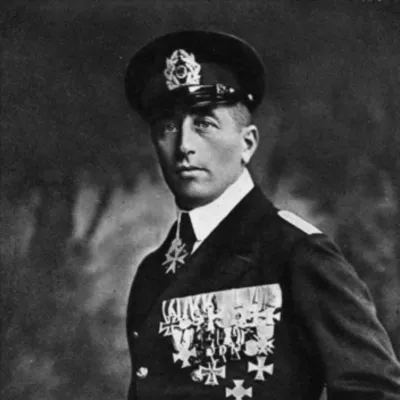
Felix von Luckner
Human Design Chart
Biography
In his youth he sailed to Fremantle, Western Australia, where he jumped ship and for seven years worked in a bewildering array of occupations: he was a seller of the Salvation Army's The War Cry; an assistant lighthouse keeper at the Cape Leeuwin Lighthouse in Augusta, Western Australia, a job he abandoned when he was discovered with the lighthouse keeper's daughter by her father; a kangaroo hunter; a circus worker; a professional boxer (due to his exceptional strength); a fisherman; and a seaman. In Latin America he was a guard in the Mexican Army for President Díaz, a railway construction worker, a barman, and a tavern keeper. He was incarcerated for a short time in a Chilean jail accused of stealing pigs, he twice suffered broken legs, and he was thrown out of a hospital in Jamaica for lack of money.
In February 1912 thirty-year-old Luckner was called up by the Navy and served on the gunboat SMS Panther. He saw action at the Battle of Heligoland Bight (1914). At the Battle of Jutland (1916) he commanded a gun turret on board the battleship Kronprinz Wilhelm.
Hoping to revive commerce raiding, the Imperial Navy equipped the impounded three-masted sailing ship Pass of Balmaha (1,571 tons) with two 105 mm guns hidden behind hinged gunwales, several machine guns, and two carefully hidden 500 HP auxiliary engines. She was commissioned as the auxiliary cruiser Seeadler ("Sea Eagle").
What does Manifestor 2/5 mean for Felix von Luckner?
Manifestor 2/5 — Design at a Glance
Felix von Luckner's Human Design shows a tendency towards proactive action and the role of a leader. As a Manifestor, he was designed to lead the world into a new future, similar to an emperor in ancient Rome who had visions but did not lead every battle himself. This configuration often led to misunderstandings, as his thinking extended beyond that of his surroundings. This resulted in polarizing reactions: while some loved and followed him for his great dreams, others rejected or even hated him because of these visions.
To find the right followers, it was crucial for his design to inform others about his intentions in a timely and precise manner. This formed the ideal strategy for him. If he followed this strategy and respected his authority, he was rewarded with a sense of inner peace. Living against this design, however, he felt a persistent, deep anger. Thus, his character trait as a pioneer and visionary shaped his entire work, with the balance between informing action and the resulting emotional reward or frustration being central.
Emotional Authority
Felix von Luckner was someone who did not make decisions based on initial, intense emotional impulses. His design carried Emotional Authority, meaning his defined Emotional Center acted as the internal authority – independent of all other defined centers in his chart. This configuration was subject to a natural emotional wave, a permanent up and down of feelings. Felix von Luckner saw the world colored by his current mood; a moment of enthusiasm could quickly turn into a negative perspective. Since these feelings were only snapshots and first impressions, they did not necessarily represent his deeper truth. Quick, spontaneous decisions from such an emotional state could have had negative consequences for him. Instead, his mechanism required patience and time. Felix von Luckner let decisions mature, slept on them multiple times, and sought emotional distance. Only when the intense feelings subsided did clarity and calmness set in for him. This process was essential for long-term decisions that significantly influenced his life course. Through delaying and waiting, he gained the necessary depth to recognize comprehensively rather than reacting to superficial impulses. His inner truth emerged only after going through this emotional cycle.
The 2/5 Profile — Hermit / Heretic
Felix von Luckner navigated between the urgent need for withdrawal and the expectation of others to rely on him as a problem solver. His design was marked by Profile 2/5, a configuration that showed tension between the Hermit Line (2) and the Hero Line (5). While Line 2 required him much time for himself and inner clarity, others sought solutions from him and expected quick help due to Line 5. This created a dynamic in which Felix von Luckner had to carefully weigh where he wanted to invest his energy to avoid falling into the role of a constant rescuer.
His presence often worked like that of a tribal leader who checks for consensus and develops methods that can serve others. At the same time, however, he refused blind conformity when foreign methods contradicted his personal interests. In crisis situations, he showed a direct, mutative ability to act that produced unconventional solutions. This directness could trigger negative projections in others as it violated established behavioral norms, but it was essential for his way of finding practical answers to urgent problems. Felix von Luckner thus used his withdrawal phases strategically to determine when and for whom he would use his abilities as a hero, without forgetting his own essence.
Split Definition — Defined & Open Centers
Felix von Luckner's Human Design shows a tendency towards consequent, independent will expression, paired with a complex emotional and mental structure. His defined Heart Center provided him with a constant source of willpower and ego strength; he was designed to take control of his life, keep promises, and prove his worth through action. This energy served as a driving force for him to control resources and be successful as long as he followed his inner guidance.
This determination was channeled through his defined Throat Center, which acted as a pivot point for communication and manifestation. It allowed him to make his intentions and concepts visible in the world. However, this expression power was closely linked to his defined Ajna Center, the center of conceptual thinking. Felix von Luckner had a constant, specific mental function that enabled him to create concepts and pressure others into thinking. His mind was always active, which helped him process data but also made him prone to compulsive behavior with unfinished decisions.
Additionally, he had a defined Solar Plexus Center, which formed his inner authority. This meant that he had to be patient and wait for the emotional wave to pass before acting. His emotional clarity did not arise in the moment but through going through the emotional phases. Furthermore, his defined Spleen Center gave him a reliable, spontaneous intuition for health and well-being in the present moment.
In contrast, his open centers shaped his vulnerabilities. His open Head Center made him susceptible to mental pressure and the questions of others, which he often interpreted as his own. His open G Center led him to take identity and direction from the environment rather than owning them. His open Sacral Center made him amplify foreign energies, leading to exhaustion if he ignored boundaries. Finally, his open Root Center absorbed external stress, leading him to internalize adrenalized pressure from the environment and try to get rid of this non-self pressure through overactivity.
Channels for dedication, curious seeking and emotional openness.
Felix von Luckner used stories to make complex ideas tangible and his social interaction strongly depended on his emotional mood. This attitude resulted from Channel of Curiosity 11-56, which connects the Ajna Center with the Throat Center. This channel drove him to constantly seek new stimuli, not to find definitive truths, but to transform ideas into captivating narratives. He functioned as a storyteller, preparing abstract information through filling gaps and imagination so that it influenced and taught others. His creativity lay in translating philosophical contemplations into life parables meant for further storytelling.
Simultaneously, Channel of Openness 22-12 shaped his way of communication. It connected the Solar Plexus Center with the Throat Center and subjected his articulation to the emotional wave. His ability to achieve emotional impact through voice and expression depended on his current mood. He did not seek constant social connection but waited until he felt in the mood to bring his mutative potential into play. Only then could he encourage others and dissolve barriers; forced socializing led to abruptness.
In the background, Channel of Devotion 44-26 from the personality, connecting the Spleen and Heart Centers, gave him an instinctive sense of what the tribe needed, combined with the willpower to convincingly 'sell' it. He was designed to generate resources and supply his team, waiting for market recognition to use his platform.
Additionally, Gate 45 (tribal energy and hierarchy), Gate 47 (collective understanding of the past), Gate 40 (liberation and recovery), Gate 24 (individual mental mutation), and Gate 8 (contribution and identity) contributed to his configuration. These gates underscored his need for meaningful structure, inner peace after performance, and the desire to receive attention and support through individual uniqueness.
Tribal Circuitry — Circuit Signature
Felix von Luckner was marked by two separate, parallel functioning energetic blocks. The first block connected the Throat, Solar Plexus, and Ajna Centers. Here, the Knowledge Circuit drove the search for the unique path. Channel of Openness (12-22) directly connected the Throat and Solar Plexus Centers. This allowed him to express emotional waves from the Solar Plexus immediately through the Throat Center. His identity was pulsing and acoustic, driven by the need to creatively and individually formulate new insights. Parallel to this, the Meaning Circuit was at work. Channel of Curiosity (11-56) connected the Ajna with the Throat Center. This promoted the ability to reflect on past experiences and recognize their meaning. The energy flowed in waves and cycles; Felix von Luckner shared these felt insights with the collective to learn together from the past. The second, isolated block included the Heart and Spleen Centers. Here, the Ego Circuit determined the dynamics. Channel of Devotion (26-44) connected these two centers. This promoted cooperation and the joint creation of resources. Since there was no connection to the Sacral Center, the constant life force was missing. Felix von Luckner therefore needed rest periods to rebuild energy for the tribe. His actions were traditional and conservative, marked by a clear relationship of giving and taking. Both blocks worked independently of each other, without direct energetic exchange.
Right Angle Cross of Rulership 2
Felix von Luckners Human Design shows the structure of the right-hand cross of governance. This configuration shaped a fundamental attitude that was not about personal rule but about creating order and stability for others. In Human Design, this cross describes a specific kind of influence: it's not about exercising power in an authoritarian sense, but about establishing structures that offer security and clarity. Felix von Luckner demonstrated himself as someone who directed his energy towards shaping an environment in which others could orient themselves and act. His role was to lay the groundwork on which communities or systems could function. This was not a matter of dominance, but of responsibility for the welfare of the whole. The mechanics of this design suggested that his influence was most effective when he focused on supporting and protecting others. He lived in a way that aimed to reduce chaos and create reliable conditions. His contribution lay in the ability to provide a foundation for others to thrive through his own stability. This was the core of his expression: a serving governance defined by reliability and the creation of security, not by commands or control.
Saturn Return · Uranus Opposition · Chiron Return · 2nd Saturn Return — Life Cycles
Felix von Luckners Human Design showed a tendency towards strategic realignment and the search for new allies. This attitude was evident in 1921, when at the age of 40, he joined the Freemason lodge 'Zur goldenen Kugel' in Hamburg. This step fell into the phase of the Uranus opposition, an astrological cycle often marked by a need for freedom, breaking with old establishments, or building new, freer networks. For Luckner, this was not just a hobby entry, but an expression of his inner dynamics to move into structures that offered him more autonomy and a broader horizon than the rigid hierarchies of the past.
Later, in 1931, at the age of 50, he reached his Chiron Return. In Human Design mechanics, this period marks the 'blooming', in which the deepest life task, if lived, is realized in everyday life. Indeed, Luckner received his own weekly radio series with the American network CBS at that time. This was the moment when his personal mission, his message of global unity and understanding, found a massive, public format. The Chiron Return confirmed not a healing, but the full unfolding of his purpose: the dissemination of his vision across borders.
Manifestor · Emotional Authority — Synthesis
He was a Manifestor whose life was marked by a deep drive for initiation and an unconventional path (Manifestor type, defined Ajna). This pioneering spirit, fueled by constant mental processing (defined Ajna Center) and curiosity (Channel of Curiosity), led him to new horizons and unusual ventures. The ability to form and communicate concepts was central, as was the inner compass that always drove him towards new experiences. The profile as a natural talent and hero (2/5 Profile) points to a natural ability to offer solutions, coupled with a pronounced need for withdrawal and inner reflection to use this energy purposefully.
At the same time, an inner tension between the desire for autonomy and the emotional wave (Emotional Authority) was revealed. The necessity to let decisions mature over time stood in contrast to the impulsive action characteristic of the Manifestor type. This dynamic was evident in phases of intense activity, followed by phases of withdrawal, in which he processed experiences and sought new paths for his initiatives. The cycles emphasized this alternation by marking both professional successes (Saturn Return) and phases of transformation and upheaval (Uranus Opposition).
3 Defined Channels
Incarnation Cross - Right Angle Cross of Rulership 2
Solar Return
The Solar Return shows the moment when the sun returns to its exact birth position - your personal solar year.
Life Cycles
Discover the life cycles with a detailed triple view (birth chart, cycle chart, composite).
Human Design Profile
- Type
- Manifestor
- Strategy
- To inform others before acting
- Authority
- Emotional Authority
- Profile
- 2/5 - Hermit / Heretic
- Definition
- Split Definition
- Incarnation Cross
- Right Angle Cross of Rulership 2
- Date of Birth
- 09.06.1881 15:00
- Place of Birth
- Dresden, Germany
Frequently Asked Questions
What was Felix von Luckner's Human Design type?
What Profile did Felix von Luckner have in Human Design?
Which Authority guided Felix von Luckner?
What incarnation cross was active for Felix von Luckner?
When was Felix von Luckner born?
Discover your own Human Design
Are you also a Manifestor? Find out in a personal reading how to use your initiation power peacefully and dissolve resistance.
More Personalities
Back to overviewAlain-Fournier

Angeli

Christian-Jaque
Juninho

Kesha

Lucebert