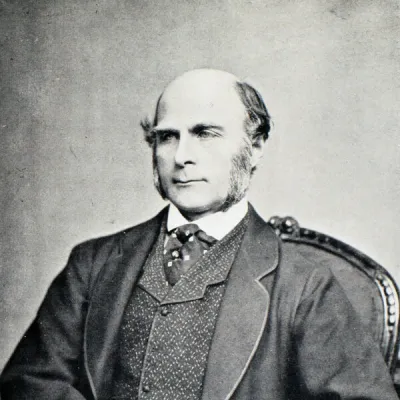
Francis Galton
Human Design Chart
Biography
Galton produced over 340 papers and books. He also developed the statistical concept of correlation and widely promoted regression toward the mean. He was the first to apply statistical methods to the study of human differences and inheritance of intelligence, and introduced the use of questionnaires and surveys for collecting data on human communities, which he needed for genealogical and biographical works and for his anthropometric studies. He popularised the phrase "nature versus nurture". His book Hereditary Genius (1869) was the first social scientific attempt to study genius and greatness.
As an investigator of the human mind, he founded psychometrics and differential psychology, as well as the lexical hypothesis of personality. He devised a method for classifying fingerprints that proved useful in forensic science. He also conducted research on the power of prayer, concluding it had none due to its null effects on the longevity of those prayed for. His quest for the scientific principles of diverse phenomena extended even to the optimal method for making tea. As the initiator of scientific meteorology, he devised the first weather map, proposed a theory of anticyclones, and was the first to establish a complete record of short-term climatic phenomena on a European scale.
Francis Galton as a Projector 4/6 in Human Design
Projector 4/6 — Design at a Glance
Francis Galton had a Projector Aura that felt like a focused flashlight. This density allowed him to spot weaknesses in systems immediately – he saw the error where others only saw chaos. But this direct confrontation with others' shortcomings could quickly be perceived as unpleasant or aggressive. Instead of pushing his observations, his true strength lay in attracting others through his clarity. His design required him to wait for an honest invitation before sharing his insights. Only then was his leadership accepted and effective.
Since his Sacral Center was undefined, Francis Galton lacked a constant, intrinsic life force. He worked in phases of high intensity, followed by necessary rest periods to avoid burnout. The conformist system that demanded constant availability stood in opposition to this rhythm. Living by the strategy of patience and waiting for recognition brought him success as a reward. Ignoring this necessity and pushing himself in, however, led sooner or later to his non-self theme: bitterness. His path was to not shine where he was not asked, but to give light where it was sought.
Splenic Authority
Francis Galton showed a decision-making stance based on immediate, physical intuition. His design carried authority in the Spleen, meaning his inner compass system was directly linked to his health and alarm system. With both his Emotional and his Sacral Center open, he had a fine survival intelligence that gave him spontaneous knowledge about whether a situation or environment was right for him.
This Spleen voice, however, appeared only as a fleeting, very subtle impulse in the moment. It could easily be drowned out by other influences, so Francis Galton needed high vigilance to hear and follow this first impulse. This spontaneous impulse served his immediate health and helped him rigorously isolate himself from harmful influences.
Since he only knew what was right for him in the moment, his plans often changed short-term. Long-term commitments were difficult for him, as they contradicted this flexibility. Instead of being bound by commitments, he preferred spontaneous agreements and kept himself much open space. A retreat to decision-making could help him hear this fine impulse clearly before acting.
The 4/6 Profile — Opportunist / Role Model
Francis Galton showed himself to be someone who was experimental and curious about relationships in the first three decades of his life before his attitude fundamentally changed. His Profile 4/6, the Networker/Role Model, shaped this development: The Line 4 initially acted like a Line 3, leading to much trial and error in friendships. Once Line 6 became active, an inner conflict emerged. Francis Galton stood between the desire to belong to a community and the urge to withdraw to think about the meaning of life. This conflict between heart and head shaped his entire later life.
Line 4, associated with Gate 30, drove him to be influential in the network. For Projectors, this energy carries risks: The desire for intense feelings could lead to an emotional breakdown if not channeled through analytical thinking. At the same time, Line 6, represented by Gate 14, demanded a confrontation with wealth, power, and humility. Francis Galton acted here only with significant mutations or new insights. His spiritual stance saw material success as divine will. In his later years, he was expected to meet the high standards of a wise role model. His heart, characteristic of Line 4, remained cautious to avoid opening up to the wrong people and getting hurt. Cooperation with others was paramount, always accompanied by the necessity of selection.
Split Definition — Defined & Open Centers
Francis Galton had a fixed, reliable self-identity and a clear sense of direction. His defined G Center gave him the ability to comfort others by helping them understand the nature of human evolution without relying on their approval. This inner security was strengthened by his defined Heart Center, which gave him willpower and control over his resources. He enjoyed working as his own boss, following his inner mechanisms, and keeping promises, which naturally bolstered his self-esteem. His defined Spleen Center provided a strong intuitive awareness in the present moment. He trusted his spontaneous judgments and immune system, living in a concerned yet mindful devotion to existence, moment by moment. The pressure from his defined Root Center drove him to rise materially and nourish survival consciousness.
At the same time, Francis Galton was vulnerable to mental confusion due to his open Head Center. He tended to engage with questions that were not his own and sought inspiration to relieve mental pressure. His open Ajna Center made him receptive to other people's concepts, putting him at risk of holding others' opinions as his own truth or appearing unsure to be accepted. The open Throat Center brought the fear of not being noticed, leading him to force attention through unpredictable speaking rather than waiting for invitations. His open Sacral Center allowed him to absorb and amplify foreign energy, leading to exhaustion if he did not pause. Additionally, his open Solar Plexus absorbed the emotions of the environment, causing him to fluctuate between happiness and depression without recognizing these feelings as his own.
Channels for pioneering spirit and the search for life's meaning.
Francis Galton's design inclined him towards competitive forward movement, coupled with the ability to inspire others to individualize. This was evident through the Initiation Channel 51-25. It connected the egoistic energy of Gate 51, which always wants to be first, with the universal love of Gate 25. This configuration made Initiation an art: recognizing the potential for individualization and, when invited, delivering the necessary shock to strengthen others. It was a transformative force that exerted pressure on humanity to develop deeper consciousness, where mastery over the self and the world went hand in hand.
Parallel to this, the Life Struggle Channel 28-38 worked. It connected the Root Center with the Spleen Center and drove the search for meaning in life's struggles. Gate 28 intuitively recognized which struggle was worth it and rewarding, while Gate 38 provided the pressure to maintain individual integrity against external distractions. This connection gave a stubborn determination to follow one's own path and find meaning in struggles, serving as an example for others.
Additionally, specific Gates shaped his profile. Gate 30 contributed to the recognition of feelings and the longing for positive experiences, often seeing freedom as an illusion. Gate 14 ensured skillful power preservation and direction finding. Gate 8 promoted the individual contribution to group goals and the activation of uniqueness. Gate 29 in the Sacral Center emphasized persistence and saying yes to challenges correctly. Gate 58 in the Root Center enabled experiments and the refinement of processes through pattern recognition. Gate 10 in the G Center integrated complex behavioral rules and genetically fixed beliefs.
Individual Circuitry — Circuit Signature
Francis Galton's design inclined him towards inner strength and pragmatic endurance. His split definition meant that two separate energetic blocks worked in parallel without directly merging. The Knowledge Circuit connected his Spleen and Root Centers through the Life Struggle Channel. This created a pulsing energy that responded to acute necessities and formed survival strategies in the present moment. Parallel to this, the Centering Circuit connected his Identity with the Heart Center through the Initiation Channel. This connection strengthened his self-esteem and deep convictions, giving him courage and a strong, individual imprint. However, lacking a connection to the Throat Center, these firm inner stances often remained unspoken or hard to put into words. The two circuits colored his entire being, on one hand providing the ability for quick, instinctive problem-solving (Spleen-Root) and on the other hand a steadfast inner identity (Identity-Heart). Thus, Francis Galton was someone who acted through inner strength and practical adaptability, with the emotional and identity-forming level operating separately from the immediate survival reaction.
Right Angle Cross of Contagion 1
Francis Galton's Human Design profile established a specific, often unconscious aura that prompted others to align with him or adopt his ideas. This dynamic was characterized by the right infection cross, a configuration that did not exert a conscious persuasive force in the traditional sense but rather exerted a magnetic influence. People often intuitively absorbed his attitudes and beliefs, as if infected, without Francis Galton having to actively persuade them. It was a passive yet effective force that blurred the boundaries between individuals and facilitated the rapid spread of his internal states. This mechanism did not mean that Francis Galton exercised control over others but rather that his energy generated a kind of resonance that triggered imitation and identification. For him, this was an inherent part of his structure that significantly shaped his interactions with the world. The effect of this cross was evident in the way his presence impacted others: not through argumentation but through a near physical infection with his thoughts and feelings. This shaped his social environment and the way he was perceived as someone who spread attitudes through mere presence.
Saturn Return · Uranus Opposition · Chiron Return · 2nd Saturn Return — Life Cycles
Francis Galton's Human Design profile set a tendency towards long-term, structured development that condensed into clear phases. The first Saturn return often marked the transition from preparation to concrete implementation. In 1850, at the age of 28, he embarked on a research trip to South West Africa. This was not a random step but the moment when years of groundwork condensed into a tangible, external result.
The Uranus opposition around the age of 41 often brought a phase of breaking free from old structures and publishing new insights. In 1863, Francis Galton published his book *Meteorographica*. This work symbolized the success that came from the ability to integrate new perspectives into established systems and make them visible.
The Chiron return, a fulfillment cycle between the ages of 49 and 51, marked the bloom of his incarnation purpose. Those who had lived according to their strategy now experienced the deepening unfolding of their life's meaning. In 1869, at the age of 47, Francis Galton published his most famous work *Hereditary Genius*. This was the peak of this phase, where the deeper life purpose showed as tangible success and the inner purpose became experiential.
Projector · Splenic Authority — Synthesis
He was a projector, defined by his clear G Center, which gave him a distinct direction and identity. This inner security allowed him to see and understand where others needed support—he effortlessly found the flaw in the system (Channel 51-25). However, this ability to recognize patterns and provide insights was always coupled with an inner drive to create something new and transform knowledge (Knowledge Circuit), which propelled him to initiate changes and influence the world around him. The connection between self-identity and the desire for innovation shaped his work profoundly.
A central tension arose from the interplay between Heart and Head (Profile 4/6). On one hand, he sought belonging and cooperation (Line 4), while on the other, he felt the urge to distance himself from others and ponder overarching questions (Line 6). This interplay between social connection and the need for individual reflection led to internal conflicts but also showed in the ability to both observe and initiate—a life marked by the search for balance between understanding others and pursuing unique insights.
2 Defined Channels
Incarnation Cross - Right Angle Cross of Contagion 1
Solar Return
The Solar Return shows the moment when the sun returns to its exact birth position - your personal solar year.
Life Cycles
Discover the life cycles with a detailed triple view (birth chart, cycle chart, composite).
Human Design Profile
- Type
- Projector
- Strategy
- Wait for the respectful invitation
- Authority
- Splenic Authority
- Profile
- 4/6 - Opportunist / Role Model
- Definition
- Split Definition
- Incarnation Cross
- Right Angle Cross of Contagion 1
- Date of Birth
- 16.02.1822 21:00
- Place of Birth
- Birmingham, England, United Kingdom
Frequently Asked Questions
What was Francis Galton's Human Design type?
What profile did Francis Galton have?
What authority did Francis Galton have?
What incarnation cross did Francis Galton have?
When was Francis Galton born?
Discover your own Human Design
Are you also a Projector? Find out in a personal reading how to unfold your leadership qualities and recognize the right invitations.
More Personalities
Back to overviewSissy Spacek

Alain-Fournier

Anémone

Ann-Margret

Bourvil
Hergé