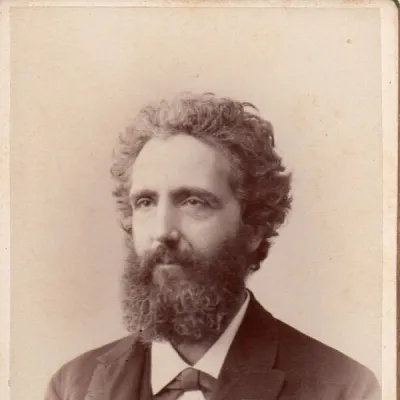
Franz Brentano
Human Design Chart
Biography
Originally a Catholic priest, Brentano withdrew from the priesthood in 1873 due to the dogmatic definition of papal infallibility in Pastor aeternus. Working subsequently as a non-denominational professor, his teaching triggered research in a wide array of fields such as linguistics, logic, mathematics and experimental psychology through the young generation of philosophers who were gathered as the School of Brentano.
What does Projector 6/2 mean for Franz Brentano?
Projector 6/2 — Design at a Glance
Franz Brentano revealed himself as someone with a focusing aura. His Projector Design endowed him with the ability to immediately recognize where errors lay or processes stalled in other systems. This perception was akin to a bright flashlight that uncovered areas left in darkness.
However, this direct confrontation with weaknesses often proved counterproductive. When he pointed out these flaws abruptly, it felt like glaring light into someone's face and frequently met resistance or anger. A more effective approach involved attracting others through his own harmonious actions. People then sought him out voluntarily to benefit from his clarity.
As Franz Brentano lacked a defined Sacral Center in his Projector Design, he did not have a constant intrinsic energy source. Instead, he experienced phases of high intensity and rapid productivity followed by necessary rest periods for regeneration. A steady, uniform work rhythm quickly led to exhaustion. His success depended largely on waiting for appreciative, honest invitations from others before taking on leadership roles. Without adhering to this invitation-and-restraint strategy, feelings of bitterness as an expression of not being in control would eventually surface.
Emotional Authority
Franz Brentano exhibited a decision-making stance that did not follow the first emotional reaction but was based on conscious delay. His design featured Emotional Authority, meaning his defined Emotional Center held inner guidance – independent of other defined areas in his chart. This configuration subjected him to a natural wave pattern of emotions: moods swung between enthusiasm and rejection, with each moment only a provisional coloring, not the final truth. Spontaneous judgments from this fleeting emotion would often lead him astray. Instead, his mechanism required patience and conscious waiting for clarity. By letting decisions sleep and taking time, intense inner movements subsided. Only then did calmness set in and allowed deeper, more comprehensive insight. This process was particularly crucial for long-term decision-making that shaped his life trajectory sustainably. Through waiting, he gained emotional distance from the current mood state and could act according to his true inner truth rather than reacting only to a first impression, often misleading.
The 6/2 Profile — Role Model / Hermit
Franz Brentano's design was characterized by clear biphasicity: In his youth, Profile 6/2 drove him towards experimentation. Here, the principle of trial and error applied; he gathered life experience but withdrew after failures to learn. This early phase was marked by the necessity of finding one's own path through trying.
After turning thirty with the activation of the sixth line, his attitude fundamentally changed. Franz Brentano metaphorically retreated into a 'cave' to reflect on past experiments from a distance. This period served for intensive reflection, healing, and deep self-knowledge. The sixth line promoted the mutation of knowledge into collective wisdom; it reviewed the practicality of earlier solutions and decided which insights were socially relevant.
At the same time, Line 2 of Gate 50 projected determination. Franz Brentano presented his ideas intelligently but encountered resistance as his value stance had not yet gained broad support. Instead of confrontation, he chose withdrawal or used friends' support to circumvent this opposition.
Once the phase of reflection was complete, Franz Brentano emerged as a wise figure. Others now sought his counsel to partake in his life wisdom and learn the ability for deep introspection. His design thus showed the path from an experimenting seeker to an acknowledged role model validating collective knowledge through personal verification.
Single Definition — Defined & Open Centers
Franz Brentano was marked by a defined Heart Center, which gave him natural willpower and the desire for self-determination. He tended to shape his life actively and tried to consistently keep promises in order to strengthen his self-esteem. At the same time, his defined Solar Plexus acted as an emotional authority; he needed time to go through the waves of his feelings before finding clarity in decisions. This combination created a person who could appear powerful but only recognized their deeper truth after emotional impulses subsided.
In contrast, his design revealed several sensitive areas. His open Head Center made him vulnerable to mental pressure and confusion; he tended to engage with questions that did not originate from him or sought inspiration to quiet this inner noise. His open Ajna Center meant that his conceptual thinking was flexible but could also lead to over-identification with foreign opinions, causing him to compensate for uncertainty through imposed security.
Furthermore, the open G Center and open Sacral Center worked together. Without a fixed identity or constant energy source, he relied on being initiated by his environment. He tended to lose himself in relationships or environments to "borrow" a sense of direction or strength, which often led to exhaustion as he amplified foreign energies rather than generating them himself. His open Root Center also absorbed external stress, causing him to unnecessarily put pressure on himself to escape this adrenergic feeling. His challenge lay in not seeing these open fields as deficiencies but as mirrors for the correct choice of his environment and partners.
Channels for authentic connection between freedom and heart.
Franz Brentanos Design points to a tendency towards strategic, reciprocal connections. He sought his place in the whole and understood the necessity of building bridges between individuals to create communities with honourable functions for all members. This was shaped by the Community Channel 37-40, connecting Solar Plexus and Heart. This configuration required time to gain emotional clarity about agreements; spontaneous closures were impossible. Instead, he sought the right personal invitation or "touch" to enter organizations, where willpower sealed the connections.
Additionally, specific Gates influenced his perception and ability to act. Gate 61 in the Circuit of Knowledge drove him towards seeking inner truth and silence, a process of thought mutation from individual to collective understanding. Gate 62 promoted logical pattern recognition and fact clarification through patience and concentration, presenting facts convincingly. In the realm of survival, Gate 3 in the Sacral Center supported mutations to create new orders out of confusion, while Gate 50 as a conservative protective reflex preserved tribal values and traditions. On the level of personality, Gate 6 with its emotional waves of fertility, along with Gate 21 seeking control over material things and recognition within the community, were influential. In his design itself, Gate 55 with its extreme mood swings shaped emotional awareness, while Gate 51 provided a strong willpower without social bonds that reacted to shocks with insight and chose between material or spiritual development. These mechanisms formed a person who linked logical structures with emotional depth to establish stable community ties.
Tribal Circuitry — Circuit Signature
Franz Brentano's design inclines towards cooperative action where mutual support is prioritized. As a person with a simple definition, he possesses a coherent energetic flow that does not fragment into isolated islands but rather acts as an integrated force.
This flow forms the Ego Circuit, a system that does not primarily seek individual fame but instead promotes the joint creation of resources. For Franz Brentano, this circuit was activated by Channel 37-40, connecting the Heart Center with the Solar Plexus Center. This connection established a clear dynamic of giving and taking: an inner readiness to support (Heart) met the emotional processing and perception of these interactions (Solar Plexus). It was about a fair relationship where help was given with the implicit expectation or experience that this gesture would be reciprocated in the social fabric.
Since this circuit does not connect to the Sacral Center, there is no constant self-regulating life force for this specific theme. Instead, emotional waves and a certain conservatism or loyalty to tradition prevail here. This means that Franz Brentano needed pauses in areas of cooperation and resource acquisition to generate new energy. He could not operate continuously at this level without exhausting himself. Rest periods were necessary to maintain his capacity for support and understanding of social exchange processes sustainably. His design thus showed a structure based on mutual help but marked by emotional cycles and essential recovery phases rather than an uninterrupted, autonomous drive in this area.
Left Angle Cross of Obscuration 2
Franz Brentano's design indicated a tendency towards internal confusion that was triggered by external circumstances or other people. This configuration, known as the left cross of veiling, described a pattern in which clarity often temporarily vanished. It wasn't due to a lack of understanding but rather a specific kind of perception that was vulnerable to disturbances.
In this state, Franz Brentano could misunderstand simple connections or draw false conclusions when under pressure or influenced from outside. The mechanics of this cross showed that inner security could be shaken by external factors. This led to temporary uncertainty in decisions and assessments.
The challenge lay in recognizing these phases of confusion and not accepting them as final truth. Franz Brentano had to learn to pause in such moments and seek calm to regain his clarity. Without this pause, the veiling could persist and lead to misjudgments.
Thus, the design demanded a conscious confrontation with these disruptive sources. It was about protecting one's perception and not accepting every external input unfiltered. Through understanding this inclination, Franz Brentano learned to wait in moments of uncertainty until clarity returned. This was an essential part of his inner development to return to his center despite external influences.
Saturn Return · Uranus Opposition · Chiron Return · 2nd Saturn Return — Life Cycles
Franz Brentano's design showed a tendency towards profound structural transformation phases that corresponded with clear biographical turning points. In 1864, at the age of 26 and during his first Saturn Return cycle, he was ordained as a priest. This cycle often marks the transition into a more stable life phase where earlier impulses solidify into a viable professional or spiritual identity.
Later, in 1879 at the age of 41, he left the church – an event that coincided with his Uranus opposition. This phase often brings internal tensions and a drive for individual freedom from established structures, manifesting here as a crisis and break from previous commitments.
At 50 years old in 1888 during his Chiron Return cycle, his son Johann Michael was born. This cycle is seen as the fulfillment phase where one's life purpose increasingly materializes; the birth of his son can be understood as an expression of this flourishing and sense-making period.
Finally, he moved to Florence in 1895 at the age of 57 and married Emilie Rueprecht. This occurred during his second Saturn Return cycle, often initiating a reconsolidation and restructuring of private relationships. Franz Brentano's path followed these rhythmic patterns of his astrological configurations, with each cycle shaping a specific aspect of his life journey – from binding through release to new foundation.
Projector · Emotional Authority — Synthesis
Franz Brentano was a projector whose defined Heart Center (and the Channel of Community) showed a strong tendency towards self-determination and resource building. This combined with a natural ability to recognize weaknesses in systems (projector design), yet not directly impose them but subtly hint at them instead. This combination of inner drive and fine sensitivity for others' dynamics shaped his approach to relationships and tasks – he sought opportunities to create value while also pursuing his own path. The repeated turning points in his life (ordination as a priest, leaving the church, birth of his son, second marriage) pointed towards a deep engagement with personal values and their implementation.
A central paradox lay in his emotional authority, which inclined him towards profound contemplation and slow decision-making while his profile as an exemplar (6/2) required intense experience for wise perspective that he could impart. The early years were marked by experimental freedom, followed by a need for withdrawal and reflection to finally make his insights accessible – a dynamic interplay between active experimentation and passive observation that propelled him forward.
1 Defined Channel
Incarnation Cross - Left Angle Cross of Obscuration 2
Solar Return
The Solar Return shows the moment when the sun returns to its exact birth position - your personal solar year.
Life Cycles
Discover the life cycles with a detailed triple view (birth chart, cycle chart, composite).
Human Design Profile
- Type
- Projector
- Strategy
- Wait for the respectful invitation
- Authority
- Emotional Authority
- Profile
- 6/2 - Role Model / Hermit
- Definition
- Single Definition
- Incarnation Cross
- Left Angle Cross of Obscuration 2
- Date of Birth
- 16.01.1838 12:00
- Place of Birth
- Boppard, Germany
Frequently Asked Questions
What was Franz Brentano's Human Design type?
What profile did Franz Brentano have?
What authority did Franz Brentano have?
What incarnation cross did Franz Brentano have?
When was Franz Brentano born?
Discover your own Human Design
Are you also a Projector? Find out in a personal reading how to unfold your leadership qualities and recognize the right invitations.
More Personalities
Back to overviewSissy Spacek

Alain-Fournier

Anémone

Ann-Margret

Bourvil
Hergé