
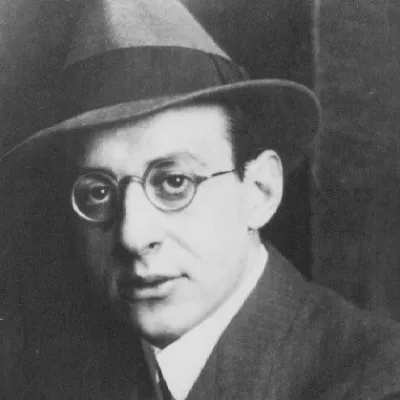
Fritz Perls
Human Design Chart
Biography
The core of the Gestalt Therapy process is enhanced awareness of sensation, perception, bodily feelings, emotion, and behavior, in the present moment. Relationship is emphasized, along with contact between the self, its environment, and the other.
He died on 14 March 1970, aged 76, in Chicago, Illinois.
Human Design Analysis: Fritz Perls as Generator 2/4
Generator 2/4 — Design at a Glance
Fritz Perls possessed immense and enduring strength that made him seem like a strong workhorse. As a Generator, he had abundant sacral energy, but it was not released through spontaneous initiation; instead, it was activated solely by reacting to external impulses. His strategy involved waiting for life to send a signal and then responding with a clear internal “yes.” Only then would he act effectively from the gut.
This design carried two specific risks: either he wasted his energy on tasks without inner resonance, leading to exhaustion, or he was hindered in continuing his heart projects despite having available energy. If Fritz Perls lived in harmony with this mechanism—reactive rather than proactive—the system rewarded him with deep satisfaction and fulfillment. However, if he initiated against his natural rhythm, he encountered frustration and a lack of energy. His effectiveness depended directly on whether he correctly read the signals from his environment and acted accordingly, instead of taking the first step himself. This endurance could propel him unceasingly as long as it was guided by genuine inner consent.
Sacral Authority
Fritz Perls had sacral authority, which distinguished him as a Generator. In this type, the strategy of responding to life impulses aligns exactly with his internal decision-making process, simplifying his orientation mechanism. This required an open emotional center; external stimuli did not trigger immediate emotional reactions but waited for physical confirmation.
His inner voice manifested in physical signals like bursts of energy or vocal affirmations—grunts, hums, or verbal confirmations such as “Mhm.” As long as this sacral response was positive, he felt vital and alive. Then an apparently inexhaustible energy became available to him, enabling him to devote himself enthusiastically to his tasks. This energy source served not primarily for achieving external goals or purposefulness but for the sheer joy of being immersed in the act itself. Through this configuration, he was born to derive satisfaction directly from the exercise of his activities.
Additionally, an activated spleen center acted as a supportive instance. This connection gave him the ability to respond quickly and spontaneously to situations. He had immediate access to his physical well-being and instinctive perception. This inner compass was reliable and served as a crucial guide for his actions, complementing his sacral energy with intuitive sharpness.
The 2/4 Profile — Hermit / Opportunist
Fritz Perls lived in a constant interplay between the deep need for withdrawal and the drive towards community. His design inclined him to withdraw into intensive phases of internal reflection to create clarity before re-opening himself to his closest circle. This dynamic matched Profile 2/4, known as “Natural Talent / Networker,” embodying the tension between solitary Line 2 and community-oriented Line 4. During his alone time, he processed impressions and developed new impulses; once this inner work was complete, he sought exchange with trusted individuals. Clear communication of his needs was crucial: signaling when he needed company and when he wanted solitude. This ability to evaluate knowledge from the network in isolation shaped his way of developing brilliant ideas. Line 2 brought a natural momentum that required patience and waiting for the right impulse, while the fourth line showed some fixity in handling challenges but was balanced by inventiveness. Thus, a pattern emerged where success and setbacks were not seen as endpoints but as part of a cyclical learning process.
Single Definition — Defined & Open Centers
Fritz Perls' Human Design profile established a tendency towards a clear and independent identity. With his defined G Center, he had a reliable sense of direction and the ability to show others new paths without needing their approval. This inner authority formed the foundation of his presence: He knew who he was and could radiate this confidence without being guided by external expectations.
His energy source came from his defined Sacral Center. As a Generator, Fritz Perls possessed a constant vital force that was activated through reaction. His design called on him not to initiate but to wait until life asked questions of him before responding with a clear yes or no answer. This ensured the endurance needed for his work and protected against exhaustion caused by false initiatives.
Additionally, his defined Spleen Center acted as an intuitive instance. It provided him with spontaneous judgments about what was healthy or correct. Fritz Perls tended to trust this non-verbal body awareness that guided him in "the now" and warned of dangers before the mind could rationalize them. His defined Root Center also created a steady pressure to secure existential awareness and material survival, underpinning his actions with fundamental urgency.
In contrast, open centers showed areas of receptivity. His open Head Center made him susceptible to mental confusion or the pressure to provide answers to others' questions. He tended to get lost in intellectual monologues if he did not follow his inner authority. The open Ajna Center allowed for flexible thought processes but also posed the risk of adopting foreign opinions as personal truth or feigning uncertainty.
His open Throat Center meant that Fritz Perls lacked a consistent communication strategy. He was dependent on invitations rather than forcing attention through constant talking. His open Heart Center relieved him from the compulsion to prove willpower or keep promises he could not fulfill; he did not need to demonstrate his worth through competitions. Finally, his open Solar Plexus absorbed the emotions of others around him. He acted as a barometer for the emotional climate of those around him but was at risk of personalizing foreign moods and conflicts or losing himself in emotional waves if he did not identify them as non-self.
Channels for ambitious growth, intuitive elegance and caring values.
Fritz Perls revealed himself as someone who allowed his actions to be guided by deep intuitive impulses moment by moment. This attitude stemmed from Channel 57-10, which connected the Spleen Center with the G Center. Through Gate 57, intuitive insight, and Gate 10, self-behavior, a rare clarity emerged: He reacted spontaneously to what was perceived as out of order in his environment by paying more attention to tone and quality than to words alone. This allowed him to walk through the world existentially and unburdened, letting go of unfounded future fears and loving himself enough to remain true.
Parallel to this, Channel 27-50, which connected the Sacral Center with the Spleen Center, was at work in his design. Here, care flowed together with values and laws from Gate 27 and Gate 50 respectively. This configuration gave him an aura that automatically attracted trust; people sought his support. He possessed the potential to take responsibility for others but instinctively understood that care begins by first properly taking care of oneself—a form of "enlightened self-interest" that only worked when he trusted his sacral response.
On a personal level, further structures shaped his approach. Channel 54-32 connected the ambition from Gate 54 with the continuity from Gate 32, driven by the desire to be seen and improve one's position in life. This created a drive for recognition that was only sustainable when supported by the root. Additionally, Channel 53-42, which represented the heart of the human experience process, came into play: He entered new cycles, went through them completely, and reflected on them afterward to gain wisdom. This cyclical movement from beginning to end allowed him to learn from empirical history and make insights useful for the collective.
Individual gates like Gate 51 (willpower and shock reaction) or Gate 28 (willingness to take risks in the here and now) rounded out this profile, with the ability to react to shocks with insight being characteristic of his way of transforming confusion into new order.
Tribal Circuitry — Circuit Signature
Fritz Perls' design laid a tendency towards cyclical emotional waves that drew from the past. Since he was simply defined, all his energetic connections flowed in one continuous stream through the Sacral, Spleen, and Root Centers as well as the G Center. This created an integrated foundation where physical intuition and emotional maturity were directly interwoven.
The Meaning-Finding Circuit operated through the Channel "Maturity" (Gates 42–53). It connected Fritz Perls' Sacral Center with his Root Center. This connection allowed past experiences and emotions to be transformed into a wave-like process that sought completion, thereby gaining collective insights from it.
Parallel to this, the Ego Circuit displayed the energy of the Channel "Transformation" (Gates 32–54). This channel connected the Spleen Center with the Root Center. Here, it was not about egocentric action but rather intuitive transformation of resources and support for the tribe through skillful adaptation to the environment.
The Protector Circuit carried the Channel "Preservation" (Gates 27–50), which linked the Sacral Center with the Spleen Center. This brought a primal force of preservation and care, aimed at securing survival and integrity of one's system through instinctive nurturing.
Finally, in the Integration Circuit, the Channel "Perfect Form" (Gates 10–57) connected the Identity Center with the Spleen Center. This allowed intuitive perceptions and inner self-image to be anchored in the present situation, thereby creating high individual stability and clarity in the now. All these aspects formed a closed, mutually reinforcing whole for Fritz Perls.
Right Angle Cross of Penetration 2
Fritz Perls' Human Design indicated a tendency towards deep, often unconscious transformation. The right cross of penetration acted as an internal mechanism that did not aim for superficial adaptation but rather to break down old structures radically and reform them anew. This configuration described a process of letting go of outdated identities to make space for more authentic expressions. It was less about conscious planning than an organic, sometimes painful development where the old had to die so that new could emerge. In this context, Fritz Perls appeared as someone whose energy was directed at removing obstacles to true nature. The mechanics of this cross promoted a stance requiring confrontation with the subconscious to release blocked life forces. This shaped his way of seeing himself and others: not as static beings but as dynamic processes in constant change. Penetration here meant delving into the depths of one's psyche to make hidden patterns visible, integrate them or let them go. This path was marked by a certain harshness, as it broke through comfort zones, yet it allowed for profound renewal. Fritz Perls lived this dynamics by facing changes that emerged from his inner structure and letting them flow into his interactions.
Saturn Return · Uranus Opposition · Chiron Return · 2nd Saturn Return — Life Cycles
Fritz Perls showed himself to be someone whose life journey was characterized by clear structuring and the integration of opposites. His design indicated a tendency to transform internal tensions into tangible results. In 1930, at age 37, he married Laura Perls. This fell during his Uranus phase, a time when new relationship structures often form or existing ones are dynamically changed. The union became the foundation for their later joint work.
Later, in 1941 at age 48, he entered the South African army as a captain. This marked his Chiron return, a fulfillment cycle where one's incarnation cross unfolds and personal meaning becomes experiential. This service period was not just an interim step but a phase of deepening his own role and responsibility.
The peak of this development showed itself in 1951 at age 58 with the publication of 'Gestalt Therapy', which he wrote together with Paul Goodman and Ralph F. Hefferline. This corresponded to his second Saturn return, a time when years of groundwork condenses into a solid public result. The book stood for the crystallization of his ideas in a tangible form meant to have lasting impact. Through this sequence of relationship, service, and publication, his design was effective: inner dynamics gave rise to outer structure that defined his work.
Generator · Sacral Authority — Synthesis
He was a Generator whose life was marked by deep sacral energy (Design Perspective). This energy manifested as an unrelenting drive to tackle and complete things while in alignment with his internal motivation (Authority). His defined G Center endowed him with clear self-identity and natural direction sense (Centers), which found expression through behavior based on intuitive awareness via the Channel of Completed Form (Channels/Gates). The connection between Lines 2 and 4 in Profile (Profile Role) suggests that he oscillated between a need for inner retreat and a desire to exchange with others – a rhythm reflected in the cyclic patterns of the Perception Circuit (Circuit).
A central paradox lay in the tension between his strong creative impulse and the necessity to activate this energy through authentic reactions to external stimuli. While possessing natural authority stemming from gut feeling, he also lived in a field of tension between withdrawing into the inner self (Line 2) and connecting with a community (Line 4). Events such as marriage (Uranus Opposition), military service (Chiron Return), and the success of a book (Saturn Return) underscore that he pursued both relationships and career goals while simultaneously seeking his inner clarity.
4 Defined Channels
Incarnation Cross - Right Angle Cross of Penetration 2
Solar Return
The Solar Return shows the moment when the sun returns to its exact birth position - your personal solar year.
Life Cycles
Discover the life cycles with a detailed triple view (birth chart, cycle chart, composite).
Human Design Profile
- Type
- Generator
- Strategy
- To respond - wait for something to respond to
- Authority
- Sacral Authority
- Profile
- 2/4 - Hermit / Opportunist
- Definition
- Single Definition
- Incarnation Cross
- Right Angle Cross of Penetration 2
- Date of Birth
- 08.07.1893 04:00
- Place of Birth
- Berlin, GER
Frequently Asked Questions
What is Fritz Perls' Human Design type?
Which profile did Fritz Perls have in Human Design?
What authority guided Fritz Perls' decisions?
What incarnation cross characterized Fritz Perls?
When was Fritz Perls born?
Discover your own Human Design
Are you also a Generator? Find out in a personal reading how to use your sacral energy correctly and discover deep satisfaction.
More Personalities
Back to overviewAaliyah

Alain-Fournier

Alexia

Angèle

Angeli

Anne-Marie
