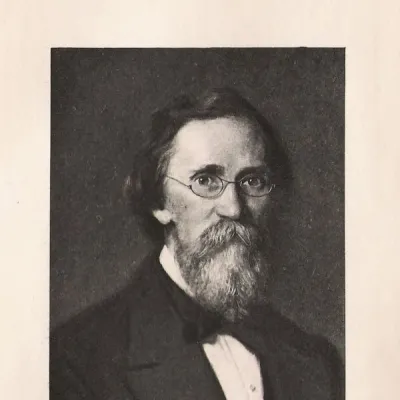
Georg Buchmann
Human Design Chart
Biography
Buchmann became well known as a result of his 1864 book Geflügelte Worte, Der Zitatenschatz des Deutschen Volkes, a collection of quotations. Specifically, the book (the title of which, loosely translated, is "Winged Words") included literary quotes that had become part of common speech. The book was such a lively popular that every year a new edition was initially required.
He died 24 February 1884 in Schöneberg.
Georg Buchmann — Projector with Profile 4/1
Projector 4/1 — Design at a Glance
Georg Buchmann's design points towards a tendency for precise system analysis. As a projector, he did not have an intrinsic source of life energy due to his undefined Sacral Center. Instead, his aura acted like a focused beam of light that immediately revealed weaknesses in other people's structures or relationships. This ability to spot the 'error in the system' was effective only when it wasn't perceived as direct criticism. An immediate confrontation with these flaws would often trigger resistance from those around him, similar to shining a bright light directly into someone's face.
The optimal strategy for Georg Buchmann involved waiting for an honest and appreciative invitation from others. By living harmonious patterns himself, he attracted people who actively sought his insights. His energy flow followed a rhythmic pattern: phases of high productivity alternated with necessary rest periods to avoid burnout. Conventional work structures demanding constant availability did not fit this natural rhythm. If he accepted the dynamics of invitations and conserved his energy, his path was rewarded by external success. Ignoring this principle of patience and waiting for recognition led over time to a feeling of bitterness as an expression of his non-self. His design therefore did not require continuous action but rather targeted shining on invitation.
Emotional Authority
Georg Buchmann's design points towards emotional depth and cyclical decision-making. His inner authority was the emotional authority, carried by the defined Emotional Center. In Human Design mechanics: If the Emotional Center is activated, it always takes over the role of internal leadership regardless of other definitions in the chart. This marked Georg Buchmann as someone whose perception and judgments were strongly colored by his current emotional state. He experienced a constant wave of ups and downs in his moods; what appeared exciting at one moment could turn negative the next. His design indicated that such fleeting impressions did not represent ultimate truth but merely initial reactions. Quick, spontaneous decisions based on these transient emotions often proved problematic for him. Instead, his mechanics required patience and time to gain clarity. By letting decisions sleep and reviewing them multiple times, intense feelings subsided. Only when emotional distance was established and calmness set in could he perceive the deeper truth of a situation. This process of waiting was not an obstacle but rather the essential path to well-founded, long-term life decisions that positively influenced his course.
The 4/1 Profile — Opportunist / Investigator
Georg Buchmann's design points towards deep, unchangeable grounding. As a 4/1 Profile – the only fixed profile in Human Design – his inherent essence was so deeply rooted within him that he rarely strayed from his individual path. This structure marks the transition from 'I' to 'You'.
His fourth line created a large heart that needed protection against injuries. This led to a specific reaction to criticism: Well-intentioned impulses for change by others were often perceived as non-acceptance of his essence. As a result, Georg Buchmann cautiously excluded such people from his emotional circle. To his surroundings, this appeared externally like stubbornness or lack of critical thinking, which sometimes shook his self-confidence.
At the same time, the first line of his profile marked a dynamic tension between confusion and clarity. Gate 57 in the Spleen indicated that intuition here did not arise as immediate certainty but through experiencing uncertainty. This confusion was no weakness but rather the necessary foundation for an extraordinary later clarity.
Only when Georg Buchmann truly recognized himself and his life theme did this inner strength become effective. Then he acted like a rock in the surf: stable, secure in his character, and capable of teaching others magnificently through his constancy or serving as a reference point. His aggressive resistance often hindered investigations; trust and individual processes were crucial for his development.
Single Definition — Defined & Open Centers
Georg Buchmann revealed himself as someone with a firmly anchored self-identity and clear inner direction, supported by his defined G Center. This stable foundation gave him the ability to comfort others and show them new perspectives without being dependent on their approval. At the same time, he had constant willpower in his Heart Center, which enabled him to keep promises and control his resources autonomously while seeking recognition for his contribution. However, his decisions were subject to the rhythm of his defined Solar Plexus Center; he needed time to gain emotional clarity rather than reacting impulsively to waves of excitement or depression. His actions were also guided by his defined Spleen Center, which gave him spontaneous intuition about health and well-being in the here and now, combined with the stable pressure of the Root Center for material existence security.
In contrast, his Head Center was open, making him vulnerable to mental confusion and putting pressure on him to find answers to questions that were not his own. He tended to get caught up in intellectual whirlpools of doubt when trying to solve these mentally rather than trusting his inner authority. Similarly, his open Ajna Center reflected the concepts and opinions of the environment, leading him to feel unsure or pretend to possess certainties to be accepted. His open Throat Center meant that he did not have a consistent communication strategy; instead of forcing attention through constant talking, he had to wait for invitations to appear authentic and powerful. Finally, his open Sacral Center lacked a constant generative energy source. He absorbed the vitality of others and amplified it, which quickly exhausted him when overloaded because he didn't know how to set boundaries or withdraw based on his own sacral answers.
Channels for intuitive form, pioneering spirit, community and emotions.
Georg Buchmann revealed himself as someone who guided his behavior from deep intuitive impulses. The Channel of Perfect Form 57-10 connected the intuitive insight with self-behavior, giving him a rare clarity to act spontaneously and appropriately without being blocked by unfounded future fears. This shaped his way of moving through the world unburdened existentially and perfecting individual survival in the present moment.
At the same time, he carried a natural competitiveness that did not exist for profit's sake. The Channel of Initiation 51-25 linked ego with self-spirit. For Georg Buchmann, this meant that through authentic living and personal triumphs, he encouraged others to recognize their potential for individuation. He delivered the necessary 'shock' of initiation only when invited, thereby mutating the collective without having to act controlling.
In interpersonal relationships, Georg Buchmann sought genuine belonging and fair agreements. The Channel of Community 37-40 connected friendship with the need for solitude and reward. He waited for the correct invitation to become part of an organization or circle and built bridges between individuals by carefully considering how a connection could be beneficial for all sides. This created harmonious relationships based on mutual respect and shared work rather than material calculation.
His emotional landscape was marked by a pulsating wave. The Channel of Emotional Release 39-55 connected provocation with the perception of mind. Georg Buchmann used this mechanism to tease out the moods of others, thereby learning who truly fit him correctly. He accepted his moods – from ecstatic joy to melancholic uncertainty – as necessary processes to explore the depth of his mind and express authentic emotional creativity.
Additionally, individual Gates influenced him: Gate 38 set boundaries for defending his identity under pressure. Gate 30 helped him see through great expectations and illusions of freedom. Gate 36 enabled him to use crises as cyclical movements for development. Gate 50 provided a conservative protective reflex that preserved his values and traditions.
Individual Circuitry — Circuit Signature
Georg Buchmann's design was characterized by a simple, coherent energetic structure. All defined centers – G Center, Spleen, Heart, Solar Plexus, and Root Center – formed one continuous flow without interrupted islands. This created in him a coherent experience where impulses could work directly from intuition through emotional processing to physical implementation.
The Knowledge Circuit connected Georg Buchmann's Solar Plexus with his Root Center. Here it was about releasing emotions and transforming new insights into tangible change, carried by a pulsating, acoustic energy. Parallel, the Centering Circuit linked Identity and Heart Centers via the Channel of Initiation. This channel promoted solidified convictions and self-worth but was inwardly directed and did not directly express through the Throat Center.
In the Ego Circuit, Georg Buchmann connected Heart and Solar Plexus Centers through the Channel of Community. This involved cooperation and resource exchange in terms of 'giving and taking', yet required pauses as there was no direct connection to the constant life force of the Sacral Center. Finally, the Integration Circuit integrated Identity with Spleen Center via the Channel of Perfect Form. Here it was about drawing strength from reacting to life and channeling intuitive knowledge in the present moment. This configuration supported his individual survival through precise, situation-appropriate actions.
Juxtaposition Cross of Opposition
Georg Buchmann's design indicated a tendency towards internal tensions arising from the simultaneous presence of conflicting impulses. This configuration, known as the Juxtaposition Cross of Contradictions, did not describe an external indecision but rather a deep structural duality in his essence. It was a pattern where two entirely different energies or needs existed side by side and generated a constant inner dialogue. For Georg Buchmann, this meant he often faced seemingly incompatible demands that could not be resolved through logical reasoning.
The mechanics of this cross were evident in the way opposites – such as between rest and movement, or the desire for connection versus the necessity of distance – were not seen as errors but as integral parts of his energy. This polarity shaped how he perceived the world: living in the tension between two poles gave him a unique ability to recognize nuances that others missed. It was not an ongoing crisis but a dynamic equilibrium that he had to maintain and utilize. The challenge lay in seeing these opposites not as obstacles, but as sources of a unique perspective. Georg Buchmann's path was thus marked by the integration of these dual forces without having to sacrifice either.
Saturn Return · Uranus Opposition · Chiron Return · 2nd Saturn Return — Life Cycles
Georg Buchmann's design indicated a tendency towards resilient structuring that manifested in systematic organization of linguistic material. This stance aligned with the mechanics of an Uranus aspect in his chart: Uranus represents innovation and breaking old patterns, while opposition points to tension resolved through clear definitions and boundaries. Buchmann did not use this energy for chaotic rebellion but rather to reorder existing knowledge and make it accessible.
In 1864, at age 42, his work 'Geflügelte Worte – The Quotation Treasury of the German People' was published. This success was no coincidence but an expression of mature Uranus energy: the ability to transform transient and everyday elements (proverbs, quotes) into a lasting innovative structure. At 42 years old, Buchmann was in the middle of his first Saturn return cycle, often leading to condensation of lifelong work. The Uranus opposition demanded balance between individual creativity and collective acceptance. His work became a mirror of an era by preserving the linguistic awareness of a people while innovating through its new form. This showed as a powerful synthesis of tradition and modern reinterpretation, precisely matching the tension described in his chart: reviving the old without destroying it.
Projector · Emotional Authority — Synthesis
Georg Buchmann was a Projector whose life seemed marked by a deep need to bring light into others' darkness. His defined G Center and Channel of Perfect Form (57/10) indicated an acute ability to gain intuitive insights about other people's behavior and integrate these for his own life design – a process always guided by strong self-worth. He lived out his individuality consistently, grounded through his fixed 4/1 profile, finding fulfillment in showing others new directions or conveying love in their lives. Emotional authority required time for decision-making to allow initial emotional impressions to mature.
A central paradox in his design lay in the combination of the projecting nature of a Projector and the cautious heart of the 4/1 line. He quickly recognized flaws in systems (Gate 57), yet the need to protect his own essence led him to reject impulses from outside if they did not align with his deeply rooted identity. This tension between wanting to illuminate others and defending against unsolicited advice shaped his interactions and was evident in documented success in 1864.
4 Defined Channels
Incarnation Cross - Juxtaposition Cross of Opposition
Solar Return
The Solar Return shows the moment when the sun returns to its exact birth position - your personal solar year.
Life Cycles
Discover the life cycles with a detailed triple view (birth chart, cycle chart, composite).
Human Design Profile
- Type
- Projector
- Strategy
- Wait for the respectful invitation
- Authority
- Emotional Authority
- Profile
- 4/1 - Opportunist / Investigator
- Definition
- Single Definition
- Incarnation Cross
- Juxtaposition Cross of Opposition
- Date of Birth
- 04.01.1822 03:00
- Place of Birth
- Berlin, Germany
Frequently Asked Questions
What was Georg Buchmann's Human Design type?
What Profile did Georg Buchmann have in his Human Design?
What authority did Georg Buchmann possess?
Which incarnation cross characterized Georg Buchmann?
When was Georg Buchmann born?
Discover your own Human Design
Are you also a Projector? Find out in a personal reading how to unfold your leadership qualities and recognize the right invitations.
More Personalities
Back to overviewSissy Spacek

Alain-Fournier

Anémone

Angeli

Ann-Margret

Bourvil