
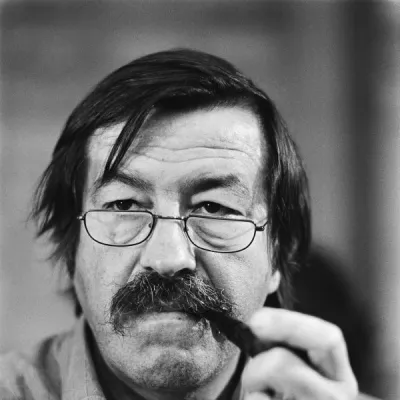
Günter Grass
Human Design Chart
Biography
What does Generator 2/4 mean for Günter Grass?
Generator 2/4 — Design at a Glance
Günter Grass had a high, enduring sacral energy that as a Generator endowed him with enormous potential for materializing projects. His design suggested he was most effective when he did not initiate things himself but responded to external impulses. This reactive strategy was key to his deep satisfaction and avoiding burnout.
As a Generator, Günter Grass possessed much energy, comparable to a strong workhorse that works efficiently only if intrinsically motivated for the task at hand. His life’s mission was to wait for signals from life and then act only when his Sacral Center gave a clear “yes.” If he ignored these inner confirmations or forced himself to work without interest, this inevitably led to frustration and energy depletion.
Two main pitfalls shaped his dynamics: either he squandered his strength on things that did not fulfill him, leading to burnout, or he was held back from his heart project even though he still had plenty of power. Successful action arose only through responding to inner confirmation. When Günter Grass accepted this reactive nature and acted from the gut, nothing could stop him. He then received as a reward a feeling of deep fulfillment. Ignoring this rhythm, however, resulted in persistent frustration. His design thus demanded patience while waiting for the right impulse to use energy sustainably and satisfyingly.
Sacral Authority
Günter Grass’s decision-making did not rely on intellectual deliberation but rather on an immediate physical reaction. As a Generator, he possessed sacral authority that was also his strategy: waiting for the impulse. This inner instance manifested in bodily signals such as a surge of energy or a "gut feeling," often audible as grunts, hums, or spontaneous “mmms.” Such sounds marked resonance with external stimuli.
When his sacral motor kicked in, he felt vital and alive. Then, seemingly inexhaustible energy was at his disposal, enabling him to tackle his tasks with great enthusiasm. This alignment with the inner motor brought him joy in decision-making and contentment; he moved through life without rigid purposefulness but rather fully immersed in his duties. The authenticity of his actions lay precisely in this spontaneous bodily reaction.
A prerequisite for this clear guidance was an open emotional center. Since Grass also had an active spleen, which might have been directly connected to the sacral center, he could make particularly quick and spontaneous decisions. This gave him immediate access to his physical well-being and instinctive perception, from which he reliably guided himself. His design simplified the process of choice: He responded to life rather than planning it.
The 2/4 Profile — Hermit / Opportunist
Günter Grass's Design revealed a tendency towards a rhythmic alternation between intense withdrawal and the desire for specific community. As Profile 2/4, the Natural Talent-Networker Profile, he constantly oscillated between two poles: Line 2 with its drive for solitude and Line 4 with its longing for time spent with chosen people. This configuration required clear communication of his boundaries – when society was welcome and when silence was necessary – to avoid frustration.
The Sun in Gate 32 strongly dominated his projection. This gate unconsciously projected control, particularly regarding finances and power, outward. Without maturity, this projection often led to misunderstandings as the outside world perceived qualities that were not consciously directed. At the same time, the fourth line demanded asceticism and time for inner processing. Günter Grass needed undisturbed phases to organise details before expressing them. If he was pulled out of this internal work too early, restlessness ensued.
The success of his design was evident when he could reflect on knowledge from his network during his alone-time. In these quiet moments, the impressions of community condensed into clear insights. Managing this interplay – between the unconscious projection of Line 2 and the necessary detailed work of Line 4 – shaped his life rhythm. He created a safe environment where this process could occur, allowing him to develop brilliant ideas based on deep inner processing.
Split Definition — Defined & Open Centers
Gunter Grass's design inclined towards persistent mental conception and reliable communication. His defined Ajna Center ensured continuous data processing and creativity, while the connected Throat Center translated these thoughts into the world. This connection allowed him to express what he thought. His energy source was his defined Sacral Center, an enormous vital force that responded with yes or no reactions. This created a clear mechanism for energy availability: only upon affirmative reaction would full power be available for actions. The also defined Root Center provided necessary internal pressure and stress management to move forward and maintain survival consciousness.
At the same time, his system was marked by several open centers. His open Head Center did not provide constant inspiration; instead, he absorbed external ideas without having to solve mental questions independently. He tended to be influenced by doubts or confusion in his environment rather than generating his own answers. His open G Center indicated a lack of firm identity or direction. Instead of prescribing his own path, he adapted to places and relationships to find out what was correct. The open Heart Center led him not to have constant willpower and to avoid making promises due to lacking the energy to keep them long-term. He tended to want to prove his worth through competition or overcompensation rather than trusting his inner authority. His open Solar Plexus Center made him susceptible to absorbing external emotions; he amplified others' feelings without having an emotional constancy of his own. Finally, his open Spleen Center caused sensitivity towards health and well-being in the environment, coupled with a fundamental survival anxiety that made spontaneous decisions risky.
Channel 11-56: Curiosity — Channels & Gates
Gunter Grass was someone who not only experienced life but translated it into narrative forms to teach and entertain others. His design inclined towards collecting experiences and then passing them on through magical communication. This dynamic arose from the interplay of two dominant energy fields: an ongoing search for new perspectives and a cyclical need to fully live each phase.
The Channel of Curiosity 11-56 connected his Ajna Center with his Throat Center. Through the Gate of Ideas (11) and the Gate of Inspiration (56), he relentlessly sought inspiration. This energy drove him not to ask for facts but to weave stories that stimulated imagination and feelings. He functioned as a storyteller, preparing information in such a way that it could influence the collective. His communication was less logical than parabolic; he used his ability to believe in something to make it real for his audience.
Parallel to this, the Channel of Maturation 42-53 worked from his Juxta-Pose. This channel connected his Root Center with his Sacral Center through the Gate of Beginnings (53) and the Gate of Growth (42). It subjected Gunter Grass to a process in which each experience had to be fully lived before starting a new one. Expectations were here hindering; the experience itself was the goal. This cycle forced reflection to gain wisdom.
The combination of both channels created a person who delved deeply into life cycles (maturation) and then passed them on as living parables (curiosity). His stories served to give the collective the opportunity to evaluate new ideas. Additionally, Gates like 32 (Continuity), 62 (Logic/Details), and 61 (Inner Truth) shaped his attitude. Gate 32 provided stability and checked situations for values, while Gate 62 promoted patience and pattern recognition. Gate 61 sought inner truth beyond the noise. These energies supported him in grasping complex connections and bringing them into a form accessible to others.
Collective Circuitry — Circuit Signature
Gunter Grass revealed through a divided energetic structure that showed two parallel, not directly connected energy fields in his design. This meant that his internal processes were not experienced as one continuous flow but rather as coexisting areas with their own dynamics and logic.
A central element of this configuration was the Meaning-Finding Circuit. In Gunter Grass's case, it consisted of two separate parts: a connection between the Ajna and Throat Centers and a separate connection between Sacral and Root Centers. This separation ensured that themes of reflection and physical vitality did not overlap but were maintained as distinct experiences.
The circuit itself directed his energy towards reflecting on the past and finding meaning behind what had already happened. Unlike future-oriented logic, these energies moved in waves – with beginning, middle, and end – often emotionally or inexplicably marked. Through the Channel of Curiosity (Gates 11 and 56), he connected Ajna Center's visual thinking with Throat Center's expressive power. This allowed him to collect visual impressions from the past and incorporate them as curiosity into communication.
Parallel to this, the Channel of Maturation (Gates 42 and 53) worked between Sacral and Root Centers. Here it was about sharing emotional insights gained through experience and maturation. These felt insights served to share with the collective so that lessons could be learned from the past together. The energy was cyclical and brought emotional wave movements into exchange without needing logical derivation. Gunter Grass used this mechanism to emotionally prepare past experiences and make them accessible to others.
Right Angle Cross of Maya 3
Günter Grass's design carried the signature of the right Maya 3 cross. This configuration shaped a fundamental attitude characterized by a deep need for inner stability and clarity in an often chaotic external world. The focus was on building a solid foundation that served as an anchor point for decisions and stances.
In Human Design, this cross describes a specific energetic alignment associated with the search for truth and structure. It is less about external expansion or social adaptation than about developing an unwavering inner position. Günter Grass was shown through this mechanism to value authenticity and consistency. His energy was directed towards organizing complex situations and drawing clear lines rather than being carried away by external currents.
This structure fostered a kind of wisdom that grew from experience and reflection, allowing him to maintain calm in uncertainty and focus on what is essential. The power of this design lay not only in survival but also in developing a reliable presence through consistent orientation towards inner values. Günter Grass lived this tendency toward anchoring by maintaining his own standards and shielding himself against superficial influences to preserve deep, personal integrity.
Saturn Return · Uranus Opposition · Chiron Return · 2nd Saturn Return — Life Cycles
Günter Grass's life path followed the classical structuring of the four major astrological cycles that marked milestones in maturation phase by phase. These cycles did not define a specific character trait from his Human Design centers but provided the temporal framework for his personal development and integration.
The first Saturn return around age 29 marked the consolidation phase. Here, years of groundwork condensed into viable results, helping Günter Grass establish his position in the world. Following this was the Uranus opposition towards the end of his thirties. This cycle often brought identity crises or revolutionary changes, a time to break free from earlier structures to make way for new paths.
The Chiron return between ages 49 and 51 represented an achievement cycle. If Günter Grass had lived according to his strategy and authority, this phase increasingly unfolded his incarnation cross. Meaning and purpose became experiential; it was a time of flourishing, not the healing of old wounds in a mythological sense. The second Saturn return around age 58 concluded this sequence. It demanded further integration of gained experiences and stabilized newly found structures sustainably. These recurring archetypal challenges - consolidation, revolution, and fulfillment - structured Günter Grass's life into clear stages of maturation.
Generator · Sacral Authority — Synthesis
Günter Grass lived a profound rhythm of energy generation and withdrawal. As a Generator with sacral authority (sacral center defined), he responded to external stimuli with an immediate, physical impulse - a 'yes' or 'no', fueling his work and giving him endurance. This ability to dive into the flow of life's energy was complemented by the profile as a natural talent/networker: the alternation between the need for inner reflection (line 2) and the desire for exchange with others (line 4) shaped his working style. The channel of curiosity (Gate 11 & 56) points to an ongoing search for new perspectives and sharing insights, making him a storyteller.
A central paradox lay in the tension between the defined mental center and the perception circuit. While the Ajna Center enabled consistent conceptual thinking, he processed experiences cyclically through the meaning-finding circuit - past, emotions, sharing. This led to an inner interplay of rational analysis and emotional understanding, where the search for significance from the past continually fueled new ideas. The cycles pointed towards a lifestyle marked by phases of departure, consolidation, and transformation.
2 Defined Channels
Incarnation Cross - Right Angle Cross of Maya 3
Solar Return
The Solar Return shows the moment when the sun returns to its exact birth position - your personal solar year.
Life Cycles
Discover the life cycles with a detailed triple view (birth chart, cycle chart, composite).
Human Design Profile
- Type
- Generator
- Strategy
- To respond - wait for something to respond to
- Authority
- Sacral Authority
- Profile
- 2/4 - Hermit / Opportunist
- Definition
- Split Definition
- Incarnation Cross
- Right Angle Cross of Maya 3
- Date of Birth
- 16.10.1927 05:00
- Place of Birth
- Danzig, Polska
Frequently Asked Questions
What was Günter Grass's Human Design type?
What Profile did Günter Grass have in Human Design?
What Authority guided Günter Grass?
What incarnation cross did Guenter Grass have?
When was Guenter Grass born?
Discover your own Human Design
Are you also a Generator? Find out in a personal reading how to use your sacral energy correctly and discover deep satisfaction.
More Personalities
Back to overviewAaliyah

Alain-Fournier
Alexia

Angèle

Angeli

Anne-Marie
