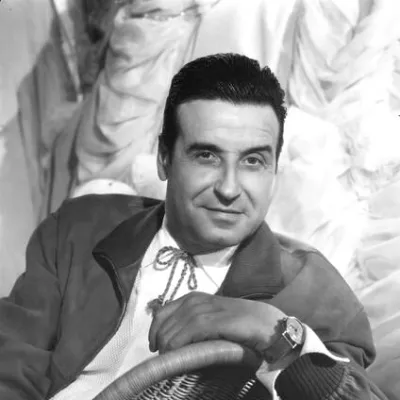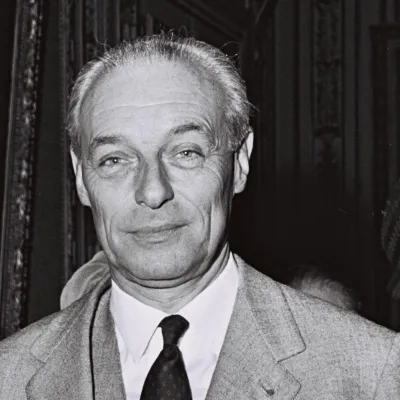
Guy de Rothschild
Human Design Chart
Biography
He chaired the bank Rothschild Frères from 1967 to 1979, when it was nationalized by the French government, and maintained possessions in other French and foreign companies including Imerys.
He died on 12 June 2007 in Paris.
The Human Design of Guy de Rothschild: Projector 6/2
Projector 6/2 — Design at a Glance
Guy de Rothschild appeared as a Projector, whose design was characterized by a dense, focused aura. This quality allowed him to immediately recognize systemic errors and weaknesses in his environment, much like a bright flashlight shining into dark corners. His nature was to bring light into the darkness for others and to show the way by identifying problems that were still hidden from others.
However, this sharp vision required a specific approach. Directly addressing the errors often caused resistance or anger in his surroundings, as if he shone his light clumsily into the faces of others. Instead, his most effective strategy was to attract others through his own harmony and exemplary behavior. People came to him of their own accord to seek advice, drawn to his radiant presence.
Central to his functioning was waiting for a respectful and sincerely meant invitation. Only this confirmation from others allowed him to use his energy efficiently without becoming exhausted. Since Projectors do not have an undefined Sacral Center, they do not possess a constant, intrinsic life force. Instead, they experience phases of high productivity followed by necessary rest periods to prevent burnout. Living according to this design rewarded him with success; ignoring it led to the non-self theme of bitterness appearing sooner or later.
Emotional Authority
Guy de Rothschild showed himself as someone who did not make decisions on impulse but consciously let them rest. His design was marked by Emotional Authority, located in the defined Solar Plexus Center. This center was subject to a constant emotional wave, a continuous up and down of feelings. The world appeared to him colored by the current mood: in one moment full of enthusiasm, in the next marked by negative judgment.
This emotional state was, however, only a snapshot, not a final claim to truth. Spontaneous decisions arising directly from this temporary emotion often turned out to be disadvantageous. The mechanics of his design required patience. By taking time and letting decisions rest overnight multiple times, he gained emotional distance. The intense feelings subsided over time, leading to clarity and calm. This process was particularly crucial for long-term, life-defining decisions.
Emotional Authority always took precedence over all other defined centers in his chart, regardless of further configurations. Guy de Rothschild used this inner rule to protect himself from hasty judgments. He took his time properly, asked himself multiple times, and waited until the emotional tide had ebbed. Only then, when clarity had emerged through the process of distancing, did he act. This ability to observe his own emotional wave movement and not confuse it with the final truth shaped his decision-making process significantly.
The 6/2 Profile — Role Model / Hermit
Guy de Rothschild revealed himself in his youth as someone who learned through intense experimentation and the principle of trial and error. As a 6/2 Profile, his energy before the age of thirty resembled that of a 3/6 Line: he gathered diverse experiences, withdrew after setbacks, and sought his path in the social fabric. This early phase was marked by the search for the right timing and the handling of hypocrisy, as described by Gate 8 in his first phase. It was about recognizing the authentic moment for a contribution without being led by external expectations.
After the age of thirty, his dynamics fundamentally changed. The sixth line became active, leading him into a phase of deep introspection and distance. He metaphorically retreated into his 'cave' to reflect and heal from past experiments. This process of self-awareness was necessary to develop the wisdom he later made accessible to others. Simultaneously, Gate 55 in his second line projected his emotional mindset outward, leading to mood swings and dependence on the trust of others, where suspicion or gossip could diminish his inner fullness. His authenticity required him to see through these projections and not turn them into their opposite by trying to prove trustworthiness. Only after this inner work could he appear as a wise person, inspiring others through his deep introspection and the balance he had achieved.
Single Definition — Defined & Open Centers
Guy de Rothschild revealed himself as someone who steered his willpower and resources self-determinedly, driven by a defined Heart Center. This gave him a natural authority over his own life and a strong desire to keep promises to create trust. However, his decisions were influenced by a deep emotional wave movement through the defined Solar Plexus Center. He relied on practicing patience and waiting for the emotional wave to pass before acting, as immediate reactions often led to regrettable impulsiveness. This emotional depth served as an inner compass needle, offering clarity only after going through the emotional phases. Additionally, he had a constant inner pressure through the defined Root Center, which propelled him forward and helped him cope with stress without losing control.
In contrast, Guy de Rothschild was open to external influences in several areas. His open Head Center made him vulnerable to mental confusion and the pressure to find answers to questions that were not his own. He tended to get caught in intellectual whirlpools rather than trusting his inner authority. His open Ajna Center allowed for flexible, creative thinking but led to the risk of interpreting foreign opinions as his own truth or pretending to be uncertain. His open G Center meant that he did not have a fixed, unchanging identity but defined himself through relationships and places; he sought the right direction by trying out different environments. His open Sacral Center made him react to the energy of others, which could lead to exhaustion if he did not pay attention to his own limits. Finally, his open Spleen Center was vulnerable to fears and the need to cling to secure people rather than trusting his own intuition. These opennesses required constant vigilance to avoid conditioning.
Channels for community, emotional release and inner liberation.
Guy de Rothschild revealed himself as someone deeply rooted in the dynamics of relationships and communities, with his actions shaped by a pulsating emotional wave. His design tended to form connections not spontaneously, but through careful consideration to ensure they were beneficial for all involved.
This attitude was significantly influenced by the Community Channel 37-40. This channel connected the Solar Plexus Center with the Heart Center and mediated the balance between the need for recognition (Gate 37) and the will to provide for loved ones while simultaneously requiring breaks (Gate 40). For Guy de Rothschild, this meant waiting for the right invitation to become part of an organization or community and always being mindful of fair deals based on mutual respect and an honorable place for everyone.
Parallel to this, the Channel of Emotional Release 39-55, connecting the Root Center with the Solar Plexus Center, was at work. Through the Gate of Provocation (39) and the Gate of the Mind (55), he was exposed to a profound, creative force that oscillated between ecstatic joy and melancholic uncertainty. This mechanism required him to authentically deal with his moods to filter out the true nature of others and act only when he was in the right mood.
Additionally, specific gates shaped his profile: Gate 8 propelled him to individually advocate for group goals and attract attention through the expression of his uniqueness. Gate 14 gave him the ability to handle power and wealth with grace and self-control, enabling clear direction. Gate 59 in the Sacral Center directed his genetic strategy towards bonding and unification, regardless of personal preferences. Further influences came from Gate 30, which promoted the recognition of feelings and the acceptance of limitations, and from Gate 51, which provided a strong willpower and adaptability in shocks. Gate 53 allowed him to be a pioneer in exploring new paths, while Gate 54 linked worldly success with spiritual insight.
Individual Circuitry — Circuit Signature
Guy de Rothschild revealed himself through a separate but parallel orientation: on the one hand, emotional intensity, on the other, strategic partnership. His design featured a Simple Definition, meaning all defined centers – Solar Plexus, Heart, and Root – were energetically connected. This created a continuous flow of inner motivation through emotional processing to physical endurance.
In the Knowledge Circuit, the Channel 'Emotional Release' connected the Solar Plexus with the Root Center. This connection allowed emotional waves to be directly transformed into physical energy, leading to pulsating, creative impulses. Here, emotions served not only as mood but as driving forces for new insights and individual expression.
Parallel to this, the Ego Circuit worked through the Channel 'Community', linking the Heart and Solar Plexus Centers. This promoted a sense of reciprocity and cooperation. It was about the balance between giving and taking as well as the joint creation of resources within a group. Since there was no connection to the Sacral Center, this configuration required conscious pauses for regeneration to maintain energy for social bonds and material security. Both circuits shaped his essence as someone who combined emotional depth with strategic connectedness.
Left Angle Cross of Uncertainty 1
Guy de Rothschild lived with a profound inner tension between the desire for clarity and the accepted uncertainty of life. His design carried the left cross of uncertainty, a configuration that did not promise a linear, predictable life path but rather a journey filled with turns and unforeseen developments. For him, security was not found in fixed plans but in the ability to embrace the unknown.
This structure meant that he often found himself in situations where the next steps were not clearly marked out. Instead of fighting against this uncertainty, he learned to navigate within it. Uncertainty was not an obstacle but the natural ground on which his experiences grew. He showed himself to be someone who had to develop trust in the process, even when the outcome remained hidden.
His path was marked by the necessity to focus on the moment rather than fret about a distant, uncertain future. The challenge was not to seek fixed guarantees that were not present in this design, but to use the freedom that came with openness to the unexpected. Guy de Rothschild had to learn that his strength did not lie in control but in the adaptability to the constant changes that his chart-determined fate brought.
Saturn Return · Uranus Opposition · Chiron Return · 2nd Saturn Return — Life Cycles
Guy de Rothschild took over the leadership of Banque Rothschild in 1967 at the age of 58. This step marked his second Saturn Return, a cycle that in Human Design mechanics often coincides with the consolidation of structures and the assumption of long-term responsibility. After the first Saturn phase, which is often associated with the founding or building of fundamental life areas, the second return demands a maturation and stabilization of these achievements. It is a time when the work previously done translates into concrete, sustainable positions. For Guy de Rothschild, this mechanism was evident in the clear establishment of his authority within the family institution. The Saturn Return here did not act as mere repetition but as confirmation and deepening of the paths already taken. Taking over the top position was thus not a sudden change but the logical result of a long-term development that now found its final form. This cycle underscores the importance of continuity and the ability to carry responsibility at a high level without neglecting the original foundations. It was about securing and continuing an inheritance that was now in his hands.
Projector · Emotional Authority — Synthesis
Guy de Rothschild was a Projector, whose life was marked by a deep ability to recognize the potential and weaknesses of others (Projector Type, Gate 37). This gift, combined with a defined Heart Center, led him to effectively utilize the resources of others to achieve goals while always maintaining his own value and control over the situation. His emotional nature (Emotional Authority) required time to let decisions mature, which forced him to absorb and process the dynamics of his environment before acting.
A central paradox in his design lay in the tension between the need for recognition (Gate 37) and the natural withdrawal associated with the 6-line in his Profile. He sought connection and validation from others (Community Channel), but after periods of intense activity and relationship building, he withdrew to reflect and heal. This oscillation between engagement and distance marked his path, especially after reaching a professional milestone (Saturn Return in 1967), and revealed a wisdom that attracted others.
2 Defined Channels
Incarnation Cross - Left Angle Cross of Uncertainty 1
Solar Return
The Solar Return shows the moment when the sun returns to its exact birth position - your personal solar year.
Life Cycles
Discover the life cycles with a detailed triple view (birth chart, cycle chart, composite).
Human Design Profile
- Type
- Projector
- Strategy
- Wait for the respectful invitation
- Authority
- Emotional Authority
- Profile
- 6/2 - Role Model / Hermit
- Definition
- Single Definition
- Incarnation Cross
- Left Angle Cross of Uncertainty 1
- Date of Birth
- 21.05.1909 06:00
- Place of Birth
- Paris, France
Frequently Asked Questions
What was Guy de Rothschild's Human Design type?
What Profile did Guy de Rothschild have?
What Authority did Guy de Rothschild have?
What incarnation cross did Guy de Rothschild have?
When was Guy de Rothschild born?
Discover your own Human Design
Are you also a Projector? Find out in a personal reading how to unfold your leadership qualities and recognize the right invitations.
More Personalities
Back to overviewSissy Spacek

Alain-Fournier

Anémone

Ann-Margret

Bourvil
Christian-Jaque