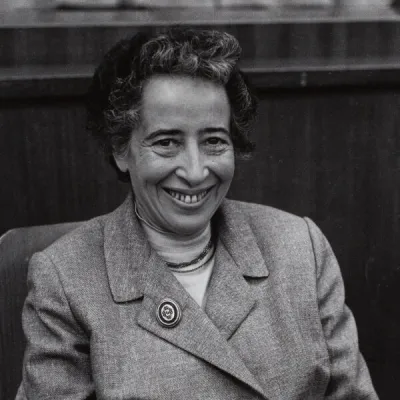
Hannah Arendt
Human Design Chart
Biography
Her works cover a broad range of topics, but she is best known for those dealing with the nature of wealth, power, fame, and evil, as well as politics, direct democracy, authority, tradition, and totalitarianism. She is also remembered for the controversy surrounding the trial of Adolf Eichmann, for her attempt to explain how ordinary people become actors in totalitarian systems, which was considered by some an apologia, and for the phrase "the banality of evil". Her name appears in the names of journals, schools, scholarly prizes, humanitarian prizes, think-tanks, and streets; appears on stamps and monuments; and is attached to other cultural and institutional markers that commemorate her thought.
Hannah Arendt was born to a Jewish family in Linden in 1906. Her father died when she was seven. Arendt was raised in a politically progressive, secular family, her mother being an ardent Social Democrat. After completing secondary education in Berlin, Arendt studied at the University of Marburg under Martin Heidegger, with whom she engaged in a romantic affair that began while she was his student. She obtained her doctorate in philosophy at the University of Heidelberg in 1929.
What does Generator 6/2 mean for Hannah Arendt?
Generator 6/2 — Design at a Glance
Hannah Arendt's design established a foundational structure based on high endurance and the ability to generate energy. As a Generator, she had a strong Sacral Center that endowed her with immense strength, comparable to a workhorse – provided this strength was used for appropriate tasks. Her life task involved not taking initiative herself but responding to impulses from her environment. This strategy of 'reacting' was crucial: Only when she responded to an external signal and confirmed it with a clear 'yes' internally could she effectively use her energy and experience deep satisfaction.
Departures from this pattern led to two specific risks. On one hand, frustration and loss of energy threatened if she engaged in things that did not suit her or for which she felt no inner desire. On the other hand, conflict potential arose when external circumstances prevented her from continuing work on her heart project, even though her internal power was still fully present. The materialization of her goals thus succeeded only through this reactive stance. Initiating actions without this inner impulse resulted in persistent frustration and a lack of energy. Her design therefore required constant checking of gut feelings to ensure that her considerable endurance was not wasted but channeled into fulfilling activities.
Emotional Authority
Hannah Arendt's design established a tendency towards emotional wave motion, fundamentally shaping her decision-making process. She appeared as someone whose inner truth did not lie in the first spontaneous judgment but became accessible only through temporal distance. This resulted from her emotional authority: The defined Solar Plexus Center carried this leadership function and always took precedence over all other defined centers, regardless of further configurations in her chart.
This mechanism meant that Hannah Arendt was subject to permanent fluctuations in feelings. The world appeared to her constantly colored by her current mood; what seemed inspiring at one moment could appear negative the next. Her immediate feeling was merely a snapshot, not an ultimate truth. Quick decisions stemming directly from this transient emotion carried a high risk of negative consequences.
Clarity emerged for her only through delay and patience. By taking time and reconsidering decisions multiple times, intense feelings subsided. This process of waiting allowed her to gain emotional distance. Only when the wave had ebbed and calmness set in was the inner process complete and a well-founded decision possible. This was especially true for long-term course settings that significantly influenced her life path.
The 6/2 Profile — Role Model / Hermit
Hannah Arendt's development proceeded through two clearly distinguishable phases. In her youth, an experimental attitude dominated: She learned through trial and error, encountered limits, and withdrew after failures to process them. This corresponded to the effect of Line 3 before the Saturn Return (around age thirty), aiming at direct life experience and trying out various roles.
Around age thirty, her basic stance fundamentally changed. The activation of Line 6 led to an intense withdrawal, a phase of distancing and deep introspection. Hannah Arendt now looked back from the outside on her earlier experiments. This period served for healing and integrating her experiences. Through this reflection, she overcame the initial fear of being a 'paper tiger' – a typical insecurity of Line 2 that manifests in detail work and discipline but often only reveals its full potential late.
From this phase of withdrawal, she ultimately emerged as an authoritative role model. Others now sought her advice to partake in her newly acquired wisdom. The earlier restlessness of detail work transformed into clear authority. Hannah Arendt thus demonstrated the classical path of the 6/2 configuration: from an uncertain experimenter through isolated reflection to a trustworthy teacher who guides others without being more in doubt herself.
Triple Split Definition — Defined & Open Centers
Hannah Arendt's design showed a tendency towards constant mental pressure and deep emotional reflection. She was someone who asked questions and cultivated conceptual thinking, driven by a defined connection between Head Center and Ajna Center. This created a permanent impulse to understand connections – not to carry them out immediately as no direct energy was available for that purpose, but rather to inspire others through inspiration. Parallel to this, she had a defined Heart Center, which gave her clear willpower and the need to determine her own resources as well as keep promises. Her generative power came from her defined Sacral Center; here lay her true energy source, waiting for reactions instead of taking initiatives. Emotional clarity was achieved through her defined Solar Plexus Center, where she allowed emotional waves time before judging them. Her intuitive survival sense was steered by her defined Spleen Center, which acted in the moment.
In contrast, her Throat Center, G Center, and Root Center were open. These areas reflected their environment rather than producing their own fixed patterns. Hannah Arendt tended to question whether she was noticed or who she actually was in uncertain situations – typical patterns of open centers seeking external validation. She absorbed stress from the environment (open Root Center) and often sought identity through relationships (open G Center), instead of setting a firm direction. Her communication was situational; she spoke when invited, not to force attention. This mechanism described someone who mentally inspired, was willful, and intuitively reacted but remained open to others' influence in terms of identity, stress management, and expression.
Channels for intuition, community sense and logical clarity.
Hannah Arendt's design showed a tendency towards intuitive individual existence, which was expressed through the Power Channel 57-34. This connection between Spleen and Sacral Center formed the absolute center of her energy, driven by Gate 57 in the Sun. She possessed sharp survival intelligence that allowed her to react spontaneously to danger or safety, free from time constraints imposed by thought or emotion. Her intuition was her primary compass for life in the here and now.
At the same time, Hannah Arendt had the Logic Channel 63-4 in her design. This connected Head Center with Ajna Center and provided a doubting mind. Unlike her intuitive security, this channel did not serve her personal way of living but rather the collective. It constantly filtered patterns to check their consistency. Doubt was essential here; logic could be correctly formulated yet still be wrong. This channel created pressure when patterns seemed inconsistent, leading to questions demanding answers. She used this skeptical scrutiny to provide reliable information for the collective while relying on her sacral reaction herself.
Additionally, the Community Channel 37-40 influenced her personality. It connected Solar Plexus and Heart Center and emphasized the necessity of agreements and belonging. Gate 37 sought recognition in the whole, while Gate 40 provided work for others' sustenance but needed breaks. This channel required emotional clarity over time to seal good deals or bonds, as spontaneous decisions here were not sustainable.
Prioritized Gates like 51 (willpower), 62 (details/logic) and 61 (inner truth/acoustics) complemented this picture. Gate 61 fought for silence and individual knowledge, while Gate 62 demanded patience for pattern recognition. Gate 51 brought strong willpower without social bonds. Together, these elements shaped a person who acted intuitively, logically scrutinized for others, and waited in communities for sustainable agreements.
Individual Circuitry — Circuit Signature
Hannah Arendt's design showed a tendency towards synthesizing rational understanding and communal support, embedded in high individual reactive power. Her Triple Definition created three separate, parallel existing energetic poles that did not flow directly into each other but rather acted as independent force fields.
The Understanding Circuit connected her Head Center with Ajna Center through the Logic Channel (Gate 63-4). This allowed an 'emotionless ratio' to lead society towards a better future free from conditioning. Parallel to this, the Ego Circuit linked Heart and Solar Plexus Centers via the Community Channel (Gate 37-40). Here it was not about individual ego but tribal dynamics: mutual support and balanced give-and-take for communal resource creation. As there was no connection to Sacral Center, pauses for regeneration of social energy were essential.
The third pole formed by the Integration Circuit with the Power Channel (Gate 34-57), connecting Sacral and Spleen Centers. This ensured individual survival through exertion in the present, derived from reacting to life and intuitive knowledge. Hannah Arendt thus showed herself as someone who combined logical future planning with traditional communal support and immediate individual action capability – three complex, parallel systems that shaped her personality.
Left Angle Cross of the Clarion 2
Hannah Arendt's Human Design profile featured the left cross of the Fanfare 2 incarnation. This configuration established a specific inner dynamic aimed at recognizing and naming differences. In Human Design, this cross describes an energy designed to break through commonalities and make individual peculiarities visible. It was not just about observing but actively highlighting what stood out from the crowd, thereby bringing clarity to confusing situations.
For Arendt, this meant her nature was programmed to perceive nuances that others might miss. She emerged as someone who created order by identifying distinctions. The mechanics of this left cross demand a kind of differentiation that does not necessarily judge but is precise in its discernment. It was about seeing what was unique and clearly stating it. This defined her way of perceiving: she did not seek the average or general, but rather the specific features that set a person, idea, or situation apart from others.
This ability to distinguish was no coincidence but an integral part of her design. It helped her unravel complex connections by clearly separating and naming individual components. Through this precise differentiation, she could understand situations where others saw only chaos. Her design thus fostered a stance of clear demarcation and exact observation, significantly influencing her entire life approach and way of thinking.
Saturn Return · Uranus Opposition · Chiron Return · 2nd Saturn Return — Life Cycles
Hannah Arendt's Human Design profile showed a clear developmental line: from theoretical clarification through political practice to historical documentation. This maturation process was structured by specific cyclical turning points that phased-focused and condensed her intellectual work.
The first Saturn Return marked the transition into a phase of serious professional anchoring. In 1932, at age 26, she published the article “Enlightenment and the Jewish Question.” This cycle promoted the ability to organize complex connections and formulate them sustainably, shaping her early theoretical work.
Later, the Uranus Opposition acted as a catalyst for sudden insights and necessary shifts in political analysis. In 1948, at age 42, her article “Peace or Armistice in the Middle East?” appeared. This cycle fostered the willingness to question established perspectives and develop new viewpoints on current conflicts.
The Chiron Return represented the peak of her individual life mission, where her specific contribution to humanity fully unfolded. In 1955, at age 49, the German edition of “The Origins of Totalitarianism” was published. This was not a moment of healing but of bloom: her central insight became tangible and powerful.
Finally, the second Saturn Return solidified her life’s work through structural completion. In 1963, at age 57, “On Revolution” appeared. This cycle ensured that her earlier analyses were integrated into a coherent, lasting whole, marking the conclusion of her intellectual journey.
Generator · Emotional Authority — Synthesis
Hannah Arendt lived a life deeply marked by the tension between inner clarity and the drive to connect. Her design as an emotional authority generator points to someone who draws energy from reactions—when she says ‘yes’ to something—but needs time for emotional waves to pass before decisions can be made. This combination manifested in a work style characterized by deep reflection and waiting for the right moment (emotional center), while simultaneously showing tireless energy for pursuing her interests (sacral center). The defined Head and Ajna centers further strengthened this inner drive, generating a constant flow of questions and inspirations that could only be channeled through sacral reactions.
A central paradox in Arendt's design lies in the interplay between the need for independent thinking (defined Head and Ajna centers) and the open G center, which requires continuous adaptation to the environment. This open center points to a search for identity and belonging that manifests as an ability to understand and integrate various perspectives while simultaneously maintaining an inner tension field between self and others' expectations. The prioritization of gates like 61 (inner truth) and 28 (risk-taking readiness) underscores this dynamic: a deep search for personal integrity, accompanied by the willingness to question conventions and chart new paths.
3 Defined Channels
Incarnation Cross - Left Angle Cross of the Clarion 2
Solar Return
The Solar Return shows the moment when the sun returns to its exact birth position - your personal solar year.
Life Cycles
Discover the life cycles with a detailed triple view (birth chart, cycle chart, composite).
Human Design Profile
- Type
- Generator
- Strategy
- To respond - wait for something to respond to
- Authority
- Emotional Authority
- Profile
- 6/2 - Role Model / Hermit
- Definition
- Triple Split
- Incarnation Cross
- Left Angle Cross of the Clarion 2
- Date of Birth
- 14.10.1906 21:15
- Place of Birth
- Hanover, Germany
Frequently Asked Questions
What was Hannah Arendt's Human Design type?
Which Profile did Hannah Arendt have?
What Authority guided Hannah Arendt?
What incarnation cross did Hannah Arendt have?
When was Hannah Arendt born?
Discover your own Human Design
Are you also a Generator? Find out in a personal reading how to use your sacral energy correctly and discover deep satisfaction.
More Personalities
Back to overviewAaliyah

Alexia

Angèle

Anne-Marie

Arcángel

Arno