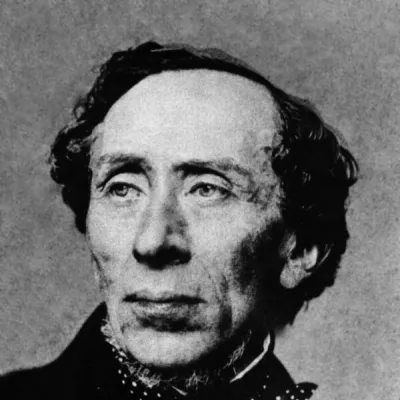
Hans Christian Andersen
Human Design Chart
Biography
His life was not that idyllic. In his family history, his dad, a cobbler, went insane and died when Hans was 11. His paternal grandmother was a pathological liar who had, in her youth, been jailed for repeatedly producing illegitimate children and her husband had a reputation as the town lunatic. One of his aunts apparently ran a brothel. He grew up in a one-room house in the slum area of Odense, usually playing by himself with puppets. The boy had few friends and spent much of his time alone with his homemade toys. As an adult, he was not particularly fond of children. He grew into an odd figure with huge feet and small blue eyes, a tall, delicate man, long and bony with a cadaverous face. With arms and legs disproportionately large for his body, he attracted nicknames that were descriptive, such as "stork" and "lamp post."
To make money for the family, as a youth, Andersen worked in a cloth factory where he was often embarrassed by the workmen's bawdy humor. Gifted with a fine soprano voice, he loved to sing, that is, until the day at work when his co-workers pulled off his pants to see if he was a girl.
Hans Christian Andersen — Projector with Profile 3/5
Projector 3/5 — Design at a Glance
Hans Christian Andersen revealed himself as someone with a dense, focused aura that immediately recognized system errors in his environment. His design tended to illuminate others' blind spots, thereby showing them the way by exposing their weaknesses. This ability acted like a bright flashlight, shining directly on areas still in darkness or not functioning optimally for the counterpart.
However, addressing these flaws head-on often led his surroundings to feel pressured or irritated as if the light was uncomfortably glaring into their faces. Therefore, his strategy involved waiting for an honest and respectful invitation before sharing his insights. Through this patience, he avoided friction and utilized the natural attraction of his aura so that others would seek out his advice on their own.
Since his Sacral Center was undefined, Hans Christian Andersen did not have constant life energy. Instead, he moved in phases: periods of high activity and rapid work alternated with necessary rest phases to prevent burnout. This rhythmic need often conflicted with societal expectations for continuous performance. By waiting for invitations and conserving his energy, he lived according to his design and was rewarded with success rather than bitterness.
Self-Projected Authority
Hans Christian Andersen appeared as a Projector with rare authority in the self, a configuration that combined profound openness with the constant risk of being distracted by external motoric energies. His inner truth rooted in his identity, not analytical processing. Decisions occurred through two pathways: spontaneous utterances or physical directional impulses.
For him, it was crucial to engage in self-talk or stimulated dialogue and carefully listen whether his own self or mind spoke. Only what was spontaneously expressed without reflection truly represented his essence. This unbiased expression made his uniqueness recognizable to others. Simultaneously, he followed bodily feelings that could attract or repel him geographically or thematically.
The greatest trap lay in losing himself in this openness and constantly chasing external energy. However, when Hans Christian Andersen recognized his inner direction and remained true to it, he became a guide for others. His specific potential for success lay precisely here: in the authenticity of spontaneous expression and trust in physical orientation rather than being overwhelmed by the loud outside world. This mechanism shaped his life as someone who acted through his unadulterated presence once he clearly distinguished between mental noise and soulful impulses.
The 3/5 Profile — Martyr / Heretic
Hans Christian Andersen revealed himself as someone who found his path through intensive experimentation, later using this practical knowledge to solve others' problems. His design inclined him to initially test everything himself since the Profile 3/5 – Explorer and Hero – is based on direct experience. Line 3 of the Adventurer brings themes such as trial and error along with confrontation with superior forces. This was about avoiding experiences of helplessness and reducing dependencies to walk his own path. Often, this resulted in withdrawal moments when external powers intervened.
This phase of learning served Line 5, the Hero's line, characterized by estrangement and isolation. As a lone fighter, he acted intuitively within his context. In crises, he stood beside others and brought new solutions through isolated combat. The greatest challenge was not being cut off from others but preventing himself from maintaining this distance.
The painful contrast in his experience lay between the attractiveness as a storyteller and public humiliation upon failure. While his experiences attracted those who wanted to learn from them, failure before an audience could be very hurtful. This inner compulsion for self-reliance stood in tension with the isolated position of the lone fighter who still stepped up for others in emergencies.
Split Definition — Defined & Open Centers
Hans Christian Andersen showed himself to be marked by continuous mental activity: inspiration flowed directly into concrete communication. His defined Head Center generated constant pressure to ask questions and expand consciousness, while the Ajna Center translated these impulses into specific concepts. This connection culminated in his defined Throat Center, through which he always articulated what his mind thought – without his own motoric energy for implementation but with a clear voice. Parallel to this, a defined G Center anchored his stable identity and inner direction; he knew who he was and where he belonged, independent of external affirmations.
However, this firm internal structure stood in contrast to high receptivity: Heart, Sacral, Solar Plexus, Spleen, and Root were open. Without constant willpower in the open Heart Center, he tended to want to prove his worth through achievement rather than simply being it. The open Sacral Center allowed him to absorb foreign energy, which often led to exhaustion as he did not have a consistent generative power. Emotional waves from the environment were absorbed by the open Solar Plexus Center, causing him to fluctuate between moods and avoid confrontation to maintain peace. Additionally, lacking intuitive security for spontaneous decisions in his open Spleen Center, he often sought external confirmation for his well-being. Finally, the open Root Center amplified stress from the environment, driving him to do more than necessary just to escape the pressure. His mechanics therefore required using mental clarity without losing himself in the energetic and emotional fields of others.
Channels for logical leadership and inner truth-seeking.
Hans Christian Andersen showed himself to be someone who exercised logical leadership not through authority but through trust and invitation from the community. His design combined this collective orientation with a mind that was constantly active and sought inner truth.
This attitude stemmed from Channel 7-31, the Alpha Animal channel. It connected the G Center with the Throat Center and enabled a leadership based on tested patterns. Andersen acted as the "power behind the throne," understanding trends and showing the way without taking it himself. Success occurred when he was invited by his own "pack" to use his competence. Parallel to this, Channel 61-24, the Awareness channel, shaped his inner experience. This flow in the Head-Ajna area generated spontaneous inspirations ("Satori"), which resulted from rational processing. His mind was occupied with "white noise," sought silence and could not be controlled. Knowledge came at its own pace; the challenge lay in distinguishing between knowledge-worthy and unworthy things.
Additionally, other Gates influenced his experience. Gate 21 brought themes of control and material life as well as a need for respect in serving the community. Gate 48 allowed for the recognition of deeper connections and patterns but also led to frustration because it did not offer direct implementation. Gate 38 set boundaries and defended individual integrity through resistance against harmful forces. Gate 39 provided fuel for mutations through provocation and analysis. Finally, Gate 62 ensured patience, concentration, and logical detail work in building frameworks for pattern recognition. This combination formed a person who navigated between collective responsibility and individual, mutative insight.
Individual Circuitry — Circuit Signature
Hans Christian Andersen was marked by a split definition: His expression of new insights or logical conclusions did not arise in isolation but rather through exchange with the environment. This configuration created two parallel, energetically separate energy fields.
In the Knowledge Circuit, Channel 24-61 (Awareness) connected the Head Center to the Ajna Center. This promoted experiencing mutations – that is, deviations from the known – and a drive to follow an innate path. The energy was pulsing and acoustic, focused on individual transformation and creativity in the here and now.
Parallel to this, the Understanding Circuit operated through Channel 31-7 (The Alpha Animal), linking the Throat Center with the Identity Center. Here, rational structure and strategic future planning were at the forefront. This was an emotionless logic aimed at improving things through reason and focus as well as visually structuring societal perspectives.
Since both circuits in Hans Christian Andersen were not directly connected to each other, these forces existed side by side: on one hand, a pulsing creative drive for individual identity formation, and on the other, a focused visual strategy for the future. The expression of both aspects always occurred through interaction with others, as his definition was split and did not offer a closed internal energy source.
Right Angle Cross of Tension 1
Hans Christian Andersen was marked by an inner dynamics based on tension and its effects. This configuration, known as the right cross of tension, established a foundational structure in which internal tension did not function as a disturbance but rather as a central element of his psychological landscape.
In Human Design mechanics, this cross describes a specific energetic alignment. It is a constellation that generates tension and uses this tension as a driving force. For Hans Christian Andersen, this meant that his inner self often remained in a state of heightened tension. This tension was not a random phenomenon but a structural feature of his design. It directly influenced his internal disposition and shaped his perception of the world.
Without specific biographical details or events in the raw content, this description remains abstract. Here, we are not talking about external actions but rather the inner experiential world. Hans Christian Andersen lived in a reality where tension was a constant companion. This inner dissonance or tension formed the backdrop against which his life unfolded. The mechanics of the right cross of tension show how such internal forces work: they create pressure that shapes and influences the individual. For Hans Christian Andersen, this tension was thus a defining element of his existence, independent of external circumstances.
Saturn Return · Uranus Opposition · Chiron Return · 2nd Saturn Return — Life Cycles
Hans Christian Andersen's life path followed a clear progression: from inner consolidation through cultural breakthrough to deep connection with international figures. This journey led him from an isolated creator to a connected author, marked by three astrological cycles.
The first Saturn return around the age of 30 served as a phase of consolidation. Here, years of groundwork crystallized into a solid result. Hans Christian Andersen wrote "The Tinderbox" in 1835 at the age of 30, while staying in the Swiss House of Park Liselund. This was a moment of success where his inner creative power concretized and stabilized.
The Uranus opposition around the age of 41 brought an abrupt opening outward. It enabled a breakthrough into new cultural spaces and expanded his sphere of influence beyond familiar boundaries. Hans Christian Andersen experienced this in 1846 at the age of 41 when his first published work in German appeared: "My Life without Poetry, A Fairy Tale." This career development demonstrated the effectiveness of unexpected opportunities and integration into a new market.
The Chiron return around the age of 52 marked the fulfillment cycle. In this phase, if lived according to strategy and authority, one's sense of purpose increasingly unfolds in life. It was not about healing old wounds but about experiencing meaning and connection. Hans Christian Andersen visited Charles Dickens in 1857 at the age of 52. This visit to an international figure highlighted a healing connection with like-minded individuals and anchoring within a larger network, completing his development into a connected author.
Projector · Self-Projected Authority — Synthesis
Hans Christian Andersen lived a life marked by a deep inner tension between the need for recognition and the ability to perceive others' flaws (Gate 38, Gate 21). His design as a Projector, combined with authority in Self, points to someone who intuitively recognized truth in others and ideally could share this through invitation. The connection of Head and Ajna Centers (Channel 61/24) gave him a special gift for sudden insights and recognizing deeper patterns, which he then communicated using his defined Throat and G Centers (Channel 31/7). This interplay led to a strong expressive power that was always dependent on appreciation.
A central paradox in Hans Christian Andersen's design lies in the combination of open centers for energy (Sacral, Heart) and the defined G Center. He had a clear identity and direction (G Center), but was also vulnerable to external influences and conditioning. This led to an ongoing search for validation and an internal struggle between self-expression and adaptation, reflected in his creative work. The right cross of tension 1 underscores this dynamic by highlighting the need to maintain inner integrity amidst outer challenges.
2 Defined Channels
Incarnation Cross - Right Angle Cross of Tension 1
Solar Return
The Solar Return shows the moment when the sun returns to its exact birth position - your personal solar year.
Life Cycles
Discover the life cycles with a detailed triple view (birth chart, cycle chart, composite).
Human Design Profile
- Type
- Projector
- Strategy
- Wait for the respectful invitation
- Authority
- Self-Projected Authority
- Profile
- 3/5 - Martyr / Heretic
- Definition
- Split Definition
- Incarnation Cross
- Right Angle Cross of Tension 1
- Date of Birth
- 02.04.1805 01:00
- Place of Birth
- Odense, Denmark
Frequently Asked Questions
What was Hans Christian Andersen's Human Design type?
What Profile did Hans Christian Andersen have in Human Design?
Which Authority guided Hans Christian Andersen?
What incarnation cross did Hans Christian Andersen have?
When was Hans Christian Andersen born?
Discover your own Human Design
Are you also a Projector? Find out in a personal reading how to unfold your leadership qualities and recognize the right invitations.
More Personalities
Back to overviewSissy Spacek

Alain-Fournier

Anémone

Angeli
Ann-Margret

Bourvil