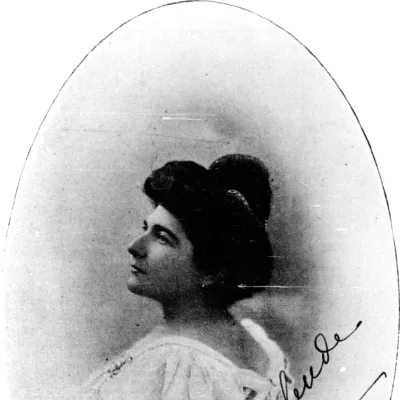
Hélène Van Zuylen
Human Design Chart
Biography
Her main creative writing period was from 1902 through 1907 when she collaborated on stories and poems with her lesbian partner Renée Vivien.
Baroness Hélène van Zuylen was one of a trio of French female motoring pioneers of the Belle Epoque. She entered the 1898 Paris–Amsterdam–Paris Trail using the pseudonym Snail, thus becoming the first woman to compete in an international motor race.
An only child, the daughter of Salomon James de Rothschild, she was disinherited by her Jewish father for marrying a Catholic, Baron Etienne van Zuylen of the old Dutch noble family Van Zuylen van Nievelt. Thus, her childhood home, the Hôtel Salomon de Rothschild, was bequeathed to the French government by her mother. Her extensive refurbishments to the van Zuylen ancestral home Kasteel de Haar near Utrecht turned it into one of the foremost Gothic Revival castles in the Netherlands.
On 16 August 1887 Hélène married the Roman Catholic Baron Etienne van Zuylen (1860–1934) of the House of Van Zuylen van Nievelt. They had two sons. Her son Baron Egmont van Zuylen van Nyevelt (1890–1960) was a diplomat and businessman and the father of Parisian socialite Marie-Hélène de Rothschild (born Baroness Marie-Hélène Naila Stephanie Josina van Zuylen van Nyevelt).
In 1902 Zuylen, a lesbian, met British poet Renée Vivien to whom she provided much-needed emotional support and stability. Zuylen's social position did not allow for a public relationship, but she and Vivien often traveled together and continued a discreet affair for a number of years. Vivien's letters to her confidant, the French journalist and Classical scholar Jean Charles-Brun, she considered herself married to the Baroness. She may have published poetry and prose in collaboration with Zuylen under the nom de plume Paule Riversdale.
Hélène Van Zuylen — Manifesting Generator with Profile 4/6
Manifesting Generator 4/6 — Design at a Glance
Hélène Van Zuylen revealed herself as a person with a hybrid energy constitution: She was a manifesting generator. Her design combined the constant, sacral life force of a generator with the ability to skip steps and quickly draw results into her life. This configuration significantly shaped her work style.
Although she possessed this fast execution capacity, Hélène Van Zuylen followed the strategy of responding. She acted most effectively when waiting for external impulses before acting, only proceeding once her Sacral Center responded with a clear "yes." Her design allowed her to pursue multiple projects simultaneously, which others often found overwhelming. For Hélène Van Zuylen, however, this parallelism was a source of creative power as long as she remained in what is called the "play mode" and her inner authority supported her activities.
The danger lay in her natural speed. If she acted too quickly or skipped important intermediate steps, she often had to return later to fill gaps. This could lead to frustration since her non-self theme involved feeling hindered by forced slowing down or correction. When she adhered to the strategy of responding and felt deep satisfaction with her activities, Hélène Van Zuylen effectively utilized her unique speed. She then not only quickly drew results but also enjoyed the variety and playful aspect of her creative process without falling into overload or failure.
Sacral Authority
Hélène Van Zuylens decision-making process involved a direct physical response to external stimuli. As a Generator, she had sacral authority, which simplified her process: strategy and inner guidance were identical. This mechanism required an open emotional center so that her responses did not come from the emotional wave but rather from the gut.
Her inner voice manifested as a physical signal—a grunt, hum, or spontaneous "mm-hm." Such a reaction marked the moment when her sacral motor kicked in. In these states, she felt vital and alive, with an inexhaustible energy source that allowed her to become fully immersed in activities. She acted not out of duty but from pure enthusiasm and contentment.
Additionally, supportive authority through the activated Spleen Center possibly directly connected to the Sacral Center enhanced Hélène Van Zuylen's ability for quick, spontaneous reactions. This gave her immediate access to her instinctive perception and physical well-being, on which she could rely reliably. This configuration allowed her to make intuitive decisions in harmony with her inner compass without lengthy deliberations.
The 4/6 Profile — Opportunist / Role Model
Hélène Van Zuylen revealed herself in her first three decades of life as an experimental personality who intensively explored relationships and friendships. Her design indicated a tendency towards direct action and focusing on experiences; she sought the simplest way to solve problems, though this straightforward simplicity was often misunderstood from the outside as unsightly or harsh.
With the activation of the second profile half, an internal conflict emerged: the desire for community stood against the need to withdraw and contemplate life's meaning. This tension between heart and head shaped her development towards a wiser stance. Later, her environment expected her to serve as a role model and stand out through cooperation. Yet, her large heart remained cautious; it only opened up to those who met her standards to prevent injuries.
Her development required authenticity without hypocrisy, a state that was only achieved after the "coming down from the roof." Hélène Van Zuylen used her timing to individually contribute to group goals and thus bring mutations into the social fabric. She combined the transpersonal clarity of her early years with her later ability to foster harmony in the collective by embedding her direct approach within a larger, authentic context.
Single Definition — Defined & Open Centers
Hélène Van Zuylen was characterized by a design marked by constant inner alignment and vital energy. Her defined G Center gave her a reliable sense of self-identity and a clear direction for her personal path; she knew who she was without needing others to tell her. This internal security allowed her to provide guidance to others as long as she did not attempt to control their paths.
At the same time, Hélène Van Zuylen had a defined Sacral Center, the engine of a Generator. This meant an enormous source of life energy that could only be correctly activated by reacting to external stimuli. Her design challenged her not to initiate but to wait until life posed questions she could answer with a clear yes or no from her Sacral. Only in this way could she use her energy sustainably and satisfyingly without falling into frustration or exhaustion.
Her communication was structured through a defined Throat Center. Hélène Van Zuylen spoke from a constant source; her words were expressions of her inner truth, not mere thought. This gave clarity and honesty to her expression as it directly addressed her defined energy sources like the G or Sacral.
In contrast, her design revealed specific vulnerabilities through open centers. Her open Head Center made her receptive to mental inspirations from the environment, which should not be misinterpreted as her own answers. She tended to get stuck in doubts when trying to respond to others' mental pressure waves. Similarly, her Ajna Center was open, indicating a flexible but unstable mind; she could take on and reflect ideas but shouldn't hold them as firm personal truths.
Especially defining were her open Heart and Solar Plexus Centers. The open Heart Center lacked consistent willpower in the sense of ego strength; Hélène Van Zuylen was vulnerable to proving herself through promises or performance, often ending in a cycle of disappointment when the energy wasn't there. Her open Solar Plexus absorbed and amplified others' emotions. She could quickly feel emotionally overwhelmed as she experienced other people's moods as her own. The challenge lay in observing this emotional wave without identifying with it or fleeing from confrontation to regain her emotional clarity.
Channels for powerful action, focus, intuition and determination.
Hélène Van Zuylen was someone who placed intense, almost unshakable focus on the essential. Channel of Concentration 52-9 connected her Root Center with the Sacral and generated a calm inner pressure towards stillness. Gate 52 promoted non-action while Gate 9 sharpened the focus on details. This formative energy allowed Hélène Van Zuylen to filter out distractions and logically perfect patterns once she dedicated herself to something.
At the same time, she possessed a powerful expressive strength. The Channel of Charisma 34-20 channeled generative life force from her Sacral (Gate 34) directly into her Throat Center (Gate 20). This gave her the ability to act in the present and express her energy charismatically, provided she reacted to external stimuli. Without this reaction, however, the energy could become chaotic.
Her intuition acted as a filter for this action. The Channel of Flash of Insight 57-20 connected the intuitive insight from her Spleen (Gate 57) with expression in the present (Gate 20). Hélène Van Zuylen often spoke spontaneous truths based on deep survival knowledge. This was complemented by the Channel of Power 34-57, which linked sacral energy (Gate 34) with intuitive awareness (Gate 57), creating a strong protective mechanism and selective attention to her environment.
Long-term discoveries also shaped her design. The Discovery Channel 29-46 connected the Sacral's saying yes (Gate 29) with determination in the G Center (Gate 46). Hélène Van Zuylen had to fully commit to processes to recognize their meaning at the end; control was less important here than persistence.
Additional Gates colored this mechanism: Gate 30 brought awareness of feelings and longing, while Gate 8 promoted contribution to the group. Gate 14 ensured skilled direction finding, Gate 18 for corrective discrimination, and Gate 32 for continuity. Gate 12 emphasized restraint in expression, Gate 16 promoted experimental mastery, Gate 39 triggered mutation through provocation, and Gate 45 anchored tribal energy and material possession.
Individual Circuitry — Circuit Signature
Hélène Van Zuylen was characterized by a design that combined creativity with structured logic and emotional reflection. As someone with simple definition, her energetic resources flowed from Root, Sacral, Throat, Spleen, and Identity Centers in a continuous stream.
The Knowledge Circuit endowed her with the Channel of Flash of Insight (20-57). This connected her Throat Center directly to her Spleen, enabling quick intuitive insights she could articulate immediately. It was about expressing her unique identity through creative innovations here and now.
In the Understanding Circuit, the Channel of Concentration (9-52) worked. It linked her Sacral Center with her Root Center. This created a stable base for focused energy towards logical analysis and strategic planning. Hélène Van Zuylen used this 'emotionless ratio' to improve things and share rational insights free from conditioning.
The Meaning Circuit activated the Discovery Channel (46-29) in her. It connected her Identity Center with her Sacral Center. Here lay the power to emotionally process past experiences and draw meaning from them. These cyclical, wave-like feelings served to reflect insights from the past and share them with others to learn together.
Additionally, integration channels worked: Charisma (20-34) connected Throat and Sacral Centers while Power (34-57) linked Sacral and Spleen Centers. These channels allowed her to draw strength from reacting to life, guide it through intuitive knowledge, and act effectively in the present. Together, these circuits formed a system that united creative impulses, logical structure, and emotional depth into one coherent life energy.
Right Angle Cross of Contagion 3
Hélène Van Zuylen was marked by the right infection cross 3, a configuration indicating an intense engagement with the process of learning and inner transformation. This design element did not describe passive receptivity but rather a dynamic mechanism: Hélène Van Zuylen went through phases where she first absorbed ideas or experiences before digesting them and ultimately transforming them into a new, more personal form.
The term 'infection' here does not refer to illness but to the ability to be inspired by the energy and impulses of her environment – whether from people, books, or events. Hélène Van Zuylen consciously used this risk of infection as raw material for her own development. The 'right cross' emphasized the emotional and intuitive dimension of this process. She processed impressions not only intellectually but also let them resonate in her emotional center until a new insight matured.
This mechanism meant that Hélène Van Zuylen often articulated her true thoughts or decisions only after a certain incubation period. She needed time to translate the foreign into the personal. This cycle of absorption, processing, and reformation profoundly shaped her inner experience. It was an ongoing flow of change in which Hélène Van Zuylen continually rediscovered herself by filtering impulses from the outside world and integrating them into her own life wisdom. This process required patience with herself as the maturation of new insights occurred gradually.
Saturn Return · Uranus Opposition · Chiron Return · 2nd Saturn Return — Life Cycles
In her middle phase, Hélène Van Zuylen underwent profound personal upheavals that challenged her established identity. In 1902, at age 39, she met the British poet Renée Vivien and began a discreet affair with her. This event marked the beginning of an intense relationship characteristic of her design: The Uranus opposition often acts as a catalyst for sudden changes in interpersonal bonds. It breaks old patterns and forces a realignment of one's role in others' lives. For Hélène Van Zuylen, this meant not only a romantic connection but also a moment of liberation from previous structures. The opposition represents the conflict between the known and the unpredictable, leading to an intense confrontation with her own freedom. During this time, she sought new ways of self-expression beyond conventional expectations. Her relationship with Vivien became a mirror of her inner dynamics: a constant struggle between the desire for intimacy and the need for autonomy. This cycle shaped her further steps toward a more authentic life, free from external constraints.
Manifesting Generator · Sacral Authority — Synthesis
Hélène Van Zuylen lived a life marked by a constant interplay between internal drive and the need for authentic expression. As an Manifesting Generator, she possessed the ability to quickly initiate things (Manifestor aspect), yet her sacral energy always required a reaction in the present moment – an impulsive spark amplified through concentration (Channel 52/9). This combination of initiation and reaction formed the thread of her actions, driving her to continually face new challenges while seeking her inner truth.
A central paradox in her design lay in the conflict between the desire for connection (Line 4 in Profile) and the need for individual reflection (Line 6). She sought cooperation with others but felt called to contemplate the meaning of life. This tension was also evident in her relationships, where she engaged in intense connections (documented event), as well as phases of distance and self-discovery – an expression of the knowledge circuit and strengthening of her own individuality.
5 Defined Channels
Incarnation Cross - Right Angle Cross of Contagion 3
Solar Return
The Solar Return shows the moment when the sun returns to its exact birth position - your personal solar year.
Life Cycles
Discover the life cycles with a detailed triple view (birth chart, cycle chart, composite).
Human Design Profile
- Strategy
- To respond - wait for something to respond to
- Authority
- Sacral Authority
- Profile
- 4/6 - Opportunist / Role Model
- Definition
- Single Definition
- Incarnation Cross
- Right Angle Cross of Contagion 3
- Date of Birth
- 21.08.1863 14:30
- Place of Birth
- Paris Arrondissement 8, France
Frequently Asked Questions
What is Hélène Van Zuylen's Human Design type?
What Profile did Hélène Van Zuylen have in Human Design?
What authority did Hélène Van Zuylen possess?
What incarnation cross did Hélîne Van Zuylen have?
When was Hélîne Van Zuylen born?
Discover your own Human Design
Are you also a Manifesting Generator? Find out in a personal reading how to unfold your multi-talents and direct your energy wisely.
More Personalities
Back to overviewAlain-Fournier

Aldair

Alizée

Angeli

Arletty

Artus