
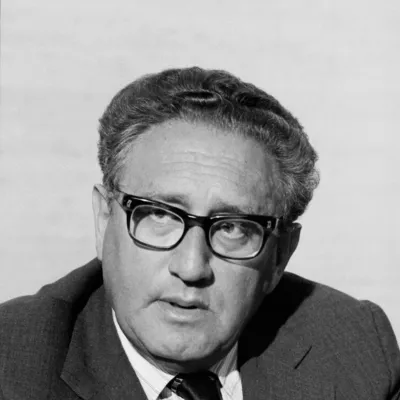
Henry Kissinger
Human Design Chart
Biography
Kissinger's legacy remains controversial and polarizing in U.S. politics. He is both considered an effective Secretary of State and condemned for allegedly turning a blind eye to war crimes committed by American allies.
The man who shaped American foreign policy in the late '60s and early '70s and who coined the phrase "power is the greatest aphrodisiac," spent a traumatic boyhood in Nazi Germany in an Orthodox Jewish family that marked Kissinger with "an odd mixture of ego and insecurity that can come from growing up smart yet persecuted." Escaping further persecutions, the family emigrated to America in 1938 where, living in New York, the 15-year-old Heinz changed his name to Henry and displayed great eagerness to please his teachers. Attending Harvard University, he joined the faculty in 1958 where he remained until Nelson Rockefeller drafted him from the classrooms of academia to become his advisor in 1969. That same year, he was appointed as assistant to President Nixon for National Security Affairs. Upon meeting First Lady Patricia Nixon for the first time, he praised her husband highly. "Haven't you seen through him yet?" she replied.
While Kissinger privately referred to Nixon as "meatball mind" and "a basket case," he became the foremost American figure in negotiations to end the Vietnam War during the Nixon administration.
Human Design Analysis: Henry Kissinger as Manifesting Generator 6/2
Manifesting Generator 6/2 — Design at a Glance
Henry Kissinger revealed himself as someone who possessed a hybrid energy: the constant power of a Generator paired with the lightning-fast execution power of a Manifestor. His design indicated that he did not just react to impulses but often implemented these reactions so quickly that he could skip steps and bring things into his life extremely fast. However, this speed was a double-edged sword. If he acted too hastily or pursued multiple projects simultaneously without waiting for inner confirmation, it easily led to frustration – the specific non-self theme of his type. The mechanics of his Manifesting Generator required him to act only when his Sacral Center signaled a clear "yes." Only then could his creative power lead to deep satisfaction. Instead of focusing on one thing at a time, he often found his energy in "play mode," with variety and the parallel handling of different tasks. As long as he responded to life and regularly checked whether projects still aligned with his inner authority, he could use this versatility without falling into exhaustion. His path involved channeling the speed through conscious reaction rather than blindly initiating.
Emotional Authority
Henry Kissinger demonstrated a decision-making approach that did not rely on an initial emotional reaction but was based on conscious delay. His design featured Emotional Authority, meaning his defined Emotional Center always took precedence over all other defined centers – a mechanical law that holds true regardless of further configurations. This structure generated waves of shifting moods; his perception was colored by the current emotional state, which often represented only a momentary and unripened assessment. Spontaneous judgments made in this emotional heat would have proven unreliable as they obscured deeper truths. Instead, his inner logic required patience and conscious postponement of decisions. By repeatedly "sleeping on" an issue, initial emotional fluctuations subsided. Only when these waves had ebbed did clarity emerge and calm settle in. This process of emotional distancing was crucial for long-term orientation. Henry Kissinger used this time to move from the first, often extremely colored snapshot to a more comprehensive and serene understanding. Authority thus lay not in quick action but in the ability to let one's own emotional turbulence subside before taking a final stance. This ensured that his decisions were based on a stable foundation rather than fleeting moods or impulsive reactions.
The 6/2 Profile — Role Model / Hermit
Henry Kissinger showed a development line that was characterized by two clearly distinct phases: an early period of experimentation and a later one of detached reflection. In his youth, before the age of thirty, his design appeared as a 3-line profile. This meant he moved through trial and error, gathered many personal experiences, and withdrew after setbacks to learn from them. This phase served for self-strengthening and building practical skills.
Around the age of thirty, this dynamic fundamentally changed. The sixth line of his profile became active. Henry Kissinger metaphorically retreated into a "cave" – a state of intense distance and introspective contemplation. Here he reflected on his previous life, leading to a period of healing and deep self-awareness. From this isolation, he emerged later as a wise figure whose insights could attract others. His role became that of an exemplar transmitting transpersonal wisdom.
This development was in tension with his second profile line, which was based on individual responsibility within organic communities. This line often projected a lack of awareness of one's true abilities outward and preferred undisturbed action, similar to spiritual communities. Therefore, Henry Kissinger had to feel part of such a structure first to access resources, as he understood familial or traditional bonds less well. His path led from an experimenting lone fighter to a reflective teacher who made values useful for society.
Single Definition — Defined & Open Centers
Henry Kissinger revealed himself as someone who acted through a constant, clear voice and direct willpower. His defined Throat Center connected communication with action; he did not just speak concepts but acted on them. This was supported by his defined Heart Center, which gave him the energy to keep promises and assert his authority in the material world. He possessed natural ego strength that allowed him to control resources and be successful as long as he listened to his inner guidance.
At the same time, as a Generator, he had a defined Sacral Center, giving him an enormous source of vital energy. This power was only available through reaction; initiatives without prior inquiry often led to resistance and exhaustion. His inner authority lay in the Solar Plexus: He needed to wait for the emotional wave to gain clarity. Impulsive decisions based on emotional highs or lows were avoided in favor of a deeper, time-based insight. Additionally, his defined Spleen Center gave him a spontaneous intuitive sense for health and well-being in the moment.
In contrast, his vulnerability was revealed in the undefined centers. His open Head and Ajna Centers made him susceptible to mental pressure and confusion; he tended to internalize others' questions or seek inspiration to resolve uncertainties. His open G Center meant lacking a firm identity; he often adapted to the environment and sought security in "borrowed" direction, making him vulnerable to false environments. Finally, his open Root Center absorbed external stress, which could lead him to amplify adrenalized pressure from the environment or flee rather than stand up to it.
Channels for intuitive power, emotional depth and communal connection.
Henry Kissinger revealed himself as someone whose influence was strongly dependent on his emotional state. Channel 22-12 connected his Solar Plexus Center with the Throat Center; his articulation and social presence were capricious and only worked when he felt like it. Pressure led to harshness, while successful interactions touched others emotionally through the quality of his voice.
At the same time, he possessed a deep intuitive sharpness. Channel 48-16 connected the Spleen Center with the Throat Center. Here, Gate 48 sought life-critical information, while Gate 16 perfected skills. This allowed him to develop a specific talent through repeated experimentation and dedication based on inner intelligence that could not be grasped by the mind.
His ability to act was also shaped by Channel of Charisma 34-20. This connected the Sacral Center with the Throat Center, driving him to act in the moment. The generative power from Gate 34 pushed for immediate expression through Gate 20, enabling him to maintain prolonged activity if he responded to external stimuli rather than acting impulsively.
This energy was supported by Channel of Brainwave 57-20, which translated intuitive insight directly from the Spleen Center into communication in the present moment. This gave him the ability to articulate spontaneous truths and encourage others to awaken their own survival intelligence.
The foundation was laid by Channel of Power 34-57 between Sacral and Spleen Centers. It secured his individual existence through constant vigilance against dangers, allowing for quick, instinctive reactions to protect his well-being.
In interpersonal relations, Channel of Community 37-40 connected the Solar Plexus Center with the Heart Center. It sought recognition and a place in the whole through fair agreements that had to be carefully scrutinized to benefit all parties involved.
Additionally, Gate 32 in his Personality focused on continuity and material success for the tribe, while Gate 27 took on a genetic caregiver role. Gate 44 promoted awareness and transformation through interaction, and Gate 42 in his design emphasized the necessity of completing processes before taking on new commitments.
Individual Circuitry — Circuit Signature
Henry Kissinger revealed through his design as someone who combined knowledge, strategy, and community resources into a single, cohesive energetic flow. Since he had a Simple Definition, all of his defined centers – Throat, Solar Plexus, Heart, Spleen, and Sacral Center – formed an integrated whole without separate pieces.
The Knowledge Circuit gave him the ability to generate new ideas through flashes of insight (Channel 20-57) and express them openly (Channel 12-22), emotionally and intuitively. This connected his Throat Center with the Solar Plexus and Spleen. Parallel to this, he used the Understanding Circuit to share rational insights strategically (Channel 16-48), which also linked the Spleen with the Throat Center. Thus, creative inspiration and logical structure were united in his communication.
In the Ego Circuit, Channel 37-40 ("Community") fostered a clear understanding of giving and taking by connecting the Heart Center to the Solar Plexus. This underscored his orientation towards mutual support and resource creation within group structures. Finally, the Integration Circuit secured his survival: Through charisma (Channel 20-34), he responded in the moment to circumstances, while power (Channel 34-57) helped him channel intuitive strength through proper behavior. These channels connected the Throat Center with the Sacral Center and Spleen. Overall, these interwoven energies shaped a personality that united creative intuition, strategic logic, and social cooperation into one coherent expression.
Left Angle Cross of Duality 1
Henry Kissinger exhibited a fundamental disposition aimed at the unification of seemingly opposing forces. His Human Design profile featured the 'left cross of duality', a configuration that describes an inner drive to bridge polarities and unite opposites into a higher unity. This was not a passive trait but an active impulse to see contradictions not as insurmountable barriers, but as necessary poles of a greater whole. The mechanics of this cross suggested that true insight or stability could only be achieved through the integration of light and shadow, mind and matter. For him, this likely meant constant engagement with the tension between different worldviews or interest groups to develop syntheses. It was not about subordinating one pole to another but understanding and utilizing the dynamic relationship between them. This archetypal task shaped his approach to complex situations: by seeking the connecting middle that encompasses both extremes. The left cross of duality provides a specific perspective on conflict resolution – not through elimination of parts, but through creation of a new level where both sides coexist and define each other. Henry Kissinger lived this challenge of integration by trying to form coherent wholes from dualistic structures.
Saturn Return · Uranus Opposition · Chiron Return · 2nd Saturn Return — Life Cycles
Henry Kissinger's design was marked by a clear sequence of structural consolidation and professional establishment that correlated closely with his astrological cycles. In 1950, at the age of 27, he received his Bachelor’s degree from Harvard College. This milestone fell during his first Saturn return, a phase where years of groundwork and learning often condense into a solid foundation. It was a moment of crystallizing his intellectual base.
Ten years later in 1973, Kissinger took office as Secretary of State under Nixon. At age 50, he entered the Chiron return, also known as the fulfillment cycle. During this life phase, one's incarnation cross increasingly unfolds; if a person has followed their strategy and authority, personal meaning and purpose become experiential. This positioning thus marked more than just a career change but the peak of a long-term development towards full realization of his design intentions.
The second Saturn return around 1982, when he was 59 years old, brought another structural realignment: founding Kissinger Associates. The second Saturn cycle typically serves to review and expand already established structures. Here it showed the ability to pour established knowledge into a new, independent format. The three events illustrate a coherent line: from academic anchoring through political practice to entrepreneurial institutionalization of his influence.
Manifesting Generator · Emotional Authority — Synthesis
He was an Expressing Generator with emotional authority and the profile of a Role Model/Natural Talent. This combination shaped a life path fueled by swift action – through sacral energy and the ability to skip steps (Design) – but always requiring deep emotional maturation (Authority). Early years were marked by experimenting and exploring various paths (Profile Line 6 as 3), followed by phases of intense reflection from which wisdom emerged. The defined Throat Center (Centers) enabled him to articulate messages shaped through emotional coloring and openness for new experiences (Channel of Openness); he used his voice to initiate change (Knowledge Circuit).
A central paradox lay in the tension between the impulsive action of an Expressing Generator and the necessity of emotional clarity. He could seize opportunities quickly, yet decisions had to be filtered through the emotional wave pattern to be sustainable long-term. The left cross of duality 1 points to an internal struggle with his path and questions about authenticity – a constant weighing between rapid progress and deep inner conviction that manifested in career events.
6 Defined Channels
Incarnation Cross - Left Angle Cross of Duality 1
Solar Return
The Solar Return shows the moment when the sun returns to its exact birth position - your personal solar year.
Life Cycles
Discover the life cycles with a detailed triple view (birth chart, cycle chart, composite).
Human Design Profile
- Strategy
- To respond - wait for something to respond to
- Authority
- Emotional Authority
- Profile
- 6/2 - Role Model / Hermit
- Definition
- Single Definition
- Incarnation Cross
- Left Angle Cross of Duality 1
- Date of Birth
- 27.05.1923 05:30
- Place of Birth
- Fürth, Germany
Frequently Asked Questions
What was Henry Kissinger's Human Design type?
What profile did Henry Kissinger have in Human Design?
What authority did Henry Kissinger have?
What incarnation cross did Henry Kissinger have?
When was Henry Kissinger born?
Discover your own Human Design
Are you also a Manifesting Generator? Find out in a personal reading how to unfold your multi-talents and direct your energy wisely.
More Personalities
Back to overviewAldair

Alizée

Angeli

Arletty

Artus

Balthus
