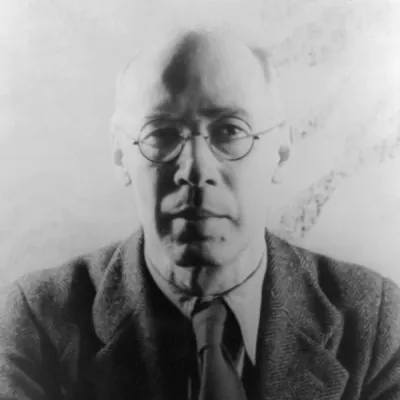
Henry Miller
Human Design Chart
Biography
Henry Miller as a Manifestor 1/4 in Human Design
Manifestor 1/4 — Design at a Glance
Henry Miller appeared as a pioneer who directed the world into a new direction. His design was characterized by the role of a leader and visionary, similar to an emperor in ancient Rome. Like this emperor, he had the vision of a great whole but did not wage the necessary wars himself; instead, he sent others to conquer foreign territories for him. This kind of leadership inevitably polarized. Miller was often misunderstood because he thought further ahead than most of his contemporaries. While some loved and followed him because of his huge visions, others found him unpleasant or even hated him for precisely the same reason. This pain point of not being understood was a central aspect of his experience. To find the right followers, it was crucial for him to inform others about his plans in a timely and precise manner. This strategy of informing was the key to his inner balance. If he lived according to this design, he was rewarded with a feeling of inner peace. If he acted against this design, he instead felt a persistent, deep anger. His path was thus marked by the tension between the necessity of communicating his vision and the inevitable reaction of the environment, which either followed or rejected him.
Splenic Authority
Henry Miller showed himself to be someone who made his decisions not through long contemplation but through an immediate, physical impulse. His design gave him an inner authority in the Spleen Center, a center that functions as a health and alarm system. Since both his Emotional and his Sacral Centers were open, this specific survival intelligence could be effective – a configuration that only Projectors or Manifestors exhibit.
This Spleen Authority manifested as spontaneous inner knowledge about whether a situation, a place, or a society was right for him. His instinct and physical well-being served as reliable indicators. The first, spontaneous impulse was the decisive factor; it served his health directly and enabled him to rigorously isolate himself from harmful influences. This impulse, however, was very subtle and only appeared once in each moment. It could easily be ignored or drowned out by other influences, which required high vigilance.
Since Henry Miller could only know what was right for him in the moment, his plans often changed short-term. Long-term commitments were difficult for him. Instead, he needed a lot of freedom and flexibility. A retreat for decision-making could be helpful to perceive this subtle impulse without it being overlaid by external expectations. His lifestyle thus oriented itself on the ability to protect and move intuitively in the here and now.
The 1/4 Profile — Investigator / Opportunist
Henry Miller showed himself as a researcher and networker, a rare profile that combined a drive for deep knowledge with the need for a familiar community. His Line 1 drove him to thoroughly explore things, while Line 4 awakened the desire for a group of familiar people with whom these insights could be shared. Through his deep knowledge, he could influence others, but Line of the Great Heart simultaneously caused a great fear of being exposed to his loved ones if he still did not know enough. This would cause him particular heart pain. A loving environment with a deep trust basis was therefore essential for his abilities to come to the fore and for him to become an authority in his heart themes through his network and knowledge.
His zest for life and experimental drive, shaped by Gate 58 Line 1, were crucial for the correcting process of Day 58. Without mindfulness, however, this energy led to frustration. The Moon gave this zest for life a cyclical quality; without it, the quality of the first line did not change. The love for correction was necessary for a safe future. At the same time, Gate 18 Line 4 brought difficulties due to inadequacies that could not be corrected. This spiritual line fixated on correction and what could not be corrected. Survival happened through suffering from incompetence. In the second generation, the demands of correction were associated with the fear of failure and its consequences. Henry Miller lived this tension between the desire for perfection and the acceptance of the uncorrectable.
Split Definition — Defined & Open Centers
Henry Miller's design predisposes him to a constant mental pressure to question and form concepts. His defined Head and Ajna Centers created a trustworthy yet uninterrupted mental activity that was not directly translatable into energy. This state required patience; the attempt to immediately realize thoughts led to frustration, while waiting for the right moment fostered clarity. His defined Throat Center enabled him to communicate these mental processes reliably, with his voice serving as a pivot to carry inner inspirations outward.
Simultaneously, his defined Spleen Center provided an intuitive, momentary perception. It delivered spontaneous judgments about health and well-being that he could not rationalize but had to trust. His defined Root Center offered the physical pressure to move forward and ensured the necessary survival consciousness.
In contrast, Henry Miller revealed himself through his undefined centers as susceptible to external conditioning. His open G Center meant he did not have a fixed identity but merged with his environment. He tended to question whether he was in the right place and sought direction through the reflection of others. His open Heart Center often made him feel not valuable enough, leading him to prove his worth through promises or overcompensation rather than trusting his inner authority. Additionally, his open Sacral Center was sensitive to the energy of others; he absorbed foreign vitality, which could lead to exhaustion if he did not pause. His open Solar Plexus absorbed the emotions of his surroundings, causing him to oscillate between the feelings of others without identifying them as his own. These opennesses made him a sensitive barometer for the social and emotional climate, but also required the ability to disengage from foreign energies.
Channels for life purpose, intuition, logic and mental images.
Henry Miller's design is characterized by a deep, intuitive search for mastery, paired with an unrelenting drive to correct and perfect patterns. This attitude resulted from the interplay of several channels. The channel of wavelength 48-16 connected the inner intelligence of the Spleen Center with the expressive capability of the Throat Center. Here, Gate 48 constantly sought vital information, while Gate 16 considered new experimental possibilities and gradually refined skills. This led Henry Miller to combine intuitive depth with repeated experimentation to transform his skill into a talent.
This process was supported by the channel of judgment 58-18, which linked the Root Center with the Spleen. Gate 58 drove a love for life and constancy, while Gate 18 functioned as a correction mechanism by questioning patterns and naming the unhealthy. This configuration gave him the ability to challenge what did not work and find solutions that contributed to perfection.
Simultaneously, the channel of the life struggle 38-28 shaped his attitude. Through Gate 38 in the Root Center, there was a strong pressure to maintain individual integrity and resist distracting forces. Gate 28 in the Spleen Center evaluated whether a struggle was appropriate and what value it held. This endowed Henry Miller with a stubborn determination to follow his own path and find meaning in daily struggles, even if it was against the status quo.
Mentally, the channel of abstraction 64-47, which connected the Head Center with the Ajna Center, worked. Gate 64 brought a certain confusion and play with possibilities, while Gate 47 aimed to understand the past and gain perspectives. Henry Miller's mind filtered every experience through a kaleidoscope of mental images to discover an inspiring story or a new viewpoint, which he then communicated.
Additionally, gates like Gate 52, which required a self-imposed pause for concentration and pattern correction, and Gate 17, which emphasized logical teaching and organization for the future, were influential. Gate 44 promoted awareness and transformation through interaction, while Gate 60 represented the acceptance of limitations as a prerequisite for transcendence. Gate 63 drove the mental process through doubt to achieve security and improvement. Gate 50 protected values and traditions, and Gate 8 promoted the individual contribution to the group.
Collective Circuitry — Circuit Signature
Henry Miller's design predisposes him to parallel, not directly connected energetic fields. As a person with split definition, he possessed two separate groups of defined centers that existed as independent forces alongside each other without forming a common flow.
The Knowledge Circuit connected his Spleen and Root Centers through the channel of the life struggle. This shaped a pulsating energy that responded to intuition and survival pressure to strengthen his own individuality. The Understanding Circuit connected Throat, Spleen, and Root Centers through the channels of wavelength and judgment. Here, a focused, rational force shared logical structures for the future's improvement, free from emotional influence. Both circuits utilized the Spleen but remained energetically separate from the second system.
The second system, the Meaning Circuit, connected Head and Ajna Centers through the channel of abstraction. This area was dedicated to the cyclical reflection of the past and the search for meaning in past experiences, separate from the rational future orientation of the first system. Henry Miller thus experienced intuitive survival energies, rational future planning, and emotional past reflection as three distinct, parallel processes that did not interweave but acted independently.
Right Angle Cross of Service 4
Henry Miller's design established a foundational disposition of serving action. This configuration, known as the right cross of service, described a specific energetic alignment: the action was not primarily aimed at personal ambitions or personal gain, but rather served a higher order or the well-being of others. It was an intrinsic motivation to contribute through concrete action that went beyond the individual.
In Human Design mechanics, this cross configuration means that the system's energy was programmed to act through service and support for others. Henry Miller often acted guided by this impulse – not out of compulsion or traditional moral obligation, but as a natural expression of his inner architecture. The 'service' here was not a sacrifice, but the path where his own energy found its most meaningful expression.
This orientation shaped his interactions with the environment. Instead of pushing to the forefront to pursue personal goals, he often acted as a support or catalyst for processes larger than himself. Energy flowed where it was needed to establish order or provide help. This created a dynamic where Henry Miller served others through his actions, which in turn enriched and stabilized his own existence. It was a cycle of giving and receiving, where giving was the driving force.
Saturn Return · Uranus Opposition · Chiron Return · 2nd Saturn Return — Life Cycles
Henry Miller's design set a tendency towards structural turning points, often marked by external obligations or new roles. In 1920, at the age of 29, he got a job as a personnel manager at a Western Union Telegraph Company branch. This fell in the first Saturn return, a cycle in which years of groundwork often condenses into a solid result and new responsibilities are taken on.
Later, in 1931 at the age of 40, Miller began working for the Paris edition of the Chicago Tribune. This step corresponded with the Uranus opposition, a phase that often brings unexpected freedoms or radical changes in career when old structures lose their viability.
The second Saturn return occurred in 1948 when Henry Miller was 57 years old. In this year, his son Tony was born. This cycle often deepens personal responsibility and strengthens the foundation for the second half of life. The events show how Henry Miller's chart connected structural milestones with professional and family obligations, rather than focusing solely on internal processes.
Manifestor · Splenic Authority — Synthesis
He was a Manifestor, defined by his Spleen Center and the Profile of the Researcher/Networker, possessing deep inner wisdom and the urge to share it. This inner compass, paired with the ability to inspire others to think (defined Head Center) through inspiration, shaped his life. The Channel of the Wave (48/16) points to an innate ability to gain deep insights and refine them through skillful action, while the Knowledge Circuit strengthened his inclination towards transformation and the development of new perspectives. The recurring professional turning points (Saturn return, Uranus opposition) showed how he constantly sought expression and the realization of his visions.
A central paradox lay in the tension between his manifesting impulse to initiate and shape things and the need to heed the subtle impulses of his Spleen Center. He was destined to lead and inspire, yet the authenticity of his decisions depended on spontaneous, bodily confirmation. This combination of visionary pioneering role and instinctive self-care led to an inner dynamic where he had to both change the world and ensure he remained healthy and vital in the process.
4 Defined Channels
Incarnation Cross - Right Angle Cross of Service 4
Solar Return
The Solar Return shows the moment when the sun returns to its exact birth position - your personal solar year.
Life Cycles
Discover the life cycles with a detailed triple view (birth chart, cycle chart, composite).
Human Design Profile
- Type
- Manifestor
- Strategy
- To inform others before acting
- Authority
- Splenic Authority
- Profile
- 1/4 - Investigator / Opportunist
- Definition
- Split Definition
- Incarnation Cross
- Right Angle Cross of Service 4
- Date of Birth
- 26.12.1891 12:30
- Place of Birth
- Manhattan, United States
Frequently Asked Questions
What was Henry Miller's Human Design type?
What profile did Henry Miller have in Human Design?
What authority did Henry Miller have?
What incarnation cross did Henry Miller have?
When was Henry Miller born?
Discover your own Human Design
Are you also a Manifestor? Find out in a personal reading how to use your initiation power peacefully and dissolve resistance.
More Personalities
Back to overviewAlain-Fournier

Angeli

Christian-Jaque
Juninho

Kesha

Lucebert