
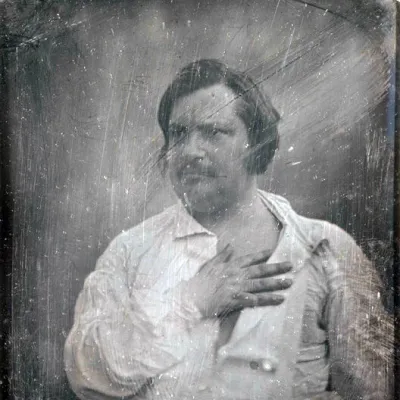
Honoré de Balzac
Human Design Chart
Biography
Born in the Loire valley, he arrived in Paris when he was 20 to conquer the world of commercial journalism, churning out articles, reviews and the occasional potboiler with such titles as "Lost Illusions," and "The Splendors and Miseries of Courtesans."
Impractical in mundane affairs, Balzac was always looking for the big financial score, venturing into Mediterranean silver mines and Brazilian treasure hunts to elaborate publishing schemes. The plans always failed and he spent a lifetime in debt.
He came into his own as a novelist during the 1830s. By the time he died at the age of 51, he had produced more than a hundred novels and tales filled with his countless recurring characters. Only a fraction of his books are printed in English, where he is little read.
His letters portrayed his mother as a tyrannical witch from whose suffocating embrace he was never entirely able to extricate himself. Along with casual love affairs, for 17 years he conducted a long-distance romance with Eveline Hanska, a wealthy Polish countess living in the Ukraine. His letters to her were voluminous though he seldom saw her in person. When her husband died in 1841, she finally arrived in Paris and they married at long last. They were only together for about four years, but they were blissfully happy, overwhelmingly in love.
Honoré de Balzac as a Manifesting Generator 6/2 in Human Design
Manifesting Generator 6/2 — Design at a Glance
Honoré de Balzac revealed himself as a Hybrid being that combined the lightning-fast execution of a Manifestor with the constant energy source of a Generator. His design allowed him to skip steps and quickly produce results. However, this speed carried risks: He tended to overlook important phases or exhaust himself through parallel project overload, often leading to frustration - his theme of Not-Self.
The solution did not lie in blindly working through task lists but rather in the strategy of responding to life impulses instead of initiating on a whim. Only when his sacral center gave a clear “Yes” for an undertaking and maintained this affirmation throughout the process, deep satisfaction arose. In this state, he fell into a productive play mode that allowed him to follow several threads simultaneously without getting distracted. His creative power remained intact as long as variety and inner consent prevailed; compulsion or ignoring sacral feedback quickly led to stagnation. Thus, his success depended on channeling his own speed through conscious reactions to authentic impulses.
Sacral Authority
Honoré de Balzac revealed himself as a Generator whose decision-making was guided not by intellectual analysis but by direct physical signals. His inner authority lay in the defined sacral center, meaning he responded to external stimuli with an “inner voice” or a noticeable surge of energy - audible as grunts, hums, or affirming mmm's. These physical impulses served him as reliable orientation.
This mechanism required an open Emotional Center. Only under this condition could his sacral authority clearly guide him to act without being goal-bound. When his sacral motor engaged with something, Honoré de Balzac felt vital and alive; he possessed seemingly inexhaustible energy and tackled tasks with great enthusiasm. He was born to immerse himself in his activities and feel joy as well as satisfaction.
Since strategy and inner authority were identical for him - both based on sacral reaction - his decision-making process simplified. Instead of searching for the “Why,” he trusted in the immediate “How” of his body. This configuration enabled him to go through life with enthusiasm and apply his energy where it was internally triggered, rather than getting lost in mental deliberations.
The 6/2 Profile — Role Model / Hermit
Honoré de Balzac's design laid out a development clearly divided into two phases. In the early years, before the age of 30, he acted like an Experiencer who learned through trial and error. This phase was marked by the necessity to gather personal experiences, often requiring retreats after setbacks. The focus lay on finding one’s authenticity in a world frequently characterized by hypocrisy.
After turning 30, this dynamic fundamentally changed. Honoré de Balzac now showed a tendency towards withdrawal to reflect upon his earlier experiments from a distance and process them intensively. This period of deep reflection served for healing and deeper self-knowledge. Only when this inner clarification was achieved did he re-enter the social fabric, now as a figure carrying wisdom.
This transformation mirrored the mechanics of his configuration: Early confrontation with right timing and overcoming hypocrisy laid the groundwork for a later role as an authentic role model. While others initially reacted uncertainly due to mistrust or projection, Honoré de Balzac could build trust through his purified stance. He became an anchor point in the collective, enabling others to participate in his deep introspection and learn from his gained wisdom.
Single Definition — Defined & Open Centers
Honoré de Balzac revealed himself as someone with a massive, constant internal infrastructure. His design provided stability in thinking, identity, and expression: The defined Ajna Center ensured consistent, specific conceptualization; the G Center granted reliable self-identity and inner direction; the Sacral Center generated daily vital energy as a motor. This structure contrasted with his open centers - Head, Heart, Solar Plexus, Spleen, and Root - which made him situationally open to external inspirations, emotional currents, uncertainties, and stress.
As a Generator operating from this firm foundation, the challenge lay in not overriding his defined authority through conditioned reactions of the open centers. He had to wait to react correctly rather than initiate from an open Head or Heart. His open Solar Plexus made him susceptible to absorbing environmental stress and emotions, which could disturb his defined calm if he did not trust his inner authority.
The open Head Center tended to exhaust mental pressure or get entangled in others' doubts instead of filtering clear inspiration. The open Heart Center pulled him into the cycle of wanting to prove his worth, often leading to promises he could not keep. The open Spleen caused a fundamental survival fear and the temptation to cling to uncertain things, while the open Root Center amplified external stress, potentially leading to hyperactivity to relieve this pressure.
Balzac's mechanics required him not to personalize these open windows as his own reality. By waiting for his sacral response and drawing mental and emotional stability from defined centers, he avoided exhaustion through false initiatives. His strength lay in connecting the clarity of Ajna and G with the endurance of Sacral without being led astray by the confusing dynamics of his open fields.
Channels for rhythm, inspiration, structure and powerful expression.
Honoré de Balzac revealed himself as someone whose mere presence and authentic self-expression inspired the collective. This effect did not primarily stem from words or explanations but from a exemplary life of his individual truth. The Channel of Inspiration 1-8 connected the G Center with the Throat Center through Gate 1 (Self-Expression) and Gate 8 (Contributing). It required the courage to stand out from the crowd, awakening new perspectives in others as an example. His unique identity drew attention, a co-creation between his dedication to individuality and recognition by the environment.
Simultaneously, Honoré de Balzac possessed the Channel of Beats 14-2, linking Sacral with G Center through Gate 14 (Power Competence) and Gate 2 (Higher Knowledge). He had resources to transform mutative impulses into material directions, guiding innovative new paths by trusting his Sacral reactions without knowing the goal in advance. This gave him a powerful life energy that encouraged others in their creative direction.
The Channel of Rhythm 5-15 also connected Sacral and G Center via Gate 5 (Fixed Rhythms) and Gate 15 (Extremes). Honoré de Balzac was carried forward by the flow of life, with an inner timing that kept him vital. His natural routines drew others into a continuous energy flow that propelled the group forward.
Additionally, the Channel of Structuring 43-23 between Ajna and Throat Center influenced his design. Gate 43 (Insight) received spontaneous breakthroughs processed through Gate 23 (Assimilation). Honoré de Balzac developed techniques to increase efficiency and expressed innovative perspectives that changed others' thinking. His knowledge often seemed light-years ahead; recognition came when he aligned with the flow of his design and timing matched.
Individual Gates complemented this picture: Gate 59 pursued a genetic strategy of bonding without personal preferences. Gate 55 brought emotional awareness and mood changes. Gate 16 promoted mastery through experimentation, while Gate 62 emphasized details, logic, and pattern recognition. Gate 29 stood for persistence and saying yes to life. Gate 24 provided mental renewal in the pulse of knowledge. Gate 47 helped recognize meaning from past experiences and clarity.
Individual Circuitry — Circuit Signature
Honoré de Balzac's design showed a clear, coherent energetic structure. As a person with simple definition, his energy flowed in one continuous stream between centers of Identity, Sacral, Ajna, and Throat. This direct connection allowed a seamless transition from inner authority through logical thinking to spoken expression.
The Knowledge Circuit shaped the foundation. Through Channels of Structuring (43-23), Inspiration (8-1), and Beats (2-14), it connected Ajna, Throat, Identity, and Sacral centers in Honoré de Balzac into a single unit. This promoted the drive to express unique identity and bring new knowledge through emotional waves and creative impulses into the world. Energies of these channels supported creating anew and announcing it via Solar Plexus influence on the Throat Center.
Parallel, the Understanding Circuit worked through the Channel of Rhythm (15-5). It specifically linked Identity with Sacral center. Here, logical, rational insights were passed on free from conditioning and emotional coloring. As Solar Plexus was not involved here, a focused visual ratio came to the fore aiming at improving structures and pointing towards the future.
Both circuits worked in Honoré de Balzac not isolated but as part of his simple definition. Connecting all four centers (Identity, Sacral, Ajna, Throat) created an integrated experience: Creativity and emotional transformation from Knowledge Circuit flowed directly together with strategic, logical clarity of Understanding Circuit. This resulted in a profile that combined innovative individual expressions with structured rational thinking to bring about change and disseminate insights.
Left Angle Cross of Uncertainty 1
Honoré de Balzac lived his entire life in a profound existential experience of uncertainty. His design was marked by constant confrontation with the unknown; it wasn't primarily about finding definitive answers or certainties, but rather about dealing with fundamental uncertainty. This attitude formed a consistent imprint on the level of the cross.
The left cross of uncertainty 1 defined his life through the necessity to move in a state of not knowing. For Honoré de Balzac, this dynamic was not a temporary phase but a structural reality. He showed himself as someone who had to learn to live with open questions and unclear situations without grasping for immediate clarity. The mechanics of this design suggested that security wasn't achieved through external facts but rather through the inner ability to endure the unpredictable.
This configuration described a life task where the focus was on the process of enduring and navigating uncertainty. Honoré de Balzac lived with the realization that life remains full of gaps that do not need or can be filled. Instead, his development was shaped by accepting this fundamental indeterminacy. It mattered less to know where one is going than how to walk the path in the fog. This constant confrontation with the unknown formed his inner attitude and significantly determined how he perceived and reacted to the world around him.
Saturn Return · Uranus Opposition · Chiron Return — Life Cycles
Honoré de Balzac's design was characterized by recurring cyclical patterns that linked crisis, professional expansion, and relationship formation as structural axes of his life path. This dynamic manifested concretely in the major planetary transitions of his biography.
The first Saturn return often marked a phase of consolidation or collapse under pressure. In 1826, at age 27, Balzac bought a printing press with a loan and later had to declare bankruptcy. This event corresponded to the typical saturnine test where earlier ambitions were put to their limits.
The Uranus opposition, on the other hand, signaled a break from the existing in favor of new forms of expression. In 1839, at age 40, he published works such as “Le cabinet des antiques” and “Les secrets de la princesse de Cadignan”. This was a moment of professional expansion where his creative potential unfolded through innovative publications.
The Chiron return around the age of 51 is not a healing process in the traditional sense but a fulfillment cycle, in which the incarnation task is completed. In 1850, Balzac married Eveline Hańska in Berdyczów. This relationship marked the end of the cycle where his life purpose became experientially manifest in a binding partnership. The sequence of financial crisis, artistic breakthrough, and personal commitment illustrated the rhythmic nature of his design.
Manifesting Generator · Sacral Authority — Synthesis
Honoré de Balzac was a Manifesting Generator whose life seemed to be characterized by a constant interplay between initiating and reacting. His defined sacral energy (Sacral Center) gave him the ability to work on projects with great endurance as long as they truly fulfilled him. However, Channel 1-8, which connects inspiration and expression, along with Channel 14-2, which releases a mutative force, pointed to a drive to create new things and break conventions – an inner motor that drove him to reinvent himself repeatedly. This dynamic led to the appearance of easily initiating projects (manifesting component), yet also taking the risk of getting lost in too many things at once (as described in the design view).
A central paradox lay in Balzac's strong need for recognition and validation of his individuality (G Center connected with Gate 1) while simultaneously having an open Heart Center. This led to a constant search for external validation, making him vulnerable to conditioning and leading him to make decisions out of fear of rejection rather than relying on his inner authority. His ability to forge new paths through creativity and expression (Knowledge Circuit) thus stood in tension with the internal uncertainty whether these paths were truly correct for him.
4 Defined Channels
Incarnation Cross - Left Angle Cross of Uncertainty 1
Solar Return
The Solar Return shows the moment when the sun returns to its exact birth position - your personal solar year.
Life Cycles
Discover the life cycles with a detailed triple view (birth chart, cycle chart, composite).
Human Design Profile
- Strategy
- To respond - wait for something to respond to
- Authority
- Sacral Authority
- Profile
- 6/2 - Role Model / Hermit
- Definition
- Single Definition
- Incarnation Cross
- Left Angle Cross of Uncertainty 1
- Date of Birth
- 20.05.1799 11:00
- Place of Birth
- Tours, France
Frequently Asked Questions
What was Honoré de Balzac's Human Design type?
What profile did Honoré de Balzac have in Human Design?
What authority did Honoré de Balzac have?
Which incarnation cross was active for Honoré de Balzac?
When was Honoré de Balzac born?
Discover your own Human Design
Are you also a Manifesting Generator? Find out in a personal reading how to unfold your multi-talents and direct your energy wisely.
More Personalities
Back to overviewAlain-Fournier

Aldair

Alizée

Angeli

Arletty

Artus
