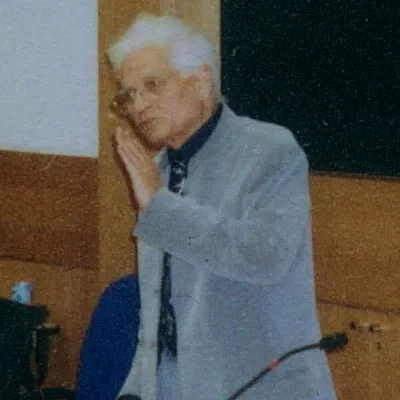
Jacques Derrida
Human Design Chart
Biography
During his career, Derrida published over 40 books, together with hundreds of essays and public presentations. He has had a significant influence on the humanities and social sciences, including philosophy, literature, law, anthropology, historiography, applied linguistics, sociolinguistics, psychoanalysis, music, architecture, and political theory.
Into the 2000s, his work retained major academic influence throughout the United States, continental Europe, South America and all other countries where continental philosophy has been predominant, particularly in debates around ontology, epistemology (especially concerning social sciences), ethics, aesthetics, hermeneutics, and the philosophy of language. For the last two decades of his life, Derrida was Professor in Humanities at the University of California, Irvine.
What does Generator 2/4 mean for Jacques Derrida?
Generator 2/4 — Design at a Glance
Jacques Derrida's design inclined towards high endurance, provided the activity aligned with his inner impulse. As a Generator, he possessed abundant sacral energy that made him extremely strong and resilient—provided he was passionate about his task. This energy did not get released through self-initiation but only when he responded to signals from life. The motto of his design was clear: Do not initiate, but react.
His most successful strategy involved waiting until the sacral center gave a clear "yes," and then responding with action. When Jacques Derrida followed this resonance from his gut, nothing could stop him; he would be rewarded with a deep sense of fulfillment. Conversely, ignoring this principle—such as by constantly initiating without inner confirmation or engaging in compulsive activities without enjoyment—ultimately led to frustration and energy depletion. Two pitfalls shaped his potential: either wasting energy on tasks that did not interest him, leading towards burnout, or being held back from his heart's project despite still wanting to continue working with full power. His path to satisfaction therefore lay in disciplined reactions to inner confirmation.
Sacral Authority
Jacques Derrida revealed himself as someone whose decision-making was characterized by a direct physical resonance. As a Generator, he possessed sacral authority, meaning that his strategy and inner guidance were identical: He responded to life rather than actively planning it. This configuration greatly simplified his process, as he did not have to choose between different internal voices but could wait for a clear impulse.
The prerequisite for this authority was his open Emotional Center, which ensured that he was not led astray by fleeting emotional fluctuations that would not provide stable answers there anyway. Instead, Derrida sought the "gut feeling" – an immediate surge of energy or physical confirmation like an inner nod or grunt in response to external stimuli. When his sacral motor kicked in, he felt vital and energized; then he could dive into his activities with great enthusiasm without having a compulsive sense of purpose.
Additionally, an activated Spleen Center acted as a supportive instance. In conjunction with the Sacral Center, this enabled quick, spontaneous reactions and reliable access to instinctive perception. Derrida could therefore rely on this immediate physical intuition to make decisions that brought him well-being and clarity. His design called upon him to observe these inner signals closely and trust them rather than overriding them through intellectual deliberation.
The 2/4 Profile — Hermit / Opportunist
Jacques Derrida was characterized by a Profile 2/4, which carried a constant tension between the desire for withdrawal and the wish for community. As a "natural talent" and "networker," he oscillated between Line 2, which required time alone for inner processes, and Line 4, which sought exchange with familiar people. This configuration demanded clear communication: He had to signal when he retreated into his "cave" to gain clarity and when he was ready to receive company.
During his solitary times, he reflected intensely, where the second line of Gate 62 offered a positive limitation through discipline. Here it was necessary to do detailed work and resist the fear of being a "paper tiger" if one still felt unsure. Often he only recognized his full capability when called upon to act. Once the need for rest was satisfied, Line 4 came into play: It acted as a mediator and promoted collective processes through pragmatic action and maturity. Jacques Derrida used these phases to evaluate the knowledge of his network and develop brilliant ideas by navigating between isolated depth and social exchange.
Split Definition — Defined & Open Centers
Jacques Derrida's Human Design profile indicated a tendency towards constant mental pressure. He was someone who asked questions and cultivated conceptual thinking – not to provide final answers but to keep the thought process going. This configuration stemmed from his defined Head and Ajna Centers: A firm way of thinking that generated inspiration, yet lacked energy for direct implementation. His mind was always active; clarity and doubt were natural phases of this process.
As a Generator, he had a powerful sacral energy source (defined Sacral Center), which gave him vitality and endurance. Yet, this power was only available when responding correctly – not on mentally initiated projects. His defined Spleen Center provided spontaneous, intuitive judgments in the present moment; his defined Root Center supplied the necessary pressure to move forward and master existential challenges.
At the same time, he was vulnerable to conditioning through his open centers. His open Throat Center tended to feel pressured to demand attention through speaking – rather than waiting for the invitation to be truly heard. His open G Center meant no fixed identity or direction; he took on roles and environments without claiming them as part of himself. His open Heart Center lacked consistent willpower to give promises; it did not need to prove anything. And his open Solar Plexus Center absorbed other people's emotions – which could make him feel emotionally unstable if he held onto others' moods. His wisdom lay in not filling these open spaces with mental chatter but using them as mirrors for the environment.
Channels for meaning, care, growth and mental clarity.
Jacques Derrida's Human Design profile established a fundamental approach that combined spontaneous insights with the necessity of their rational classification. The Channel of Awareness 61-24 connected the Head Center to the Ajna Center; here, the sudden inspiration of Gate 61 was transformed into clear knowledge through the rationalizing energy of Gate 24. This process did not require active control but rather a surrender to the moment when inner truth revealed itself—a state that sought silence and was often eased by music.
Parallel to this, there was a deep connection with preserving structures and values. The Channel of Preservation 27-50 linked the Sacral Center to the Spleen; the nurturing energy of Gate 27 served here to preserve the traditional values of Gate 50. This created a natural ability to take responsibility for the "tribe" and provide support, always guided by one's own sacral reaction to others' requests—not through external pressure.
Another defining aspect was his stubborn determination to follow a personal path. The Channel of Life Struggle 38-28 connected the Root Pressure of Gate 38 with the intuitive valuation of Gate 28 in the Spleen. This drove Jacques Derrida to resist distractions and endure struggles that were recognized as meaningful to preserve individual integrity.
Furthermore, he experienced cycles until completion. The Channel of Ripening 42-53 connected the Sacral Center to the Root Center; Gate 53 initiated processes that only unfolded their wisdom through reflective growth at Gate 42. Each experience had to be lived to its end and then reflected upon in order to transition into new cycles.
Additionally, isolated Gates played a role: Gate 62 sought logical patterns and details, Gate 32 aimed for continuity and material success for the tribe, while Gate 3 in the Sacral Center promoted mutations to overcome confusion. The Personality Gates 63 (Doubt), 52 (Concentration/Pause), and 58 (Experiment/Pressure) as well as Role Gate 59 (Mating Strategy) rounded out this complex structure by posing questions, requesting pauses for pattern correction, or activating genetic bonding patterns.
Individual Circuitry — Circuit Signature
Jacques Derrida's design predisposes a tendency towards internal fragmentation, as his energetic connections fall into two separate groups. This is not a continuous unity but rather consists of parallel, non-directly communicating energy fields.
In the Knowledge Circuit, he connects the Head Center with the Ajna Center and the Spleen with the Root Center. This configuration promotes sudden mental impulses and instinctive reactions to life's struggle without these areas forming a common flow. Parallel to this, in the Meaning-Finding Circuit, there is a connection between the Sacral and Root Centers, which manifests as a cyclical search for meaning in past experiences. Here it involves emotionally processing history, separate from the other energies.
A third aspect is the Protector Circuit, which in Jacques Derrida connects the Sacral with the Spleen Center. This manifests as instinctive care and preservation, an ancient energy of protection and conservation. Since this is a split definition, these three circuits exist alongside each other: mental-instinctual impulses, emotional meaning-finding, and protective care remain energetically isolated from one another, leading to a complex but fragmented inner landscape.
Right Angle Cross of Maya 2
Jacques Derrida's Human Design configuration pointed towards a deep and often painful confrontation with his true essence. This setup, known as the right cross of Maya, marked a life span characterized by intense inner transformation and letting go of old identities. It was not about superficial adaptation but rather a necessary process of decay and rebuilding where Jacques Derrida had to abandon old beliefs and structures in order to find a more authentic form of being.
This mechanism acted as a catalytic force, pushing him constantly to redefine himself. The path often led through phases of uncertainty and loss since the old was not simply replaced but fundamentally dissolved. Jacques Derrida showed himself someone who did not avoid these challenges but accepted them as necessary parts of his growth. The energy of this cross ensured that he did not settle into comfort zones, but was continuously questioned and changed. This resulted in a person deeply marked by these processes internally yet also bearing the burden of always being in flux. Experiencing this design meant for Jacques Derrida that his identity was no static construct but a dynamic process of constant renewal and deepening.
Saturn Return · Uranus Opposition · Chiron Return · 2nd Saturn Return — Life Cycles
Jacques Derrida appeared as someone whose intellectual structure was characterized by clear milestones of consolidation. His Human Design pointed towards a tendency to carry internal maturation processes outwardly during specific life phases and translate them into lasting results. This did not happen randomly but followed the rhythm of Saturn Returns, cycles of consolidation where years of groundwork condensed.
In 1956 at age 26, Jacques Derrida passed the Agrégation in Philosophy. For his design, this first Saturn Return marked the transition from a learning phase to an established position; knowledge became a solid foundation. Decades later, in 1972 at age 42, he published 'Ökonomimesis'. This time fell on the Uranus Opposition, a period of upheaval and redefinition. Here his design showed its ability to question established structures and open up new perspectives, propelling his career forward.
The second Saturn Return around 1985 (age 55) brought with it the second edition of 'Right to Insight', further affirming his intellectual position. This cycle underscored the constancy of his work and deepened his authority in philosophical discourse. Jacques Derrida's path was thus characterized by these recurring phases of structuring and change, where internal processes condensed into public contributions.
Generator · Sacral Authority — Synthesis
He was a Generator whose life was marked by a deeply rooted need to immerse himself fully in activities that activated his sacral energy (sacral center, authority). This work style not only allowed for endurance and creative power but also revealed an inner logic: decisions were easier when initiated from the body – a rumbling, humming or groaning signaled the right direction. The profile as a natural talent and networker points to a rhythm that fluctuates between withdrawal into internal processes (line 2) and the need for exchange with others (line 4); a dynamic that provided him clarity and inspiration when kept in balance.
A central paradox lay in the connection of defined mental activity (head-ajna center) and the knowledge circuit. The constant mental pressure to question and explore the unknown culminated in sudden flashes of insight (channel 24-61), which he rationalized and transformed. However, this ability to generate and express new insights was always accompanied by a melancholic note – an expression of his individuality that drove him to challenge existing structures and initiate change (documented events 1956, 1972, 1985).
4 Defined Channels
Incarnation Cross - Right Angle Cross of Maya 2
Solar Return
The Solar Return shows the moment when the sun returns to its exact birth position - your personal solar year.
Life Cycles
Discover the life cycles with a detailed triple view (birth chart, cycle chart, composite).
Human Design Profile
- Type
- Generator
- Strategy
- To respond - wait for something to respond to
- Authority
- Sacral Authority
- Profile
- 2/4 - Hermit / Opportunist
- Definition
- Split Definition
- Incarnation Cross
- Right Angle Cross of Maya 2
- Date of Birth
- 15.07.1930 08:30
- Place of Birth
- El Biar, Algeria
Frequently Asked Questions
What is Jacques Derrida's Human Design type?
Which profile did Jacques Derrida have?
What authority did Jacques Derrida have?
What incarnation cross did Jacques Derrida have?
When was Jacques Derrida born?
Discover your own Human Design
Are you also a Generator? Find out in a personal reading how to use your sacral energy correctly and discover deep satisfaction.
More Personalities
Back to overviewAaliyah

Alexia

Angèle

Anne-Marie

Arcángel

Arno