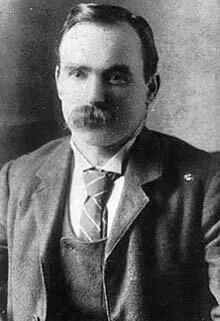
James Connolly
Human Design Chart
Biography
The Human Design of James Connolly: Projector 5/1
Projector 5/1 — Design at a Glance
James Connolly was revealed as a Projector, whose design was characterized by a specific way of perception and interaction. His undefined Sacral Center meant that he did not have a constant, intrinsic source of life energy. Instead, he went through phases of high activity, during which he could work quickly, followed by necessary rest phases to avoid exhaustion. This rhythmic pattern often conflicted with societal structures that expected continuous performance.
As a Projector, his aura worked like a focused flashlight, immediately revealing weaknesses in systems or in others. This ability to identify flaws in the system was sharper than many environmental people could tolerate. Directly addressing these deficits often led to friction, as it was perceived as unpleasant. The more effective strategy was to attract others through his own harmony and clarity, so that they would seek his advice on their own. His design required him to wait for a respectful and honest invitation before taking on a leadership role. Living this pattern was rewarded with success. Ignoring this dynamic led to the non-self theme of bitterness, a sign that he was not acting according to his natural mechanics.
Emotional Authority
James Connolly's design laid a tendency to emotional turbulence that significantly influenced his decision-making. He was constantly swept up in waves of emotional highs and lows, making the world appear colored by his current mood. What was seen as inspiring in one moment could appear negative in the next. This emotional authority, carried by his defined Solar Plexus Center, always took precedence over all other defined centers in his system, regardless of further configurations. His immediate feeling was, however, only a snapshot, not a final judgment. Quick, spontaneous decisions made in this emotional heat often proved problematic. Instead, his design required patience and conscious hesitation. By letting decisions rest overnight, the intense impulses subsided. Only with this temporal distance did he gain emotional distance, allowing clarity and calmness to set in. This process of maturation was crucial for long-term course corrections that influenced his life path. Only through this repeated review and waiting could he distinguish his true inner truth from passing moods.
The 5/1 Profile — Heretic / Investigator
James Connolly was someone who used deep knowledge to help others in crises. His design as a Hero/Researcher (Profile 5/1) inclined him towards practicing the sharing of experiences and selflessness. Line 1 drove him towards intense self-discovery and research, while Line 5 translated these insights into practical solutions for others. Others often sought his answers, which made him magnetic, but could also lead to exhaustion if he did not set boundaries.
Gate 35 promoted his altruism in the context of sharing experiences. He learned from practice and helped others solve problems without clinging to the outcomes. Gate 22 brought attention and politeness to his interactions. It helped him to transfer mutations into society, even if he was not always rewarded for it. The ability to accept a subordinate position was crucial to his success. Attempts to take on an inappropriate role led to social humiliation.
James Connolly had to learn to say no to maintain the balance between research for himself and problem-solving for others. Only in this way could he optimally use his gifts and not be burned out by the expectations of others. His design marked him as someone who not only collected knowledge but actively put it into service for the community, while always consciously drawing the line between helping and taking on the burden of others' problems.
Split Definition — Defined & Open Centers
James Connolly's design shows a tendency towards consequent, conceptual clarity, paired with the ability to directly translate these thoughts into the world. His defined Ajna Center ensures a constant mental function that creates concepts and theories in a trustworthy manner. Since this center is connected to his also defined Throat Center, he reliably spoke out what his mind conceptualized. This connection allowed him to not only process mental processes internally but also to carry them out as clear communication and action.
At the same time, his defined Solar Plexus Center shaped his inner authority. He relied on waiting for the emotional wave before making decisions. Emotional clarity came to him only over time, not in the moment of impulse. His defined Root Center provided a steady, adrenalized pressure that drove him towards material awareness and survival consciousness. This constant inner pressure served as a motor to move forward in the world as long as he was guided by his emotional authority.
In contrast, his vulnerability was shown in the open centers. His open Head Center had no constant source of inspiration; he tended to mentally exhaust himself or get entangled in questions that were not his own if he did not trust his authority. His open G Center meant that he did not have a fixed identity or direction. He relied on being initiated through correct environments and relationships to feel where he belonged. The open Heart Center made him susceptible to the pressure of having to prove his worth, although he did not have a constant willpower for it. His open Sacral Center led to him amplifying the energy of his environment, which could lead to exhaustion if he did not set boundaries. Finally, his open Spleen Center was vulnerable to fears and spontaneous, impulse-driven decisions that often resulted from conditioned insecurity rather than true intuition.
Channels for accepting clarity and emotional release.
James Connolly exhibited a fundamental disposition based on logical order of details, paired with a deep, rhythmic emotional wave. His design marked him as someone who not only absorbed information but integrated it into a coherent mental system before articulating it verbally.
This process was steered by the Accepting Channel 17-62, connecting the Ajna Center with the Throat Center, allowing him to translate visual patterns (Gate 17) into precise language and details (Gate 62). Connolly continuously organized his perception internally; only what fit into his logical worldview he understood. This created a constant pressure to explain his opinions and understanding in detail. The ability to present complex connections as theories or formulas was closely linked to the necessity of waiting for the right timing and the receptiveness of the audience to avoid resistance.
Simultaneously, he experienced a pulsating emotional dynamics carried by the Channel of Emotional Release 39-55. This channel connected the Root Center with the Solar Plexus Center and set the wave between joy and melancholy in motion. Connolly was not designed to rationalize these moods but to live them as an authentic, transformative force. His Provocation (Gate 39) served to test and filter the minds and moods of others to identify who fit his individual frequency.
Additionally, Gates like 35 (Change through Interaction), 5 (Rhythm and Energy Build-up), and 22 (Social Mutation through Calmness) influenced his cross. This configuration promoted an attitude focused on waiting, building firm habits, and observing collective changes. Gates like 47 (Purpose from the Past) and 30 (Recognition of Feelings and Destiny) deepened his ability to gain clarity from experiences and illusions, while Gate 52 (Focused Pause) allowed him to withdraw to correct patterns and find inner stillness.
Collective Circuitry — Circuit Signature
James Connolly's design shows a tendency towards separate, parallel forces. His structure was a 'Split Definition', meaning two independent energetic blocks existed that were not directly connected to each other. This shaped an experience world where rational strategies and emotional impulses acted as separate, coexisting systems rather than a cohesive flow.
The Understanding Circuit connected his Ajna and Throat Centers. This connection allowed him to directly articulate logical strategies and focused thoughts. It was an 'emotionless ratio' aimed at clearly and structurally sharing rational insights to communicate improvements or future-oriented solutions.
Simultaneously, the Knowledge Circuit, connecting the Solar Plexus with the Root Center, was at work. Here, it was about releasing emotions and transforming knowledge. This energy pulsing and acoustically, drove the expression of his unique identity forward. Emotional waves served as a motor to transform new understanding and initiate change.
Since these two circuits lay in different groups, there was no direct energetic bridge between the rational analysis in the Ajna-Throat area and the emotional driving force in the Solar Plexus-Root area. James Connolly lived with these two distinct energy fields: one for clear, strategic communication and one for emotional, transformative expression, each working independently.
Left Angle Cross of Separation 1
James Connolly's design carried the signature of the left cross of separation. This configuration established a fundamental tendency towards inner disintegration, coupled with the urge to draw clear boundaries. His chart did not show a predetermined harmony but rather a dynamic tension that drove him to distance himself from groups or ideas that no longer served him. The mechanics of this cross describe the process of separation: it is not about isolation but about the conscious creation of distance to maintain one's own integrity. James Connolly lived this dynamic by repeatedly separating himself from collective structures as soon as they restricted his individual truth. This separation was not an act of rejection but a necessary strategy for self-assertion. His design required him to break away from what did not represent him in order to find his own path. The energy of this cross acted as a catalyst for independence; it forced him to constantly redefine himself by leaving the past behind. James Connolly thus demonstrated himself as someone who gained clarity through distancing. His life task was to use separation as a constructive process to form an authentic identity that did not rely on conformity but on genuine difference. This mechanism shaped his actions sustainably and determined how he interacted with his environment.
Saturn Return · Uranus Opposition — Life Cycles
James Connolly's design established a tendency towards structural innovation and the separation from existing systems when they no longer aligned with his inner truth. This was evident in 1907, at the age of 39, when he founded the Irish Socialist Federation, edited its journal “The Harp,” and left the SLP.
This step corresponds to the Uranus opposition, a transitory aspect often associated with a desire for radical change and independence. In Human Design mechanics, this configuration marks phases where old ties are dissolved and new, independent structures are established. For James Connolly, this was not just a break but a necessary differentiation. The founding of his own organization and the assumption of the editorship signalled the will to not only theoretically represent his own ideas but to anchor them institutionally. The departure from the SLP underscored the priority of authenticity over conformity. This mechanism describes a process where the pressure for change becomes so strong that it can no longer be integrated within the old framework conditions. Instead, a new platform emerges that better aligns with one's own values and strategies. James Connolly used this energetic situation to pursue his vision independently and form a community that shared his specific orientation.
Projector · Emotional Authority — Synthesis
James Connolly was a projector, whose life was marked by a deep need to recognize patterns and bring light into the darkness for others. His defined mental center (Ajna) and the channel of acceptance (Gate 17/62) indicated a capacity to analyze information precisely and translate it into understandable concepts. This inclination to grasp underlying mechanisms was reinforced by his profile as a Hero/Researcher (5/1), who gathered knowledge to make it available to others and offer solutions. He thus lived a process of continuous learning and the dissemination of insights, with a constant focus on structure and detail.
At the same time, his emotional authority revealed an internal tension field. While his mind tended to quickly identify errors and present solutions, his emotional center required time to let decisions mature and fully grasp the implications of his insights. This paradox between the need to analyze and communicate quickly and the necessity to consider the emotional wave shaped his approach and created a dynamic between problem recognition and finding sustainable solutions.
2 Defined Channels
Incarnation Cross - Left Angle Cross of Separation 1
Solar Return
The Solar Return shows the moment when the sun returns to its exact birth position - your personal solar year.
Life Cycles
Discover the life cycles with a detailed triple view (birth chart, cycle chart, composite).
Human Design Profile
- Type
- Projector
- Strategy
- Wait for the respectful invitation
- Authority
- Emotional Authority
- Profile
- 5/1 - Heretic / Investigator
- Definition
- Split Definition
- Incarnation Cross
- Left Angle Cross of Separation 1
- Date of Birth
- 05.06.1868 14:30
- Place of Birth
- Edinburgh, United Kingdom
Frequently Asked Questions
What was James Connolly's Human Design type?
What Profile did James Connolly have in Human Design?
What authority did James Connolly have?
What incarnation cross did James Connolly have?
When was James Connolly born?
Discover your own Human Design
Are you also a Projector? Find out in a personal reading how to unfold your leadership qualities and recognize the right invitations.
More Personalities
Back to overviewSissy Spacek

Alain-Fournier

Anémone

Ann-Margret

Bourvil
Hergé