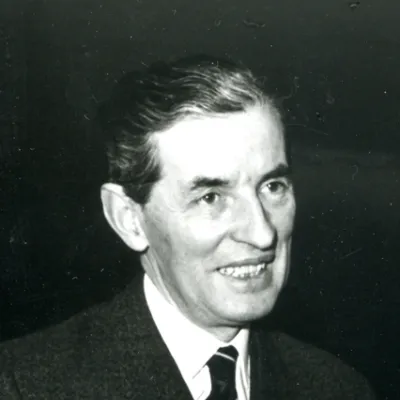
Photo: Wikimedia Commons
Jean Fourastié
Human Design Chart
Biography
He died on 25 July 1990 in Douelle, Lot, France.
Jean Fourastié as a Generator 4/6 in Human Design
Generator 4/6 — Design at a Glance
Jean Fourastié revealed himself as someone who unleashed his power not through spontaneous initiatives, but through patient waiting for inner signals. His Generator design laid down an enormous, enduring energy foundation, comparable to that of a workhorse, which only runs effectively when properly guided. This energy source, the sacral center, did not respond to arbitrary decisions but to genuine impulses from the environment. The central mechanics of his design consisted in not taking the first step himself, but waiting for a life signal and then responding from the gut.
This reactive mode was the key to his effectiveness. When he responded to such a signal with a clear inner 'yes', he could act with deep satisfaction and inexhaustible endurance. Conversely, ignoring this principle - whether by forcing initiatives or suppressing the urge to work on heart projects - quickly led to frustration and energy loss. Jean Fourastié's life energy was thus not a free good that he could use at will, but a resource that only freed itself through correct reactions to external occasions. His success depended directly on living this reactive strategy consistently, rather than working against the natural flow of his energy.
Sacral Authority
Jean Fourastié revealed himself as someone whose decision-making was based on an immediate physical resonance. As a Generator, his strategy was also his inner authority: the Sacral Authority. This mechanism simplified his process, as he did not need to think but wait for an inner confirmation. A prerequisite for this was his open emotional center, ensuring that he did not act impulsively but trusted the clarity of the sacral response.
This authority expressed itself in a 'gut feeling' or a sudden surge of energy as a reaction to external stimuli. Jean Fourastié learned to pay attention to these physical signals - whether as a soft grunt, an affirming 'Mhm', or a rejecting sound. When his sacral motor responded to something, he felt vital and alive. He then had seemingly inexhaustible energy and completed his work with great enthusiasm. His design predisposed him to go through life with joy and satisfaction, fully immersed in activities without them having to be strictly purpose-driven.
Additionally, his activated spleen center acted as a supporting authority. This gave him the ability to react particularly quickly and spontaneously. He had an immediate access to his physical well-being and instinctive perception. Jean Fourastié could reliably be guided by this instinctive intelligence, which complemented his sacral decision joy with quick, intuitive assessments. His life energy thus arose from the synthesis of deep, sacral drive and quick, spleen-based intuition.
The 4/6 Profile — Opportunist / Role Model
Jean Fourastié revealed himself as someone who throughout his life oscillated between a deep need for connection and the urge for detached wisdom. In his first thirty years, before the return of Saturn, his sixth profile line still acted like a third: He experimented intensely, especially in relationships and friendships, to find his role. This early phase was marked by the fourth line, waiting for favorable opportunities to act as a mediator and promote collective processes.
With the activation of the sixth line, an inner conflict came to the fore: the contradiction between the desire to belong to the community and the impulse to withdraw to think about the meaning of life. This tension between heart and head shaped his development. He was expected to function as a wise role model through cooperation. His large heart remained cautious, not to open up to the wrong people.
The sixth line also checked the practicality of solutions and decided whether they were confirmed or denied. It contributed to transferring important knowledge into social consciousness when it was of great significance. Jean Fourastié knew the clichés that wanted to find application in the collective, yet often the collective did not listen. His task was to proceed pragmatically and develop maturity to not hinder growth while simultaneously strengthening the mutation of knowledge into the collective.
Split Definition — Defined & Open Centers
Jean Fourastié revealed himself as a person with a clear inner orientation and a deep connection to himself. His defined G Center gave him a constant sense of self-identity and the feeling of being lovable without being dependent on others. This allowed him to show others new directions or perspectives, as he was secure in his own mission. At the same time, his defined Sacral Center provided a huge source of vital energy that drove him to move through life by reacting to it and finding satisfaction in his work. His strategy was not to initiate but to wait until life asked him, and then to respond with full force. His defined Spleen Center ensured a strong body awareness and intuition, helping him to make healthy decisions in the present moment and protect his well-being.
In contrast, Jean Fourastié was open to external influences in other areas. His open Head Center meant that he did not have a constant mental inspiration and was vulnerable to getting caught up in the thoughts and questions of others rather than using his own inner authority. He tended to question whether he had the right answers, even though these questions often did not belong to him. His open Ajna Center allowed him to think flexibly and take in many ideas without identifying them as his own truth. The open Throat Center showed that he did not need to communicate constantly but could wait for the invitation to speak to gain attention without effort. His open Heart Center made him vulnerable to the pressure of proving his worth through promises or competitive behavior, which he could avoid by trusting his inner guidance. Finally, his open Solar Plexus absorbed the emotions of his environment, causing him to distinguish between his own feelings and those of others to remain emotionally stable.
Channels for rituals, extreme diversity and ambitious transformation.
Jean Fourastié was characterized by a deep, biological rhythm that connected him to the flow of life. The Rhythm Channel 5-15 linked his sacral energy with the G Center. Gate 5 held onto fixed habits, while Gate 15 integrated the diversity of society into this life flow. This mechanism gave him natural timing; he acted vital and drew others into his energy flow without having to consciously control it. It was an impersonal magnetism that propelled humanity forward.
At the same time, the Transformation Channel 54-32 drove him. This connected the Root Center with the Spleen and generated ambition through constant effort. Gate 54 aimed for ascent and change, motivated by the desire to be seen. Gate 32 instinctively sought talents and continuity to secure the existence of the tribe. Fourastié worked hard to prove his worth and sought the support of his environment to realize his ambitions. This combination of deep rhythm and social ambition shaped the way he moved in the world.
Additionally, individual gates influenced his development. Gate 42 emphasized the importance of experience and completing processes for new commitments. Gate 61 sought inner truth and silence, while Gate 62 promoted logical details and pattern recognition. Gate 60 accepted limitations as a prerequisite for transcendence. Gate 58 experimented with life processes, and Gate 52 required focused pauses for pattern correction. Gate 41 drove evolutionary development through specific experiences. Gate 1 emphasized uniqueness in the present moment. Gate 38 defended individual integrity through resistance. Gate 39 activated mutation through provocation and analysis. These configurations shaped his inner structure and his reactions to the world.
Collective Circuitry — Circuit Signature
Jean Fourastié was revealed through his design as someone who carried two separate, parallel operating energy streams within him that were not directly connected. This resulted from his split definition, which divided his inner self into two independent functional areas.
One area connected the Identity Center with the Sacral Center through the Rhythm Channel. This connection shaped a powerful but rhythmically pulsing life energy. Jean Fourastié had the ability to express his identity and will through constant, yet wave-like appearing energy. It was a pure, emotionless ratio aimed at guiding society towards a better future through logic and structure. The energy of this connection was designed to share and format insights free from conditioning.
At the same time, a completely separate stream existed between the Spleen and Root Centers, carried by the Transformation Channel. This area had nothing to do with the identity-forming energy of the first strand. Instead, it provided a deep, instinctive perception of transformation and change. Jean Fourastié reacted here to what was necessary to survive and adapt. It was about the intuitive recognition of moments when the old had to give way to the new.
Since these two groups were energetically isolated from each other, Jean Fourastié experienced these aspects of his character as different, non-converging forces. Rational, future-oriented planning did not directly exchange with the instinctive, transforming perception. Instead, they worked alongside each other, resulting in a clear separation between strategic thinking and survival-necessary adaptation. This structure required him to consciously use both areas without mixing them.
Right Angle Cross of Maya 1
Jean Fourastié's Human Design configuration carried the signature of the right cross of the Maya, a configuration that pointed to a specific, often misunderstood life task. This structure connected the energy of Gate 1, which represents the impulse to start something new and set the first movement, with the depth of Gate 11, which represents the ability to grasp the essence of a matter and accompany its development to the end. In the right cross of the Maya, this power was, however, in a special tension: The inner drive to call something into life stood in contrast to the need to understand one's role in the greater whole without defining oneself through external recognition.
This mechanism described a tendency to do pioneering work, not out of the desire to stand in the spotlight, but from the deep conviction of setting a necessary beginning. Jean Fourastié showed himself through this configuration as someone willing to take the first step, even if the path was uncertain. The challenge of this design was to recognize the difference between the mere impulse to act and the true inspiration that comes from the connection with one's essence. It was about using one's initiative to create structures that grew beyond the individual without investing one's identity in the success or failure of the project. This energy shaped a stance of quiet but determined pioneering power.
Saturn Return · Uranus Opposition · Chiron Return · 2nd Saturn Return — Life Cycles
Jean Fourastié's design was characterized by a strong orientation towards long-term visions and structural changes. This configuration promoted the ability to recognize far-reaching economic interconnections and translate them into concrete strategies. The Uranus opposition in the chart signaled a cycle of transformation in which established systems were questioned and reorganized.
This energetic background became concrete in 1945, at the age of 38, when he counted among the economic experts around Jean Monnet. In this phase of post-war order, his design showed its strength: The integration of innovative ideas into practical politics. The Uranus energy, often associated with sudden insights and the desire for freedom from outdated structures, found a constructive expression here. It was not about chaotic rupture, but about creating new, more efficient frameworks.
For Jean Fourastié, this moment was proof of how his inner mechanics responded to external demands. The opposition energy pressed for balance and realignment, which was visible in his collaboration with Monnet. His contribution lay in pouring the theoretical vision into manageable economic models. This corresponded to the typical effect of this configuration: It enabled clear directions to be set in times of upheaval and new orders to be established that pointed beyond the immediate here and now.
Generator · Sacral Authority — Synthesis
Jean Fourastié was a Generator whose life was marked by a deep, sacral energy. This energy, connected with the Rhythm Channel (Gates 5 and 15), created a natural endurance and the ability to flow when the work was done with joy and inner consent. His Profile as a Networker/Role Model (4/6) points to a lifestyle that combined the need for community with the need for inner reflection – a constant weighing between the desire to connect and the urge to act from a higher perspective. The defined identity and direction gave him a clear inner compass, enabling him to guide others and show new paths.
A central paradox in his design lay in the tension between the sacral drive and the need for inner peace. The sacral authority challenged him to pay attention to physical reactions and commit to work that truly fulfilled him, while the Line 6 in the Profile showed a tendency towards reflection and distance. This led to an inner conflict between the heart, which sought connection, and the head, which sought meaning – a dynamic that repeatedly showed itself throughout his life and led him to redefine his place in the world, such as in the phase when he counted among the economic experts.
2 Defined Channels
Incarnation Cross - Right Angle Cross of Maya 1
Solar Return
The Solar Return shows the moment when the sun returns to its exact birth position - your personal solar year.
Life Cycles
Discover the life cycles with a detailed triple view (birth chart, cycle chart, composite).
Human Design Profile
- Type
- Generator
- Strategy
- To respond - wait for something to respond to
- Authority
- Sacral Authority
- Profile
- 4/6 - Opportunist / Role Model
- Definition
- Split Definition
- Incarnation Cross
- Right Angle Cross of Maya 1
- Date of Birth
- 15.04.1907 03:00
- Place of Birth
- Saint-Benin-d'Azy, France
Frequently Asked Questions
What was Jean Fourastié's Human Design type?
What Profile did Jean Fourastié have in Human Design?
What Authority guided Jean Fourastié?
What incarnation cross did Jean Fourastié have?
When was Jean Fourastié born?
Discover your own Human Design
Are you also a Generator? Find out in a personal reading how to use your sacral energy correctly and discover deep satisfaction.
More Personalities
Back to overviewAaliyah

Alexia

Angèle

Anne-Marie

Arcángel

Arno