
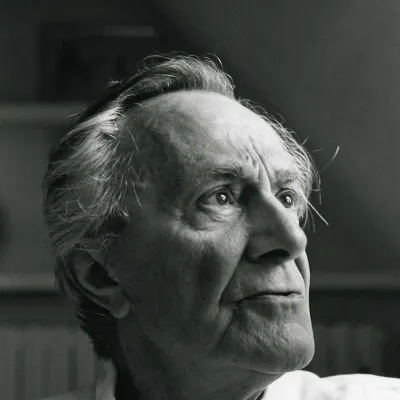
Jean-François Lyotard
Human Design Chart
Biography
His work exceeds many popular conceptions of postmodernism in its depth, imagination, and rigor. His thought remains pivotal in contemporary debates surrounding philosophy, politics, social theory, cultural studies, art and aesthetics.
He died from leukemia on 21 April 1998, Paris.
What does Generator 5/1 mean for Jean-François Lyotard?
Generator 5/1 — Design at a Glance
Jean-François Lyotard was someone who possessed immense, enduring strength, comparable to a powerful workhorse. His Generator design established a foundational structure aimed at utilizing a large amount of sacral energy. However, this energy was not freely available for him to initiate projects independently. Instead, it primarily manifested when he responded to impulses from his environment. The motto of his design was not to initiate but to react.
When a signal from life came and his inner self responded with a clear 'yes', he could transform this energy into concrete action. This process of reacting from the gut was the key to his effectiveness. Living in harmony with this strategy led to a deep sense of fulfillment and satisfaction. Conversely, frustration and energy depletion threatened when he acted against this principle, such as by constantly initiating projects without an inner impulse.
Two specific pitfalls shaped his experiential world. One involved expending energy on things that did not intrinsically interest him, leading to long-term exhaustion. The other danger arose when he was prevented from working on his heart projects, even though he was still full of power. His design allowed him to materialize things, but only through the right timing of reacting to external signals, not through compulsive pushing forward.
Emotional Authority
Jean-François Lyotard's design inclined him towards emotional decision-making that did not rely on first impressions. His inner authority lay in the defined Emotional Center. In Human Design mechanics, this center carries authority independent of other defined areas. This dictated a specific lifestyle: Lyotard was subject to an emotional wave that manifested in a constant up and down of his feelings. The world appeared to him always colored by his current mood. In one moment, he could be enthusiastic about something, in the next, he could see the same thing entirely negatively. His feeling in the moment was, however, only a snapshot, a first impression that did not necessarily represent his truth. Quick, spontaneous decisions based on emotion could therefore have negative consequences.
The mechanics of his authority required patience. The more time he took to let a decision mature, the deeper and more comprehensive he could understand something. This meant that he should hesitate and ask himself several times. Over time, the intense feelings subsided, he gained emotional distance, and clarity and calmness set in. Only then had he gone through the process. This mechanism was particularly important for long-term decisions that could have a significant impact on his life course. Lyotard lived this necessity to sleep on decisions as a central strategy to find his inner truth.
The 5/1 Profile — Heretic / Investigator
Jean-François Lyotard was someone who gathered deep, introspective insights to offer others for problem-solving. His design as a 5/1 profile - the Hero/Researcher - established a specific dynamic: Line 1 stood for intensive, private research and the accumulation of knowledge, while Line 5 carried these treasures outward. Others often sought him out, driven by the need to find solutions to their own questions. This magnetic aura, however, carried a danger: without clear boundaries, he risked being overwhelmed by the expectations and demands of his environment, similar to an expert exhausted after a strenuous conference, while new demands already awaited.
Line 5 also projected an authority that was especially sought after in crises. The collective saw in him a figure who could take charge in emergencies - a temporary general who brings order. This projection was ambivalent: if he met expectations, his reputation grew; if he disappointed, he became a scapegoat. Additionally, the expression of his new insights, supported by Jupiterian energies of expansion, could undermine established rules and values. This sometimes led to negative consequences when radical ideas clashed with existing structures. Lyotard had to learn to say no to maintain the balance between his inner research work and his outer responsibility for others.
Split Definition — Defined & Open Centers
Jean-François Lyotard's Human Design profile indicated a tendency towards consistent, conceptual work characterized by persistent mental activity. His defined Ajna Center enabled him to construct concepts and theories in a specific, trustworthy manner, without being easily influenced from the outside. This mental structure culminated in his defined Throat Center, which served as a focal point to transform these thoughts into clear communication and action in the world. He thus articulated what his mind conceptualized, and had the ability to directly manifest his intellectual processes.
At the same time, he had a defined Sacral-Motor, which provided him with an enormous vital energy source. This energy, however, required reaction rather than initiation; it was only available when he responded to a question or invitation. His profile also showed a defined emotional authority through the Solar Plexus Center, meaning that he did not make decisions in the moment but waited for an emotional wave to gain clarity. The defined Root Pressure provided a constant impulse to move forward, often in conjunction with this emotional or sacral energy.
In contrast, his open Head Center revealed a vulnerability to mental pressure and confusion when trying to find answers that did not lie within his established mental framework. He tended to be influenced by others' doubts or to fall into an internal monologue that distracted him from the correct decision-making process. His open G Center meant that he did not have a fixed identity or direction but took it from the environment and relationships, making him vulnerable to false initiations. The open Heart Center led to a lack of constant willpower and not needing to prove himself through promises, while the open Spleen Center made him vulnerable to fears and spontaneous, conditioned decisions that did not rely on his inner authority.
Channels for focus, principles, insight and emotional release.
Jean-François Lyotard exhibited a profound, almost meditative focus on details and logical structures. This attitude stemmed from the Channel of Concentration 52-9, a format energy connecting the Root Center with the Sacral Center. Through the Gate of Non-Action (52) and the Gate of Focusing (9), a calm pressure to hold still and avoid distractions arose, enabling precise analysis and perfection of patterns. This energy required a step-by-step logical approach, where he fully immersed himself in a task to confirm or refute it.
Parallel to this, the Channel of Structuring 23-43, connecting the Ajna Center with the Throat Center, played a role. Here, he received spontaneous breakthroughs through the Gate of Insight (43) and translated them into clear, innovative concepts through the Gate of Assimilation (23). This allowed him to articulate unique perspectives that changed others' thinking, provided he waited for the right timing to find acceptance.
Additionally, the Channel of Synthesis 19-49 and the Channel of Emotion Release 39-55 shaped his interpersonal dynamics. The Channel of Synthesis 19-49 connected the Root Center with the Solar Plexus Center, creating an emotional sensitivity for belonging and tribal connection, seeking loyalty and fairness through the Gate of Claims (19) and the Gate of Principles (49). The Channel of Emotion Release 39-55, also between Root and Solar Plexus Center, brought a pulsating emotional wave, generating moods and melancholic depth through provocation (Gate 39) and the mind (Gate 55).
Individual Gates like the Gate of Meaning (13), the Gate of Leadership (7), and the Gate of Formulation (4) supported this mechanism through reflection, hierarchical awareness, and logical formula creation. Additionally, Gates such as the Gate of Saying Yes (29), the Gate of Emotional Control (30), the Gate of Detail Work (62), and the Gate of Openness (22) influenced his persistence, emotional processing, pattern recognition, and social ease.
Individual Circuitry — Circuit Signature
Jean-François Lyotard's Human Design profile indicated a tendency towards structured expression and emotional synthesis. His Knowledge Circuit connected two separate segments: on one hand, Ajna with Throat Center for structuring thoughts, on the other hand, Solar Plexus with Root Center for releasing emotions. This configuration promoted a pulsating, acoustic expression of individual identity through emotional waves. Parallel to this, the Understanding Circuit, which connected his Sacral and Root Centers, generated a focused, visual energy for concentration on logical connections and strategic improvement, free from emotional influence. The Ego Circuit followed and connected Solar Plexus with Root Center, this time for synthesis. Here, it was about mutual giving and taking and support within a group, with pauses for resource regeneration necessary as there was no direct connection to the Sacral Center. Through shared definition, these forces existed in parallel: a group of Sacral, Root, and Solar Plexus Centers formed a cohesive energetic basis for strategy and social synthesis, while Ajna and Throat Center served as a separate unit for structured expression. Jean-François Lyotard thus combined rational concentration with emotional communication, always aware of the necessity of pauses and mutual support.
Left Angle Cross of Masks 2
Jean-François Lyotard's Human Design configuration carried the signature of the left Cross of Masks 2. This configuration set a specific inner tension: the deep need to protect and define one's identity was in constant exchange with the necessity to show authenticity to others. It was not a simple role-playing, but a complex process of self-perception, where the boundaries between the private self and the public persona were constantly negotiated.
For his system, this dynamic was central. The energy of this cross promoted a high sensitivity to how one was perceived by the environment, without losing one's own substance. Jean-François Lyotard often appeared as someone who consciously used his masks, not to deceive, but as a tool for navigation in social and intellectual spaces. This structure created a constant reflection on which parts of the self could be exposed and which needed to be protected.
The resulting attitude was one of cautious openness. He learned to manage his vulnerability through targeted distancing or intellectual abstraction. This shaped his way of handling relationships and conflicts: always with an eye on the integrity of his own center, while at the same time considering the expectations of the outside world. This balance was not a static state, but a continuous act of adjustment that influenced his entire life course.
Saturn Return · Uranus Opposition · Chiron Return · 2nd Saturn Return — Life Cycles
Jean-François Lyotard's Human Design indicated a tendency towards structural condensation followed by later blooming, which was evident in his professional milestones. His first Saturn Return occurred in 1950 at the age of 26. This cycle often marks the point where years of groundwork condenses into a viable, public result. Lyotard passed his agrégation, the state examination in philosophy, that year. This examination not only confirmed his knowledge but also formally established him in his field, which is typical of Saturn energy: creating structure and gaining recognition through performance.
The phase of fulfillment and blooming began with his Chiron Return in 1974 when he was 50 years old. During this life stage, one's incarnation cross unfolds increasingly if the person has followed their strategy. Lyotard published 'Economy of Desire'. This was not just an academic step, but a moment when his specific life purpose became tangible and he brought his unique insights into the world. His second Saturn Return followed in 1982 at the age of 58. Here, there is a renewed consolidation and deepening of previous work. With the publication of 'The Postmodern Condition', Lyotard solidified his position and thus shaped the understanding of his time in a lasting way. This sequence of testing, blooming, and consolidation illustrates the rhythmic nature of his design.
Generator · Emotional Authority — Synthesis
Jean-François Lyotard, as a Generator with emotional authority, lived a process of deep knowledge acquisition and transformation. The sacral energy available to him was directed through concentration (Channel 52-9) on details, enabling him to grasp complex issues and organize them into concepts (defined Ajna Center). This format potential, coupled with the Profile of the Hero and the Researcher (5/1), led others to seek him out as a knowledge source and he repeatedly provided solutions to their problems. The recurring career events tied to Saturn and Chiron returns bear witness to a continuous need to deepen his knowledge and pour it into new forms.
A central paradox in his design lay in the tension between the need for deep, concentrated learning and the emotional wave that influenced his decisions. While the defined Ajna Center promoted consistent, conceptual thinking processes, emotional authority required time for feelings to mature and clear judgments to be made. This discrepancy between the drive to generate knowledge and the need to filter it emotionally created a field of tension that compelled him to constantly weigh and interpret.
4 Defined Channels
Incarnation Cross - Left Angle Cross of Masks 2
Solar Return
The Solar Return shows the moment when the sun returns to its exact birth position - your personal solar year.
Life Cycles
Discover the life cycles with a detailed triple view (birth chart, cycle chart, composite).
Human Design Profile
- Type
- Generator
- Strategy
- To respond - wait for something to respond to
- Authority
- Emotional Authority
- Profile
- 5/1 - Heretic / Investigator
- Definition
- Split Definition
- Incarnation Cross
- Left Angle Cross of Masks 2
- Date of Birth
- 10.08.1924 00:15
- Place of Birth
- Versailles, France
Frequently Asked Questions
What was Jean-François Lyotard's Human Design type?
What Profile did Jean-François Lyotard have in Human Design?
What was Jean-François Lyotard's Authority?
What incarnation cross did Jean-François Lyotard have?
When was Jean-François Lyotard born?
Discover your own Human Design
Are you also a Generator? Find out in a personal reading how to use your sacral energy correctly and discover deep satisfaction.
More Personalities
Back to overviewAaliyah

Alain-Fournier

Alexia

Angèle

Angeli

Anne-Marie
