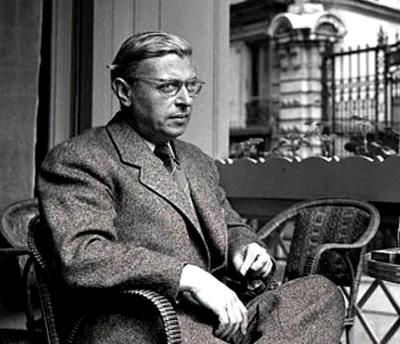
Jean-Paul Sartre
Human Design Chart
Biography
An only child of a distinguished family, he was a handsome, active baby, pampered by his mother after his father's death when he was just a year old. When his hair was long it was curly, but when cut, people realized how ugly he was. His full height was less than 5 ft. With a vindictive and angry personality, he was self-confident, knowing he was smarter than other children. Feeling a sense of power and control while writing, in October 1914 he wrote a short story about a French private who captures the Kaiser. Growing close to his mother he rebelled when she re-married April 1917.
In 1920 he was sent to boarding school in Paris. With an excellent mind but lacking discipline, he raced from topic to topic, never refining a thought, substituting eloquence for any depth of knowledge. His personal habits were abominable. In August 1924 Sartre placed seventh on entrance exams for Ecole Normale Superieure, a distinguished philosophy campus. In 1928 he placed last, fiftieth, in his exit exam, placing first on a re-exam in 1929. He was in the military for 18 months beginning in 1929 and took a teaching position thereafter, with a hiatus for study in Berlin in 1933.
Sartre's novel "Nausea" was published in 1938. He was conscripted at the start of WW II and captured 21 June 1940. Escaping in March 1941, he joined the resistance movement. One of his most famous essays, "Being and Nothingness" was published 1943. By 1945 Sartre was famous, rejecting God and external values, touting existentialism as the philosophy to study. He became co-editor of the magazine "Les Temps Modernes.
Human Design Analysis: Jean-Paul Sartre as Manifesting Generator 2/4
Manifesting Generator 2/4 — Design at a Glance
Jean-Paul Sartre was someone who possessed constant energy but did not merely wait passively. Instead, he could act swiftly and decisively. His design combined generative power with the ability to skip steps and quickly draw things into his life. This hybrid nature required precise balance: Only when he responded to external impulses and his Sacral Center consented would a productive 'play mode' be activated, creating deep satisfaction.
Ignoring this inner authority or acting too quickly inevitably led to frustration – his experience of non-self. In such cases, he often had to backtrack and make up for missed steps. His tendency towards multitasking was also characteristic; he started several projects simultaneously. This worked smoothly only when strategy and internal consent were always 'in the boat.' Otherwise, the joy of creation quickly turned into exhaustion.
The challenge lay in not misusing his natural speed as a reason to ignore processes but rather channeling it through regular checks on his own resonance. When this inquiry was given, he greatly benefited from variety and parallel work. The compulsion to complete one thing before starting another would have slowed down his energy more than helped it. His path to satisfaction thus lay in consciously reacting to life while maintaining the freedom to pursue multiple threads simultaneously, as long as each action was carried by a clear inner confirmation.
Emotional Authority
Jean-Paul Sartre carried his inner authority in the defined Solar Plexus Center. This configuration shaped his essence through an emotional wave marked by constant ups and downs of feelings. His perception was always colored by the current mood; he swung between enthusiasm and negativity about the same thing. The momentary feeling only formed a first impression, not necessarily his deeper truth. Spontaneous decisions made in this emotional heat carried the risk of negative consequences.
The mechanics of his Emotional Authority required time and patience for decision maturity. Sartre had to be patient and ask himself multiple times to gain clarity. By waiting until intense feelings subsided, he gained emotional distance. This process led to calmness and a more comprehensive understanding. Especially in long-term decisions with significant influence on life's course, this strategy of sleeping on it was crucial. Emotional Authority always took precedence over other defined centers regardless of further configurations in his chart. This mechanism ensured that his choice did not follow fleeting moods but rather rested on a matured inner truth.
The 2/4 Profile — Hermit / Opportunist
Jean-Paul Sartre lived in an intense rhythm between extreme isolation and the urge for connection. His design as Profile 2/4, combining natural talent with networking, created fundamental tension: Line 2 demanded withdrawal to reflect on internal processes and gain clarity; Line 4 pulled him back into his community to exchange knowledge.
This dynamic was not accidental but structurally determined. In his 'Me-Time,' Sartre immersed himself inwardly while preserving a certain innocence and identity. Only when this need for peace was fulfilled did he actively seek contact with his favorite people. Clear communication of these states – the signal 'Now Company' or 'Now Quiet Time' – was crucial to maintaining a safe environment.
The extremes of his rhythms were valuable. Through withdrawal, he could evaluate the knowledge from his network and develop brilliant ideas. Line 4 gave him an infectious influence on his community while the Sun in Gate 15 (Line 2) drove the necessary pulse of retreating. Sartre had to learn to accept this range: not as contradiction but as a necessary sequence of solitude and social exchange, allowing him to live out his uniqueness and humility at his own pace.
Split Definition — Defined & Open Centers
Jean-Paul Sartre was characterized by a constant, autonomous mental structure and self-determined willpower. His defined Ajna Center ensured consistent conceptual thinking; concepts were his trustworthy foundation that he did not easily allow to be influenced from the outside. This inner strength was reinforced by his defined Heart Center, which endowed him with robust willpower. He determined his life and resources independently, kept promises, and sought recognition for his contribution without being dependent on external validation.
The energy for this came from his defined Sacral Center. As a Generator, he waited for external impulses before his vital life force reacted. This reaction was mechanical and immediate: a clear yes or no decided the availability of his power. Combined with his emotional authority in the Solar Plexus Center, he went through a necessary maturation process. He patiently waited until emotional waves subsided before decisions were expressed in his consistent communication style (defined Throat). His intuition and health sense remained as constant companions preserved by his defined Spleen Center, acting in the present.
At the same time, he was vulnerable to external pressure. His open Head Center led to mental inspiration sporadically coming from outside; seeking answers could lead him to confusion through non-self questions. The open G Center meant a lack of fixed identity; he found this situationally in the right context and relied on initiation by the environment rather than setting his own direction. Additionally, his open Root Center absorbed stress from the environment. This required an awareness not to interpret foreign adrenalized pressure as his own to avoid exhaustion. His mechanics thus involved a combination of inner stability and the need to carefully filter external influences.
Channels for values, structure, connection and self.
Jean-Paul Sartre was characterized by a deep responsibility for material structures and collective survival, paired with the necessity to communicate unique insights. His design suggested that he accepted material conditions and masterfully steered them. The Channel of the Money Line 21-45 connected his Heart Center (Ego) with the Throat Center. Gate 21, the Hunter's Gate, demanded control over work rhythms to protect the heart and ensure breaks. Gate 45, the Voice of the Gatherer, exercised authoritative hierarchy to secure resources and offer loyalty as well as material provision to the tribe. This dynamic created a will for control over money and work as means to protect the ego and ensure collective existence.
Simultaneously, he was marked by the ability to clearly express complex connections. The Channel of Structuring 23-43 connected his Ajna Center (Mind) with the Throat Center. Gate 43 received spontaneous insights and innovative perspectives while Gate 23 translated these through assimilation into understandable, efficient language. This enabled him to formulate mutative ideas in a way that others could adopt, provided the timing was right.
Additionally, Channels of Preservation 27-50 and Community 37-40 were at work. The first promoted care and preservation of traditional values through his Sacral Center (Gate 27) and Spleen (Gate 50). The second connected Solar Plexus (Gate 37, Friendship) with Heart (Gate 40, Solitude), strengthening emotional bonds in communities aimed at mutual benefit and respectful agreements. Further Gates like 15 (collective flow), 10 (integration), and 25 (spiritual innocence) rounded out his profile, while the channels formed the primary mechanism of his material and communicative orientation.
Tribal Circuitry — Circuit Signature
Jean-Paul Sartre was characterized by two separate, unconnected energy systems. The first system connected Ajna with Throat Center through the Knowledge Circuit (Channel 23-43). This generated a pulsating, acoustic energy of individual identity and creative intuition that structured expression. Parallel to this, the Ego Circuit operated, connecting Heart, Solar Plexus, and Throat Centers (Channels 21-45, 37-40). Here it was about cooperation, the joint creation of resources as well as a balanced relationship between giving and taking. Since this system did not connect with Sacral Center, generating these energies required necessary rest periods.
The second completely isolated system formed the Archer Circuit. It connected Sacral with Spleen Center (Channel 27-50). This provided timeless, instinctive energies for protection, preservation, and survival of genetics or family.
As Sartre had a Shared Definition, these two systems existed as parallel, non-directly connected forces side by side. There was no automatic flow between the pressing need for individual emotional expression and transformation in the first system and the deep, instinctive responsibility for preservation in the second. Sartre had to integrate these different impulses – the 'now' of creativity versus the 'timeless' of preservation – situationally without them mechanically interfering with each other. The tension between these separate poles shaped his energetic landscape.
Right Angle Cross of the Vessel of Love 2
Jean-Paul Sartre's Human Design profile featured the right cross of the Love Vessel 2. This configuration formed the energetic backdrop to his existence, although no further elaboration was provided on the specific dynamics of this structure in the available data. There was no detailed description of the associated life task or concrete behavioral patterns. The design thus pointed towards a deeper structural imprinting whose mechanical translation into everyday actions could not be derived here. The focus was solely on naming this cross type without additional contextualization from raw content. This meant that while Jean-Paul Sartre belonged to this archetypal category, the resulting energetic impulses or specific challenges were not further illuminated. His chart contained this information as a mere marking of a particular geometric arrangement of energy centers and gates. Without mechanical explanation, the practical impact of this configuration on his experience and decisions remained in darkness. The structure was present, its functional significance however not specified. This was evident in that no concrete character traits or life paths could be directly derived from this cross type. Jean-Paul Sartre lived with this indeterminate energetic foundation whose full implications were not deciphered in the current analysis.
Saturn Return · Uranus Opposition · Chiron Return · 2nd Saturn Return — Life Cycles
Jean-Paul Sartre's life followed a clear cyclical structure, alternating between development, inner conflict, and external validation. His design included three prominent astrological phases: the first Saturn return, the Uranus opposition, and the second Saturn return. These cycles structured his life stages and marked crucial turning points.
In 1933, at age 28, Sartre experienced his first Saturn return. This cycle condensed years of groundwork into substantial results; he spent this time on a study trip to Berlin, a step towards consolidation and intellectual deepening.
The phase of the Uranus opposition around the 40th year often brought inner conflicts and a drive for change. For Sartre, this coincided with a profound personal crisis in 1945: the death of his stepfather followed by moving to live with his mother. This moment reflected the typical disintegration of old structures characteristic of this cycle.
The second Saturn return around age 59 marks societal recognition and validation of one's path. In 1964, Sartre was awarded the Nobel Prize for Literature – a massive external affirmation. His refusal of this prize however underscored his inner independence; he did not let himself be defined by external honors but remained true to his own authority, marking the completion of this cycle as an act of sovereignty.
Manifesting Generator · Emotional Authority — Synthesis
He lived as an Manifesting Generator with emotional authority and a profile as a natural talent and networker. This combination shaped a character marked by constant inner dynamism: sacral energy provided continuous drive while the defined mental center (Ajna) enabled deep, conceptual thinking. The Channel of the Money Line indicates strong responsibility and a desire to create structures and guide others – a power enhanced by his ability to quickly manifest things into life. This led to a life where he actively shaped and developed concepts, always driven by an inner necessity to realize his visions.
A central paradox lay in the tension between his need for isolation (Line 2) and community (Line 4). Emotional authority required time for decision-making while the manifesting component tended towards quick action – a discrepancy that showed in cycles: a study trip (1933), withdrawal after loss (1945), and refusal of an honor (1964). He thus moved between seeking inner clarity and the urge to share his ideas with others, always searching for balance between self-realization and social engagement.
4 Defined Channels
Incarnation Cross - Right Angle Cross of the Vessel of Love 2
Solar Return
The Solar Return shows the moment when the sun returns to its exact birth position - your personal solar year.
Life Cycles
Discover the life cycles with a detailed triple view (birth chart, cycle chart, composite).
Human Design Profile
- Strategy
- To respond - wait for something to respond to
- Authority
- Emotional Authority
- Profile
- 2/4 - Hermit / Opportunist
- Definition
- Split Definition
- Incarnation Cross
- Right Angle Cross of the Vessel of Love 2
- Date of Birth
- 21.06.1905 18:45
- Place of Birth
- Paris, France
Frequently Asked Questions
What was Jean-Paul Sartre's Human Design type?
What profile did Jean-Paul Sartre have in Human Design?
What authority did Jean-Paul Sartre have?
Which incarnation cross was active for Jean-Paul Sartre?
When was Jean-Paul Sartre born?
Discover your own Human Design
Are you also a Manifesting Generator? Find out in a personal reading how to unfold your multi-talents and direct your energy wisely.
More Personalities
Back to overviewAldair
Alizée

Angeli
Arletty
Artus

Balthus