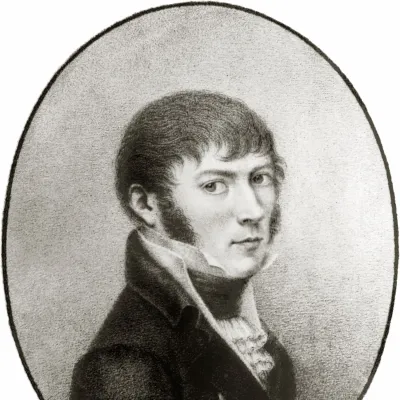
Joseph von Fraunhofer
Human Design Chart
Biography
He was the tenth and last son of a poor glass-grinder who was unable to give his boy even the rudiments of knowledge. At the age of twelve he lost both parents. The house where he worked collapsed in 1801, burying the boy under the ruins, but not injuring him fatally. This fortunate accident brought him to the notice of court-councilor von Utzschneider, who gave him books on mathematics and optics, and also interested King Max Joseph in him who supported him.
In 1819 Fraunhofer was appointed professor royal. The University of Erlangen gave him the degree of Ph.D., honoris causâ in 1822. The following year he was appointed conservator of the physical cabinet of the academy at Munich.
Like many glassmakers of his era who were poisoned by heavy metal vapors, Fraunhofer died young, on 7 June 1826 at the age of 39.
The German Fraunhofer society (Fraunhofer Society for the advancement of applied research) is named after him. It is the largest organisation in Germany for applied research and employs over 20,000 people.
Joseph von Fraunhofer as a Projector 6/2 in Human Design
Projector 6/2 — Design at a Glance
Joseph von Fraunhofer appeared as someone with a focusing aura who immediately recognized structural weaknesses in his environment. His design as a Projector shaped a lifestyle that aimed less at independent, constant action and more at guiding others. He did not have an uninterrupted intrinsic energy source, which led to phases of high productivity followed by necessary rest periods to prevent exhaustion.
The mechanics of his design described him like a bright flashlight: he shed light on areas in the dark or not functioning properly. This ability to identify system errors immediately could be counterproductive if he addressed these deficiencies directly; others often felt this as unpleasant or confrontational. A more effective strategy was to attract others through his own harmony and competence, so that they would seek advice of their own accord. Joseph von Fraunhofer lived most successfully when he waited for an honest invitation before bringing in his expertise. This waiting period was not a symptom of passivity but essential for the correct alignment of his energy. If he followed this strategy, he was rewarded with success; if he deviated and acted without invitations, it eventually led to the typical feeling of non-selfhood characterized by bitterness. His undefined Sacral Center thus dictated a rhythm of intense mental work and necessary regeneration that conventional working environments often did not support.
Emotional Authority
Joseph von Fraunhofer showed a basic attitude of emotional reevaluation: his inner truth emerged not from the first impulse but after the initial wave of feelings had subsided. His design carried emotional authority, meaning that the Solar Plexus Center was defined and thus took precedence over all other defined centers – regardless of which additional areas were active in his graph.
This configuration subjected him to a constant up-and-down of moods. The world appeared colored by his current emotional state; a topic could seem absolutely inspiring at one moment, deeply negative the next. Joseph von Fraunhofer recognized, however, that this first impression was only a snapshot and not yet his true reality. Quick, spontaneous decisions from such an emotional place often had detrimental effects.
Instead, it required patience in him. He let decisions mature, slept on them multiple times over, and sought distance from the intense feelings. Only when the emotional wave subsided did clarity and calm set in. This process of refinement and repetition was essential for him, especially regarding long-term choices that significantly influenced his life course. Only through this temporal distancing could he gain a deeper, more comprehensive insight that his emotional authority offered as truth.
The 6/2 Profile — Role Model / Hermit
Joseph von Fraunhofers design shaped two distinctly different phases of life driven by Profile 6/2. In his youth, he appeared like an experimenter who developed himself through trial and error. This early period was characterized by the desire to gather personal experiences and use mistakes as learning opportunities before a deeper structure emerged.
After turning thirty with the activation of the sixth line, his orientation fundamentally changed. Joseph von Fraunhofer increasingly withdrew to look back on his past experiments from a great distance. This withdrawal served not only isolation but was a phase of intense reflection and healing. He overcame old doubts through nostalgic contemplation without falling into pure nostalgia. Instead, he used this time to ask valuable questions and achieve mutations in his own circuitry.
The second line promoted his ability for deep introspection. Although it made him appear as an hermit, his goal was a connection to collective memory and learning from painful experiences. He developed strong self-strength but had to learn to deal with the natural tendency towards exaggeration or unconscious distortion.
At the end of this developmental journey, Joseph von Fraunhofer emerged as a wise person. His profound self-awareness enabled him to attract others who wanted to partake in his life wisdom and learn the art of deep reflection. His path showed how from youthful experimentation through withdrawal and analysis can emerge a leading personality.
Split Definition — Defined & Open Centers
Joseph von Fraunhofer was someone who operated under constant mental pressure to ask questions and understand connections. His design linked the Head Center with the Ajna Center, creating a specific, trustworthy form of conceptual thinking. This channel generated inspiration in the form of questions but did not provide the energy for direct implementation. Joseph von Fraunhofer tended to experience this mental activity as a source of concern when he tried to relieve the pressure through immediate action. Instead, his strength lay in inspiring others to think and waiting for the right timing to realize his ideas.
At the same time, his defined Solar Plexus Center acted as an emotional authority. Joseph von Fraunhofer had to exercise patience to navigate through waves of emotions before gaining clarity. His decisions were not made in the “now,” but revealed themselves over time. This emotional depth allowed him to view situations from various perspectives rather than reacting impulsively to highs and lows of his mood.
In contrast, Joseph von Fraunhofer had open centers in areas like communication (Throat), identity (G Center), and willpower (Heart). His undefined Throat Center made him vulnerable to the pressure to demand attention through constant speaking. He tended to wonder if he was heard rather than waiting for an invitation to speak. The open G Center meant that he did not have a fixed identity but absorbed it from his environment; he sought the right place and people who would make him feel at home. His open Heart Center led him to risk proving his worth through excessive effort rather than being motivated by willpower or competition. This configuration marked him as someone who had to learn to follow his inner authority instead of mental pressure or a need for validation.
Channels for mystical synthesis and rational awareness.
Joseph von Fraunhofer was deeply embedded in the cohesion of his community while simultaneously seeking internal clarity. His design tended to balance between the need for belonging and the search for individual truth.
The Synthesis Channel 19-49 connected his Root Center with the Solar Plexus. This created an emotional frequency that acted as glue for the tribe. He felt responsible for protecting resources and territory while also seeking principles compatible with his ideals. This connection determined who deserved support based on loyalty and mutual care. Joseph von Fraunhofer was dependent on being needed and receiving support to feel fulfilled.
Parallel to this, the Awareness Channel 61-24 connected his Head Center with the Ajna Center. Here it wasn't about logical discovery but mutative knowledge. Sudden insights or moments of enlightenment broke old thought patterns. Joseph von Fraunhofer could not control his thinking; knowledge entered when it was ready. This channel helped him distinguish what was worth knowing by transforming inspiration from Gate 61 into rational answers at Gate 24.
Additionally, gates like Gate 63 (Doubt) and Gate 64 (Past Experiences) shaped his mental process. Doubt drove him to improve uncertain patterns and gain security. Gate 26 in the Heart Center allowed him to accept innovations within conservative structures while Gate 45 bundled energy for the tribal level. Through Gate 22, he showed openness and calmness when listening, which promoted mutations in social environments. Gate 60 taught him to accept limitations to enable transformation.
Individual Circuitry — Circuit Signature
Joseph von Fraunhofer was marked by two separate, parallel energetic streams. As a Split Definition, these forces did not exist as an integrated whole but rather as adjacent areas of different nature.
The Knowledge Circuit connected his Head Center with the Ajna Center. Through the Awareness Channel (Gates 61 and 24), innovative flashes of insight emerged. This energy promoted the ability to gain new knowledge and express individual identity through creative deviations from existing norms. It was about pulsating, acoustic impulses aimed at bringing change into the world.
Completely independently, the Ego Circuit operated. Here, the Synthesis Channel (Gates 49 and 19) connected his Solar Plexus Center with the Root Center. This stream concerned cooperation and joint creation of resources within a group. Since there was no connection to the Sacral Center, this energy required sufficient rest periods for recovery. It was about mutual support and material well-being in tribal contexts.
These two systems – the creative impulse from Head and Ajna as well as cooperative resource building from Solar Plexus and Root – functioned separately and not directly connected at Joseph von Fraunhofer. One stream served individual knowledge acquisition, the other group stability and support.
Left Angle Cross of Dominion 1
Joseph von Fraunhofer demonstrated a fundamental stance aimed at establishing clear structures and boundaries. His design focused on bringing order to complex situations and taking responsibility for defined areas. This aligned with the mechanics of the left authority domain 1 cross, which describes the ability to exercise authority through clear definitions of responsibilities. It was not about arbitrary power but rather creating a stable framework within which others could orient themselves. Joseph von Fraunhofer thus acted as someone who created security through structure and ensured that rules and boundaries were understandable. This configuration shaped his actions by driving him to reduce uncertainties through clear demarcations. He sought ways to make power relations transparent, thereby enabling effective coexistence. His approach consisted of understanding authority not as suppression but as an organizing force that creates space for orderly processes. Through this attitude, he contributed to communities or systems operating on a basis of clear expectations.
Saturn Return — Life Cycles
Joseph von Fraunhofer revealed himself as someone whose deepest inner resonance was activated by precise structure and clear order. His design inclined towards methodical thoroughness, where external clarity was the prerequisite for internal energy. This configuration described a path in which discipline did not act as restriction but rather as enabling: Only when conditions were stable could his specific life force unfold and produce sustainable results.
In 1814, at age 27, he discovered Fraunhofer lines and invented the spectroscope. For his design, this marked the first Saturn return, a cycle where years of groundwork often condensed into a viable result. The discovery was not a sudden coincidence but the logical conclusion of an intensive phase of internal condensation and external structuring. At this age, the maturity of his strategy came into effect: Life demanded stability, and Joseph von Fraunhofer responded with focused endurance. The invention of the spectroscope became an expression of this matured stance – an instrument of precision that reflected exactly the need for clarity his design had called for since childhood. Through this connection between inner authority and external form, he created a foundation pointing beyond the momentary to translate his essence into tangible reality.
Projector · Emotional Authority — Synthesis
He was a projector whose life was marked by a deep desire to recognize potential in others and highlight it through precise observation (Projector Type, Gate 19/49). This ability to uncover errors in the system and synthesize principles (Channel of Synthesis) always came with an emotional wave (Emotional Authority), requiring mature decision-making. He drew inspiration from a defined Head Center, yet this constant mental activity also carried the risk of concern and the need for understanding.
A central paradox shaped his path: Although he was designed to guide others and recognize their potential, he himself went through a process of intense self-reflection (6/2 Profile), which at times forced him into withdrawal. This oscillation between 'projecting' light onto others and diving deeply into analysis and understanding created tension reflected in the ups and downs of his emotional wave. A notable event, the discovery of Fraunhofer lines, demonstrated how he created new knowledge through precise observation and transformed it (Knowledge Circuit).
2 Defined Channels
Incarnation Cross - Left Angle Cross of Dominion 1
Solar Return
The Solar Return shows the moment when the sun returns to its exact birth position - your personal solar year.
Life Cycles
Discover the life cycles with a detailed triple view (birth chart, cycle chart, composite).
Human Design Profile
- Type
- Projector
- Strategy
- Wait for the respectful invitation
- Authority
- Emotional Authority
- Profile
- 6/2 - Role Model / Hermit
- Definition
- Split Definition
- Incarnation Cross
- Left Angle Cross of Dominion 1
- Date of Birth
- 06.03.1787 20:30
- Place of Birth
- Straubing, Germany
Frequently Asked Questions
What was Joseph von Fraunhofer's Human Design type?
What Profile did Joseph von Fraunhofer have?
What Authority did Joseph von Fraunhofer have?
What incarnation cross did Joseph von Fraunhofer have?
When was Joseph von Fraunhofer born?
Discover your own Human Design
Are you also a Projector? Find out in a personal reading how to unfold your leadership qualities and recognize the right invitations.
More Personalities
Back to overviewSissy Spacek
Alain-Fournier
Anémone
Ann-Margret
Bourvil
Hergé