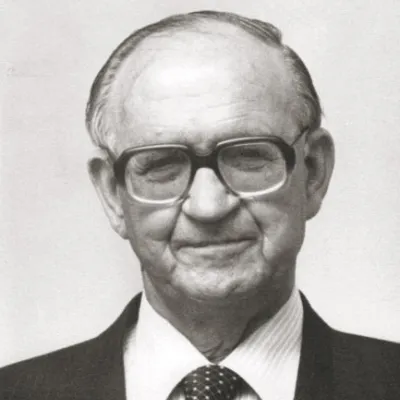
Kazimierz Sabbat
Human Design Chart
Biography
He died 19 July 1989.
The Human Design of Kazimierz Sabbat: Manifestor 4/6
Manifestor 4/6 — Design at a Glance
Kazimierz Sabbat's Human Design profile marked him as a pioneer and visionary destined to lead the world into a new future. His Human-Design Type was Manifestor. This Profile worked similarly to an emperor in ancient Rome: He had the vision of a grand whole but did not wage the necessary wars himself; instead, he sent others to conquer foreign lands for him.
This style of leadership inevitably polarized people. As Manifestors often think ahead of their environment, they are frequently misunderstood. Some loved Kazimierz Sabbat with his big dreams and followed him as a fan base; others disliked or even hated him precisely because of these grand visions.
To find the right support, it was crucial for his design to inform others about his intentions in a timely and precise manner. This formed his ideal strategy. If Kazimierz Sabbat followed this strategy and trusted his inner authority, he was rewarded with a sense of inner peace. Living against this design, however, led him to experience an enduring, deep-seated anger within himself. His path was thus marked by the tension between radiating a leading vision and the necessity to communicate it clearly to reduce resistance and find peace.
Emotional Authority
Kazimierz Sabbat's inner compass was Emotional Authority carried by his defined Emotional Center. This configuration fundamentally shaped his decision-making: He was subject to a constant emotional wave, a steady up-and-down of feelings. The world appeared colored by his current mood; enthusiasm could turn into deep skepticism in the same moment. His immediate feeling was only a snapshot, a first impression that did not necessarily reflect his truth. Spontaneous decisions made from this emotional heat often proved detrimental to him.
The mechanics of his authority required patience and time. Kazimierz Sabbat had to let decisions mature so he could see deeper and more comprehensively. This meant concrete hesitation: He asked himself multiple times, slept on important questions, and waited. Over time, the intense feelings subsided; he gained emotional distance. Only then did clarity and calmness set in – a sign that he had gone through the process. This strategy was particularly crucial for long-term decisions with significant impact on his life trajectory. His inner truth revealed itself not in the first impulse but in the peace after the emotional wave.
The 4/6 Profile — Opportunist / Role Model
Kazimierz Sabbat showed himself to be someone who acted experimentally during the first three decades of his life before developing a deeper, reflective stance. His Profile 4/6 shaped this development: The Line 4 initially worked like Line 3, leading him towards promising but often still uncommitted social contacts. He sought connection and tested relationships without yet bearing the full weight of later responsibility.
With Saturn's return, his focus shifted fundamentally. Kazimierz Sabbat now experienced an inner conflict between his heart's desire for community (Line 4) and his head need for wise distance (Line 6). He faced the task of integrating these two poles: On one hand, the urge to be part of a network; on the other, the drive to think about the meaning of the whole.
In later years, he became an example to others. His leadership was based not on authority but on exemplary behavior and providing resources for his surroundings (Gate 37). At the same time, he trusted in the process itself. Line 6 taught him to find joy in small steps and take details seriously without losing sight of the end goal. Kazimierz Sabbat understood that true leadership lies in making principles visible in daily life through persistence towards long-term goals. His design challenged him to be cautious with his heart, opening up only to those who shared his values, thus taking on a trusting yet clear community role.
Single Definition — Defined & Open Centers
Kazimierz Sabbat's Human Design profile points towards a tendency for clear and resolute communication that arises from deep emotional truth and spontaneous instinct. His defined Throat Center served as a constant focal point for expression; he did not just speak what he thought but articulated his inner states directly. This voice was fueled by his defined Heart Center, which gave him natural willpower and a strong ego – he knew what he wanted and had the energy to keep promises and stand up for himself. At the same time, his defined Solar Plexus imbued these expressions with a characteristic emotional wave; his statements carried the depth and passion of a consciousness that needed time to find clarity. His defined Spleen Center complemented this by providing spontaneous intuition in the present moment, allowing him to immediately recognize health-promoting or harmful situations.
This inner strength contrasts with his open centers, making him vulnerable to external influences. His open Head and Ajna Centers meant he did not have constant mental inspiration; he tended to be overwhelmed by doubts or the questions of others rather than generating his own answers. Without a fixed mental center, he sometimes sought intellectual validation from his environment. His open G Center showed that he did not carry a rigid identity; he reflected the direction and self-image of those around him and often felt lost when not at the "right place." Additionally, his open Sacral and Root Centers absorbed the stress and vital energy of the environment, leading him to amplify external pressure or overextend himself with borrowed energy rather than trusting in his own rhythm.
Channels for emotional depth, community spirit and intuitive precision.
Kazimierz Sabbat revealed himself as someone whose social presence strongly depended on his emotional mood. His design indicated a tendency to show openness only during moments of genuine inner readiness, which was often misunderstood as moodiness or reticence. This resulted from the Channel of Openness 22-12, connecting the Solar Plexus Center with the Throat Center. Here, the caution of Gate 12 regulated the emotional wave of Gate 22; Kazimierz Sabbat spoke and affected others deeply only when his feelings allowed it, enabling him to have a transformative impact that was not constantly available.
Parallel to this, he possessed deep intuitive intelligence that manifested through years of perfecting skills. The Channel of Wavelength 48-16 connected the Spleen Center with the Throat Center and drove him to combine dexterity (Gate 16) with inner depth (Gate 48). For Kazimierz Sabbat, this meant that talent was not seen as a mere gift but as a result of repetition and dedication; he sought recognition and resources to continue refining it, where the relationship between master and apprentice played a central role.
In interpersonal relationships, Kazimierz Sabbat searched for a community based on fair agreements. The Channel of Community 37-40 connected his Solar Plexus Center with the Heart Center. He waited to be personally invited to find his place in a larger whole (Gate 37) and was ready to work for the group (Gate 40), but required clear contracts and mutual respect for this. Spontaneity had no place here; relationships needed to be carefully examined and sealed to ensure loyalty and stability.
Additionally, Gate 9 at the Sacral Center shaped his ability for detailed work and focused goal-setting. Without adequate energy fulfillment, however, this power could lead to depression as the existing potential could not be effectively channelled.
Individual Circuitry — Circuit Signature
Kazimierz Sabbat's Human Design profile is characterized by a clear and coherent energetic structure. Since he has a simple definition, his defined centers—Throat Center, Solar Plexus, Heart, and Spleen—form one continuous flow. This gave him a consistent way of expressing himself and taking action without internal energetic breaks or separated vibrations.
Within this current, three specific circuits were at work. The Knowledge Circuit connected his Throat Center to the Solar Plexus through the Openness Channel (Channels 12-22). This allowed him to directly translate emotional waves and intuition into words, making his communication authentic and grounded in the moment.
Parallel to this, he activated the Understanding Circuit via the Wavelength Channel (Channels 16-48), which links the Throat Center with the Spleen Center. Here, intuitive perception for what is essential and necessary flowed into his verbal articulation, helping him share precise and to-the-point information.
Additionally, he was represented in the Ego Circuit through the Community Channel (Channels 37-40), connecting Heart and Solar Plexus. This connection created a dynamic between willpower and emotional reaction aimed at mutual support and giving and taking in social contexts. Since all these channels are part of the same defined network, Kazimierz Sabbat's authentic expression, precise perception, and cooperative interaction worked as an integrated force.
Right Angle Cross of Planning 1
Kazimierz Sabbat's Human Design chart indicated a tendency towards structured preparation. His chart included the right cross of Planning 1, suggesting an inner architecture that sought order and predictability. This configuration promoted a need for clear plans and well-thought-out processes before actions were carried out in the world. Kazimierz Sabbat appeared as someone who valued establishing solid ground under his feet rather than blindly exposing himself to the unpredictable.
The right cross of Planning 1 describes an energy that creates stability through organization. It is not about rigid control but about creating a framework where creativity and intuition can safely operate. For Kazimierz Sabbat, this likely meant he could only successfully shape projects or life areas if he had laid a solid foundation beforehand. Without this planning ability, his energy might have been scattered. Instead, he knew the way to translate ideas into tangible reality by proceeding step-by-step and minimizing risks. This trait characterized his approach to tasks and goals: methodical, thoughtful, and designed for long-term sustainability. He relied on good planning as the basis for effective action.
Saturn Return · Uranus Opposition · Chiron Return · 2nd Saturn Return — Life Cycles
In later years, Kazimierz Sabbat showed a search for structural stability and long-term order. His second Saturn return, which typically begins at age 59, marks a phase of maturation in which earlier ambitions must be grounded in realistic foundations. This cycle demands discipline and the ability to take responsibility for what has been built up over life.
In 1972, exactly at this age of 59 years, this mechanical dynamic became evident: Kazimierz Sabbat reconciled divided circles around the Triumvirate and the Exile President. This success was no coincidence but the result of a mature attitude fostered by Saturn's influence. Instead of getting lost in short-term conflicts, he used his position to build bridges and resolve existing tensions. The second Saturn return favors such integrative actions as it provides energy for consolidation and reconciliation. Kazimierz Sabbat lived this task by acting as a connecting element, thereby contributing to the cooperation between different political factions again. This underscores how his design was aligned in this life phase to create structure and find sustainable solutions for complex interpersonal or political problems.
Manifestor · Emotional Authority — Synthesis
Kazimierz Sabbat was a Manifestor who throughout his life was marked by a profound inner drive towards initiation and transformation. The connection between the defined Throat Center and the open Solar Plexus (Channel 22-12) points to a voice that not only expresses thoughts but also carries emotional waves and triggers mutative processes through interaction with others. This potential for change was confirmed multiple times in his life – one documented event shows him reconciling circles around an Exile President (Saturn Return). Thus, he lived the role of a pioneer and leader who polarized and was often misunderstood due to his visions.
A central tension field in his design lay between the desire for community (Line 4 in Profile) and the inner necessity to distance himself from others and act from a unique perspective (Line 6). This dynamic led to an ongoing interplay between heart and head, between the need for validation by others and the drive towards independent insight. The Knowledge Circuit intensified this internal conflict further by driving him to constantly acquire new knowledge and bring it out into the world – often through the emotional wave.
3 Defined Channels
Incarnation Cross - Right Angle Cross of Planning 1
Solar Return
The Solar Return shows the moment when the sun returns to its exact birth position - your personal solar year.
Life Cycles
Discover the life cycles with a detailed triple view (birth chart, cycle chart, composite).
Human Design Profile
- Type
- Manifestor
- Strategy
- To inform others before acting
- Authority
- Emotional Authority
- Profile
- 4/6 - Opportunist / Role Model
- Definition
- Single Definition
- Incarnation Cross
- Right Angle Cross of Planning 1
- Date of Birth
- 27.02.1913 22:00
- Place of Birth
- Bieliny, POL
Frequently Asked Questions
What Human Design type was Kazimierz Sabbat?
Which Profile did Kazimierz Sabbat have?
What Authority did Kazimierz Sabbat have?
When was Kazimierz Sabbat born?
Discover your own Human Design
Are you also a Manifestor? Find out in a personal reading how to use your initiation power peacefully and dissolve resistance.
More Personalities
Back to overviewChristian-Jaque
Kesha

Laurent-Eynac
Lucebert
Masaccio

Papus