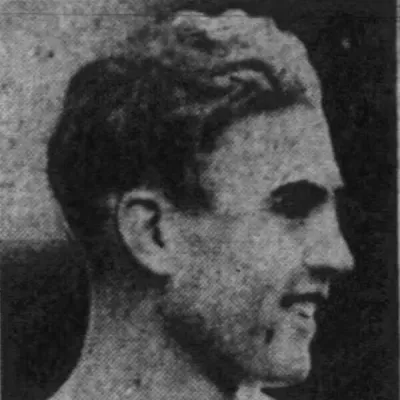
Lee Barnes
Human Design Chart
Biography
Barnes attended the University of Southern California in Los Angeles. He competed in Athletics at the 1924 Summer Olympics in Paris and won gold, beating fellow American pole vaulter Glenn Graham, who received silver.
Barnes has the honor of being the only known stunt double for silent film star Buster Keaton during Keaton's independent years of film making. In Keaton's 1927 feature College, Barnes performed a pole vault through an open upper-story window.
What does Projector 3/5 mean for Lee Barnes?
Projector 3/5 — Design at a Glance
Lee Barnes revealed himself as someone with a focusing aura that immediately recognized system errors. His design acted like a bright flashlight, illuminating the darkness and guiding others. This ability to identify weaknesses in his environment was central to his nature as a Projector.
However, directly confronting these flaws would have been counterproductive. Such an approach would have provoked resistance, akin to shining light directly into someone's face. Instead, Lee Barnes was most effective through harmonious role modeling. By showing balance himself, he attracted others who then asked for his insights. His strategy involved waiting for a respectful invitation. This protected him from the unpleasant projection of criticism and ensured acceptance in social settings.
Since his Sacral Center was undefined, Lee Barnes lacked a constant source of life energy. He experienced phases of high productivity that needed to be balanced with necessary rest periods to prevent burnout. This cyclical energy management was crucial for his well-being. Living according to this design rewarded him with success. Deviations led to the experience of bitterness as a non-self theme. His path involved bringing in his specific perspective when invited and carefully conserving his energy.
Self-Projected Authority
Lee Barnes revealed himself as a Projector with rare authority in self, a configuration that delivered extreme openness towards external influences. This design carried the risk of running out or constantly seeking external energy, especially if motoric energies distracted him. His inner truth did not lie in the mind but in his identity. Lee Barnes found decisions through spontaneous self-dialogues or dialogues when invited to do so. Crucial was distinguishing between the spontaneous expression of true essence and the considered thoughts of the mind. What spoke without thought revealed his uniqueness to others. Alternatively, Lee Barnes followed physical push-pull forces that directed him geographically or thematically in certain directions. By recognizing and staying loyal to this inner orientation, his initial vulnerability through distractibility transformed into strength. He became a direction-setter for others by consistently following his own path. This loyalty to his direction was his specific success potential: Not chasing after validation but the clarity of self-expression and bodily intuition allowed him to make his unique perspective effective without losing himself in the open receptivity of his design.
The 3/5 Profile — Martyr / Heretic
Lee Barnes revealed himself as someone who did not acquire knowledge from books, but through personal experimentation and learning from mistakes. His design inclined towards initially remaining skeptical and experiencing everything firsthand before deeming it valid. This attitude stemmed from his Line 3 of the 3/5 profile, which defined trial and error as a necessary learning process. He pressed buttons, entered into commitments, and broke them again to make unusual discoveries. For him, mistakes were not defeats but valuable details in the fine work that enabled innovation.
This experiential knowledge later served as a foundation for his role as hero and savior (Line 5). While he experimented privately, he stepped forward in crisis situations to offer practical solutions to others. The tension in his design lay in the necessity of publicly failing or making mistakes often clashing with the pressure to be perceived as a competent savior. His attractive charm resulted from others learning from his rich life experiences. After such interventions, however, he withdrew to restore his energy and shed the mask of invincibility before re-entering public view again.
Single Definition — Defined & Open Centers
Lee Barnes revealed himself as being shaped by a consistent mental architecture: defined Head, Ajna, and G Centers created a perpetually active thought process that culminated in reliable communication through the defined Throat Center. This configuration offered a stable identity and direction while continuously generating inspiration and questions. The challenge lay in accepting this mental pressure without impulsively acting on it or imposing his own direction.
At the same time, his design revealed a deep receptivity to external fields through five open Centers: Heart, Sacral, Solar Plexus, Spleen, and Root. His open Heart Center tended to lose itself in competition with other egos or make promises to prove its worth—a conditioning pattern that required deconditioning. His open Sacral Center absorbed the vital energy of his surroundings, which could lead to overexertion if he did not listen to his inner authority and take breaks. Emotionally, Lee Barnes was a barometer for the climate around him due to his open Solar Plexus; he amplified others' feelings and had to learn to distinguish them from his own rather than identifying with or avoiding confrontation.
His open Spleen Center made him vulnerable to spontaneous decisions out of fear or through the attraction of defined Spleen fields in others, often leading to unhealthy attachments. Finally, his open Root Center took on external stress as adrenalized restlessness, which could tempt him to overwork to relieve this pressure. The wisdom of his design lay in using clear mental structures without getting lost in the conditioning spirals of his open Centers—by learning to observe foreign energies rather than accepting them as his own reality.
Channels for logical doubt, reflection, acceptance and awareness.
Lee Barnes revealed himself to be shaped by a design dominated by the intellect as his primary work instrument. His personality was determined by the Channel of Logic 63-4, connecting the Head Center and Ajna Center. This channel embodies the "doubting mind," where skepticism (Gate 63) is essential: logic is only considered true when it has been critically examined for consistency. Lee Barnes constantly filtered patterns; only once they were consistent and verifiable did he formulate logical responses (Gate 4). This was not mere thinking but a collective service of prediction based on data.
In his design, the Channel of Acceptance 17-62 between Ajna Center and Throat Center played a role. Here, his mind organized visual patterns (Gate 17) into detailed language (Gate 62). Anything he could not mentally fit into this system was incomprehensible to him; speaking served as a release from the internal pressure of structuring information. His Sun Gate 62 drove an active desire to communicate this logical order.
Additionally, the Juxta-Channel of the Lost Son 13-33 added a reflective layer. Through listening and gathering experiences (Gate 13), Lee Barnes withdrew (Gate 33) to process these before communicating them. This combination of immediate logical analysis and patient reflection shaped his way of structuring and sharing knowledge.
Collective Circuitry — Circuit Signature
Lee Barnes exhibited a fundamental stance characterized by logical structure and strategic thinking. His design connected the Head, Ajna, and Throat Centers directly within the Understanding Circuit. This configuration allowed for a clear, visual focus on future solutions. The energy of this connection was rational and free from emotional coloring since the Solar Plexus Center was not involved. Lee Barnes utilized this flow to penetrate complex relationships and then clearly articulate them.
Additionally, his Awareness Channel between Head and Ajna Centers activated the Knowledge Circuit, fostering innovative insights and the ability to generate new knowledge. Simultaneously, the Meaning Circuit connected Throat with Identity Centers via the "Lost Son" Channel. This involved sharing experiences from the past to derive lessons for the community.
Although all three circuits were active, they did not form a single continuous energy pathway. The connection between Head, Ajna, and Throat Centers stood separately from the other pieces. Lee Barnes lived these separate forces: on one hand, the cool, future-oriented logic aimed at improving society; on the other, the emotional reflection of the past. His simple definition ensured a stable, coherent expression of these different aspects in his personality and work.
Right Angle Cross of Maya 2
Lee Barnes' design carried the signature of the right cross of the Maya 2. This configuration is characterized by a deep, often unconscious connection to collective processes and the flow of time. In Human Design, this cross represents the potential to act as a silent catalyst, enabling change not through loud action but through inner alignment and patience.
The mechanics behind it describe an energy that accumulates in secrecy. It is less focused on individual ego projections than on waiting for the right moment when the collective is ready to accept new information or structures. Lee Barnes lived with this subtle power, which allowed him to bypass resistance by not opposing it but gliding past it.
This pattern fostered an attitude of humility and trust in a greater plan. It was not passive waiting but active inner work – creating space for others so they could find their own truth. The energy of this cross worked healing on communities, offering stability and continuity without standing in the spotlight itself. Lee Barnes' path was marked by his ability to influence events decisively simply through how he moved and interacted with others, even while remaining in the background.
Saturn Return · Uranus Opposition · Chiron Return · 2nd Saturn Return — Life Cycles
Lee Barnes went through several significant astrological cycles throughout his life, which can be understood as general structural characteristics. Without specific Human Design data such as defined centers, active channels or a particular incarnation cross, his design cannot be reduced to individual mechanical patterns. Instead, the provided facts merely show the presence of standardized life phases relevant to everyone.
The first Saturn return typically marked a phase of consolidation and adulthood, where earlier decisions showed their long-term effects. The Uranus opposition followed as a period of possible inner unrest or desire for change, a general rhythm of maturation. The Chiron return appeared as a fulfillment cycle, in which – assuming a life lived according to one's own strategy and authority – personal meaning increasingly unfolded; this did not heal old wounds but blossomed into the individual purpose. The second Saturn return rounded off this development, often accompanied by deeper integration of lived experiences.
Without concrete Human Design configurations, the description remains limited to these universal cycles. They do not describe unique character traits of Lee Barnes', but rather general temporal frameworks that structured his life. The mechanics of Human Design could not be applied here due to missing data; thus, these phases merely reflect the natural course of time without attributing specific energetic signatures.
Projector · Self-Projected Authority — Synthesis
Lee Barnes' life was marked by a deep ability to recognize patterns and uncover flaws in systems (Gate 63, Channel 17-62). This sharp perception, fueled by an activated mental center (Head & Ajna), led him not to settle for superficial explanations but always to seek deeper connections and the true functioning of things. His energy flowed into formulating these insights to make them accessible to others – a process enhanced by his defined Throat Center that made him share his observations (Channel 13-33). This pattern of analysis, recognition, and communication formed a red thread through his life.
At the same time, Lee Barnes' design revealed a paradox between the need for clarity and inherent doubt (Gate 63) as well as the ability to gain deep insights (Gate 24). He was both a seeker and a critic who constantly questioned patterns and opened new perspectives. This tension between the desire for certainty and acceptance of uncertainty shaped his approach to the world, creating a dynamic force that drove him to dig deeper and challenge the status quo.
4 Defined Channels
Incarnation Cross - Right Angle Cross of Maya 2
Solar Return
The Solar Return shows the moment when the sun returns to its exact birth position - your personal solar year.
Life Cycles
Discover the life cycles with a detailed triple view (birth chart, cycle chart, composite).
Human Design Profile
- Type
- Projector
- Strategy
- Wait for the respectful invitation
- Authority
- Self-Projected Authority
- Profile
- 3/5 - Martyr / Heretic
- Definition
- Single Definition
- Incarnation Cross
- Right Angle Cross of Maya 2
- Date of Birth
- 16.07.1906 15:00
- Place of Birth
- Salt Lake City, Utah, United States
Frequently Asked Questions
What was Lee Barnes' Human Design type?
What profile did Lee Barnes have in Human Design?
What authority did Lee Barnes possess in his chart?
What incarnation cross did Lee Barnes have?
When was Lee Barnes born?
Discover your own Human Design
Are you also a Projector? Find out in a personal reading how to unfold your leadership qualities and recognize the right invitations.
More Personalities
Back to overviewSissy Spacek

Alain-Fournier

Aldair

Anémone

Ann-Margret

Bourvil