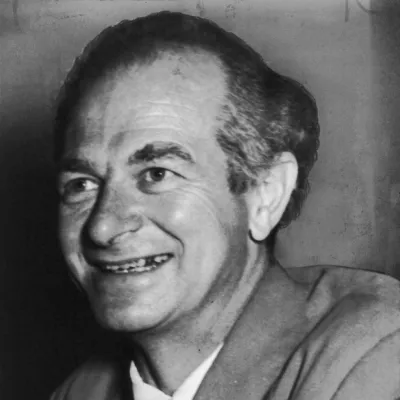
Linus Pauling
Human Design Chart
Biography
He died of prostate cancer on 19 August 1994 in Big Sur, California, aged 93.
What does Manifesting Generator 5/1 mean for Linus Pauling?
Manifesting Generator 5/1 — Design at a Glance
Linus Pauling demonstrated himself as someone who through a hybrid configuration combined the enduring strength of a Generator with the lightning-fast initiative of a Manifestor. His design featured a defined Sacral Center, which provided him with constant life energy and brought along the imperative advice not to initiate himself but to respond to external impulses. Simultaneously, active connections from Motor Centers to Throat Center enabled the ability to skip steps and quickly pull things into his life.
This speed carried specific risks: Linus Pauling tended to miss important stages or pursue multiple projects simultaneously. Acting without confirmation of his inner authority led to frustration, his non-self theme, very quickly. To effectively utilize his immense creative power, it was crucial for him to only start when his Sacral Center gave a clear “yes” in response to an impulse. Regularly checking the ongoing enthusiasm of his own projects was indispensable.
With correct application of this strategy – reacting instead of initiating and continuously querying inner approval – Linus Pauling could draw deep satisfaction from his work. Under these conditions, parallel processing of various tasks was no obstacle but rather fostered his necessary play mode. His energy flourished through variety and fun; the compulsion to complete one thing before starting another would have hindered rather than supported his natural dynamics. Thus, his potential restlessness transformed into productive versatility.
Emotional Authority
Linus Pauling showed a decision-making stance that was marked by a deep inner wave: His perception of the world oscillated between intense enthusiasm and sharp rejection. This dynamic stemmed from his emotional authority, carried by the defined Solar Plexus Center. In this design, this inner voice had absolute precedence over all other defined centers; it determined significantly how he assessed and reacted to situations.
His feelings always formed a first, often still incomplete impression. What appeared correct in one moment could look entirely different in another due to changed mood swings. Hence, spontaneous judgments by Linus Pauling were no reliable basis for his actions. Instead, his mechanics required patience and time. He had to let decisions rest, sleep on them, and engage with them multiple times before clarity emerged. Only when the initial emotional heat subsided and distance was gained did calmness set in. This process of maturation was essential for all long-term turning points in his life. Only through this conscious waiting could he ensure that his choice was not just a temporary mood issue but aligned with his true inner truth. His strength thus lay not in the speed of judgment, but in the ability to endure and let his emotional flow subside before acting.
The 5/1 Profile — Heretic / Investigator
Linus Pauling's design featured Profile 5/1: The Hero Researcher. This configuration combined the depth of a profound knowledge base with the drive to make these insights accessible for problem-solving to others. He showed almost magnetic charisma, which made others actively seek his solutions. However, this created a structural tension field: While he enjoyed the process of learning and mastering new challenges, he risked rapid exhaustion through constant demands from his environment. Without clear boundaries, he could become overwhelmed, similar to an expert confronted with a flood of further inquiries after intensive consultations.
His inner compass oriented towards persistence and maintaining personal rhythms (Line 1). This gave him the strength to maintain his own pace even in difficult phases and adhere to established rituals. Simultaneously, he carried aspects of natural surrender and harmonious exchange in interpersonal dynamics (Gate 37), which could pose risks of dependencies or frustration without proper distancing. The essential life task was to find a balance: preserving deep research for himself while using his gifts purposefully and with protection against overloading. Through learning the ability to say no, he could stabilize the beneficial tension between private depth and public effectiveness.
Split Definition — Defined & Open Centers
Linus Pauling demonstrated a reliable inner identity and direction supported by his defined G Center. This gave him a stable self-esteem as well as the ability to offer guidance to others without controlling their paths. His actions were also characterized by strong willpower; his defined Heart Center ensured that he kept promises and used his resources in an autonomous manner. The Sacral Center served as his engine, providing constant vital energy. However, this power was only effective when he responded to external stimuli rather than initiating them, which brought him deep satisfaction in his work.
His communication was clear and steady, thanks to his defined Throat Center translating messages from these inner sources directly into the world. Additionally, he possessed an intuitive authority through the Spleen Center, allowing him to act in the moment, as well as emotional depth through the Solar Plexus, which required patience in decision-making. The constant pressure of his defined Root Center propelled him forward and helped him cope with stress.
In contrast, his open Head and Ajna Centers revealed a vulnerability to mental confusion. Since these centers were undefined, he tended to get entangled in questions that weren't his own or felt the need to find answers to appear intelligent. However, this open structure also allowed him to flexibly adopt new ideas and act as a mirror for others' thinking, provided he didn’t take mental pressure as his own truth.
Channels for emotional rhythm, community and powerful manifestation.
Linus Pauling's design inclined towards innovative direction changes driven by the Beat 14-2 channel. This channel connects the ability to handle material resources skillfully (Gate 14) with higher knowledge about identity and direction (Gate 2). It enabled him to drive mutations and forge new paths by trusting his inner response.
His life followed the Rhythm 5-15 channel as well, linking firm habits (Gate 5) with a love for extremes and diversity (Gate 15). This created a biological life rhythm that kept him directly connected to the flow of nature without intellectual arrogance or emotional waves. His vitality arose from this constant movement in harmony with his inner timing.
In interpersonal relationships, the Charisma 34-20 channel was at work. It linked raw physiological energy (Gate 34) with an urge for immediate expression (Gate 20). This gave him the strength to remain active over long periods and act in the moment provided he responded to external stimuli rather than acting impulsively.
The Life Struggle 38-28 channel endowed him with the determination to find meaning in struggles. Gate 38 urged the preservation of individual integrity against external pressure, while Gate 28 sharpened awareness of which battles were truly worth fighting. This drove him to fight for his beliefs and discover significance in the obstacles on his path.
Additionally, Gates like 62 (logical detail work) and 35 (change through interaction) shaped his profile. Gate 62 promoted patience and pattern recognition, while Gate 35 sought progress through new experiences. This combination supported his ability to logically structure complex connections while remaining open to change.
Individual Circuitry — Circuit Signature
Linus Pauling's design inclined towards separate, parallel acting energetic fields. As a person with Split Definition, he had two non-interconnected groups: one linking Throat-, Sacral-, Solar Plexus-, Heart- and G Centers; the other Spleen- and Root Centers. This created a duality between strong emotional expressiveness on one side and instinctive survival-oriented perception on the other without these areas directly flowing into each other.
The Knowledge Circuit shaped him through Openness (Channel 12-22), Beat (2-14) and Life Struggle (28-38). It linked Throat with Solar Plexus Center as well as Identity with Sacral Center, separate from the Spleen-Root connection. This promoted seeking one's own path and new knowledge expressed through emotional waves.
In the Understanding Circuit, only Rhythm (Channel 15-5) was at work, connecting Identity and Sacral Centers. Here it was about logical structure and sharing rational insights free of emotions, focused on the future.
The Ego Circuit showed Community (Channel 40-37) between Heart and Solar Plexus Centers. This concerned cooperation and mutual support in the tribe with a need for rest pauses to generate resources as there was no direct Sacral connection.
Finally, Integration worked through Charisma (Channel 20-34), linking Throat and Sacral Centers. This ensured survival through reacting to life guided by proper behavior and intuitive knowledge in the present moment. Linus Pauling thus lived with these specific independent power fields structuring his actions and perception.
Left Angle Cross of Migration 1
Linus Pauling's Human Design profile established a foundational disposition characterized by the 'left cross of perseverance.' This configuration described someone who did not easily deviate from their path and whose energy was aligned with persistently pursuing goals with unwavering determination. In Human Design, this cross marks a specific life task: the ability to maintain focus on what is essential even in the face of resistance or delay, without succumbing to internal conflict.
For Linus Pauling, this meant that his inner structure inclined him towards not just starting projects and ideas but driving them through to completion. The 'perseverance' here was not merely a matter of stubborn persistence out of duty, but rather a natural expression of his energetic alignment. He appeared as someone who achieved results through consistency, which often seemed like mere obstinacy to superficial observers, in reality stemming from a profound inner clarity about his path. This mechanical quality created a stable foundation for his work, allowing him to ignore external disturbances and instead focus entirely on the realization of his visions. His design thus did not prompt quick changes in direction but rather deep anchoring in what he had once recognized as right.
Saturn Return · Uranus Opposition · Chiron Return · 2nd Saturn Return — Life Cycles
Linus Pauling's Human Design profile established a tendency towards strategic, goal-oriented action that intensified during phases of maturity. His structure promoted a deep need for order and clear outcomes, filtering impulses through inner confirmation before acting on them. This mechanism was particularly evident during his Chiron Return, a cycle of fulfillment in which his life purpose increasingly crystallized. In 1948, at the age of 47, he received the Medal for Merit – an achievement that confirmed years of consistent work and solidified his path as an acknowledged expert. This moment did not mark the healing of old wounds but rather the blossoming of his incarnation task: conveying knowledge at the highest level. Later, during his second Saturn Return in 1957 at age 56, he began a petition campaign against atomic testing alongside Barry Commoner. This was not a sudden career shift but the logical consequence of his mature position: using established authority and deep understanding to take on societal responsibility. His design allowed him to translate complex scientific insights into tangible demands that others could follow. Through this combination of individual excellence and later public advocacy, he shaped his life as someone who did not just accumulate knowledge but actively used it for progress – always guided by inner authority and the strategy of waiting for impulses before reacting.
Manifesting Generator · Emotional Authority — Synthesis
He was a Generator who developed a unique dynamic through the connection between Sacral Center and Throat Center. This configuration gave him constant energy, as well as the ability to quickly initiate things (Manifestor aspect). His profile as a Hero and Researcher (5/1) amplified this trait: he actively sought knowledge and problem-solving solutions to provide for others. The process of learning and sharing seemed to attract him, yet the constant demand for his insights could also be burdensome. A pattern emerged where he attracted others through his energy and knowledge while simultaneously needing to withdraw and regenerate – fueled by the connection between sacral reaction and manifesting initiative.
A central paradox lay in his emotional makeup. Emotional authority required time to let decisions mature, yet his design allowed him to act swiftly and initiate things quickly. This tension between the need for reflection and the ability for rapid implementation defined his path. He lived within an inner dynamic that led him to seek profound knowledge (Knowledge Circuit), but he did not immediately express it; instead, he had to filter it through emotional processes first. A notable event illustrated this: success in 1948 was followed by engagement for a cause in 1957, indicating a process of maturation and expression.
6 Defined Channels
Incarnation Cross - Left Angle Cross of Migration 1
Solar Return
The Solar Return shows the moment when the sun returns to its exact birth position - your personal solar year.
Life Cycles
Discover the life cycles with a detailed triple view (birth chart, cycle chart, composite).
Human Design Profile
- Strategy
- To respond - wait for something to respond to
- Authority
- Emotional Authority
- Profile
- 5/1 - Heretic / Investigator
- Definition
- Split Definition
- Incarnation Cross
- Left Angle Cross of Migration 1
- Date of Birth
- 28.02.1901 22:00
- Place of Birth
- Portland, OR, United States
Frequently Asked Questions
What was Linus Pauling's Human Design type?
What Profile did Linus Pauling have in Human Design?
Which Authority guided Linus Pauling?
What incarnation cross was Linus Pauling assigned to?
When was Linus Pauling born?
Discover your own Human Design
Are you also a Manifesting Generator? Find out in a personal reading how to unfold your multi-talents and direct your energy wisely.
More Personalities
Back to overviewAldair

Alizée

Angeli

Arletty

Artus
Balthus