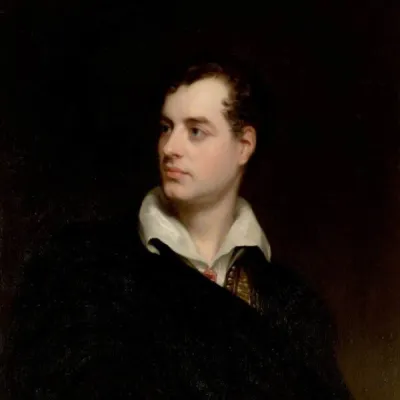
Lord Byron
Human Design Chart
Biography
His first poems were published in 1806. His epic poem, "Childe Harold's Pilgrimage," begun in 1812, made him a celebrity, but his affairs outraged London society and he was forced into exile in 1815 after a scandal over a liaison with his half-sister, Augusta Leigh.
When he came of age, Byron took his seat in the House of Lords, then toured Europe for two years after 1809. Deeply in debt, he made an advantageous marriage in 1815. His wife bore their daughter, Ada, before she left him a year later. After the breakup, Byron then moved to Italy, where he lived the rest of his life.
He did become involved with helping Greece in its struggle for independence from Ottoman Turkey. While on this expedition, he appeared to have epileptic fits.
Human Design Analysis: Lord Byron as Projector 1/3
Projector 1/3 — Design at a Glance
Lord Byron's design tends towards a dense, focused aura that acts like a bright flashlight, directing energy precisely to weaknesses in his surroundings and allowing him to immediately spot system errors in others. With an undefined Sacral Center, he lacked constant intrinsic life force energy, instead experiencing phases of high activity followed by necessary rest periods to avoid burnout.
The mechanics of his Projector type show that direct criticism of others' mistakes often triggers defense mechanisms, similar to being blinded by bright light. More effective was attracting through harmony and waiting for value-based invitations. If he adhered to this strategy without going against his design, he was rewarded with success. However, if he did not live by these principles, the non-self theme of bitterness would come into play. His essence is designed to illuminate paths for others by bringing light into darkness, but only effectively when he relinquishes initiative and responds to invitations from others, thereby protecting himself from exhaustion and ensuring his effectiveness as a leader.
Emotional Authority
Lord Byron's design tends towards emotional wave motion that significantly influences his decision-making process. He had to ignore impulses of immediate rejection or approval to avoid being misled. His inner authority was emotional, carried by the defined Emotional Center. In Human Design mechanics, people with this configuration experience constant ups and downs in their feelings; they see the world colored by their current mood. A moment of enthusiasm could quickly turn into negative perspectives, yet this immediate feeling is just a snapshot, not necessarily his deeper truth.
Quick, spontaneous decisions based on such emotions often had negative consequences. His design required patience and multiple reconsiderations before making decisions. Only through time could he distinguish between temporary moods and deeper truths. The longer he waited, the more intense feelings subsided, creating emotional distance. Then clarity and calm set in, marking the process as complete. This strategy was particularly important for long-term decisions that significantly impact his life course. By delaying and waiting, he gained access to his true inner voice beyond transient emotional noise.
The 1/3 Profile — Investigator / Martyr
Lord Byron's design tends towards cyclical learning: He first sought deep theoretical understanding before diving into practical application. This configuration of Profile 1/3, the Researcher and Experimenter, shaped his life task as a continuous process of study and experimentation. The energy of Line 1 fosters an intense thirst for knowledge that drives him to internal reflection. It's important to penetrate fantasies and delegate responsibility in proper measure to make meaningful experiences. Often, however, this drive towards complete information leads to paralysis before action due to the feeling of not knowing enough.
At the same time, Line 3 acts as a counterbalance, conveying an adventurous spirit and willingness to take risks for personal goals. Here lies the conflict: While the first line warns against insufficient knowledge, the third urges unconsidered experimentation. Lord Byron's development involved integrating this dialectic over time. He learned to selectively take risks and weigh important decisions more rationally. In this context, mistakes were not seen as failures but necessary data points for gaining insight. His judgment only gained validity and trust when it was both intellectually grounded and empirically validated through personal experience. Thus, a tested competence emerged where theory and practice are inseparable.
Split Definition — Defined & Open Centers
Lord Byron's design inclined towards constant yet limited communication driven by a defined Ajna Center (mental thinking) and a defined Throat Center. He processed concepts consistently, allowing him to reliably express his thoughts. However, this mental structure was moderated by his emotional authority in the Solar Plexus Center. The central challenge here was that decisions required patience and waiting for the emotional wave to avoid impulsiveness. Truth revealed itself to him over time, not immediately.
Additionally, his Spleen Center (Intuition/Survival) and Root Center (Stress/Pressure) were defined. This gave him a strong existential grounding and a specific way of dealing with pressure that promoted survival. His instinct was spontaneous and effective in the present moment, while internal pressure propelled him forward.
In contrast, Head, G Center, Heart, and Sacral Centers were open. This meant that inspiration, identity, willpower, and generative energy were situationally taken from the environment. Lord Byron was vulnerable to conditioning in these areas: he tended to be guided by external mental pressure (Head) or borrowed identity (G Center), rather than trusting his inner authority. The open Heart Center made him sensitive to the need to prove his worth, while the open Sacral Center led him to amplify foreign energy and easily overexert himself due to a lack of consistent generative power. The distinction between his defined emotional core and the situationally taken energies in the open centers was crucial for his well-being.
Channel 30-41: Recognition — Channels & Gates
Lord Byron's design inclined towards constant restlessness and a root-driven urge for new experiences. This unease was marked by Channel 41-30 (Recognition), which connected pressure from the Root Center with intense emotions in the Solar Plexus, creating a cycle of expectation, disappointment, and the need to follow emotional waves to gain clarity on his desires.
Alongside this driving force, other mechanisms were at work: Channel 11-56 (Curiosity) linked Ajna Center with Throat Center through Gates of Ideas (11) and Inspiration (56). This fostered a magical way of storytelling where abstract concepts became vivid parables that influenced others by stimulating imagination and feelings. Lord Byron sought less for fixed facts than for how stories could illustrate lessons.
Furthermore, Channel 23-43 (Structuring) activated innovative insights. Through Gate 23 (Assimilation) in Throat Center, he processed spontaneous breakthroughs of the mind (Gate 43) and expressed them outwardly. This enabled him to communicate complex perspectives efficiently, provided he followed his inner timing rather than planning ahead.
Finally, Channel 32-54 (Transformation) propelled his ambitious advancement. It connected ambition (Gate 54) with an instinct for continuity and talent (Gate 32). This motivated him to improve his position through constant effort and rise by competence, always driven by the fear of failure and the desire to be recognized by the tribe. This combination of emotional intensity, narrative creativity, innovative expression, and social ambition shaped his characteristic work.
Collective Circuitry — Circuit Signature
Lord Byron's design inclined towards emotional reflection that flowed through structured channels. His energy was pulsing and cyclical: new knowledge was not only grasped but transformed by waves of past emotions. This manifested in an individual identity based on sharing these insights.
The Knowledge Circuit connected Ajna and Throat Centers via Channel 23-43 (Structuring), offering a clear framework for expressing unique ideas, supported by creativity and melancholy as driving forces. Parallel to this, the Meaning Circuit worked with two separate segments: Ajna and Throat Center on one side, Solar Plexus and Root Center on the other. Channel 30-41 (Recognition) linked Head and Throat Centers, while 11-56 (Curiosity) connected Ajna with Solar Plexus – yet without a direct link between these two groups. Thus, two independent streams emerged: one for intellectual structuring, another for emotional processing of past experiences.
The Ego Circuit included Spleen and Root Centers via Channel 32-54 (Transformation), hinting at an ability to build resources but lacking the constant life force of Sacral Center. Rest periods were therefore necessary to renew this energy.
Lord Byron's overall design revealed a complex dynamic: emotional depth from the past met innovative impulses, carried into the world through structured communication.
Right Angle Cross of the Unexpected 4
Lord Byron's design predisposed him to attract the unexpected and unconventional. He was a magnet for situations that challenged or shocked established norms. This configuration did not describe a conscious provocation but rather a deeper archetypal force: Lord Byron became an instigator of the unexpected, shining in contexts where the norm broke down.
This dynamic arose from the mechanics of the right cross of the Unexpected 4. This element in the Human Design system marks a life task where the individual does not primarily act through planning but rather through spontaneous and often surprising turns. The energy of this cross attracts circumstances that challenge the status quo. For Lord Byron, this meant his influence was felt most strongly when predictable outcomes failed and something new and radical took place. He was not an architect of these events in a traditional sense but a catalyst whose mere presence or actions could undermine conventional expectations. This mechanics shows someone at their strongest when they do not control but react – and thereby trigger what others see as impossible or too risky. His design challenged him to embrace this role of instigator without seeking rational justification for the shock effect. The power lay in the authenticity of this unpredictable element, which set him apart from the masses and made him a center of attention, not just through actions but by breaking with the familiar.
Saturn Return — Life Cycles
Lord Byron's design predisposed him towards deep structural breaks when external conditions no longer aligned with his inner truth. This was evident in 1816, at age 28, when he permanently left London and England. This step was not an arbitrary flight but a direct reaction to the first Saturn Return. During this life phase, years of development culminate into a point where old identities and societal expectations often feel unbearable or false. For Lord Byron, it meant letting go of established structures in England for a new, more authentic existence form. The Saturn Return functioned here as a catalytic turning point forcing him to radically question and leave the previous life order. It was about freeing himself from external demands to be true to his essence. This departure was a structuring act: by leaving the familiar, he created space for a lifestyle shaped less by social conventions and more by inner necessities. The pain of separation from his homeland was the price for this structural realignment described in his design as an unavoidable process towards establishing a stable, independent identity.
Projector · Emotional Authority — Synthesis
He was a projector defined by his clear mental center (Ajna) and the channel of curiosity, living an unceasing search for understanding and new perspectives. This ability to recognize patterns and identify 'errors in the system' (typical for projectors) was always accompanied by an emotional wave. He needed time to process impressions, yet the energy of researcher/experimenter in his profile drove him to experiment and learn through experience – a constant drive towards knowledge colored by his inner authority.
This interplay created a central paradox: he was both the detached observer who saw the big picture and formed concepts as well as the engaged participant generating knowledge through trial and error. Curiosity (Gate 11) challenged him to share insights, while emotional authority required careful consideration; a tension between the need for expression and the necessity of emotional clarity. A documented event showed that this internal conflict led him to distance himself from existing structures to find his own path.
4 Defined Channels
Incarnation Cross - Right Angle Cross of the Unexpected 4
Solar Return
The Solar Return shows the moment when the sun returns to its exact birth position - your personal solar year.
Life Cycles
Discover the life cycles with a detailed triple view (birth chart, cycle chart, composite).
Human Design Profile
- Type
- Projector
- Strategy
- Wait for the respectful invitation
- Authority
- Emotional Authority
- Profile
- 1/3 - Investigator / Martyr
- Definition
- Split Definition
- Incarnation Cross
- Right Angle Cross of the Unexpected 4
- Date of Birth
- 22.01.1788 14:00
- Place of Birth
- London, United Kingdom
Frequently Asked Questions
What was Lord Byron's Human Design type?
What Profile did Lord Byron have in Human Design?
Which Authority guided Lord Byron's decisions?
What incarnation cross did Lord Byron have?
When was Lord Byron born?
Discover your own Human Design
Are you also a Projector? Find out in a personal reading how to unfold your leadership qualities and recognize the right invitations.
More Personalities
Back to overviewSissy Spacek

Alain-Fournier

Anémone

Ann-Margret

Bourvil

Hergé