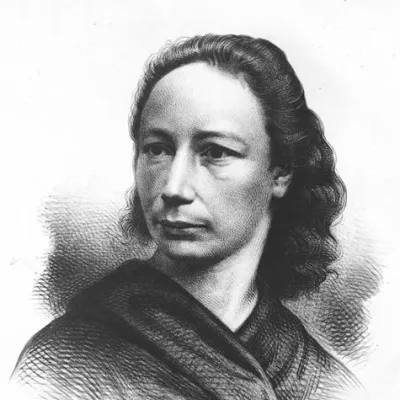
Louise Michel
Human Design Chart
Biography
Victor Hugo's poem "Viro Major" was written in her honor. A prolific writer, resistance worker and organizer, she was exiled to New Caledonia in 1873, returning to Paris in 1880 when amnesty was granted. In 1881, she was arrested for anti-government activities and she was sentenced to six years in prison. Pardoned, she spent several years in London. She died January 9, 1905, age 74.
Louise Michel — Manifestor with Profile 3/5
Manifestor 3/5 — Design at a Glance
Louise Michel revealed herself as a pioneer whose design was destined to lead the world into a new future. Similar to an emperor in ancient Rome, she had the vision of a great whole, but did not lead the necessary wars and battles herself. Instead, she sent her soldiers out to conquer foreign lands for her. This kind of leadership inevitably polarized: Her great dreams were loved by those who followed her, but hated by others precisely because of these visions. A central pain point of her design was the misunderstanding, as she often thought further ahead than her surroundings. For the right followers to find her, it was crucial that she informed others in a timely and precise manner about her visions. This formed the ideal strategy for her Manifestor design. If she followed this strategy, she was rewarded with a feeling of inner peace. If she lived against her design, she likely felt a persistent, deep anger. Her path was therefore characterized by the necessity of clear communication to minimize resistance and effectively exercise her leading role without getting entangled in conflicts that did not align with her nature.
Emotional Authority
Louise Michel showed herself as someone who did not make decisions based on a first, often intense emotional impulse. Her design laid a tendency to emotional turbulence, which forced her to take time before acting. This attitude resulted from her emotional authority, carried by the defined Solar Plexus Center. In Human Design mechanics, this authority always takes precedence over all other defined centers, regardless of further configurations in the chart.
She was subject to a constant wave of emotional ups and downs. The world always appeared colored by her current mood: a topic could be totally inspiring in one moment, completely negative in the next. Her immediate feeling, however, was only a snapshot, a first impression that did not necessarily reflect her deeper truth. Quick, spontaneous decisions from this emotional heat could have had negative consequences.
Therefore, she exercised patience. She let decisions mature, slept on them multiple times, and had others ask her multiple times. Only when the intense feelings subsided and emotional distance was gained, clarity and calmness set in. This process was essential for long-term, life-defining decisions. Only through this delay did she arrive at a more comprehensive understanding that lay beyond the transient emotional coloring.
The 3/5 Profile — Martyr / Heretic
Louise Michel revealed herself as someone who gained knowledge not from books, but through her own, often risky experimentation, to offer it to others as a solution. Her design as a 3/5 profile type established this dynamic: The line 3 of the experimenter prompted her to test everything herself first and learn from mistakes, while the line 5 of the hero made her present these practical experiences as a valuable treasure. Others felt attracted to this authentic, tested life wisdom and sought her leadership.
This role, however, came with specific tensions. Through Gate 16 in the third line, she needed independence and the right timing to bring her talents to bear; a constant need for validation from the environment could, however, lead to doubts when the inner energy was lacking. At the same time, Gate 37 in the fifth line shaped her relationships. Here, a natural devotion was shown, but it was endangered by emotional waves. Projections of lasting connection often broke down when dependency arose. Instead of harmony, this could lead to mutual hatred, as the attempt to enforce security through attachment restricted freedom. Louise Michel lived this balance between the urge to prove herself through her own actions and the danger of failing in interpersonal dependencies.
Split Definition — Defined & Open Centers
Louise Michel was marked by a design characterized by constant mental pressure and a firm inner direction. Her defined Head and Ajna Centers generated a continuous inspiration that raised questions and challenged consciousness. This mental process was always active, yet without direct motoric energy for immediate implementation. Instead of acting hastily, she used this intellectual tension to inspire others to think. Her defined Throat Center enabled her to articulate these concepts clearly and reliably, while her defined G Center provided a stable identity and a clear sense of her life mission. She knew who she was and where she was going, without needing to force others to follow her path.
Her defined Heart Center gave her the willpower to keep promises and determine her own resources. She enjoyed working autonomously and invested her energy where she deemed it appropriate. At the same time, her Solar Plexus was defined, meaning she did not make decisions impulsively but waited for the emotional wave. This patience allowed her to gain emotional clarity before acting and protected her from hasty reactions.
In contrast, her Sacral, Spleen, and Root Centers were open. The open Sacral Center made her susceptible to absorbing foreign energy, which could lead to exhaustion if she did not pay attention to her limits. She tended to question whether she had done enough or needed to continue, rather than listening to her inner authority. The open Spleen Center amplified fears about survival and health, causing her to mistrust spontaneous decisions, as these were often driven by conditioned impulses. Finally, her open Root Center absorbed external stress, leading to a feeling of pressure and chaos that she did not generate herself. Louise Michel learned to recognize this foreign pressure and not identify it as her own, to maintain her inner balance.
Channels for emotional depth, reflection, community and abstraction.
Louise Michel was marked by a complex emotional dynamic that required both social openness and deep reflection. Her design tended towards moody but potentially transformative communication. The Channel of Openness 22-12 connected her Solar Plexus to the Throat Center; her articulation depended on the emotional wave. Gate 22 brought passion and drama, while Gate 12, with its caution, limited openness to people with great transformative potential. It worked best when she waited for her mood to speak rather than acting impulsively.
Parallel to this, she gathered life experiences through the Channel of the Lost Son 13-33. Here, Gate 13 listened and stored secrets, while Gate 33 withdrew to reflect on these information. This process required patience, as she was only ready to share her gained truths after a complete maturation cycle. She functioned as a guardian of memories that brought continuity to development.
Her ability to form communities was shaped by the Channel of Community 37-40. This connected Solar Plexus and Heart Center. Gate 37 sought recognition and affection, while Gate 40 was ready to work for loved ones but needed breaks and rewards. She built bridges between individuals by waiting for direct, personal invitations to close fair deals based on mutual benefit.
Mentally, she experienced a constant search for meaning through the Channel of Abstraction 64-47. Gate 64 generated mental confusion through the experience of seven, until Gate 47 enabled understanding. This mind was unsuitable for steering her own life but revealed unique perspectives and stories she could share with others.
Additionally, specific Gates were active: Gate 16 promoted experimental mastery, Gate 9 allowed for precise focus. Gate 63 drove the mental process forward through doubt, while Gate 55 provoked extreme mood swings. Gate 8 sought validation for her individual contribution, Gate 10 integrated complex behavioral rules. Gate 61 fought for inner truth and silence, and Gate 17 organized for the future through logical teaching and service.
Collective Circuitry — Circuit Signature
Louise Michel was marked by her design as someone who directly translated emotional waves into expression. The Knowledge Circuit connected her Throat to her Solar Plexus Center. This created a pulsating energy that allowed her to articulate new insights and her individual identity acoustically and in the present moment, driven by openness.
At the same time, she possessed two separate segments of the Meaning Circuit. The connection between Head and Ajna Centers promoted abstract, innovative flashes of insight. Separately, the Channel 'The Lost Son' connected the Throat to the Identity Center. This helped her reflect on past experiences and their meaning and share these insights with the collective to learn from them. The energy here flowed cyclically and visually.
A third aspect was the Ego Circuit, which connected her Heart to her Solar Plexus Center. This concerned the community and the giving and taking. It was about mutual support and the joint creation of resources. As there was no direct connection to the Sacral Center, rest pauses were necessary to replenish the energy for the tribe.
As a person with split definition, Louise Michel's energy consisted of two parallel, not directly connected groups. The first group included Throat, Solar Plexus, Heart, and Identity; the second Head and Ajna. These separate energy fields existed alongside each other without a continuous flow between all centers. She acted from these specific, separate energetic configurations.
Right Angle Cross of Planning 2
Louise Michel revealed through her Human Design as someone capable of translating complex internal impulses into clear, tangible structures. This ability stemmed from the configuration of the 'right cross of Planning 2'. This specific aspect of her Human Design chart combined the power of authority with the ability for strategic implementation. It was not just theory, but a mechanism that allowed her to transform visions into concrete, step-by-step plans.
The energy of this cross acted like a compass, swinging between the desire for change and a realistic assessment of means. Louise Michel used this structure to not only dream her ideas but actively bring them into the world. She understood how to maintain a broad perspective without getting lost in the details. This gave her the stability to guide a clear path even in uncertain times.
Her design promoted a stance of patient preparation. Before acting, this configuration ensured that the necessary resources and the correct sequence of steps were clear. It was a process of inner order that outwardly appeared as calm but resolute determination. Louise Michel lived this dynamic by carefully planning before implementing her plans, creating a foundation for sustainable results based on solid planning rather than impulsive reactions.
Saturn Return · Uranus Opposition · Chiron Return · 2nd Saturn Return — Life Cycles
Louise Michel showed herself as someone who, in times of crisis, adopted a clear, protective stance based on collective responsibility. This inclination was reflected in 1871 when, at the age of 41, she was part of the watch committee of Montmartre during the Paris Commune. This Uranus opposition cycle often marked a turning point where internal tensions sought external structure and collective protection.
Her design unfolded further in the Chiron Return, a fulfillment cycle where one's life purpose deepens. In 1880, at 50 years old, she returned to Paris after her pardon. This was not just a geographical change but a return to the space where her incarnation task continued to work. The pardon allowed her to continue her role in the social fabric, now with the certainty that her path had meaning.
Later, in the second Saturn Return, she faced the harsh realities of life fully. In 1888, at 58 years old, she was attacked and injured after a lecture. This cycle often tests whether the established structures hold up. The attack was not a defeat but a test of her inner strength. Louise Michel proved through her reaction that her convictions were not just theoretical but existentially anchored. Her design challenged her to declare the truth even under pressure, cementing her authority in collective consciousness.
Manifestor · Emotional Authority — Synthesis
Louise Michel's design showed a strong inner dynamic, fueled by the interplay of emotional authority and a defined Head Center. The emotional wave (emotional center) shaped her decisions, requiring time to mature and leading to profound insights. Simultaneously, the Head Center (Channel 22-12) generated a steady mental pressure to question and spread inspiration, making her a powerful, though sometimes misunderstood, voice. This combination of deep emotional depth and the drive to share knowledge characterized her path and led to a role as an experimenter and savior (Profile 3/5), drawing on her own experiences and sharing this knowledge. The recurring cycles, especially the Uranus opposition (1871) and Saturn Returns, confirm a life marked by upheaval, crises, and the pursuit of change.
4 Defined Channels
Incarnation Cross - Right Angle Cross of Planning 2
Solar Return
The Solar Return shows the moment when the sun returns to its exact birth position - your personal solar year.
Life Cycles
Discover the life cycles with a detailed triple view (birth chart, cycle chart, composite).
Human Design Profile
- Type
- Manifestor
- Strategy
- To inform others before acting
- Authority
- Emotional Authority
- Profile
- 3/5 - Martyr / Heretic
- Definition
- Split Definition
- Incarnation Cross
- Right Angle Cross of Planning 2
- Date of Birth
- 29.05.1830 17:00
- Place of Birth
- Vroncourt-la-Côte, France
Frequently Asked Questions
What is Louise Michel's Human Design type?
What Profile did Louise Michel have in Human Design?
Which Authority guided Louise Michel's decisions?
What incarnation cross was Louise Michel assigned?
When was Louise Michel born?
Discover your own Human Design
Are you also a Manifestor? Find out in a personal reading how to use your initiation power peacefully and dissolve resistance.
More Personalities
Back to overviewChristian-Jaque

Kesha

Laurent-Eynac
Lucebert
Masaccio
Papus