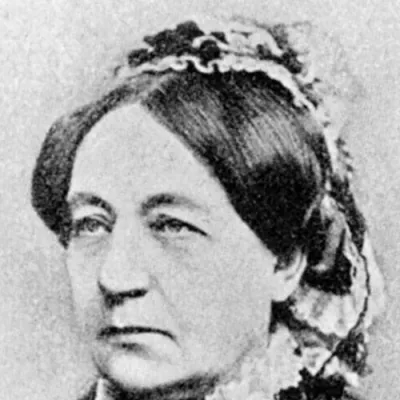
Louise Otto-Peters
Human Design Chart
Biography
She died 13 March 1895.
Louise Otto-Peters as a Projector 2/4 in Human Design
Projector 2/4 — Design at a Glance
Louise Otto-Peters' design featured a tendency towards focused perception. As a Projector, she did not have an intrinsic and constant energy source like other types but rather acted more like a bright flashlight: She could immediately spot where systems or relationships were "in the dark" and reveal errors. However, this ability to see others' weaknesses was a double-edged sword. When she addressed these flaws directly, she risked provoking defensive reactions as if shining her light too brightly into someone else's face.
Her optimal strategy involved not taking the initiative herself but waiting for a respectful and sincerely meant invitation from those around her. By living in harmony with her own nature, she became attractive; others then actively sought out her advice. This waiting for recognition was crucial to her well-being. If she lived by this principle, she was rewarded with success. However, if she ignored the need for an invitation and instead tried to impose her perspective, it eventually led to her non-self theme: bitterness. Additionally, she required regular periods of rest to avoid burnout, as her undefined Sacral Center did not provide continuous life energy—a need often foreign to conventional work environments.
Emotional Authority
Louise Otto-Peters lived with an internal authority that did not make her decisions in her Head Center but drew from the depth of her feelings. Her defined Emotional Authority served as a compass for her life. This did not mean spontaneous joy in action, however, but subjected her to a wave-like rhythm of moods and sensations. Her perception of the world was always colored by her current emotional state; what appeared inspiring at one moment could seem negative in the next. This initial impression did not yet constitute an ultimate truth.
The mechanics of her emotional authority therefore required time and distance. Quick decisions made from the immediate wave of feelings proved risky and often counterproductive. Instead, patience had to be exercised and important turning points left to rest. Only through repeatedly "sleeping on" a situation could the initial emotional heat subside. With this distance, Louise Otto-Peters gained clarity; intense emotions receded, and deep calm set in. This process of emotional maturation was essential for long-term orientation. Only when she took the path of waiting and letting go did she find her true inner truth beyond fleeting moods or impulsive reactions.
The 2/4 Profile — Hermit / Opportunist
Louise Otto-Peters revealed herself as someone who constantly oscillated between two seemingly contradictory needs: the deep desire for withdrawal and solitude alongside a strong urge to spend time with an intimate community. This Profile 2/4 set up a fundamental tension that compelled her to communicate clearly when she sought company and when she needed to be undisturbed. During her phases of isolation, she immersed herself in internal processes to gain clarity; once this inner peace was achieved, she returned to her trusted companions.
This dynamic was shaped by specific energies. The second line of her design projected discernment outward and posed the question of whom she wanted to serve – a polarity between shyness and a desire for influence. At the same time, the fourth line from Gate 58 required constant focus to externalize pressure and maintain health. During her alone times, Louise Otto-Peters could reflect on and evaluate the knowledge of her network. Only once her need for withdrawal was satisfied did she use the energy of the community to develop brilliant ideas. Her design did not allow her to remain permanently in one sphere; instead, it enabled her to create a safe environment where this shift between cave and network could clearly be structured.
Single Definition — Defined & Open Centers
Louise Otto-Peters revealed herself as a person with a deeply rooted self-identity and a clear sense of her own direction. Her defined G Center gave her a constant inner orientation that allowed her to guide others without being dependent on them. However, this magnetic presence worked harmoniously only when she allowed others the freedom to follow their own path; if she tried to impose her direction, friction arose.
Her decision-making was characterized by a defined Solar Plexus Center, which required patience. Rather than acting impulsively, she used the time of the emotional wave to gain clarity. This emotional depth served as her inner authority: She waited until her feelings had settled before taking action, which gave her a seductive aura and promoted long-term, carefully considered connections.
At the same time, Louise Otto-Peters possessed a defined Spleen Center, giving her a reliable instinct for "now." This existential sense protected her from danger and enabled spontaneous, intuitive judgments that were not distorted by logical considerations. The stress pressure of her defined Root Center drove her to establish herself materially and live life fully in the present moment.
In contrast, her design revealed vulnerable areas. Her open Head and Ajna Centers meant she did not have a constant mental inspiration; she tended to engage with foreign questions or fall into doubt when she did not trust her emotional authority. Her open Throat Center made her sensitive to the pressure of seeking attention, which sometimes led her to speak unnecessarily rather than waiting for an actual invitation to talk. Furthermore, in her open Heart Center, she lacked a constant energy for willpower and competition; she tended to want to prove herself through promises, often ending in cycles of disappointment as this energy was not her own. Finally, her open Sacral Center made her vulnerable to overload, as she absorbed and amplified the vital energy of her surroundings without having a constant source of it herself.
Channels for synthesis, intuitive form and critical judgment.
Louise Otto-Peters revealed herself through a deep intuitive connection to her own survival. The Channel of Perfect Form 57-10 connected her Spleen Center with the G Center, guiding her behavior by an acoustic sensitivity and spontaneous inner wisdom. She did not act out of fear for the future but from a deep trust in the present, allowing her to move through the world unburdened and express her uniqueness.
At the same time, she possessed a sharp mind for structures. The Channel of Judgment 58-18 drove her to logically question and correct patterns. This impulse from the Root Center served to perfect systems to make life in the collective more cheerful. She actively sought out flaws in established processes not out of criticism but from an insatiable drive to find functional solutions.
Her emotional landscape was marked by tribal loyalty and principles. The Channel of Synthesis 19-49 connected Root and Solar Plexus, making her sensitive to belonging and rejection. She searched for groups that shared her values and rejected everything that went against her inner ideal of fairness. This channel created the emotional glue for communities based on loyalty and the protection of shared resources.
Additionally, specific Gates were at play: Gate 17 promoted logical teaching and emancipation through service; Gate 52 required a concentrated pause for pattern correction. In her design, Gate 41 steered evolutionary development through crises, while Gate 50 provided a protective reflex for traditions. Gate 55 brought emotional awareness, while Gate 36 allowed cyclical downturns as necessary change. This constellation created a person who lived intuitively, logically corrected, and emotionally bonded.
Tribal Circuitry — Circuit Signature
Louise Otto-Peters revealed herself through her design as someone who combined logical clarity and strategic judgment with intuitive perception. As a person with a simple definition, she had a continuous energetic flow between the G Center, Spleen, Root, and Solar Plexus Centers, enabling an integrated capacity for action.
The Understanding Circuit worked in her through the Channel of Judgment (18-58). This connected the Spleen Center to the Root Center. It involved the ability to translate intuitive insights from the Spleen into concrete, urgent actions in the Root Center – a "dispassionate ratio" aimed at improving things through focus and structure.
Parallel to this, the Ego Circuit operated through the Channel of Synthesis (49-19). This connected the Solar Plexus Center to the Root Center. It promoted the ability to channel emotional waves and reactions into common support and cooperation. Since this circuit did not connect to the Sacral Center, pauses for resource regeneration were necessary to maintain a balance between giving and taking.
The Integration Circuit closed through the Channel of Perfect Form (10-57), which linked the Identity Center with the Spleen Center. This allowed Louise Otto-Peters to draw strength from reacting to life and direct it through intuitive knowledge as well as proper behavior in the here and now. The combination of these channels shaped a personality that linked individual intuition (Spleen) with strategic action (Root), emotional cooperation (Solar Plexus), and identity-forming self-affirmation.
Right Angle Cross of Service 1
Louise Otto-Peters was characterized by a fundamental disposition that found its deepest fulfillment in serving others and supporting her environment. Her design indicated a nature that did not primarily strive for individual power or isolated self-promotion, but whose energy became most effective when it was used to benefit others. This orientation did not mean self-denial in the negative sense, but rather a clear direction: her strength lay in functioning as support and making a positive difference through practical help or emotional connection.
The 'Right Cross of Service' precisely describes this configuration. It marks people whose life purpose is realized in helping and promoting others. For Louise Otto-Peters, this was not a secondary trait but a central driving force. She did not find her confirmation by standing in the spotlight as the sole instigator of change, but rather through enabling processes that benefited others. Her energy flowed naturally where there was need, and she drew strength from the realization that her actions had concrete benefits for her fellow human beings. This shaped her interactions sustainably: she was someone who built trust through reliability and offers of support. Thus, her path was closely connected to the question of how best to serve – a task that marked her design as the source of her satisfaction and personal success.
Saturn Return · Uranus Opposition · Chiron Return · 2nd Saturn Return — Life Cycles
Louise Otto-Peters showed herself as a person whose life work increasingly gained in structure and social anchoring. Her design indicated a tendency towards long-term development and institutional consolidation. In 1847, at the age of 28, her poetry collection 'Songs of a German Girl' was published. This marked her first Saturn Return, a cycle where years of inner groundwork often condenses into a solid public result and sets professional milestones.
Later, in 1858 at the age of 39, she married August Peters. This time fell on the Uranus Opposition, a phase that often initiates deep changes in relationships or personal freedom and readjusts existing structures. The marriage was here less an end than a new, changed web of relations.
The peak of her unfolding occurred in 1865 with her Chiron Return. At 46 years old, she founded the Leipzig Women's Education Association and convened the first German women's conference to Leipzig. In Human Design mechanics, this cycle is not one of healing but of bloom: the individual incarnation cross unfolds fully in life. Louise Otto-Peters' actions then clearly showed the clear sense and purpose of her design – the concrete organization and promotion of female education as an expression of her life task.
Projector · Emotional Authority — Synthesis
Louise Otto-Peters’ life was marked by a deep need to create connections while maintaining her own integrity. Her defined G Center (Love, Identity, Direction) points to a strong inner compass that helped her walk authentically and show others new perspectives – especially through the connection of intuitive recognition (Gate 57) with personal behavior (Gate 10). This interplay was evident in her engagement for education and social change, where she always tried to recognize and promote the potential of others. Her profile as a natural talent and networker underscored the need to balance retreats into inner reflection (Line 2) with the desire for exchange with like-minded individuals (Line 4).
A central paradox in her design lay in the tension between her Projector nature – the drive to identify flaws in the system and shed light on darkness – and her emotional authority. While she had an intuitive sense of what needed improvement, her emotional wave required time to process decisions. This likely led to internal conflict between the immediate impulse for correction and the need to emotionally digest her perception before publicly positioning herself. The documented events (career, relationship) seem to reflect this dynamic: both creative breakthroughs as well as engagement with social conventions.
3 Defined Channels
Incarnation Cross - Right Angle Cross of Service 1
Solar Return
The Solar Return shows the moment when the sun returns to its exact birth position - your personal solar year.
Life Cycles
Discover the life cycles with a detailed triple view (birth chart, cycle chart, composite).
Human Design Profile
- Type
- Projector
- Strategy
- Wait for the respectful invitation
- Authority
- Emotional Authority
- Profile
- 2/4 - Hermit / Opportunist
- Definition
- Single Definition
- Incarnation Cross
- Right Angle Cross of Service 1
- Date of Birth
- 26.03.1819 21:45
- Place of Birth
- Meissen, GER
Frequently Asked Questions
What was Louise Otto-Peters' Human Design type?
Which Profile did Louise Otto-Peters have?
What Authority did Louise Otto-Peters possess?
What incarnation cross did Louise Otto-Peters have?
When was Louise Otto-Peters born?
Discover your own Human Design
Are you also a Projector? Find out in a personal reading how to unfold your leadership qualities and recognize the right invitations.
More Personalities
Back to overviewSissy Spacek

Alain-Fournier

Anémone

Ann-Margret

Bourvil
Hergé