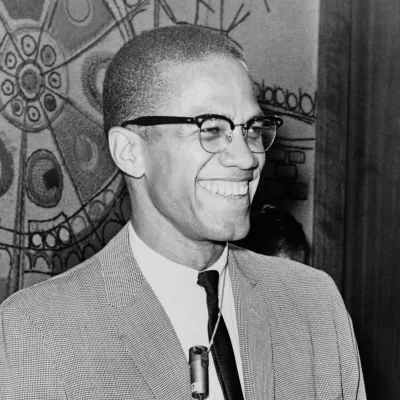
Malcolm X
Human Design Chart
Biography
Malcolm’s father was a Baptist minister who belonged to the United Negro Improvement Association. This group advocated that blacks return to Africa because they could find no peace in America. The Ku Klux Klan harassed his father and their Omaha home was burned down. The family moved to Lansing, Michigan in 1929. In his autobiography, Malcolm recalled that his father gave rousing sermons - but beat his wife and children. He attributed this to his father's self-hatred, a result of brainwashing by whites.
Malcolm's dad died a violent death in 1931 and Malcolm attributed his death to the Klan, though the Perry biography presents evidence that Little's death was from an accident. At any event, the boy was left fatherless and State welfare workers soon began harassing Malcolm's mother, grief stricken over her husband's death. She suffered a breakdown and was institutionalized until 1963. Malcolm was separated from his siblings and lived in foster families where he learned to steal and fight but retained his personal ambitions. His English teacher discouraged him from trying to become a lawyer, saying he should learn to work with his hands instead.
After Malcolm went to live with his sister in Boston, he became a gambler and thief along with his work of shining shoes at the Roseland State Ballroom. He dealt bootleg liquor and illegal drugs and eventually landed in jail, being sentenced in 1946 to ten years for burglary.
The Human Design of Malcolm X: Projector 5/1
Projector 5/1 — Design at a Glance
Malcolm X's design indicated a way of working that was more about radiating influence rather than actively engaging: He seemed to quickly recognize what wasn't functioning well in others without having his own constant, self-sustaining energy source. This fundamental orientation matched the Projector Aura-type. A Projector directs their focused attention on the other person and often immediately identifies a weak spot - comparable to a bright flashlight shining exactly where it's still dark for the other. If this insight was expressed unsolicited, it frequently met with resistance from the other side, even if it was accurate. When it came as an answer to an invitation that valued his perspective, the same sharpness of vision could serve as guidance that others followed voluntarily. Since there was no consistently defined Sacral Center for this type, there wasn't a constant bodily energy source available: Phases of intense and rapid activity alternated with phases where rest was necessary to avoid burnout. An environment that barely accounted for such rhythms - like school or work - would challenge this configuration. When this way of recognizing and leading received acknowledgment and invitation, it aligned with what the Projector was designed for; if it remained unrecognized or overlooked, a sense of bitterness typical to this type could easily set in.
Emotional Authority
191 words under the limit. Here's the final chapter text:
Malcolm X's design indicated strong fluctuations in emotional experience that made quick decisions unreliable for him. His defined Solar Plexus Center, the center of feeling waves and inner authority, carried this emotional authority independently of what else was defined in his chart: this emotional authority always took precedence over all other defined centers.
This meant a constant up-and-down mood swing that colored his view on things. What made complete sense to him at one moment could seem questionable shortly after - the first impression wasn't the whole truth. For him, it was crucial to take time for important long-term decisions rather than acting out of a momentary emotional state. Only when initial intensity subsided and repeated reflection created emotional distance could true clarity and calmness emerge - a process that required patience and couldn't be forced. Quick spontaneous reactions from strong emotions carried the risk of later proving false, while waiting until this up-and-down cycle ran its course gave him access to a deeper, more comprehensive assessment.
The 5/1 Profile — Heretic / Investigator
Malcolm X's design indicated a tendency to contribute only when asked - and then withdraw once the contribution was made. This fundamental stance stemmed from his Profile 5/1, the 'Researcher': He first thoroughly delved into his own knowledge base (Line 1) before offering what he had developed to others for solving their problems (Line 5). People with this fifth line have a magnetic effect on others - they are often sought out because people hope to get answers from them, which without clear boundaries can quickly lead to exhaustion if too many want something at once.
Connected to this was Malcolm X's inclination towards time-limited contributions: He stood up for an issue or group, did his part there - and then turned toward a new direction rather than staying permanently in the same role. This was complemented by another aspect of his design, oriented towards collaboration with strong, influential forces: Only through such cooperation could his thinking and action fully unfold, while without this connection he would sink into an internal fluctuation phase.
Triple Split Definition — Defined & Open Centers
Malcolm X's design showed a pronounced tendency to constantly feel internal pressure, to ask questions, to penetrate connections, and to seek clarity - a trait that arose from the combination of Head Center and Ajna Center, both defined in him. This combination created a constant mental pressure: the need to understand, to question, and to formulate answers that could serve as orientation for others. Since neither the Head nor the Ajna were connected to any of the physical drive centers, there was no immediate power to turn thoughts into action - the pressure rather worked as a continuous impetus to keep thinking. The defined Ajna Center also provided a firm, recurring way to form concepts, independent of who was around him.
The Throat Center was also defined in him: he had a constant, reliable way to express himself that spoke from a fixed inner source instead of adapting to the environment - his way of speaking remained recognizably consistent over time.
At the same time, this firm internal compass encountered two open centers: the Heart Center and the Sacral Center. An open Heart Center typically brings with it the vulnerability of constantly having to prove oneself to oneself and one's own will - the tendency to question whether one can keep up with others or needs to do more to be considered valuable. An open Sacral Center makes one particularly sensitive to the energy of people in the environment: lacking a reliable personal power source, foreign energy is easily taken on and amplified, at the risk of overextending beyond one's own limits. Both open areas thus did not define Malcolm X's firm nature but rather the typical vulnerability that an open center exposes.
Channel 8-1: Inspiration — Channels & Gates
Malcolm X's design laid out a dual leadership structure: the power to achieve impact through his own life, combined with the need to be recognized and invited as a leader by a group. This tension arose from two channels both leading from the Center of Identity to the Center of Expression. The Channel of Inspiration 1-8 connected the Gate of Self-expression with the Gate of Contribution: here, effect was not achieved through explanations but through an exemplary individual life that inspired others to their own paths without words. The Channel of Alpha Animal 7-31, on the other hand, needed a group stage - Gate 31 as the voice of collective leadership, Gate 7 as the role a society looks to for guidance based on proven patterns; real influence only came when a majority chose someone to represent them. In the Head, the Channel of Awareness 24-61 triggered sudden, untraceable knowledge - Gate 61 as an inner impulse, Gate 24 as the mental working-through until insight was ripe without reference to past or future patterns. Emotionally, the Channel of Emotional Release 39-55 acted: Gate 39 provoked, Gate 55 kept the mind open for a pulsating wave between melancholy and high spirits that could not be rationalized but lived through. Individual Gates further shaped the picture: Gate 14 for skillful handling of power and resources, Gate 59 as an inclination to dissolve separating barriers between people. Additionally, Gate 41 (Feeling and Desire), Gate 20 (Acting in the Moment), Gate 52 (Focused Silence), Gate 36 (Crisis as Cyclical Movement), Gate 13 (Remembering and Reflecting), Gate 38 (Struggle for Integrity), Gate 49 (Principle Loyalty), Gate 22 (Grace in Openness), and Gate 4 (Clarifying Formulas) came into play.
Individual Circuitry — Circuit Signature
Malcolm X's design consisted of several closed, but clearly separate energy fields that were not directly connected to each other - a fundamental aspect of his Triple Definition: three distinct areas of wired-in energy that only found common experience through others or the moment.
In the Knowledge Circuit, which revolved around one's own unique identity and bringing something new into being, there were three such separate paths in him. Head Center and Ajna Center were connected by a channel that transformed mental pressure into clear, thought-through views. Separately stood Throat Center and Identity Center linked - the ability to actually audibly express his unique path instead of carrying it internally only. As a third, again independent path, a channel connected Solar Plexus and Root Centers: emotional pressure building up in waves and demanding release.
In the Understanding Circuit, oriented towards logic and sharing sober insights, there was another connection between Throat Center and Identity Center - this time through the channel describing leadership by personal example rather than formal authority. This second bridge between the same two centers strengthened the drive to make one's stance visible and audible instead of just representing it.
Left Angle Cross of Uncertainty 1
Malcolm X's design carried an incarnation cross that was not oriented towards himself but rather his environment: the left uncertainty cross 1. The term 'left' in Human Design referred to a transpersonal cross, unlike a right personal cross which described a fixed role fulfilled through interaction with others and its effect on them, not by purely individual goals. Malcolm X was someone whose life theme derived less from personal plans than from what he accomplished for and with others.
The name of this cross was Uncertainty. It described a life path where the lack of knowledge, openness, and undecidedness became the supporting element – not as a deficiency but as the ground upon which his journey unfolded. For his design, this meant: being willing to act or wait during phases of uncertainty belonged to the core of his destiny, not as an obstacle on the way to it.
Saturn Return — Life Cycles
Malcolm X's design showed a tendency to take preparation beyond itself and carry it into visible, responsibility-bound positions once the external framework was ripe for it. This imprint can be read at the moment when it first became tangible: in 1953, at age 28, he was appointed deputy minister in Detroit.
For his design, this marked a typical moment: the first Saturn return. The cycle of Saturn's return lasts around 28 to 29 years and marks the point where the planet Saturn returns to its position at birth. In Human Design mechanics, this cycle is seen as a transition from a phase of experimentation and learning to one in which structure, responsibility, and a stable place in external life are demanded. What had been gathered in experience and orientation condensed into a concrete, outwardly visible role during this phase.
His appointment as deputy minister fell exactly within this window and signified a shift: from a preparatory, still searching position to an officially recognized function with duties and authority. This transition was not limited to one station but shaped how responsibility anchored itself in his life from that age on.
Projector · Emotional Authority — Synthesis
Through Malcolm X's design ran a pattern of clear, independent insight whose effect depended on invitation and timing. As a projector, he immediately saw what was wrong with others, yet his strategy required waiting for an invitation rather than pushing forward. In Profile 5/1, the same pattern repeated: The depth of his knowledge became valuable to others only when they asked about it, and without limits this questioning threatened to overwhelm him. His channel of collective leadership (Gate 31) followed the same mechanism – influence arose through trust and choice by others. His Head-Ajna Center provided constant pressure to ask and understand, which could only take effect if his environment was ready to accept him.
At the same time, there existed in his design a tension field between unrelenting internal pressure and lack of energy source. Root and Solar Plexus were defined as separate power groups: an adrenalized drive forward met with an intense, deeply felt emotional wave – motoric strength not immediately connected to his voice. Simultaneously, his Sacral Center remained open: he lacked a constant self-generated life force, living in phases of high energy followed by rest periods. So an internally pressing system faced a design dependent on pauses and patient waiting – power and depth without sustained endurance.
4 Defined Channels
Incarnation Cross - Left Angle Cross of Uncertainty 1
Solar Return
The Solar Return shows the moment when the sun returns to its exact birth position - your personal solar year.
Life Cycles
Discover the life cycles with a detailed triple view (birth chart, cycle chart, composite).
Human Design Profile
- Type
- Projector
- Strategy
- Wait for the respectful invitation
- Authority
- Emotional Authority
- Profile
- 5/1 - Heretic / Investigator
- Definition
- Triple Split
- Incarnation Cross
- Left Angle Cross of Uncertainty 1
- Date of Birth
- 19.05.1925 22:25
- Place of Birth
- Omaha, NE, United States
Frequently Asked Questions
What was Malcolm X's Human Design type?
What profile did Malcolm X have in Human Design?
What kind of authority did Malcolm X have?
Which incarnation cross did Malcolm X carry?
When was Malcolm X born?
Discover your own Human Design
Are you also a Projector? Find out in a personal reading how to unfold your leadership qualities and recognize the right invitations.
More Personalities
Back to overviewSissy Spacek

Alain-Fournier

Anémone

Ann-Margret

Bourvil
Hergé