
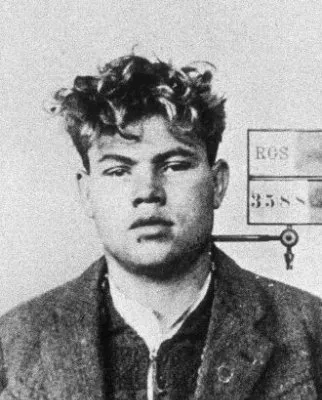
Marinus van der Lubbe
Human Design Chart
Biography
Marinus van der Lubbe was the youngest of the five children of the maiden Petronella van Handel (5 November 1870 5 AM, Gemert - 17 June 1921, Den Bosch). His mother, who had already four living children from her earlier marriage to Johannes Peute (27 December 1851, Zierikzee - 18 June 1919, Utrecht) , married his father, the hawker Franciscus Cornelis van der Lubbe (31 October 1863 11 AM, Den Haag - 1933, Leiden) on 1 June 1904. The family moved a lot because of debts and impossibility to pay the rents. In 1914 his father left the family. They now were extremely poor. After the death of his mother, he was only 12, he lived with the Christian half sister of his mother, the family Peute in Oegstgeest.
Marinus became a stonemason after finishing the primary school with poor results and was called "Dempsey" after the boxer Jack Dempsey, because of his great strength. Via his work he came in contact with the labour movement. In 1925 he joined the youth section of the Dutch Communist Party (CPN).
In 1925 and 1927 he got alkaline lime dust in his eyes at work, that lastly blinded him for 75%. In 1927 he spent in hospital for months and definitely lost his job. He lived his life in poverty with an invalid pension of only 7.44 guilders a week. He went to Leiden in 1927, got politically involved and was arrested twice: Because of resistance against the police during a demonstration and throwing a brick-stone at the "Maatschappelijk Hulpbetoon" (now Social Affairs). He needed more money to get along. Van der Lubbe preferred to work to earn his money, but he was also very sensitive to social injustice. He wanted to sacrifice himself for this. During a strike, while working for the Tielmann factory, he took the sole responsibility for it. And for the Reichstag fire he also took full responsibility, though many other agitators played a role in it.
In April 1931 he left the Communist Party.
Human Design Analysis: Marinus van der Lubbe as Generator 2/4
Generator 2/4 — Design at a Glance
Marinus van der Lubbe's design points to a tendency towards great endurance and inner drive. As a Generator, he had plenty of sacral energy that made him extremely strong and resilient – provided this power was used for tasks he genuinely enjoyed. His life force could only be unleashed through responding to signals from the outside world rather than by initiating things on his own accord. The motto of his design is: Do not initiate but wait until life poses a question or an impulse arises, then act upon it as soon as his gut feeling gives a clear 'yes'.
This mechanism held two central pitfalls for him. On one hand, burnout threatened if he continuously engaged in tasks that did not bring intrinsic joy and wasted his energy. On the other hand, frustration arose when he was prevented from working on his heart projects despite his inner engine still wanting to run full power. Living in harmony with this strategy of reacting rewarded him with a deep sense of fulfillment and satisfaction. Initiating constantly or acting against his sacral impulses, however, sooner or later led to persistent frustration and a noticeable lack of energy. His design thus required precise alignment between external occasions and inner confirmation to effectively use his great strength.
Sacral Authority
Marinus van der Lubbe's design points towards intuitive decision-making. As a Generator, his inner authority was the Sacral Authority, which also served as his strategy. This simplified his process: he did not react through prolonged thinking but responded immediately with a physical reaction to external stimuli. This 'gut feeling' manifested as an energy surge or loud grunting and humming – a clear signal of vitality and enthusiasm. When his sacral center was engaged, he had inexhaustible vigor and approached his tasks with great joy without having a specific purpose in mind.
Additionally, there was supportive Instinctive Authority from the Spleen Center at work here. Since this center was activated and likely directly connected to the Sacral Center, Marinus van der Lubbe received quick, spontaneous access to his instinctual perception. This allowed him to react swiftly to his environment based on a deep sense of physical well-being. He could reliably guide himself by these inner impulses, further strengthening his ability for immediate action and underpinning his decisions with an additional layer of instinct.
The 2/4 Profile — Hermit / Opportunist
Marinus van der Lubbe's design points towards a constant oscillation between deep withdrawal and the need for specific community. As a 2/4 Profile, he fluctuated between Line 2 seeking solitude for inner clarity and Line 4 demanding connection to a closer circle. This tension required clear communication of his needs: when he wanted company and when he needed to be left alone. During his withdrawal phases, Marinus van der Lubbe immersed himself in internal processes to find peace and clarity. Only after fulfilling this need for solitude did he return from 'his cave' to spend time with his favorite people. This profile allowed him to reflect on the knowledge of his network in isolation, evaluate it, and develop brilliant ideas.
His Gate 61 on Line 2 gave him a 'natural brilliance' that he used in private spaces to delve into mystery. While this personality was impressive as an inspiration source, there was a risk of being a 'paper tiger': the external impact could be greater than actual talent or knowledge. At the same time, his other line brought aspects of justice and power, coupled with opportunistic flexibility. He stood by his principles as long as it was safe; Saturn promoted inner strength and endurance in undisturbed security. His task was to carry something outward while its form changed but the fundamental principles remained. This configuration shaped a being that released inspiration yet always navigated between the illusion of universal knowledge and the reality of human limitations.
Split Definition — Defined & Open Centers
Marinus van der Lubbe's Human Design profile indicated a tendency towards consequential, gut-reaction energy. His defined Sacral Center generated a constant vital force that was directed by spontaneous yes or no responses to external stimuli rather than mental planning. Combined with his defined Spleen Center, he had a reliable instinct for immediate well-being and survival. This physical intelligence contrasted with his open Solar Plexus Center, which made him susceptible to picking up foreign emotions and mistakenly identifying them as their own, potentially leading to internal confusion.
His defined G Center gave him a firm sense of self-identity and clear direction independent of external expectations. This directly influenced his communication: His defined Throat Center, in conjunction with the Ajna Center, allowed him to consistently express what he conceptually thought and understood. The defined Ajna Center provided constant mental activity; his mind was always engaged in thinking and creating concepts that he carried outward.
At the same time, he struggled under the pressure of his open Head Center. Without consistent personal inspiration, he tended to identify with others' questions and mental unrest or be overwhelmed by their doubts. His open Heart Center lacked persistent willpower; he was not inclined to keep promises or prove his worth through competition. Instead, he often sought validation, which could lead him into a cycle of self-doubt when trying to meet expectations that did not align with his inner authority. The defined Root Center provided constant stress pressure, propelling him forward, but without the emotional filtering of a Solar Plexus it often felt raw and unmodulated.
Channels for self-love, logic, ambition and growth.
Marinus van der Lubbe's Human Design profile indicated a tendency towards individual self-determination paired with a strong drive for social recognition and logical structuring of his environment. His character was revealed through Channel 34-10, connecting Sacral energy to the G Center. This configuration promoted living one's own convictions and establishing self-love as the basis for interactions, emphasizing authenticity.
Parallel to this, Channel 54-32 between Root and Spleen Centers drove him through ambition and a desire for visible progress motivated by fear of failure or loss of social standing. This channel required validation from his environment to use his talents and establish himself in hierarchies.
The nature of his perception and communication was shaped by Channel 17-62, linking Ajna with Throat Center. Marinus van der Lubbe mentally organized information according to strict logical patterns; only what integrated into his worldview was accepted as understandable. This led to a constant pressure to verbally express detailed opinions and analyses often without regard for others' receptiveness.
Additionally, Channel 42-53 between Root and Sacral Center influenced his experiential pattern. He went through life cycles completely to gain wisdom from them, with each conclusion requiring reflection before new beginnings were possible. Individual Gates like Gate 61 (inner truth) or Gate 41 (evolutionary feeling) highlighted the tension between personal insight and collective expectations, while Gates such as 38 (resistance) set boundaries for preserving integrity.
Collective Circuitry — Circuit Signature
Marinus van der Lubbe's Human Design profile showed a tendency towards established individual convictions. The Centering Circuit connected his Identity with the Sacral Center, creating inner stability and self-worth but without direct connection to Throat Center for verbal articulation of this stance. Parallel to this was a separate stream: The Understanding Circuit linked Ajna and Throat Centers. This allowed logical, future-oriented sharing of insights free from emotional influence. Another independent aspect was the Purpose Circuit connecting Sacral and Root Centers. Here cyclically rising emotional waves from past experiences had to be processed. Finally, the Ego Circuit showed a connection between Spleen and Root Centers. This promoted transformative impulses for resource security through cooperation but required regular rest periods due to lack of direct Sacral connection for regeneration. Marinus van der Lubbe's chart consisted of these four separate energetic groups; they worked parallel alongside each other without forming a cohesive flow. The individual firmness of the Centering Circuit did not directly interact with logical communication or emotional past waves. Each of these energies - whether inner confirmation, rational strategy, emotional reflection, or transformative cooperation - had to be integrated separately as no direct bridge existed between these different life domains.
Right Angle Cross of Maya 4
The provided raw content contains only the name "Right Arm of the Maya 4" and no additional mechanical details, descriptions or events. As the instruction strictly prohibits using knowledge from training or making assumptions about facts not delivered, no substantive chapter can be created that refers to Marinus van der Lubbe's specific design. Any description of character traits or mechanics would require information such as defined channels, centers, or strategies in the raw content. These are completely absent here. Therefore, the output remains empty to adhere to the rule "Use NO knowledge [...] from your own training" and "Describe ONLY what [...] actually applies [based on delivered facts]". No fiction is generated.
Generator · Sacral Authority — Synthesis
He was a Generator whose life was marked by a profound inner drive to generate energy through sacral engagement (sacral energy, Channel 34-10). This power manifested in an ongoing search for activities that truly fulfilled him and gave his life meaning – a tendency amplified by the Profile of Natural Talent/Networker. The interplay between the need for withdrawal (Line 2) and the desire for community (Line 4) points to a life where he continually sought balance between individual self-discovery and social interaction. The defined mental structure (Ajna Center) supported the development of clear concepts and convictions guiding his actions.
A central paradox lay in the tension between his strong inner drive towards self-realization (Channel 34-10) and the need to connect with others (Line 4). Thus, he lived an internal dynamic that propelled him toward his own path and the expression of his individuality while also nurturing a desire for recognition and belonging. The Right Arm of the Maya indicates a life journey where these inner tensions played a central role.
4 Defined Channels
Incarnation Cross - Right Angle Cross of Maya 4
Solar Return
The Solar Return shows the moment when the sun returns to its exact birth position - your personal solar year.
Life Cycles
Discover the life cycles with a detailed triple view (birth chart, cycle chart, composite).
Human Design Profile
- Type
- Generator
- Strategy
- To respond - wait for something to respond to
- Authority
- Sacral Authority
- Profile
- 2/4 - Hermit / Opportunist
- Definition
- Split Definition
- Incarnation Cross
- Right Angle Cross of Maya 4
- Date of Birth
- 13.01.1909 05:30
- Place of Birth
- Leiden, Netherlands
Frequently Asked Questions
Which Human Design Type was Marinus van der Lubbe?
Which incarnation cross characterized Marinus van der Lubbe?
When was Marinus van der Lubbe born?
Discover your own Human Design
Are you also a Generator? Find out in a personal reading how to use your sacral energy correctly and discover deep satisfaction.
More Personalities
Back to overviewSissy Spacek

Aaliyah

Alexia

Anémone

Angèle

Ann-Margret
