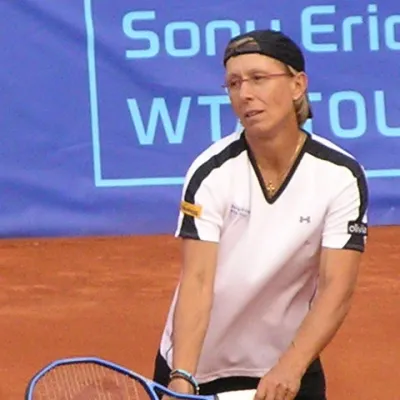
Martina Navratilova
Human Design Chart
Biography
In the summer of 1972 she won the Czech National Championship. She made her first visit to the U.S. on 22 March 1973. Two years later she was ready to defect from her homeland, on 5 September 1975. Her first Wimbledon win was in July 1978, the year she became the World No. 1 player.
Navratilova became a U.S. citizen on 20 July 1981. Early in 1982, she suffered from toxoplasmosis.
Born into a tennis-oriented family, she had the models of her grandmother, step-dad and mom as champions or administrators in the game. Spending her childhood in the Krkonose Mountains, she learned to ski as soon as she could walk. When she was five, the family moved to Prague, where she watched her folks play tournaments. She became obsessed with batting a ball against the wall for practice. At eight, she signed to play her first tournament. Off the court, she swam, skied, and played soccer and ice hockey, but nothing interfered with her love of tennis.
At 14, she captured her first title, and in 1973, she began her first tour on the circuit. Visiting the U.S., she fell in love with junk food and gained 20 lbs: 5' 8" and over 150 lbs, she failed to win any of the matches. By the following year, she was winning most of them.
In 1977, she was sharing a house in Dallas, Texas with Sandra Haynie, the pro golfer. From 1979-1981, writer Rita Mae Brown was her companion until Navratilova began an affair with basketball star Nancy Lieberman. In March 1984, she began a relationship with Judy Nelson, signing a non-marital cohabitation contract on 12 February 1986. Navratilova left Nelson for Olympic skier Cindy Nelson, separating on 3 February 1991.
Martina Navratilova as a Manifestor 5/1 in Human Design
Manifestor 5/1 — Design at a Glance
Martina Navratilova has shown herself to be a pioneer with the ability to move others and lead them in new directions. Her design portrays her as someone who actively shapes the world, much like an emperor in ancient Rome, having visions but not leading every battle themselves. This role brings with it a specific dynamic: she often thinks ahead of her surroundings, which leads to both strong admiration and vehement rejection. This polarization effect is a central aspect of her nature; her big dreams encounter resistance from those who do not want or cannot follow along, while others enthusiastically join in.
The key mechanism for Martina Navratilova lies in the strategy of informing. For the right people to find and support her, she must communicate clearly what she intends. Without this prior information, friction and resistance arise. If she follows this strategy and heeds her inner signals, she experiences a deep sense of peace. Living against this principle is felt through persistent anger. Her design is therefore geared towards gaining followership through clear communication so that her visions can be realized without getting entangled in constant conflicts.
Emotional Authority
Martina Navratilova demonstrated a decision-making process that did not rely on immediate clarity but crystallized over the course of hours or days. Her design suggested she was subject to emotional waves: her perception was permanently colored by her current mood. What seemed absolutely right at one moment could appear negative in the next, as feelings were merely snapshots and not yet the deeper truth.
This mechanism is determined by Emotional Authority, which is always active when the Solar Plexus Center is defined – regardless of other definitions in the chart. This authority takes precedence over all other inner voices. As quick, spontaneous decisions often led to negative consequences from an emotional peak, her path required patience. She had to learn to sleep on important steps and give herself time for decision maturation. Only when intense feelings subsided and emotional distance was gained did calmness set in. This process of delay was not a hindrance but the essential mechanism for gaining clarity for long-term life decisions.
The 5/1 Profile — Heretic / Investigator
Martina Navratilova demonstrated someone who used deep knowledge to provide others with concrete solutions. Her design indicated a tendency to build her own competencies through intensive research, which then magnetically attracted people seeking advice. This Profile 5/1 combines Line 1's need for thorough appropriation of information for herself and Line 5's use of this knowledge base externally to solve other people's problems.
This dynamic created a specific challenge: others often sought answers from her, which without clear boundaries could lead to exhaustion. Like an expert who answers questions day after day and ends up overwhelmed, she had to learn to say no. Only in this way could she maintain the balance between private research and public assistance.
Her flexibility (Line 5) enabled her to adapt effortlessly to changes and resist conformity. At the same time, her expression style (Line 1) emphasized the quality of stimulation. She needed feedback to test whether her ideas were effective and avoided using valuable impulses for trivial purposes. Through this combination of deep reflection and practice-oriented dissemination, she could optimally utilize her gifts without sacrificing herself.
Single Definition — Defined & Open Centers
Martina Navratilova's design laid a tendency towards constant mental pressure and intense intellectual processing. Her defined Head and Ajna Centers generated a perpetual internal drive to question, form concepts, and understand connections. This state was not a choice but a mechanical given: her mind worked continuously, often appearing as inspiration but also leading to mental worry when ideas were not always immediately actionable. The connection to the defined Throat Center allowed her to translate these thoughts and concepts directly into communication and action. She spoke from the mind, making her voice a reliable yet limited source of expression.
At the same time, Martina Navratilova showed through her open centers as someone heavily dependent on external conditions and relationships. Her open G Center meant she did not have a fixed, unchanging identity or life direction. Instead, she tended to reflect in various environments and sought the right place and people to find temporary clarity about her "self." She was prone to questioning whether she was at the wrong place or finding the right love when the environment did not match.
Her open Heart Center left her without constant willpower to assert ego claims. She tended to want to prove her worth through performance or promises, which could lead into a cycle of self-doubt if these were not met. Additionally, her open Sacral Center was responsible for unstable energy; she had no consistent reserve of generative power and needed to learn when enough was enough to avoid exhaustion. Her open Spleen Center made her sensitive to health signals and fears in the environment, while the open Root Center led her to absorb external stress and often felt pressure to release it through activity. This combination of defined mental clarity and open energetic and identity-related centers shaped a life in the tension field between inner knowing and outer adaptation.
Channels for mental images, seeking curiosity and emotional openness.
Martina Navratilova's design shows a tendency towards narrative sense-making: She combines mental abstraction with the art of storytelling to make complex experiences tangible for others. This dynamic was shaped by Channel 64-47, which connects the Head Center with the Ajna Center. This channel filters every life experience through a kaleidoscope of mental images, always searching for an underlying story or perspective. The challenge lies in the initial confusion; however, the reward is the sudden "aha" moment when clarity emerges from chaos and can be shared.
This internal processing directly flows into Channel 11-56, which connects the Ajna Center with the Throat Center. Here, the abstract idea becomes spoken story. This channel drives an insatiable seeker who does not chase final truths but rather new inspirations and perspectives. Communication here serves less to convey facts than to share life parables: "Look what I've discovered." These stories are meant to stimulate the listener's imagination and give them a chance to test new beliefs for their usefulness in their own lives.
The emotional quality of this expression was modulated by Channel 22-12, which connects the Solar Plexus Center with the Throat Center. This channel depends on an emotional wave; its effect only unfolds during moments of harmonious mood and right timing. When emotional energy flows, the voice can deeply touch others and inspire change; without this inner readiness, social interaction remains ineffective or even off-putting.
Additionally, Gates like 32 (Continuity), 42 (Completion), and 60 (Acceptance of Limitations) worked as underlying themes, while Gate 8 (Contribution) and Gate 16 (Experimenting in the Collective) influenced the nature of engagement.
Collective Circuitry — Circuit Signature
Martina Navratilova showed herself to be shaped by a design that combines emotional authenticity with the ability to transport inner states outwardly. Her simple definition means that all defined centers—Head, Ajna, Solar Plexus, and Throat center—are energetically directly connected. This created a continuous flow of thoughts over emotions to expression.
In the Knowledge Circuit, Channel “Openness” activates the connection between Throat and Solar Plexus Centers. Here it was about the pulsating, acoustic expression of one’s individuality. Martina Navratilova could translate emotional waves directly into words, making her unique identity audible. This supported transformation through authentic communication.
Parallel to this, the Meaning Circuit worked. Channels “Abstraction” and “Curiosity” connected Head, Ajna, and Throat centers. This configuration focused on reflecting past experiences to understand their meaning. The energy flowed cyclically: from the initial idea in the Head Center through emotional processing in the Ajna Center to visual or verbal sharing with the collective.
Since all centers belong to a group, there were no separate parts. Instead, logical future visions (Head/Ajna) and emotional past resolution (Solar Plexus) worked together. Martina Navratilova used this integrated flow not only to deepen her own understanding but also to make these insights accessible to others. The combination of creative inspiration and the ability to abstractly represent emotions shaped her way of transforming knowledge and bringing it into the world.
Left Angle Cross of Limitation 2
Martina Navratilova's design revealed a tendency towards clear, often painful boundary-setting. She emerged as someone who creates clarity by delineating boundaries and exclusions rather than through harmony or compromise. This configuration describes the mechanics of the left cross of limitation 2: It is about defining what *is not*, in order to make space for the essential.
In Human Design, this means that Martina Navratilova often preserved her own integrity by saying no and separating herself from others. She learned that true connection only arises when one is willing to decisively exclude the false or unwanted. This was not an act of rejection for its own sake but a necessary process of self-definition. By cutting ties or ideas that no longer resonated, she created space for authenticity.
Her design challenged her to accept these boundaries and see them not as loss but as liberation. The energy of this cross acts like a scalpel: precise, sometimes cold in appearance, yet healing in its outcome. Martina Navratilova used this power to free herself from expectations or situations that constrained her essence. Thus, limitation became the tool of her freedom and inner growth.
Saturn Return · Uranus Opposition · Chiron Return · 2nd Saturn Return — Life Cycles
Martina Navratilova's life rhythm was characterized by clear cycles of condensation. Her design suggested that she complemented periods of intense performance with moments of structural review in which internal convictions were strengthened. This was reflected in 1984: At the age of 28, her longest winning streak in tennis ended after 74 victories. For her design, this marked the first Saturn return – a life stage where years of hard work and external success are tested for lasting foundation. Instead of mere defeat, it was a necessary crisis of consolidation that stabilized her inner structure.
Later, another cycle became active: The Chiron return between 49 and 51 years old. In Human Design mechanics, this is not a process of healing past wounds but a phase of fulfillment in which one's incarnation cross unfolds and purpose becomes experiential. Martina Navratilova did not retreat during this period of bloom but continued her engagement. At the age of 49 in 2005, she participated further in doubles and mixed competitions. This action underscores the mechanics of the Chiron return: The confirmation of one's purpose through active doing when life enters its mature phase of self-realization. Both events illustrate how her design cycles shaped concrete life stations – from structural review to goal-oriented unfolding.
Manifestor · Emotional Authority — Synthesis
A central red thread runs through the design: the dynamic connection between inner perception and external expression. Emotional authority requires a maturing wave, while the defined Head Center generates constant inspiration and questions – an ongoing cycle of feeling and thinking. This internal processing feeds curiosity (Channels/Gates), which compels sharing insights, reinforced by the Profile as Hero/Researcher (Profile Role). The Knowledge Circuit underscores this ability to transform knowledge and initiate change, evident in her readiness to learn new things and pass them on.
The design harbors a paradox between being a trailblazer as a Manifestor and the internal processes conditioned by emotional authority. While the type is destined to lead and pursue visions, the emotional center requires time for decision-making – a tension between impulsive initiative and the need for emotional clarity. This reflects in the cycles: A documented event shows crisis potential (Saturn return) alongside sustained career activity (Chiron return), indicating the overcoming of internal resistance while pushing forward personal goals.
3 Defined Channels
Incarnation Cross - Left Angle Cross of Limitation 2
Solar Return
The Solar Return shows the moment when the sun returns to its exact birth position - your personal solar year.
Life Cycles
Discover the life cycles with a detailed triple view (birth chart, cycle chart, composite).
Human Design Profile
- Type
- Manifestor
- Strategy
- To inform others before acting
- Authority
- Emotional Authority
- Profile
- 5/1 - Heretic / Investigator
- Definition
- Single Definition
- Incarnation Cross
- Left Angle Cross of Limitation 2
- Date of Birth
- 18.10.1956 16:40
- Place of Birth
- Prague, Czech Republic
Frequently Asked Questions
What is Martina Navratilova's Human Design type?
Which Profiles does Martina Navratilova have?
What Authority does Martina Navratilova have?
What incarnation cross is active for Martina Navratilova?
When was Martina Navratilova born?
Discover your own Human Design
Are you also a Manifestor? Find out in a personal reading how to use your initiation power peacefully and dissolve resistance.
More Personalities
Back to overviewChristian-Jaque

Kesha

Laurent-Eynac
Lucebert
Masaccio

Papus