
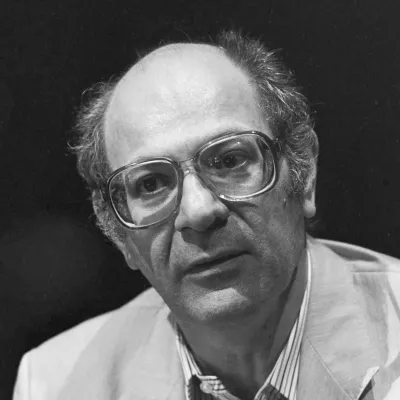
Mauricio Kagel
Human Design Chart
Biography
Mauricio Kagel — Projector with Profile 4/6
Projector 4/6 — Design at a Glance
Mauricio Kagel's design tended towards focused perception. As a projector, he did not have a constant, intrinsic energy source like the defined Sacral Center of other types. Instead, his aura projected similar to a bright flashlight directly onto weaknesses in his environment. This dense projection allowed him to immediately recognize systematic errors or inconsistencies in others.
However, this ability carried a risk: Direct criticism could be perceived as unpleasant, comparable to light shining directly into someone's face. Therefore, the optimal strategy for his design was not active intervention but waiting for an honest and appreciative invitation from his surroundings. Through this recognition, his specific expertise was legitimized and utilized.
Since his energy level fluctuated – with phases of high productivity followed by necessary rest periods – living according to this design required respect for these rhythms to avoid exhaustion. When this strategy of invitation was followed, it led to success and recognition. If Mauricio Kagel ignored this principle or tried to act without the consent of others, it often resulted in the typical projector experience: bitterness. His design thus shaped a lifestyle that relied on targeted leadership and external validation rather than independent, continuous energy production.
Splenic Authority
Mauricio Kagel's design tended towards immediate, instinctive orientation. His inner authority lay in the Spleen Center – a defined center for survival intelligence. This configuration required open emotional and sacral centers, which classified him as either projectors or manifestors. The Spleen Center served as a fine alarm system; it provided spontaneous internal knowledge about whether a situation was healthy or harmful. For Mauricio Kagel, this meant that decisions were not made through prolonged deliberation but in the immediate moment. The first impulse was considered the right path for self-care and boundary-setting against negative influences.
This spleen voice, however, was subtle and came only once per moment. It could easily be drowned out by other voices, requiring high vigilance. Often a brief retreat helped to clearly hear this fine impulse. Since knowledge always arose in the present, long-term plans were difficult to maintain; they changed short-term with new impulses. Mauricio Kagel therefore needed much freedom and flexibility rather than being set in his ways. His way of living was characterized by spontaneity: he acted according to current feelings of well-being or danger, not pre-established strategies. This mechanism shaped the way he moved through the world – always reactive to the immediate environment, protected by the intuitive ability to recognize and implement the right thing instantly.
The 4/6 Profile — Opportunist / Role Model
Mauricio Kagel's design tended towards experimental behavior that evolved into a role of wise orientation with increasing age. In his first thirty years, his Profile 4/6 still resembled a pure Fourer profile: he actively sought opportunities and tested various connections. This phase was marked by opportunism and an unpredictable fixation that only subsided when favorable circumstances for change arose. His behavior followed the strategy of waiting for the right moment rather than rigidly adhering to old patterns.
Once the sixth line became active, an internal conflict emerged: between a deep need for belonging and community on one hand, and the desire for detached reflection about the meaning of life on the other. This tension between heart and head shaped his development into a role model. Through experience, he learned to say no and consciously take on commitments that aligned with his integrity. By age fifty, this process culminated in a form of wisdom where he not only gained personal insights but also served as a teacher for others. His ability to clearly recognize the essence of his environment enabled him to smooth the path for others through cooperation and clear projection of the future, stabilizing social structures.
Triple Split Definition — Defined & Open Centers
Mauricio Kagel's Human Design profile indicated a tendency towards consequent, self-determined expression strength. His defined Heart Center provided him with a constant source of willpower and ego strength; he had the energy to keep promises and assert his own direction. This inner drive flowed directly into his also defined Throat Center, which served as a pivot point for communication. What he said or did was in line with a reliable truth stemming from his will – not a fleeting impulse but a deliberate intention.
His mental foundation was marked by the defined Ajna Center: He possessed a stable, independent form of conceptual thinking. Concepts arose in him not randomly but followed a consistent inner logic. This mental clarity combined with the defined G Center, which gave him a firm sense of identity and direction. He knew who he was and could carry this self-assurance outward without needing the energy of others.
However, his design also revealed specific vulnerabilities. His open Sacral Center meant that he did not have a constant supply of generative life force energy. He tended to absorb the vital energy of his environment and amplify it, making him vulnerable to exhaustion if he did not carefully manage his boundaries. The open Solar Plexus Center further made him act like an emotional barometer; he absorbed the emotional climate around him, which could lead to personalizing emotions that belonged to others. Additionally, his Head Center was open, making him receptive to inspiration but lacking a constant inner pressure to answer questions – instead risking getting lost in the confusion of others if he did not trust his inner authority.
Channels for mental order, spiritual breakthrough and life's meaning.
Mauricio Kagel showed himself as someone whose mind was inclined to organize complex details into logical structures. This inclination came from Channel Accepting 17-62, which connected Ajna Center with Throat Center. Gate 17 visualized patterns while Gate 62 translated them linguistically; thus he organized information mentally and communicated opinions only when listeners were ready.
At the same time, Channel Initiation 51-25 propelled him. It linked Heart Center through the competitive shock of Gate 51 with the universal love of Gate 25. This fostered a natural competitiveness aimed at unfolding individual potentials and encouraging others to expand their limits – but only upon invitation.
Furthermore, he sought meaning in resistance via Channel Life Struggle 38-28. The connection between Root Center (Gate 38) and Spleen Center (Gate 28) gave him the determination to fight for his integrity and intuitively recognize the value of certain confrontations.
His design also included Gate 10 in G Center, which promoted complex integration and genetically determined behavioral rules, as well as Gate 15, emphasizing collective behavior and adaptation to natural rhythms. Gate 46 in Throat Center underscored dedication to the process and care for the body as a temple.
In his personality, Gates 12 (restraint, poetry), 11 (visual memory, analysis) and 60 (acceptance of limitations for transcendence) were at work. Gate 4 helped formulate logical formulas for the future while Gate 18 discriminated between necessary corrections.
In his design, Gates 21 (control over material things), 47 (meaning from past), and 7 (leader personality) shaped his structure. Gate 54 connected worldly success with mystical insight, and Gate 40 expected recognition as reward for willpower and work.
Individual Circuitry — Circuit Signature
Mauricio Kagel's Human Design profile indicated a tendency towards separate, parallel energetic fields. As a Triple Defined individual, he had three independent power centers that did not merge with each other. This marked him as someone who carried different aspects of his being side by side without them automatically forming a common flow.
The Knowledge Circuit connected Spleen and Root Centers via the Life Struggle Channel (Gates 28–38). This generated a pulsating energy of individual identity based on instinct and survival pressure, yet operating isolated from other areas.
Parallel to this, the Centering Circuit linked Identity with Heart Center through the Initiation Channel (Gates 25–51). Here a fortified, courageous personality emerged with strong inner convictions and self-worth. Since Throat Center was missing, these firm stances often remained unspoken or hard to verbalize but strongly influenced his individuality.
A third separate field formed by the Understanding Circuit, which linked Ajna and Throat Centers via the Accepting Channel (Gates 17–62). This allowed sharing logical, rational insights free from emotional coloring, focused on future-oriented structure. These three groups – instinct/survival, inner confirmation, and rational communication – existed in Mauricio Kagel as independent, not directly connected systems that each brought their specific quality into his life without disturbing or unifying one another.
Right Angle Cross of the Vessel of Love 4
Mauricio Kagels Human Design indicates a tendency towards deep, often painful dedication to interpersonal bonds. He was someone who sought not just emotional closeness in relationships but experienced this connection as the central purpose of life, accompanied by the risk of injury or disappointment. This configuration corresponds to the right cross of the Love Vessel 4. In Human Design mechanics, this pattern describes a specific kind of emotional investment: The person seeks a connection that feels healing and transformative, yet must learn that intense love often comes with suffering or sacrifice. It is a process of learning through experiencing loss or pain in partnership to gain deeper wisdom about the nature of human bonds. For Mauricio Kagel, this dynamic shaped his emotional landscape; he lived the tension between the desire for absolute union and the inevitable vulnerability that accompanies it. His chart indicated that his path through relationships was not free from conflicts but that these challenges were necessary to advance his inner development. The mechanics of this cross demand no superficial harmony but an authentic encounter with the weight of coexistence, which profoundly shaped Mauricio Kagels emotional resonance.
Saturn Return · Uranus Opposition · Chiron Return · 2nd Saturn Return — Life Cycles
Mauricio Kagels Human Design indicates a tendency towards structural condensation followed by radical renewal later on. This dynamic was evident in 1960 when he was 29 years old and his work *Anagrama* premiered. For his chart, this marked the first Saturn Return: a cycle where years of groundwork often culminate in a solid result that strengthens ones life structure.
A decade later, another force came into play. In 1971 at age 40, *Staatstheater* was premiered at the Hamburg State Opera. This coincided with his Uranus Opposition. In Human Design, this configuration marks a turning point where established patterns are questioned and replaced by new, often unconventional perspectives. Kagel did not use this energetic push for mere repetition but for deep transformation of his artistic expression.
The sequence of these two planetary cycles – first stabilization through Saturn, then disruptive innovation through Uranus – shapes his design as someone who builds foundations to later consciously deconstruct them. It was not arbitrary shifts but the natural consequence of his inner mechanics: First find form, then break its boundaries. This sequence illustrates how his chart guided him to respect established structures before transcending them.
Projector · Splenic Authority — Synthesis
Mauricio Kagel primarily lived through observing and understanding systems in order to transform them innovatively. His Projector design combined with a defined mental center (Ajna) and the Channel of Acceptance (17/62), indicates an acute ability to recognize patterns and organize information precisely – an internal process that allowed him to view the world through a unique lens. This analytical strength was reinforced by Spleen Authority, providing instinctive knowledge about how things work and guiding his decisions. The Profile as Networker/Role Model (4/6) suggests he sought deep connections while maintaining a detached perspective to reflect on the meaning of life.
A central tension in his design lay between the need for belonging (Line 4) and the search for individual truth (Line 6). He was geared towards making connections and acting within systems, yet an inner call urged him to think beyond conventions and chart new paths. This dynamic manifested in documented events where he both utilized established structures (*Staatstheater* premiere) and developed radically new forms of expression (*Anagrama* work). The Knowledge Circuit reinforced this drive for individuality and transformation.
3 Defined Channels
Incarnation Cross - Right Angle Cross of the Vessel of Love 4
Solar Return
The Solar Return shows the moment when the sun returns to its exact birth position - your personal solar year.
Life Cycles
Discover the life cycles with a detailed triple view (birth chart, cycle chart, composite).
Human Design Profile
- Type
- Projector
- Strategy
- Wait for the respectful invitation
- Authority
- Splenic Authority
- Profile
- 4/6 - Opportunist / Role Model
- Definition
- Triple Split
- Incarnation Cross
- Right Angle Cross of the Vessel of Love 4
- Date of Birth
- 24.12.1931 05:20
- Place of Birth
- Buenos Aires, Argentina
Frequently Asked Questions
What Human Design type did Mauricio Kagel have?
Which Profile did Mauricio Kagel have in Human Design?
What Authority guided Mauricio Kagel?
What incarnation cross did Mauricio Kagel have?
When was Mauricio Kagel born?
Discover your own Human Design
Are you also a Projector? Find out in a personal reading how to unfold your leadership qualities and recognize the right invitations.
More Personalities
Back to overviewSissy Spacek

Aaliyah

Alain-Fournier

Alexia

Alizée

Anémone
