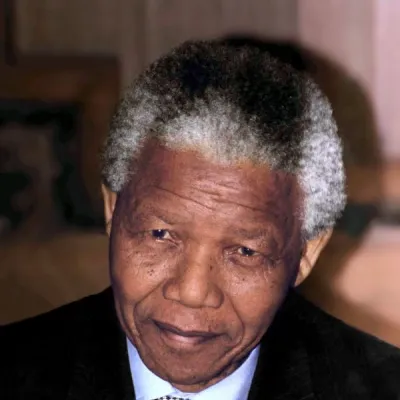
Nelson Mandela
Human Design Chart
Biography
Nelson Mandela — Projector with Profile 5/1
Projector 5/1 — Design at a Glance
Nelson Mandela was someone who could immediately recognize system flaws with sharp clarity. His Projector design gave him an aura that shone like a bright flashlight, illuminating areas where others were still in the dark. This ability to identify errors instantly could be uncomfortable for his surroundings when he addressed these flaws directly – much like shining a bright light into someone's face.
His optimal strategy was not to approach with unsolicited criticism but rather to attract through his own harmony. When he lived harmoniously, others were drawn to him and sought advice on his invitation. This waiting for valued invitations was crucial because Projectors do not have a defined Sacral Center and thus lack constant intrinsic life energy. They needed periods of rest to prevent burnout, which contrasted with the demands of school systems or many jobs.
If Nelson Mandela lived according to this design, he was rewarded with success. If he deviated from it and ignored the need for invitations and recovery, his non-self theme of bitterness would eventually surface. His path was marked by this balance between sharp recognition of errors and necessary restraint to act through radiation rather than confrontation.
Splenic Authority
Nelson Mandela's design inclined him towards immediate intuitive decision-making. His inner authority lay in a defined Spleen Center, an area that functions as the body’s health and alarm system. This configuration gave him spontaneous survival knowledge: A first impulse signaled immediately whether a situation or environment was beneficial or harmful. With his open Emotional and Sacral Centers – prerequisites for this authority among Projectors or Manifestors – he had to learn not to overlook these fine, singular signals.
The mechanics of Spleen Authority require high vigilance. The correct impulse appears only in the present moment; prolonged thinking or waiting for confirmation from others would drown it out. Thus, Nelson Mandela was someone who made decisions in the moment to preserve his integrity and health. This required strict boundaries against harmful influences and often retreats to clarify the next step. Since what is right becomes known here and now, long-term commitments were counterproductive. Flexibility rather than rigid plans characterized his strategic approach. He avoided unnecessary binding because the optimal course of action could change in the short term. His design challenged him to follow the first inner urge as a reliable indicator of well-being instead of prioritizing external expectations or logical reasoning.
The 5/1 Profile — Heretic / Investigator
Nelson Mandela presented himself through a magnetic presence based on deep, background-earned knowledge. As Profile 5/1, the Hero and Researcher, his design meant that people came to him seeking solutions for their problems. This attraction was no coincidence but an inherent trait of Line 5: It made his inner treasure trove of knowledge visible and drew those who sought answers.
The mechanics of this profile describe a specific tension field. While Line 1 stood for the intense, often isolated research process in the 'darkness,' where details were penetrated to absolute clarity, Line 5 demanded applying this knowledge in public space. Mandela showed himself as someone ready to provide practical problem-solving during crises. Yet, this configuration carried an inherent risk: Without clear boundaries, exhaustion loomed as demand for his insights could exceed his capacity.
The challenge lay in learning to say 'no' to maintain a balance between private depth (Line 1) and public responsibility (Line 5). Only through this demarcation could he preserve the beneficial synthesis of research and application. His presence was characterized by providing orderly details while simultaneously protecting his own energy from overload. This defined how he not only possessed knowledge but used it purposefully and protectedly.
Split Definition — Defined & Open Centers
Nelson Mandela's Human Design profile was characterized by a firm internal structure based on mental clarity and a stable identity. His Head Center and Ajna Center were defined, creating an ongoing inner pressure to question and understand connections. This mental process served as the source of inspiration but did not act as a direct driver for implementation. Instead, his defined Throat Center acted as a channel to bring these conceptual insights into the world, while his defined G Center provided a reliable self-identity and direction. Additionally, his defined Spleen Center gave him spontaneous, intuitive body awareness to make health-promoting decisions in the moment.
This stable internal architecture contrasted with his open energy and stress centers. His open Heart, Sacral, Solar Plexus, and Root Centers meant that he did not have a constant personal willpower, generative life force, or emotional stability. Instead, he absorbed corresponding energies from his environment and amplified them. This made him vulnerable to conditioning: He tended to question whether he was doing enough to prove his worth (open Heart), or unconsciously took on the adrenergic pressure of others, which could lead to exhaustion (open Root and Sacral). Also, he often absorbed the emotional field of his environment as his own experience (open Solar Plexus). The challenge lay in not interpreting this absorbed pressure as a personal lack but using his own strategy and authority to remain aligned with the variable energy environment.
Channels for logical leadership, intuitive experiments and inner clarity.
Nelson Mandela emerged as a leader who exercised his authority not through coercion, but through shared responsibility and logical integration into society. His design inclined towards collective leadership based on invitation. This was marked by Animal 7-31: Gate 7 provided the logical role of self, while Gate 31 acted as a collective leader. This connection required Mandela to first gain trust and be elected by the majority to demonstrate his leadership competence. It was less about absolute power than influence from a position that understood existing patterns and trends.
Parallel to this, his talent developed through consistent practice. The wavelength 48-16 connected Gate 48 of inner depth with Gate 16 of dexterity. Here it showed that mastery was no accident but the result of ninety-nine percent work and one percent inspiration. Mandela perfected his skills through repeated experimentation, where the intuitive intelligence of the Spleen Center merged with technical proficiency in the Throat Center. This talent required recognition and resources to continue flourishing, underscoring the relationship between master and apprentice.
Furthermore, he was marked by a mutative form of thinking. Awareness 61-24 connected Gate 61 of secrets with Gate 24 of rationalizing. This enabled spontaneous insights and Satori moments that broke old cycles. His mind did not seek discoveries in the traditional sense but waited for the moment when knowledge simply happened. This individual awareness allowed him to inspire new perspectives without needing to control thought. Additionally, gates like Gate 3 (Mutation), Gate 50 (Tradition), and Gate 62 (Logic/Details) contributed to the ability to transform confusion into order and recognize patterns precisely.
Collective Circuitry — Circuit Signature
Nelson Mandela was someone who combined innovative flashes of insight with structured strategy. His design presented a split definition in two parallel strands. The first strand encompassed the Knowledge Circuit. Here, Channel 24-61 ("Awareness") connected the Head Center to the Ajna Center. This connection promoted creative, often sudden ideas and the ability to recognize new paths. It was a pulsating energy aimed at individual creativity and emotional transformation.
Parallel to this, the Understanding Circuit operated as an independent block. It linked the Throat Center, Identity Center, and Spleen Center through two channels: 16-48 ("The Wavelength") and 31-7 ("The Animal"). This area stood for logical ratio, strategic thinking, and the ability to focus on sharing insights. As Solar Plexus energy was absent here, it represented an emotionless, future-oriented analysis.
Crucial was the separation of these systems: Creative impulses from Head and Ajna were not directly connected with the logical structuring in Throat, Identity, and Spleen. Nelson Mandela utilized these separate forces side by side. On one hand, he could generate new, transformative concepts and on the other, bring them into the world through clear communication and strategic planning. This duality allowed him to act both visionary and pragmatic without emotional creativity overshadowing rational strategy or vice versa.
Left Angle Cross of Obscuration 1
Nelson Mandela exhibited a fundamental approach of strategic restraint, where essential truths or intentions were not immediately revealed. His design inclined towards preserving information and energy until the right moment arrived. It was less about active foreground action than maintaining a stance of waiting and hiding, which acted as a strategic or protective instinct.
This dynamic arose from the energetic pattern of the "left cross of concealment 1". This structure defined an inner orientation toward the theme of concealing or making essential matters invisible. The mechanics here did not describe permanent secrecy but rather a rhythmic process: the visible was consciously held back to be released later with greater impact. For Nelson Mandela, this meant that he often found himself in a position of observation and internal gathering instead of immediate action. Energy was not scattered but concentrated and protected.
This configuration promoted a lifestyle that valued patience and timing over immediate transparency. The "concealing" was not an act of deception in a negative sense, but rather a means to preserve strength and clarity until the decisive moment. The structure supported him in safeguarding the essential from premature exposure so that it could only become effective when external conditions were ripe. Thus, an inner stability emerged based on the ability to vigilantly guard the invisible.
Saturn Return · Uranus Opposition · Chiron Return · 2nd Saturn Return — Life Cycles
Nelson Mandela's Human Design profile was marked by three distinct phases of life, each characterized by specific astrological cycles within the Human Design system. This structure indicated a development in which inner alignment and external circumstances were closely intertwined.
At age 26, his first Saturn Return occurred. This cycle often marks the transition to full responsibility for one's own life. In 1944, Nelson Mandela became involved with the African National Congress (ANC). This engagement was a concrete manifestation of this phase, where long-term commitments and solidifying one’s position in society were central.
At age 38, his Uranus Opposition followed. This point marks a profound upheaval period, questioning existing structures and often leading to radical changes. In 1956, Nelson Mandela, along with 155 other activists, was charged with high treason for alleged acts of sabotage against the state. This legal crisis reflected the disruptive power of this cycle, breaking old bonds and forcing new paths.
Around his 46th year, his Chiron Return is a fulfillment cycle in which one's personal purpose increasingly unfolds if one follows their own strategy. In 1964, he was sentenced to life imprisonment for sabotage and planning guerrilla warfare. This pivotal moment was part of this cycle, not as a healing of old wounds but as a phase where the full sharpness and significance of his incarnation task comes into focus in life.
Projector · Splenic Authority — Synthesis
He was a Projector whose defined connection between Head and Ajna Centers (mental pressure) made him a constant source of questions and inspiration. This ability to recognize and address the unclear (Gate 7/31 – Alpha Animal) shaped his work; he saw patterns and problems that others missed, offering solutions. His Profile as Hero/Researcher (5/1) amplified this impulse, as he gathered knowledge to make it available to others, with Line 5 exerting a magnetic attraction on Seekers. This led him repeatedly into the role of Guide and Problem Solver – a pattern reinforced by his Spleen Authority, which gave him instinctive knowledge about the correctness of decisions.
A central paradox lay in the tension between his projecting nature and his need for recognition of his solutions. As a Projector, he could point out weaknesses, but direct mention often met with resistance. At the same time, his Line 5 drew him to offer his knowledge, making him vulnerable to overextension (as illustrated by the Nobel laureate in the Profile example). The documented crisis events – indictment for treason and sentencing to life imprisonment – manifested as consequences of this tension: the necessity to share knowledge clashed with circumstances that made direct address impossible.
3 Defined Channels
Incarnation Cross - Left Angle Cross of Obscuration 1
Solar Return
The Solar Return shows the moment when the sun returns to its exact birth position - your personal solar year.
Life Cycles
Discover the life cycles with a detailed triple view (birth chart, cycle chart, composite).
Human Design Profile
- Type
- Projector
- Strategy
- Wait for the respectful invitation
- Authority
- Splenic Authority
- Profile
- 5/1 - Heretic / Investigator
- Definition
- Split Definition
- Incarnation Cross
- Left Angle Cross of Obscuration 1
- Date of Birth
- 18.07.1918 14:54
- Place of Birth
- Mvezo, South Africa
Frequently Asked Questions
What is Nelson Mandela's Human Design type?
What Profile did Nelson Mandela have in Human Design?
What Authority did Nelson Mandela have in Human Design?
What incarnation cross did Nelson Mandela have in Human Design?
When was Nelson Mandela born?
Discover your own Human Design
Are you also a Projector? Find out in a personal reading how to unfold your leadership qualities and recognize the right invitations.
More Personalities
Back to overviewSissy Spacek
Alain-Fournier
Anémone
Ann-Margret

Bourvil
Hergé