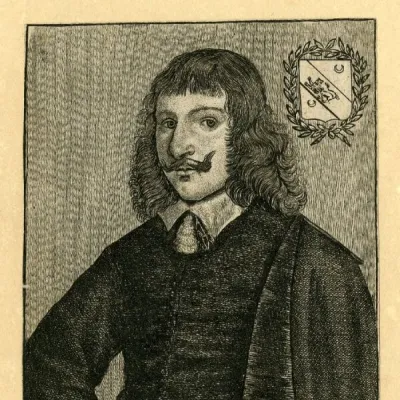
Photo: Wikimedia Commons
Nicholas Culpeper
Human Design Chart
Biography
Culpeper was the son of a titled father who owned castles and manor houses in Kent and Sussex, as the family rose to high social position during the reign of King John in the 12th century. Nicholas was named after his dad, a Reverend minister who died 13 days before the birth of his son.
Their manor house went into other hands and his mom moved with him to the village of Isfield, where her father, the Reverend William Attersole, presided over a Puritan congregation. An erudite man, Attersole was noted for his commentary on the Biblical Book of Numbers. It was he who raised the boy, recognizing his natural abilities and providing a good education. Nicholas was an apt student and applied himself, being particularly well versed in Latin and Greek. He began his astrological studies at age ten. A brilliant scholar in the humanities, he was also a scathing critic and a hot-headed revolutionary. He was a strong and loyal ally but a dangerous adversary, altruistic to those in need but reckless in slandering those with whom he disagreed. Entering Cambridge at 18, he distinguished himself in the Classics but with reckless extravagance, squandered his inheritance.
He fell in love with a beautiful heiress and they planned to elope. On the night of their rendezvous, there was a severe thunderstorm and while driving to their meeting place, his lover's coach was struck by lightning and she died instantly. Grief-stricken and incoherent, Culpeper withdrew for several months to his mother's cottage in Isfield with a nervous breakdown. Emerging from the trauma a changed man, he changed his life's direction. He refused to return to Cambridge and resumed to enter the ministry as he had planned.
What does Projector 6/2 mean for Nicholas Culpeper?
Projector 6/2 — Design at a Glance
Nicholas Culpeper revealed himself as someone who immediately recognized weaknesses in systems. His design as a Projector endowed him with a dense, focused aura, comparable to a bright flashlight that was directed specifically at dark spots in the surroundings of others. This ability to identify errors in systems instantly was his natural drive.
However, this intensity required tact. When he expressed his observations directly and unexpectedly, it often felt like a harsh light in the face to others, provoking rejection. The more effective strategy was to attract others through his own harmonious actions, so that they would seek his advice of their own accord. His design called for waiting for an honest, appreciative invitation before sharing his knowledge.
Since his Sacral Center was undefined, he did not have a constant, intrinsic energy source. Instead, he went through phases of high productivity, followed by mandatory rest phases for recovery. This up-and-down rhythm was in conflict with societal structures that demanded continuous performance. Living according to this rhythm and his invitation strategy brought him success. Ignoring this necessity eventually led to bitterness, his specific non-self theme. His path was to bring "light into the dark" for others, but only when he was asked to do so.
Emotional Authority
Nicholas Culpeper showed himself as someone who did not make decisions based on initial, strong impulses, but rather consciously let them rest. His design was characterized by the emotional authority located in the defined Solar Plexus Center. This center was subject to a constant wave of ups and downs, coloring his perception of the world through the current mood. What appeared inspiring in one moment could be perceived as negative in the next. Since this initial emotional impression did not necessarily represent the truth, spontaneous reactions were often misleading and could have negative consequences.
The mechanics of his inner authority required patience and time. Nicholas Culpeper had to allow himself to rethink decisions multiple times and let them "ripen overnight." Only when the intense feelings subsided and emotional distance was gained did the necessary clarity and calmness set in. This process was especially crucial for long-term, life-defining steps. The emotional authority always took precedence over other defined centers in his graph; it was the sole instance for direction-finding. By consciously delaying and waiting out the emotional wave, he was able to gain deeper insights instead of being led by fleeting moods.
The 6/2 Profile — Role Model / Hermit
Nicholas Culpeper's Design is characterized by a clear biphasic development, determined by the Profile 6/2. In his youth, the energy of Line 3 was active, driving him to experiment. He actively sought out his own life experiences, with trial and error being the driving principle. Mistakes served not as an endpoint but as necessary steps, followed by a strategic retreat for analysis.
After the age of 30, with the activation of Line 6, his fundamental attitude changed fundamentally. Nicholas Culpeper increasingly withdrew into a phase of distance and deep introspection. This retreat served the purpose of healing and synthesizing earlier experiences. The themes of Line 6 – impermanence, transformation, and acceptance of change – characterized this period. He developed calmness towards change and learned to maintain inner peace even in times of great uncertainty.
At the same time, Gate 56 was active, representing connection and genius. This energy radiated inspiration, even though the appropriate response to it was still incomplete in the early phase. Through the support of others and the promotion of his natural abilities, Nicholas Culpeper transformed his isolated genius into a continuous development. Eventually, he emerged from his reflective phase as a wise person. Others sought him out to partake in his life wisdom and learn the ability for deep self-reflection. His development showed how experimental error and later contemplative distance can lead to a stable, shared wisdom.
Split Definition — Defined & Open Centers
Nicholas Culpeper's design showed a tendency towards consequent, willful communication. His defined Ajna Center ensured continuous mental processes; he thought continuously and created concepts that he reliably articulated through his defined Throat Center. This connection allowed him to directly translate what his mind conceptualized into words. His defined Heart Center endowed this voice with willpower and ego strength. He determined his life himself, kept promises, and sought recognition for his contribution. However, his authority lay in his defined Solar Plexus Center: He had an emotional wave that he had to wait out to gain clarity. He avoided impulsive decisions at the highs or lows of this wave by practicing patience until the emotional charge subsided.
This strong internal system contrasted with his open centers. His open Head Center made him vulnerable to mental pressure and the questions of others; he tended to get entangled in other people's problems or seek inspiration that did not come from him. His open G Center meant that he did not have a fixed identity or direction but rather took it from the environment. He was dependent on being in the right place to reflect the correct identity. His open Sacral Center led to unstable energy; he could easily overexert himself by amplifying the generative power of others without having this constant life force himself. His open Spleen Center made him absorb fears and health issues from the environment, making him vulnerable to unhealthy dependencies. Finally, his open Root Center absorbed external stress, which could drive him into a cycle of overactivity and exhaustion if he did not recognize the stress as external.
Channels for inquiring mind and connected community.
Nicholas Culpeper showed himself to be someone who not only collected information but transformed it into lively narratives to teach others. This inclination came from the Channel of Curiosity 11-56, which connected the Ajna Center with the Throat Center. Through the Gate of Ideas (11) and the Gate of Inspiration (56), he constantly sought new perspectives, driven by an insatiable curiosity. He acted as a storyteller, making abstract concepts accessible through filling in gaps and imaginative processing. His depictions served less to simply repeat facts and more to stimulate the listener's imagination, thereby conveying complex connections as parabolic lessons.
At the same time, Nicholas Culpeper sought his place within a community, shaped by the Channel of Community 37-40. This channel connected the Solar Plexus Center with the Heart Center via the Gate of Friendship (37) and the Gate of Solitude (40). He understood the necessity of carefully negotiated agreements based on mutual benefit and emotional clarity. Rather than acting spontaneously, he waited for the right invitation or direct personal contact to enter trusting relationships. This configuration fostered a deep understanding of how individuals can find a respected place within a larger whole, with loyalty and cooperative work taking precedence.
Additional impulses came from further gates: Gate 32 ensured continuity and tested new situations for stability, while Gate 42 emphasized experience as the key to growth and the completion of processes. Gate 60 conveyed the acceptance of limitations as a path to transformation, often accompanied by melancholic phases overcome through creativity. Gate 33 promoted reflection and withdrawal to strengthen before new cycles. In the realm of design, Gates 4 with its logical formulation power for future security, 35 seeking change through interaction, 26 introducing innovations within the stem, and 24 seeking individual renewal in the rhythm of the pulse, all contributed. This combination shaped a person who structured knowledge, told stories, and held communities together through understandable teachings.
Collective Circuitry — Circuit Signature
Nicholas Culpeper's design showed a tendency towards emotional reflection, coupled with the need to share these insights. His Purpose Circuit connected the Ajna and Throat Centers through the Channel of Curiosity. This created a cyclical energy aimed at giving meaning to the past and communicating these visual, emotional waves with others. It was not cold logic but the sharing of felt experiences from history to learn together.
Parallel to this, there existed a separate, unconnected power structure. Nicholas Culpeper possessed the Ego Circuit, which connected the Heart and Solar Plexus Centers. Through the Channel of Community, this was about cooperation and the mutual giving and taking. Since this group did not connect to the Sacral Center, the constant life force was missing. Instead, the creation of resources and prosperity within the stem required necessary pauses to regenerate energy.
As a person with split definition, these two systems – the emotional communication of the past and the cooperative resource building – worked as parallel, independent forces. They did not flow into each other but shaped Nicholas Culpeper's experiential world as two different, parallel existing areas: on the one hand, the internal, wave-like processing and sharing of meaning, and on the other hand, the external, traditional support within a community that relied on pauses.
Left Angle Cross of Limitation 2
Nicholas Culpeper's design indicated a tendency towards strict self-restraint. He was someone who carefully channeled his life energy and attention to avoid spreading himself too thin. This orientation stemmed from the configuration of the left cross of limitation. In Human Design mechanics, this means that the natural inclination towards expansion is limited by an internal structure. It is not a limitation in a negative sense, but rather a focus. Nicholas Culpeper lived with the challenge of directing his diverse impulses onto a few, sustainable paths. Without this limitation, his energy would have been inefficiently scattered. By dedicating himself to specific boundaries, however, he was able to develop depth and precision. His design challenged him to practice discipline to unleash his true impact. The limitation thus served as a tool to sharpen his intentions. Nicholas Culpeper used this structure to bring clarity to his actions. He learned that renouncing the unessential created space for the essential. His life task was to respect this inner order and use it as a foundation for his work. Thus, the limitation became the foundation of his stability and effectiveness.
Saturn Return — Life Cycles
In his late adolescence, Nicholas Culpeper found himself in a phase of intense testing and structuring. His design suggested that he was confronted with the necessity of establishing inner values and external circumstances on a sustainable basis during this life phase. This corresponds to the first Saturn return, a cycle that typically begins at the age of 27 and represents a time of consolidation. During this phase, years of experience often condense into a solid foundation, with the person learning to clearly define their limits and responsibilities.
In 1643, exactly at this age, Nicholas Culpeper participated in the English Civil War and was wounded. This event marked a deep crisis, which can be understood in the context of his Human Design as a catalytic moment. The Saturn return often demands a confrontation with reality that is not always pleasant but necessary for long-term development. The wounding and participation in the conflict were expressions of this necessary confrontation with the harsh structure of life. Rather than passively experiencing it, he was forced through this experience to solidify his inner stance. This process of maturation through challenge is characteristic of the Saturn ring, which promotes stability and endurance. Nicholas Culpeper used this turbulent time to strengthen his personal integrity and focus on the essential aspects of his being, which later served as a foundation for his further life.
Projector · Emotional Authority — Synthesis
He was a projector whose life was marked by a deep need to recognize patterns and shed light on the dark (Gate 11). This ability to see what was missing was accompanied by an emotional authority that plunged him into constant emotional fluctuations. He needed time to let decisions mature to grasp the truth behind his initial impressions – a process that was intensified by the cyclical nature of his perception circuit. The early years were characterized by a spirit of experimentation and exploring various life paths, followed by a phase of intense reflection and self-discovery, from which he emerged as a wise advisor.
A central paradox in his design lay in the tension between his projection ability and his emotional nature. He saw clearly what was not working for others, yet a direct indication of this would have provoked resistance. Instead, he had to use time to process his insights and communicate them in a way that others could receive. This tension between the urge to correct and the necessity to wait out the emotional wave shaped his interactions and his work.
2 Defined Channels
Incarnation Cross - Left Angle Cross of Limitation 2
Solar Return
The Solar Return shows the moment when the sun returns to its exact birth position - your personal solar year.
Life Cycles
Discover the life cycles with a detailed triple view (birth chart, cycle chart, composite).
Human Design Profile
- Type
- Projector
- Strategy
- Wait for the respectful invitation
- Authority
- Emotional Authority
- Profile
- 6/2 - Role Model / Hermit
- Definition
- Split Definition
- Incarnation Cross
- Left Angle Cross of Limitation 2
- Date of Birth
- 18.10.1616 12:12
- Place of Birth
- Ockley, United Kingdom
Frequently Asked Questions
What is Nicholas Culpeper's Human Design type?
What profile did Nicholas Culpeper have?
What authority did Nicholas Culpeper have?
What incarnation cross did Nicholas Culpeper have?
When was Nicholas Culpeper born?
Discover your own Human Design
Are you also a Projector? Find out in a personal reading how to unfold your leadership qualities and recognize the right invitations.
More Personalities
Back to overviewSissy Spacek

Alain-Fournier
Anémone

Ann-Margret

Bourvil
Hergé